


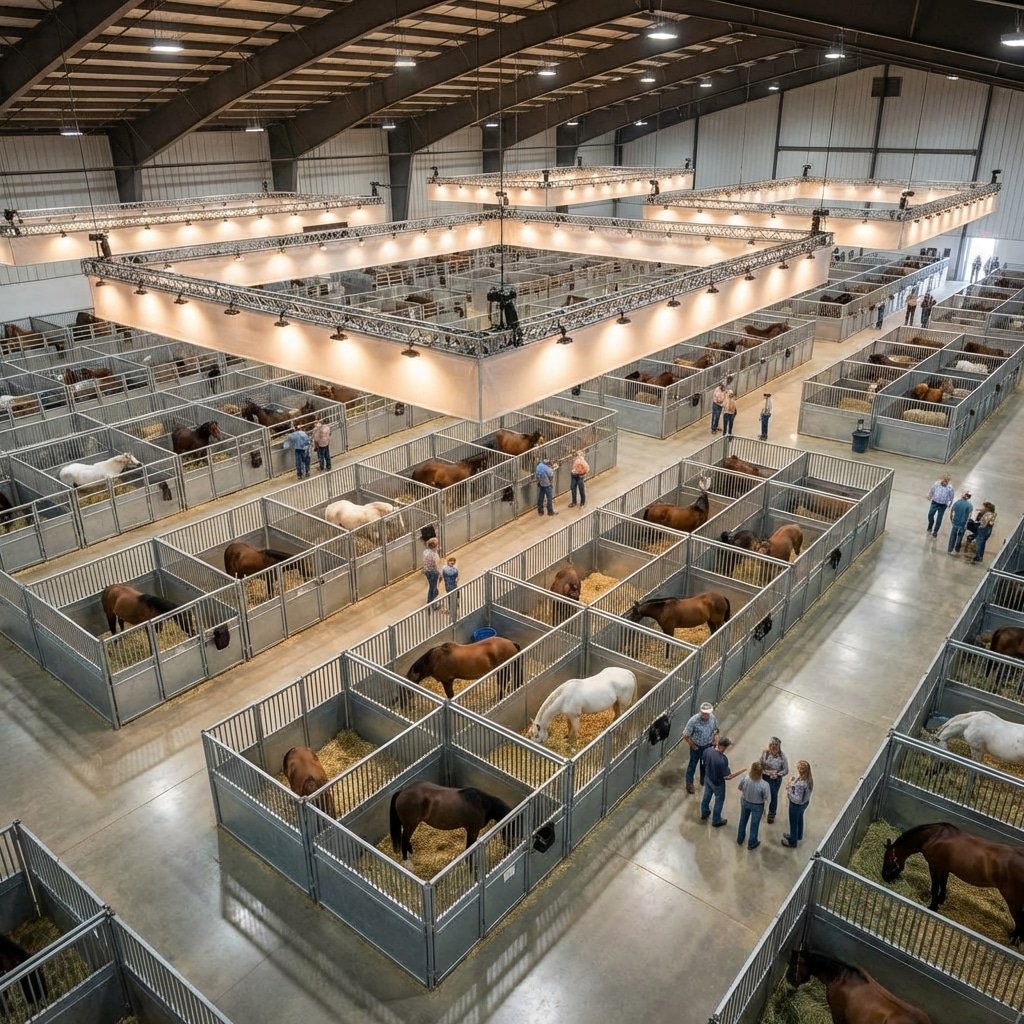
Strategic Trade Show Sourcing is the decisive factor for procurement teams balancing strict budget cuts against rising raw material costs. While Spoga Horse defines the aesthetic standard for modern stables, the Canton Fair remains the engine for scalable B2B production. Misjudging the logistical capabilities of a supplier at either event often results in inflated freight costs that erase the initial price advantage.
This guide benchmarks global exhibitions against the critical ISO 1461 hot-dip galvanization standard found in high-volume manufacturing. We analyze how identifying Q345B steel grades and flat-pack loading efficiency on the showroom floor directly impacts your long-term supply chain stability.

Designing Stables for Wheelchair Accessibility (ADA)
Accessible stable design requires widening aisles beyond the 36-inch minimum, installing 1:12 ramps, and utilizing sliding doors to eliminate dangerous swing arcs.
Critical Dimensions for Safe Maneuverability
Applying generic ADA standards to an equestrian facility often results in functional failure. While a 36-inch width satisfies the legal requirement for a hallway, it becomes a choke point in a working barn. A rider in a wheelchair carrying a saddle needs significantly more lateral space than a pedestrian. We engineer aisle layouts to accommodate both the mobility device and the handler’s equipment without forcing awkward maneuvers.
- Pathway Width: Maintain a strict minimum of 36 inches, though we recommend 48 inches to allow clearance for equestrian gear and side-by-side movement.
- Ramp Gradients: Ensure all grade changes utilize a maximum 1:12 slope ratio (one inch of rise for every 12 inches of run) to prevent user fatigue.
- Turning Space: Design tack rooms with a 60-inch clear turning radius so standard wheelchairs can rotate fully without reversing.
Optimizing Access with Sliding Door Systems
Hinged doors pose a specific safety risk in accessible stables. The “swing arc” forces a wheelchair user to back up or maneuver awkwardly while trying to open the door, which is dangerous when a horse is waiting on the other side. Our **Professional Series** eliminates this hazard by keeping the motion parallel to the stall front. This design allows the user to remain stationary and in control of the animal at all times.
- Eliminate Swing Arcs: **Professional Series** sliding doors retract into the stall front, removing the need for backward clearance in the aisle.
- Low-Resistance Operation: We utilize the **Hidden Track System** to ensure the door glides with minimal physical force, accommodating users with limited upper-body strength.
- Structural Resilience: Frames are built from **Q235B Structural Steel** (14-gauge) to withstand accidental impacts from heavy powered mobility devices without warping.
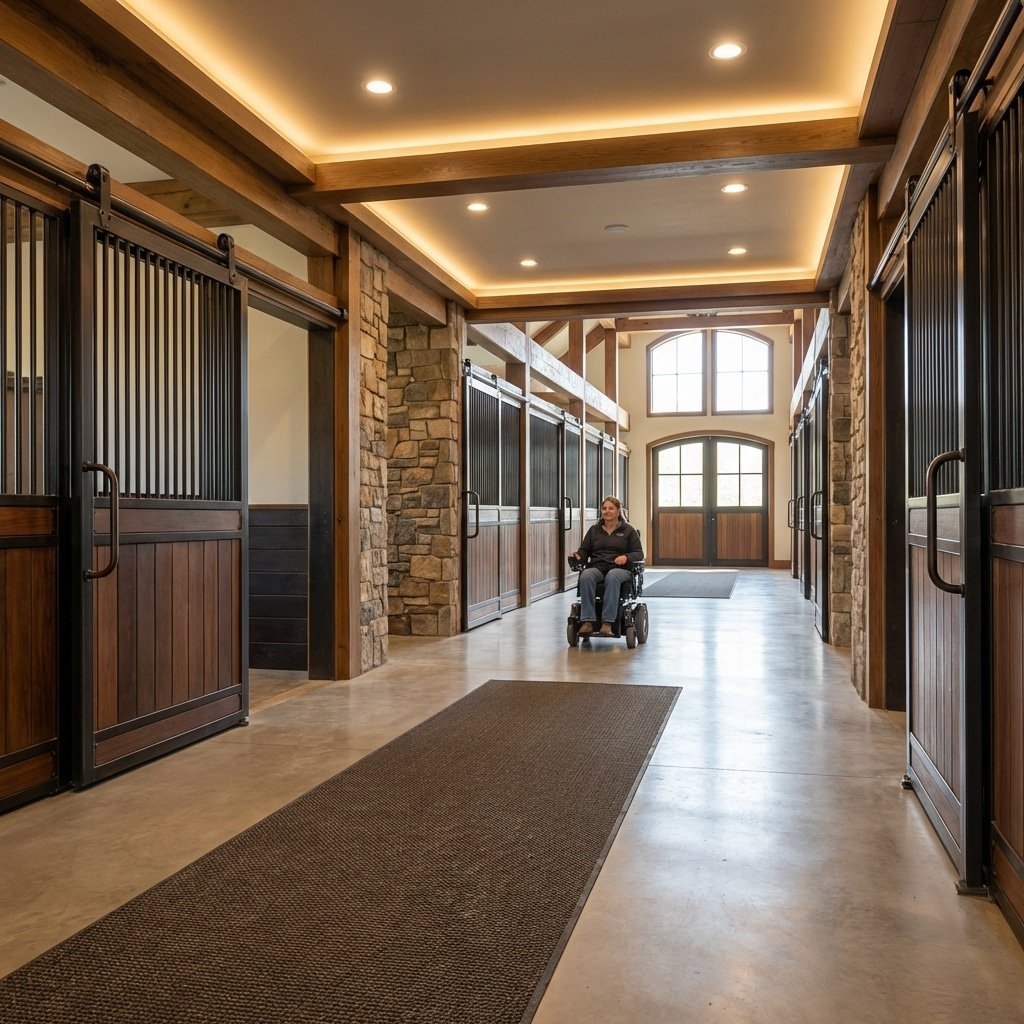
The Aisle Experience: Wide Sliding Doors vs. Swing Doors
Sliding doors maximize operational aisle width for high-traffic barns, while swing doors offer a traditional aesthetic but require significant clearance radius. We engineer heavy-duty hardware to support both.
Optimizing Aisle Flow: Spatial Requirements for Safe Handling
The choice between sliding and swing doors often dictates the daily workflow of a commercial facility. While swing doors provide a classic look, their mechanical function demands space that many modern, high-density barns simply cannot spare. A standard 4-foot door requires a corresponding swing arc. In a 12-foot aisle, opening two opposite swing doors simultaneously effectively creates a barricade, halting all traffic and complicating the movement of equipment or other horses.
Sliding doors eliminate this bottleneck. By retracting flush against the stable front, they preserve 100% of the aisle width regardless of whether the stall is open or closed. This is the preferred configuration for professional training centers where traffic flow is constant. From a safety perspective, this retraction is critical during emergency evacuations. An open swing door can inadvertently block an escape route or injure a rushing horse, whereas sliding doors maintain a clear, unobstructed path to the exit.
Mechanical Specs: Hidden Track Systems and Adjustable Hinges
Durability in a stable environment comes down to how hardware handles dust, weight, and impact. We engineer our door systems to address the specific failure points of each style, ensuring they remain operational after years of heavy use.
- Hidden Track System (Professional Series): Exposed rollers are magnets for dust and bedding. We position our track system behind the top rail of the stable front. This shields the rollers from debris accumulation, preventing the “jamming and dragging” common in cheaper exposed-track designs.
- Adjustable Heavy-Duty Hinges (Royal Series): Swing doors face the issue of “sag” over time, especially when fitted with heavy 40mm bamboo or hardwood infills. We utilize adjustable stainless steel hinges that allow you to realign the door if the post settles, ensuring the latch always meets the striker plate perfectly.
- Cast-Proof Design: Regardless of the door style, we maintain a strict 50mm bottom gap. This clearance is sufficient for drainage and ventilation but small enough to prevent a rolling horse from getting a hoof trapped under the door.
Premium Stables Engineered For 20-Year Durability

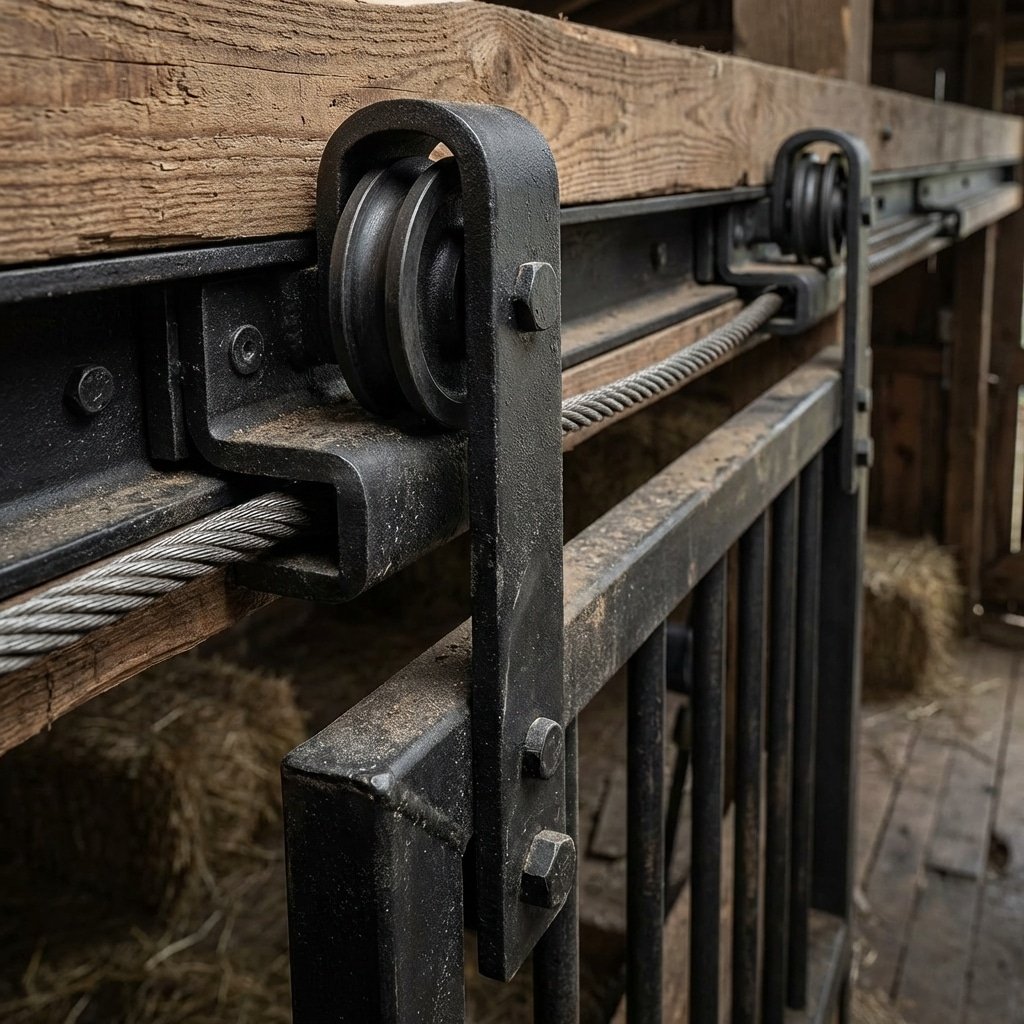
Zero-Threshold Floors: Eliminating Trip Hazards
Zero-threshold systems use magnetic drop seals and flush plates to ensure ADA compliance and water-tightness, effectively removing trip hazards in therapeutic and high-traffic equine facilities.
The Shift to Barrier-Free Accessibility Standards
The architectural standard for equine facilities is shifting rapidly away from raised door sills. In the past, a 2-inch threshold was acceptable for weatherproofing, but today, it represents a liability. This shift is driven largely by safety regulations and the specific needs of therapeutic riding centers, where removing tripping hazards for elderly users and disabled riders is non-negotiable. Compliance with ADA guidelines—and strict international codes like those in Germany—now dictates a level transition between interior aisles and exterior spaces.
Architects specify these seamless transitions to create “age-friendly” environments. It is not just about wheelchairs; it creates a safer workspace for staff carrying heavy tack or leading horses who might clip a hoof on a raised metal lip. The market demand in both residential equestrian estates and public riding sectors now favors this flush design to minimize risk and improve workflow efficiency.
Technical Innovation: Magnetic Seals and Flush Systems
Historically, the argument against zero-threshold flooring was water ingress. Contractors feared that without a raised sill, rain and draft would compromise the barn’s interior. Engineering has solved this through active sealing mechanics rather than passive barriers. Modern systems utilize magnetic drop seals that remain flush with the floor when open but drop down to seal the gap the moment the door closes.
- Magnetic Zero-Threshold Systems: Technologies like ALUMAT utilize double magnetic seals to ensure rain-tight and sound-proof performance without a physical floor barrier.
- Material Specifications: High-end systems employ Electro-polished Series 420 stainless steel, offering superior corrosion resistance against ammonia and moisture compared to standard galvanized options.
- Precision Clearances: Flush floor plates designed for pivot doors reduce installation gaps to just 7mm, preventing wheels or hooves from catching in the mechanism.
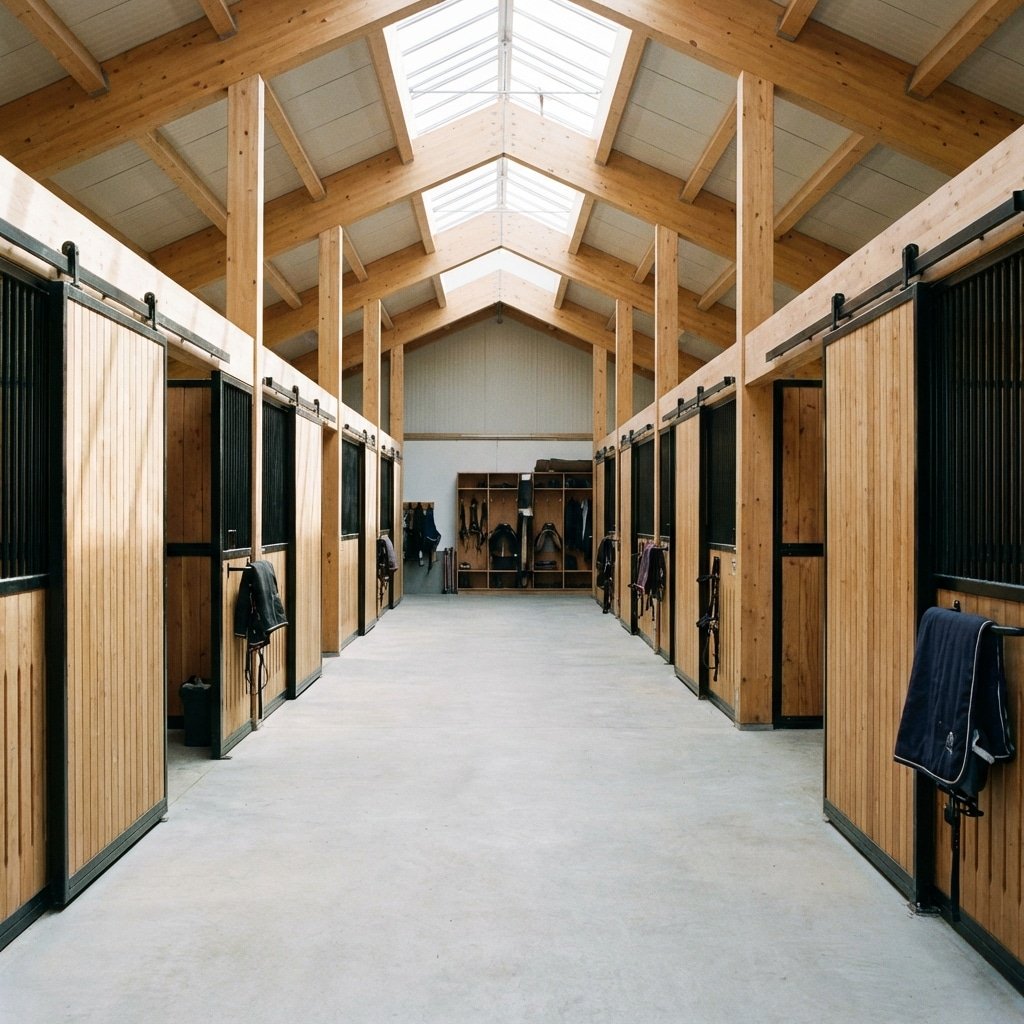
Top Suppliers Engineering for the PATH/RDA Community
The therapeutic riding sector lacks a centralized engineering registry, relying on a fragmented mix of adaptive tack specialists and custom OEM manufacturers for ADA-compliant infrastructure.
| Supplier Category | Key Market Players | Engineering Focus |
|---|---|---|
| Adaptive Equipment (Soft Goods) | Freedom Rider, Adams Horse Supply | Specialized reins, back supports, mounting aids, and adaptive apparel. |
| Structural Engineering (Hard Goods) | DB Stable (OEM/ODM), Custom Fabricators | ADA-compliant stalls, sliding door systems, zero-threshold flooring solutions. |
| Standards & Accreditation | PATH Intl, RDA (Riding for the Disabled) | Safety protocols, instructor certification, and facility guidelines (non-product). |
The Fragmented Supply Chain
The therapeutic riding market does not operate with a single “Amazon-style” distributor for facility engineering. Instead, the sector is highly fragmented. For adaptive tack and rider equipment, centers primarily rely on niche catalogs like Freedom Rider and general retailers like Adams Horse Supply, which stock specific items like wrist supports and therapeutic saddles. However, these vendors do not supply the physical barn infrastructure required for PATH or RDA accreditation.
For the engineering side—specifically stabling and facility design—no dedicated “Therapeutic Barn” supplier exists in the public directory. Most non-profit centers are forced to source from general equestrian manufacturers or local contractors who may not understand the critical nuances of ADA compliance. This forces facility managers to procure “engineering” on a case-by-case basis, often adapting standard agricultural products to meet rigorous safety needs.
Engineering Priorities for Accessibility
Since off-the-shelf products rarely meet the specific needs of riders with mobility challenges, B2B distributors and facility planners must focus on manufacturers that can engineer customized safety solutions. We specifically utilize Q345B High Strength Steel and Hot-Dip Galvanization to ensure structural integrity that withstands heavy use by volunteers and therapy horses.
- Sliding Door Systems: Swing doors are a liability in therapeutic settings. They require wide clearance and can trap handlers. We engineer sliding doors with sealed bearing tracks to ensure they can be operated with one hand, maintaining a safe aisleway for wheelchairs.
- Zero-Threshold Design: To prevent trip hazards for walkers and wheelchairs, the engineering must eliminate raised door frames. Our “Cast-Proof” bottom guides allow for smooth transitions while keeping the horse secure.
- Aisle Width Compliance: While standard barns use 12-foot aisles, therapeutic facilities require wider variances for side-walkers and ramp maneuvering. Structural posts must be positioned to allow for a minimum 48-inch clear path at all choke points.
- Impact Resistance: Therapy horses can be unpredictable. We use 28mm-32mm HDPE or Bamboo infill with Q345B steel frames (Standard for Cold Climates) to provide a “Kick-Proof Guarantee,” ensuring the safety of participants observing from nearby.
DB’s Smooth-Glide Enclosed Track System
Our Hidden Track System encloses rollers to prevent debris jamming, while Hot-Dip Galvanization (>70 microns) eliminates rust-induced friction for a lifetime of effortless operation.
The Engineering of the Hidden Track System
Most stable door failures start with the track. Traditional open-track designs expose the rollers to the harsh stable environment, where hay, bedding, and ammonia-laden dust accumulate. This debris creates friction, causing doors to stutter, jam, or jump off the rail entirely. We engineered the Hidden Track System, a core feature of our Professional Series, to solve this mechanical vulnerability.
- Debris Shielding: The track design encases the roller mechanism inside a formed steel channel, physically blocking hay and dust from gumming up the bearings.
- Safety Protocol: By enclosing the moving parts, we remove exposed sharp edges and pinch points, protecting both horses and handlers from injury during operation.
- Aesthetic Integration: The system creates a clean visual line along the stable front, hiding the industrial hardware for a polished, professional look.
Hardware Durability: Hot-Dip Galvanization vs. Rust
Friction is the enemy of a smooth-gliding door, and rust is the primary cause of friction. Many competitors use pre-galvanized tracks (black steel welded after coating), which leaves the weld points exposed to rapid corrosion. Once the track interior pits or rusts, the rollers grind rather than glide.
- The DB Standard: We utilize Hot-Dip Galvanization After Fabrication (conforming to BS EN ISO 1461). We weld the black steel track first, then dip the entire component.
- Zinc Thickness: Our tracks feature a zinc coating thickness exceeding 70 microns, providing a metallurgical bond that resists moisture and ammonia for decades.
- Tragfähigkeit: Engineered for our Professional Series, this system supports heavy infill materials like high-density bamboo (Janka Hardness > 3000 lbf) without sagging or dragging.
Häufig gestellte Fragen
How to design an ADA compliant horse barn?
Designing for accessibility requires specific spatial dimensions that exceed standard agricultural builds. Aisleways must be wider than standard (typically 14+ feet) to allow safe passage for wheelchairs alongside horses. Flooring must be firm and slip-resistant, such as rubber brick or level concrete with mats; deep sand or loose gravel makes wheelchair navigation impossible. You must also include accessible mounting platforms with ramps (1:12 slope) and ensure tack rooms have turning spaces of at least 60 inches in diameter.
Minimum door width for wheelchair access in barns?
The absolute minimum clear width for ADA compliance is 32 inches. However, in an equestrian setting, we strongly recommend a minimum door width of 48 inches (4 feet). Standard wheelchairs can be up to 30 inches wide, but powered chairs and adaptive equipment often require more clearance. A 48-inch opening ensures a rider can enter the tack room or viewing area without risking scraped knuckles or equipment damage, while also accommodating large tack trunks or feed carts.
Best stable doors for therapeutic riding centers?
Sliding doors are the superior choice for therapeutic facilities. Unlike swing doors, which arc into the aisle and create obstacle hazards for visually impaired or mobility-challenged users, sliding doors remain flush with the wall. This keeps the aisle clear at all times. We recommend sliding doors with low-profile or recessed bottom guides to eliminate tripping hazards (zero-threshold effect) and bar-top designs that allow safe interaction with the horse without entering the stall.
Are sliding stall doors easier to open?
Yes, provided they use high-quality hardware. A properly engineered sliding door with sealed bearings and a level track requires significantly less force to operate than a heavy hinged door, which fights gravity and air resistance. Hinged doors can also be caught by the wind or pushed by a horse, creating a dangerous situation for a handler with limited strength or balance. A sliding mechanism allows for controlled, one-handed operation.
PATH Intl barn safety standards?
PATH Intl standards focus on risk mitigation and emergency readiness. Facilities must maintain 100% compliance with mandatory standards to achieve accreditation. Key requirements include mandatory helmet use (ASTM-SEI certified), strict footwear rules (closed-toe with heels), and clearly posted emergency procedures. Physically, the barn must have functioning fire extinguishers, accessible first aid kits, and secure storage for all tack and equipment to prevent clutter-related accidents. Gates and doors must be kept closed and latched when not in active use.
Abschließende Überlegungen
Sourcing generic accessible infrastructure is a liability risk; true ADA compliance requires engineering that withstands heavy therapeutic use. While standard agricultural imports fail under the stress of adaptive equipment, our **Professional Series** utilizes **Q345B Structural Steel** and enclosed tracks to ensure safety and longevity. Investing in **Hot-Dip Galvanization** (>70 microns) protects your facility from rust and mechanical seizure, safeguarding both your clients and your reputation.
Do not rely on brochure specs for safety-critical infrastructure; verify the engineering firsthand. We recommend requesting a **Technical Sample Kit** to test our **Hidden Track System** and zero-threshold joinery against your local accessibility codes. Contact our engineering team today to discuss **OEM customization** for your market’s specific therapeutic requirements.


 German
  English
  Spanish
  French
  Arabic
0 Kommentare