



Schooling jumps get bought twice by accident. A training yard orders one set, builds a course, and finds quickly that some elements move before most sessions while the rest rarely leave the store. Treating those as one purchase is why yards end up with standards that slide across the footing and presets nobody can be bothered to drag out.
Weight is the visible difference. Frequency is the real one. A yard that rebuilds a grid several times a week buys differently from one that runs the same four lines all season and resets them only for a schooling show. Storage, finish and spare parts all follow from which yard you run.
Key Takeaways
- Two purchases, not one: elements you move each session and elements that live in storage need different bases and different spare-part planning.
- What this site publishes: FEI-standard jumps in the training line, and a 20-year rust-resistance claim on hot-dip galvanized steel.
- What is not published: jump weights, prices, coating thickness, and any standalone jump minimum order quantity.
- Stability is a base question: footprint and mass distribution usually hold a standard better than raw frame weight on a narrow foot.
- A common failure sequence: finish chips, then cup holes oval, then pins wear, then rust shows at the welds.
- Order timing is public: 4-6 weeks worldwide, with 1-2 week expedited options through the Sydney and Warsaw regional warehouses.
What a schooling jump takes that a show jump does not
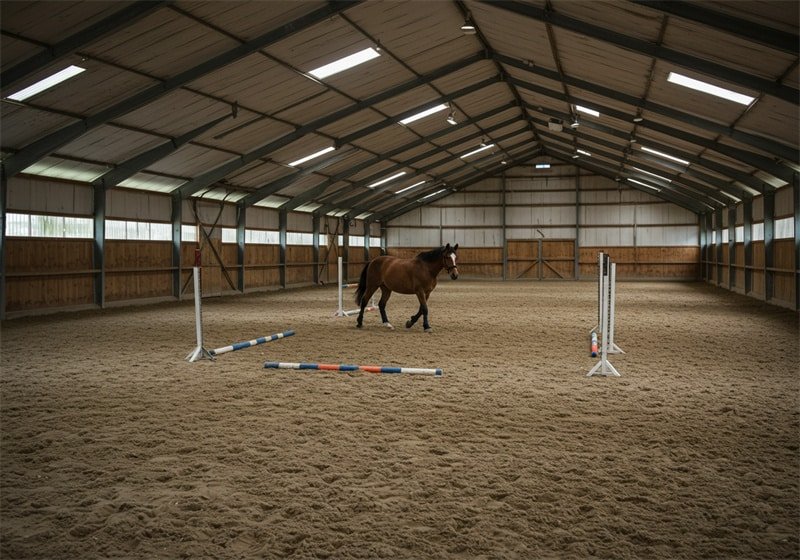
A competition course is assembled by a crew, jumped once or twice, then loaded away. A schooling element is set on Monday, clipped sideways on Tuesday, dragged across the same footing several times a week, and left standing in the rain. The load paths are not comparable, which is why competition catalogs make poor shopping lists for a training yard.
The finish is usually the first thing to go. Stone chips and hoof impact pull small pieces of coating out of the frame, and exposed steel rusts once the surface stays wet. No corrosion timing is published on this site. That is where a galvanized product and a galvanized claim part company: this site states a 20-year rust-resistance claim on its hot-dip galvanized steel, publishes no coating thickness in microns, and publishes no statement that every jump component is hot-dip treated rather than coated after fabrication. Those questions belong in the quote, not after the first winter.
Connections wear next. Cup holes absorb the energy of knocked poles, and the pins seating them can oval over time. A working yard buys spare pins the way it buys feed. Cup spacing across wing standards is a compatibility question, and we took it apart in our article on jump cups and pins.
Lightweight presets: what you gain and what you give up
Lightweight schooling jumps buy frequency. One person can set a line, change a distance, and rebuild a grid between sessions, which keeps the school useful to the horse instead of going stale. That is the whole argument, and it is a strong one where the layout is the training plan.

The cost is stability, and it is a base problem rather than a frame problem. A light standard on a narrow foot can walk across firm, level footing when a pole is clipped near the top. The same frame on a wider base plate holds better than a heavier frame balanced on a small foot.
Test it before you order. Set the tallest element you plan to school over, lean into the top rail, and watch the base rather than the pole. If it lifts or slides, you need more base, a lower working height, or a fixed element in that slot.
Lightweight presets fit flatwork schools, gymnastic grids and young-horse sessions, where the distances change every week. They fit badly where nobody wants to re-level four elements before a lesson.
Fixed presets: stability, storage, and the order tax
Fixed presets earn their place in the repeating half of the week. A base line of solid elements stays true, lessons run off the same distances, and work done in March is comparable to work done in August. On a yard that hosts occasional schooling shows, those same elements carry the event without a rebuild.
The trade is that a fixed element nobody can move becomes scenery. The pattern repeats: heavy presets arrive, and months later the school still holds the same few configurations because shifting them is a two-person job. Buying fixed is a storage decision before it is a jumping decision — somewhere dry, off the ground, and close enough to the school that a move is not a project. My read on this is blunt: the layout you can afford is the one one person can set.
Order mechanics follow the same logic. The lead time published here is 4-6 weeks worldwide, with 1-2 week expedited options through the Sydney and Warsaw regional warehouses, and a volume discount of 5% to 15% on bulk orders. None of those are published as jump-specific terms, and the order minimums given — 10 stable sets or 50 fence panels — are not jump counts, so a jump order needs its own minimum confirmed in writing. If jump elements ride in a stabling container, that mix belongs on one purchase order.
How to split the order without guessing
Split by how your week actually runs, not by what photographs well. Most training yards land near the mix below, then adjust once they see what gets moved.
| Yard profile | Standardize on | Why it holds |
|---|---|---|
| Lesson yard, one arena, grids rebuilt weekly | Lightweight frames on wider bases | Fast layout changes matter more than a permanent course. |
| Training center with a daily school and occasional shows | Fixed base line, lightweight top elements | Repeating distances stay set; show layouts come from moveable pieces. |
| Outdoor school in a wet or coastal climate | Hot-dip galvanized frames, fewer coated parts | Finish damage is usually the first outdoor failure, so process per component is the spec. |
| Hire or event fleet moving between sites | Presets that break down into modules | Handling time and transport volume decide a fleet more than course design. |
Five written answers settle most of this before anything goes into production: which components are hot-dip galvanized rather than coated after welding; the cup spacing and pin diameter, with the spare quantity; the base footprint for each frame; whether the quoted lead time and volume discount apply to the jump line in this configuration; and how the elements are meant to be stored if they live outdoors. This site states production capacity in stable sets — more than 500 a month — rather than jump components, so treat jump throughput as a question. Compare the answers against the horse show jumps line pages, and read our article on FEI-standard horse show jumps before deciding how much of that standard belongs in daily work.
Häufig gestellte Fragen
What breaks first on schooling jumps?
The finish. Stone chips and hoof strikes pull small areas of coating off the frame, and exposed steel rusts once the surface stays wet. Cup holes and pins usually follow, so ask which coating process applies to each component before you order.
Are lightweight schooling jumps less stable?
Frame weight is not the measure. A light standard can hold a working height if its footprint and mass distribution keep it planted, while a heavier frame on a narrow foot can still walk. Test the tallest element you plan to use and watch the base.
Can I order jumps inside a stabling order?
A mixed shipment is possible, but the published minimums here are 10 stable sets or 50 fence panels, and neither is a jump quantity. No standalone jump minimum is published, so request it in writing along with the freight basis.
Do FEI-standard jumps make sense for daily schooling?
FEI specifications describe competition equipment, and daily schooling is a different load. Decide which parts of that specification you need in the school — cup spacing, rail fit, stability — and which you can trade for easier handling.
How much does a set of schooling jumps cost?
This site publishes no prices. What moves the number is the fixed-to-lightweight split, the coating process per component, and how much handling and storage your yard needs, so a comparable quote has to answer those three line by line.
Schlussfolgerung
Lightweight versus fixed is not a preference; it is a description of how your week runs. Get the split wrong and you pay twice — once for elements nobody moves, and once for a course that will not stay standing. Start from the sessions you actually hold, then confirm the coating process and base footprint component by component.
Weights, prices and jump minimums stay open questions until the factory answers them in writing. Put those four lines in your next request for quotation and the comparison between suppliers stops being a guess.

 German
 English
 Spanish
 French
 Arabic
0 Kommentare