


Specifying industrial-grade Draft Door Tracks is the only defense against the structural failure of standard tubular hardware. When a 100kg warmblood door hangs on a typical 1.6mm open C-profile, the steel flares and the rollers eventually derail. This mechanical collapse creates immediate safety liabilities and forces costly emergency repairs in active equestrian facilities.
This analysis details why massive stall fronts require enclosed Box Track systems rather than open rails. We contrast the deflection rates of standard 16-gauge tubing against Q345B structural steel protocols and solid 304 stainless steel roller assemblies to define the necessary specifications for heavy-duty equine housing.

The Weight of Oversized Warmblood/Draft Doors
Oversized 4′ x 8′ draft doors with high-density bamboo infill create massive static loads, requiring Q345B structural steel and 14-gauge framing to prevent track failure.
Calculating Mass: 8ft Heights and High-Density Infill
You cannot simply scale up a standard horse stall door for a Warmblood or Draft horse without accounting for the exponential increase in mass. While a standard stall door sits at 7ft (2.1m), draft breeds require an opening height of 8ft (2.4m). This additional vertical foot drastically increases the volume of both the steel frame and the infill material.
The real weight driver, however, is the density of the board. We use strand-woven bamboo for its resilience, but this material is significantly heavier than the softwood pine used by budget manufacturers. When you combine increased dimensions with high-density materials, the physics change completely:
- Draft Dimensions: 8ft (2.4m) height and up to 5ft (1.5m) width increases leverage on hinges and tracks.
- Dichte des Materials: Our bamboo infill (Janka hardness > 3000 lbf) is roughly 3x denser than standard pine.
- Total Load: A fully assembled draft door frequently exceeds 100kg, rendering standard residential-grade hardware useless.
Supporting the Load: 14-Gauge Q345B Steel Framework
Standard agricultural steel tubing (often 1.5mm or 16-gauge) will deform under the dynamic force of a moving 100kg door. Over time, this causes the bottom guide track to bow and the upper track bearings to grind, eventually seizing the door. To handle this weight, we strictly prohibit tubing thinner than 2.0mm for these applications.
We engineer these spans using Q345B Low Alloy High Strength Steel. This is equivalent to ASTM Grade 50, offering superior yield strength compared to the industry-standard Q235B (mild steel). This upgrade ensures the door frame remains rigid and square, even when a 2,000lb animal leans against it.
- Wanddicke: Minimum 14-gauge (2.0mm – 2.5mm) is mandatory to prevent tubing collapse.
- Steel Grade: Q345B provides the necessary tensile strength for wider, heavier spans.
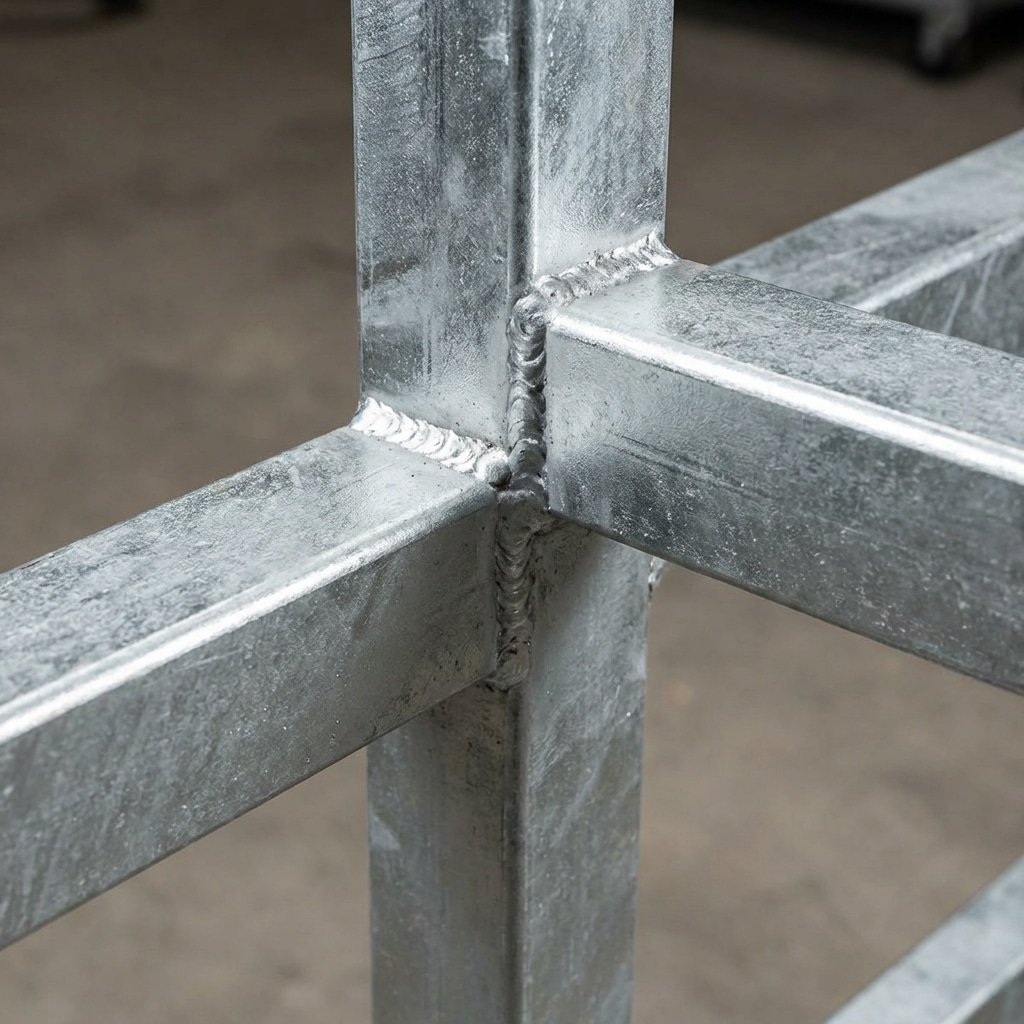
- Schweißerschutz: We use Hot-Dip Galvanization Nach Fabrication (ISO 1461) to ensure the welds holding this massive weight do not corrode and shear.

Why Standard Tubular Tracks Bend Under Pressure
Standard open C-profiles lack structural rigidity and flare open under heavy vertical loads. Most failures stem from using thin 1.6mm steel, whereas heavy warmblood doors require a minimum 2.0mm wall thickness.
Structural Stress Vectors in Open-Profile Tracks
The physics of a sliding stable door are simple but unforgiving. A fully grilled Warmblood or Draft horse door often exceeds 100kg. When this weight hangs from a standard “C-shaped” or round tubular track, it creates intense vertical point loads that attack the track’s weakest point: the open slot at the bottom.
Most generic tracks suffer from “flaring.” As the door rolls, the weight forces the bottom lips of the C-profile outward. This structural deformation changes the geometry of the roller path. The rollers eventually slip out of alignment, causing the door to grind against the track walls or jam completely.
- Vertical Point Loads: Heavy doors concentrate massive force on specific track sections, requiring high tensile strength to resist bending.
- Profile Flaring: Open C-profiles naturally want to open up under weight, leading to inevitable roller derailment.
- Deflection Issues: Standard round tubes lack internal reinforcement, causing immediate sagging between mounting brackets.
Material Deficiencies: The Risk of <2.0mm Wall Thickness
You cannot cheat physics with thin steel. A significant portion of the market reduces costs by manufacturing tracks from 1.6mm (16-gauge) steel. While this suffices for lightweight interior barn doors, it fails in an active equestrian environment. The dynamic stress of a horse kicking the door or a groom slamming it shut fatigues 1.6mm steel rapidly.
At DB Stable, we treat the track as a structural component, not an accessory. We strictly prohibit tubing thinner than 14-Gauge (2.0mm – 2.5mm) for any stall front system. We utilize Q235B Structural Steel as our baseline, with Q345B available for cold climates to prevent brittle fractures. This material density ensures the track maintains its shape and smooth operation after years of daily abuse.
- Competitor Standard: Often 1.6mm (16-gauge), which lacks the tensile yield strength for dynamic stall environments.
- DB Stable Standard: Minimum 2.0mm – 2.5mm (14-gauge) ensures long-term rigidity and safety.
- Steel Grade: We use structural Q235B and Q345B steel to resist fatigue and bending, unlike softer commercial-grade metals.
Custom Galvanized Stables: 20-Year Durability

The Box Track: Enclosed High-Load Bearing Rails
The Box Track system uses an enclosed square profile with internal T-shaped flanges. This distributes heavy door weight evenly and shields bearings from stable dust, unlike open tubular rails.
Heavy-Duty Geometry: The Square Gib Advantage
Standard tubular tracks rely on a round profile, which creates a single point of contact between the roller and the rail. For lightweight gates, this is acceptable. For heavy horse stable doors—especially those using high-density Bamboo infills (approx. 1.2g/cm³) or solid HDPE—this point-contact concentrates stress, leading to premature indentation and “flat-spotting” on the rollers.
The Box Track system solves this through a “Square Gib” design. The steel profile is formed into a box shape with internal T-shaped flanges. This geometry creates a flat running surface rather than a curved one, significantly increasing the contact patch area. By distributing the load across a wider surface, the system maintains structural rigidity even when supporting Warmblood-sized doors exceeding 400kg.
- Superior Contact Area: T-shaped flanges provide continuous support, reducing rolling resistance compared to round tubes.
- Anti-Spread Design: The enclosed box profile resists outward spreading forces that commonly warp open C-channels under heavy loads.
- High Load Capacity: Engineered to handle the density of our Professional Series Bamboo infills without sagging.
Debris Defense: Why Enclosed Tracks Last Longer
Stables are hostile environments for mechanical hardware. Airborne dust, bedding particles, and hay fragments constantly settle on horizontal surfaces. Open rail systems leave the roller path exposed. Over time, debris accumulates on the track, causing the door to stutter, jam, or “jump the track” entirely during operation.
The Box Track functions as a shield. The trolley wheels run inside the steel housing, completely protected from falling debris from above. This design is integral to our Professional Series “Hidden Track System,” ensuring that the mechanical components remain isolated from the corrosive mix of ammonia and dust found in active barns.
- Internal shielding: Prevents hay and shavings from fouling the bearings, reducing maintenance frequency.
- Ammonia protection: Enclosing the trolleys limits direct exposure to corrosive stable vapors compared to exposed overhead rails.
- Derailment prevention: The enclosed geometry physically constrains the wheels, making it nearly impossible for a horse to kick the door off its track.
| Merkmal | Open Tubular Track | Enclosed Box Track |
|---|---|---|
| Load Contact Point | Single Point (High Stress) | Flat Surface (Distributed Load) |
| Debris Vulnerability | High (Accumulates dust/hay) | Low (Shielded internal path) |
| Structural Rigidity | Prone to bending/spreading | Reinforced Box Profile |
| Risk of Derailment | Possible if lifted/kicked | Captive (Physically Enclosed) |
304 Stainless Steel Rollers (No Nylon)
We ditch nylon entirely. Solid 304-grade stainless steel rollers handle the crushing weight of warmblood doors without flattening, cracking, or seizing from rust.
Why Nylon-Coated Wheels Fail Over Time
Nylon-coated bearings are the industry standard for lightweight residential doors, but they are a distinct liability in professional equine facilities. The primary failure point is the material’s reaction to static load. When a heavy stall door—often weighing significantly more than a standard door due to hardwood infills and 600kg+ horses leaning on them—remains stationary for long periods, the nylon coating compresses against the steel track.
This compression creates permanent “flat spots” on the wheel. Once deformed, the door no longer glides; it hops and stutters, requiring excessive force to open. Beyond mechanical deformation, the stable environment itself attacks synthetic polymers. High concentrations of ammonia from urine, combined with seasonal temperature fluctuations, cause nylon to become brittle. Eventually, the plastic shell cracks and peels away from the inner bearing, jamming the track system completely.
The Durability of Solid 304 Grade Stainless Steel
To eliminate these failure points, we use solid 304-grade stainless steel for the entire roller assembly in our hardware kits. There is no synthetic coating to crack, peel, or flatten. You get a precision-machined steel wheel that maintains its perfect circular shape regardless of how long the door sits idle or how heavy the infill materials are.
- Chemische Beständigkeit: 304 stainless steel inherently resists oxidation from daily washdowns and acidic animal waste, unlike zinc-plated or carbon steel alternatives.
- Load Integrity: The metal-on-metal design (utilizing sealed internal bearings) handles dynamic impact loads from kicking or rubbing without structural deformation.
- Zero Polymer Degradation: By removing nylon, we remove the risk of UV damage or ammonia-induced brittleness, ensuring the hardware lasts as long as the galvanized steel frame.
Abschließende Überlegungen
Equipping draft horse stables with residential-grade hardware is a specific liability, not a cost-saving measure. Our system eliminates the risks of track flaring and roller seizures by utilizing Q345B structural steel and fully enclosed box profiles. For dealers, stocking this level of engineering transforms a simple stall front into a demonstrable safety asset for your high-value clients.
Stop compromising on structural integrity for your heavy-duty projects. Contact our engineering team today to review your specific load requirements and request a Professional Series sample kit. We are ready to validate our heavy-gauge specifications against your current inventory.

 German
  English
  Spanish
  French
  Arabic
0 Kommentare