


Specifying the wrong Door Pull Handles transforms a functional stable aisle into a liability zone for high-traffic equestrian facilities. Protruding hardware creates severe collision risks that result in expensive veterinary bills, torn blankets, and avoidable handler injuries.
We benchmark the mechanical safety of recessed flush hardware against the hazards of traditional D-loops. By adhering to the DB Stable ‘Sicherheit im Ingenieurwesen‘ standard and mandating 304 Edelstahl, this comparison outlines how to eliminate snag points and maintain clear passage width in professional barns.

The Aisle Hazard of the Protruding D-Handle
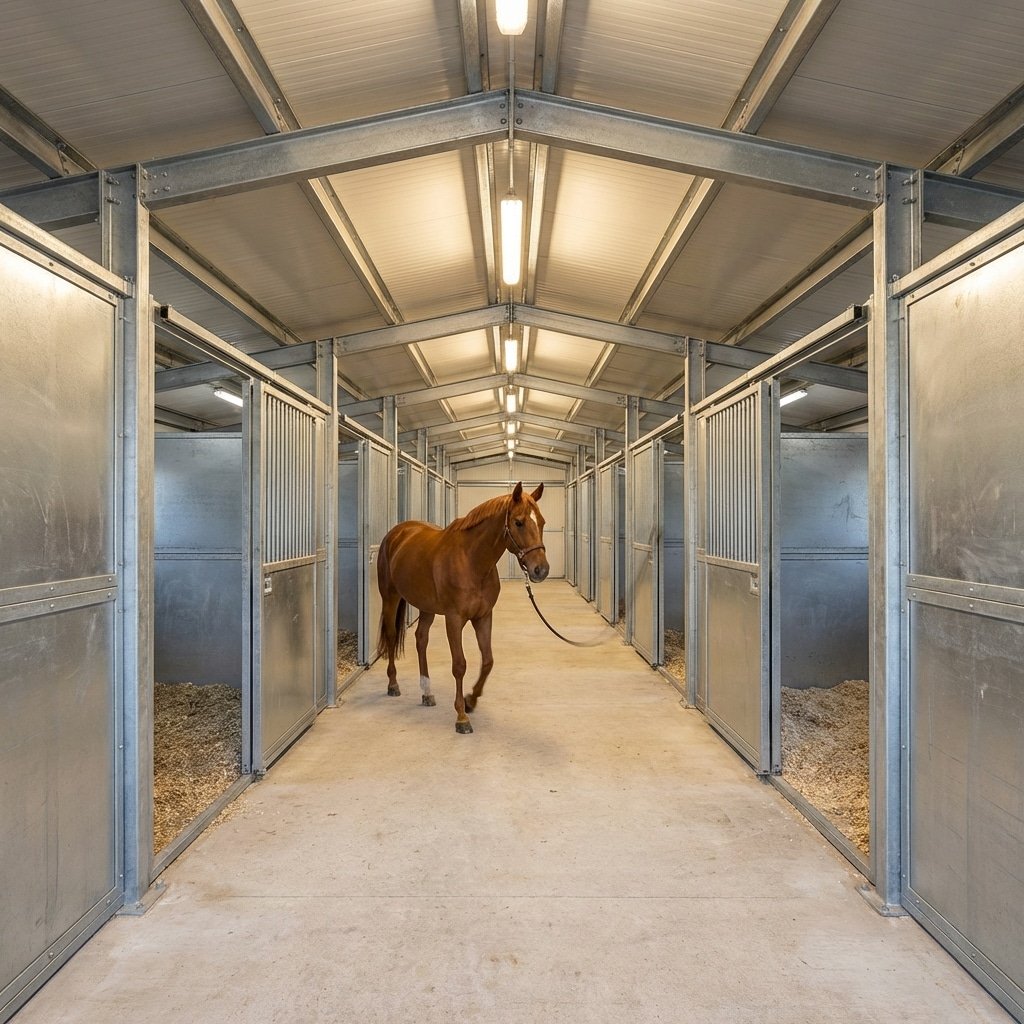
Protruding D-handles create dangerous collision points and reduce usable aisle width. Recessed hardware eliminates this blunt force hazard for safer equine transit.
Collision Risks in High-Traffic Zones
Most injuries in a stable aisle happen because someone didn’t see the hazard until they hit it. Handlers carrying bulky western saddles, hay bales, or feed buckets often have zero downward vision below chest height. In this scenario, a standard D-handle becomes a rigid steel loop waiting at hip level.
- Blind Impact: Handlers carrying tack inevitably drift close to stall fronts, causing severe blunt force trauma to the hip bone upon contact with the metal loop.
- Equine Shoulder Strikes: Horses turning into or out of a stall often cut the corner tight. A handle protruding 3-4 inches acts as a snag point that scrapes or bruises the shoulder.
- Gear Entanglement: Rug straps and halter leads easily catch on the open loop of a D-handle, abruptly halting movement and potentially causing panic in the animal.
Violating the “Clear Passage” Engineering Standard
You might specify a 12-foot aisle, but if you install hardware that sticks out 4 inches on both sides, you effectively reduce your safe circulation width. In emergency egress situations, these protrusions matter. Safety standards for human egress paths generally recommend a maximum projection limit of 4 inches for door hardware, yet many agricultural D-handles exceed this depth to accommodate gloved hands.
At DB Stable, we prioritize “Engineering Safety” by flagging these catch-points during the design review phase. If a client requests a protruding handle for a high-traffic zone, we push back. We recommend recessed flush pulls or gravity latches that sit flat against the panel. This maintains the full clear width of the aisle and removes the physical liability of steel protrusions in a dynamic animal environment.

Snagging Halters, Blankets, and passing Horses
Protruding hardware creates critical snagging hazards. Outward-facing clasps and halter rings catch on extended handles, triggering panic and severe injury in high-traffic stable aisles.
Common Entanglement Scenarios
Most injuries in stable aisles are mechanical, not behavioral. A calm horse walking past a stall front becomes a liability the moment a piece of equipment catches on a protruding handle or latch. The physics are simple but dangerous: as the horse moves forward, the snag point holds fast, turning the animal’s own momentum against it.
- Outward-Facing Clasps: Rug buckles and snaps often slide against stall fronts. If a handle or bolt protrudes even an inch, it becomes a catch point for these fasteners.
- Die Panikreaktion: Unlike humans who might freeze when snagged, a horse typically pulls back violently. This flight response escalates a minor snag into a torn rug, a broken door, or a serious soft-tissue injury.
- High-Traffic Zones: In busy training centers, horses pass close to door hardware dozens of times a day. The frequency of exposure increases the statistical probability of an accident.
Engineering Safety in the Professional Series
We address this directly in our Professional Series. For high-volume facilities like riding schools and equestrian clubs, aesthetic appeal cannot come at the cost of safety. Our design philosophy eliminates the “catch points” that standard hardware creates.
- Core Slogan Alignment: This adheres strictly to the DB Stable principle of “Engineering Safety, Defining Standards.” We remove hazardous protrusions before they reach the aisle.
- Professional Series Context: Designed for environments where aisle traffic is constant. We assume handlers are busy and horses are moving quickly.
- Prevention Design: We prioritize flush components. This ensures blankets, halters, and lead ropes slide past the stable front without catching, regardless of how close the horse walks to the door.
Precision-Engineered Stables Built for Extreme Climates


The DB Recessed Flush Pull Handle
The DB Flush Pull Handle features a fully inset design that sits flush with the stable door face, eliminating hazardous protrusions. Engineered with a deep-dish cup for secure gripping even with riding gloves, it prevents halters and blankets from snagging while ensuring smooth sliding operation.
| Merkmal | Standard D-Handle | DB Recessed Flush Pull |
|---|---|---|
| Aisle Protrusion | High (approx. 50-70mm) | Zero (Fully Flush) |
| Snag Hazard | Catches rugs & halters | Eliminated |
| Egress Safety | Reduces clear width | Maintains full aisle width |
| Material Spezifikation | Often Powder Coated Steel | 304 Edelstahl |
The Anti-Snag Flush Profile
Traditional D-handles create a persistent risk in active stables. They extend into the aisle, creating a catch point for passing horses, equipment, and handlers. We eliminated this hazard by integrating the handle directly into the door profile. The DB Recessed Flush Pull sits completely flat against the sliding door frame face. This design removes the physical protrusion that typically catches on blanket straps, halters, or lead ropes during movement.
- Zero Protrusion: Eliminates hardware that catches on rugs and halters.
- Flush Alignment: Sits completely flush with the sliding door frame face.
- Verringerung von Verletzungen: Removes strike hazards in high-traffic aisleways.
- Equipment Protection: Prevents tearing of expensive horse rugs during movement.
Ergonomic Deep-Cup Access
Many recessed handles fail because they are too shallow, forcing users to use their fingertips to slide heavy doors. The DB flush handle uses a deep-dish cavity specifically engineered for the equestrian environment. We deepened the grip area to accommodate a full hand, ensuring handlers can operate heavy sliding doors without slipping, even while wearing thick winter riding gloves.
- Full-Hand Engagement: Deep-dish cavity allows for a secure grip rather than a fingertip pull.
- Glove Compatibility: Sized to accommodate thick equestrian winter gloves.
- Heavy Door Control: Two-knuckle-deep grip depth provides leverage for solid wood or steel-framed doors.
- Safety Finish: Smooth interior edges prevent rider hand abrasion during operation.

304 Stainless Steel for Sweaty, Corrosive Hands
High-traffic stable handles face acidic sweat and harsh disinfectants. We specify 304-grade stainless steel to prevent the corrosion and bacterial buildup typical of standard zinc-plated fittings.
Combating Acidic Sweat and Bacterial Transfer
Stable environments are inherently corrosive due to ammonia and moisture, but the human element accelerates hardware failure. Human perspiration is naturally acidic and rich in chlorides. When staff members repeatedly grab door handles, they deposit salts and acids that eat through standard zinc plating or lacquer coatings found on generic hardware. Once this protective layer is breached, the underlying steel oxidizes rapidly.
Beyond structural degradation, corroded hardware becomes a biological hazard. Pitted, rusty surfaces trap moisture and organic matter, creating breeding grounds for bacteria like Staphylococcus and E. coli. In a professional equestrian facility, where biosecurity is paramount, you cannot have porous hardware acting as a vector for disease transfer between isolation units or tack rooms.
The 304 ‘Food-Grade’ Alloy Specification
To solve the corrosion issue, DB Stable strictly utilizes 304 Stainless Steel for all flush pull handles and mounting hardware. Often referred to as “food-grade” stainless, this alloy contains specific percentages of chromium and nickel that form a passive, self-healing oxide layer. This barrier blocks oxygen and moisture from reaching the iron content, effectively stopping rust before it starts.
- 18% Chromium: Provides the primary resistance to oxidation and corrosion from atmospheric conditions.
- 8% Nickel: Enhances the metal’s durability and resistance to acidic compounds found in sweat and cleaning chemicals.
- Sanitary Maintenance: Allows for rigorous cleaning with strong disinfectants without degrading the surface finish.
- Lifespan Alignment: Ensures the hardware lasts as long as our hot-dip galvanized structural frames, preventing the need for early replacement.
Häufig gestellte Fragen
What is the safest handle type for a horse stable sliding door?
Recessed flush pull handles are the only safe option for equine environments. Unlike protruding D-handles or knobs, a flush design sits flat against the door frame, eliminating the risk of snagging horse rugs, halters, or lead ropes. This design choice prevents “hip check” injuries where a horse rushing through a doorway strikes a protruding metal object. We strictly advise against any hardware that extends into the aisle width.
Why is 304 Stainless Steel recommended for stable hardware?
Stables are chemically aggressive environments due to the high concentration of ammonia from urine and moisture from horse sweat. Standard carbon steel or zinc-plated iron will corrode and seize rapidly in these conditions. We use 304 Stainless Steel for all moving parts—including latches, connectors, and flush pulls—because it resists this specific type of organic corrosion. This ensures the hardware remains smooth and functional for the lifetime of the stable without requiring constant replacement.
Can protruding door hardware really cause injuries?
Yes, hardware that sticks out into the aisle is a significant hazard. Horses often move unpredictably, and a protruding latch can cause deep lacerations to shoulders, hips, or stifles as they enter or exit a stall. Beyond the horses, handlers carrying tack or feed can easily catch clothing or equipment on extended handles, leading to dangerous entanglement situations. A smooth, flush aisle profile is critical for minimizing liability and veterinary costs.
Abschließende Überlegungen
Protruding hardware is a liability, not a design choice. While generic D-handles save pennies upfront, our Professional Series with 304 Stainless Steel flush pulls eliminates injury claims and corrosion callbacks. Your reputation relies on delivering “Engineering Safety,” not just steel.
Stop guessing on quality and start verifying it. Request a hardware sample kit to test the ergonomic depth and finish of our flush pulls firsthand. Contact our engineering team today to integrate these safety standards into your next wholesale container order.

 German
  English
  Spanish
  French
  Arabic
0 Kommentare