


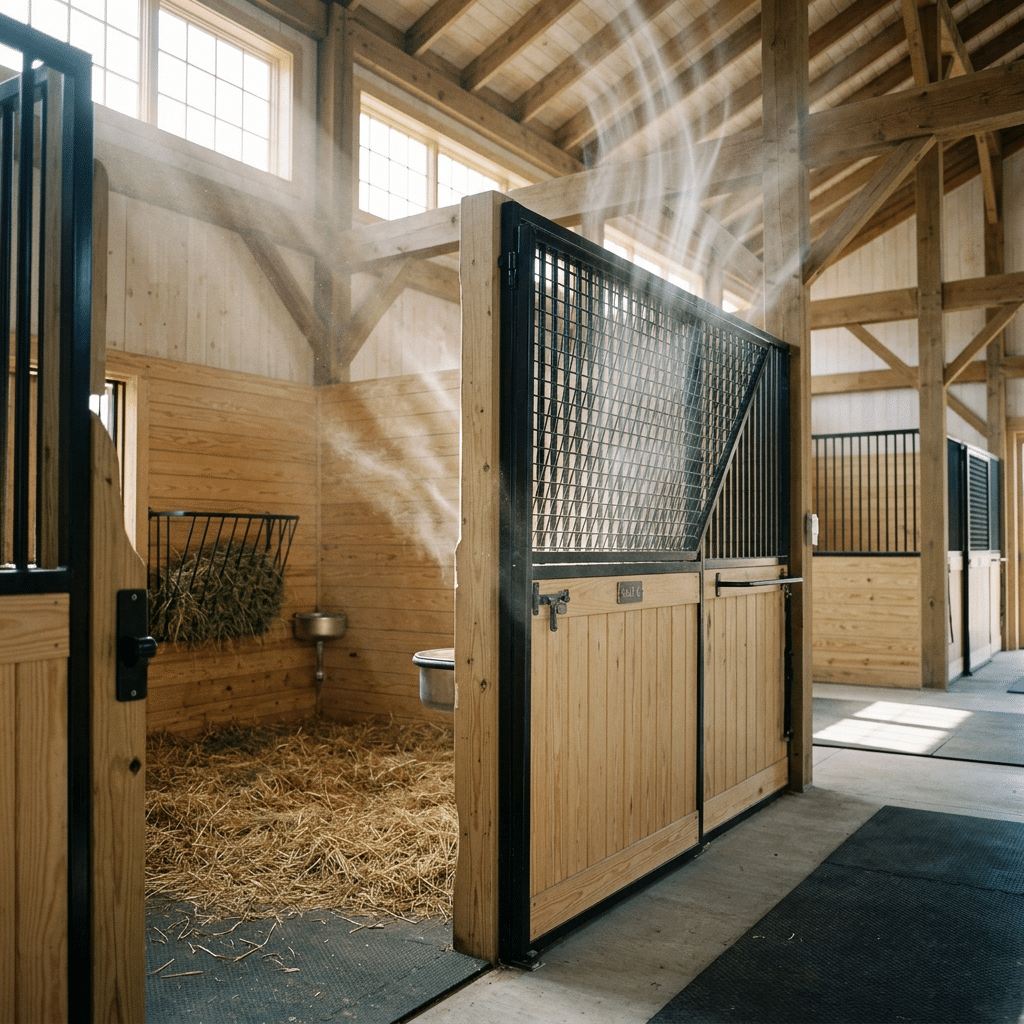
Police/Military HQ stabling procurement must prioritize structural resilience over agricultural standards to mitigate operational risk. Standard equipment often fails in humid or freezing climates, resulting in rapid material degradation, costly maintenance cycles, and safety liabilities for high-value animals.
This brief evaluates institutional-grade specifications, focusing on material performance data. We analyze low-temperature impact toughness using Q345B-Stahl and corrosion resistance via post-fabrication galvanization conforming to the ISO 1461 standard for long-term asset integrity.
Der Fäulniskreislauf in Umgebungen mit hoher Luftfeuchtigkeit
The rot cycle is rapid metal decay from moisture and heat. High humidity fuels the corrosion, which is stopped by a protective barrier like hot-dip galvanization.
The Core Mechanisms of Atmospheric Corrosion
Moisture is the main catalyst for corrosion. In humid or coastal areas, the air itself carries contaminants that make water vapor more aggressive, speeding up the chemical reactions that degrade steel. This isn’t just clean water sitting on a surface; it’s an active chemical attack.
Corrosion rates climb with temperature. Heat and humidity create a feedback loop where the metal never fully dries, and the chemical process of rusting accelerates. This turns a slow degradation into a rapid structural failure cycle.
Environmental contaminants like salt, sand, or even mud act like sponges. They trap moisture against steel surfaces for extended periods, creating localized corrosion hotspots that are far more damaging than simple air exposure.
Breaking the Cycle with Post-Fabrication Galvanization
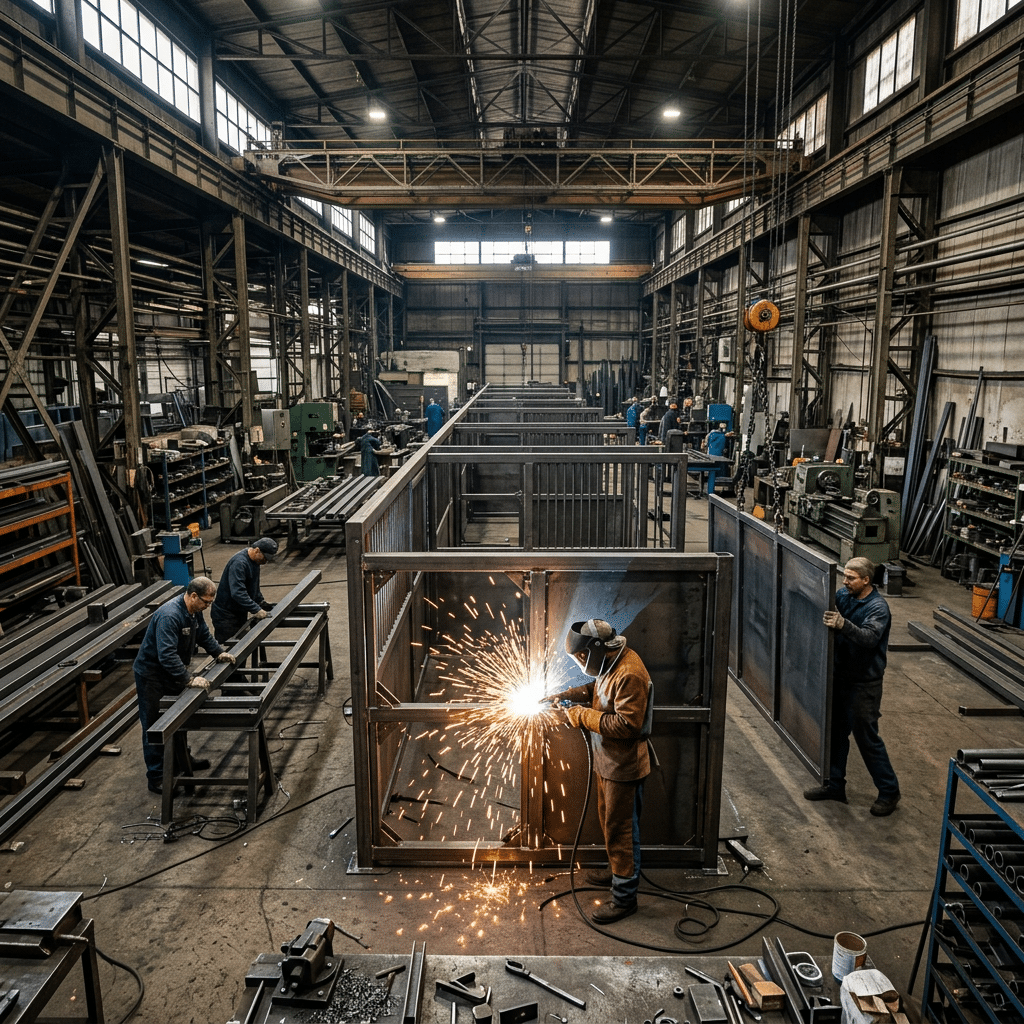
We stop this cycle by creating an impermeable barrier. Our process is called ‘Feuerverzinkung nach der Herstellung‘. We fully weld the entire steel panel first, then submerge the completed structure in molten zinc. This ensures every edge, corner, and weld is completely sealed.
This method provides a robust and uniform protective layer that meets strict international standards for corrosion resistance. The result is a physical shield that isolates the steel from the environment.
- Geltende Norm: The process conforms fully to BS EN ISO 1461.
- Dicke der Beschichtung: We achieve an average zinc coating of over 70 microns on all tubing.
- Performance Validation: Our panels withstand over 96 hours in the ASTM B117 Salt Spray Test without showing any signs of red rust.
Materialvergleich für tropische Klimazonen
In humid climates, material performance hinges on water absorption. Dense, non-porous options eliminate rot and mold risk, making wood a high-maintenance liability.
High humidity isn’t just uncomfortable; it’s a destructive force that accelerates rot, corrosion, and mold growth. When humidity stays above 60%, porous materials like wood begin a losing battle, absorbing moisture that fuels
fungal colonies. For any structure in the tropics, from buildings to equestrian equipment, material selection is the primary defense against this “rot cycle.”
The core issue is water absorption. Materials that don’t absorb water can’t host mold. The following table breaks down how common materials perform under the constant pressure of tropical moisture.
| Material | Key Weakness in Tropics | Water Absorption Rate | Urteil |
|---|---|---|---|
| Behandelte Kiefer | High moisture retention requires constant ventilation and maintenance to prevent mold. | 18-22% by weight | Suboptimal. A high-maintenance choice that creates long-term liability. |
| HDPE (Hochdichtes Polyethylen) | Surface properties can be affected by extreme heat combined with moisture, but it does not rot. | < 0.01% (Effectively zero) | Excellent. A true zero-maintenance material that is impervious to water and mold. |
| Strand-Woven-Bambus | Requires proper thermal treatment during manufacturing to ensure rot resistance. Inconsistent quality is a risk. | ~0.4% (After 24 hours) | Excellent. With a Janka hardness >3000 lbf, it is extremely dense, durable, and mold-resistant. |
| WPC (Wood-Plastic Composite) | Performance depends heavily on the wood-to-plastic ratio and density. Lower quality WPC can still have issues. | < 1.5% | Good. A significant upgrade over treated wood, but less reliable than solid HDPE or high-density bamboo. |
For distributors and project managers specifying materials for tropical climates, the data is clear. Choosing options with virtually no water absorption, like our UV-stabilisiertes HDPE or high-density strand-woven bamboo, isn’t about luxury. It’s about eliminating the primary fuel for rot and mold, which protects the asset and removes long-term maintenance costs for the end client.
Custom Horse Stables Engineered to Last
Luftstromdesign zur Verhinderung tropischer Pilzinfektionen
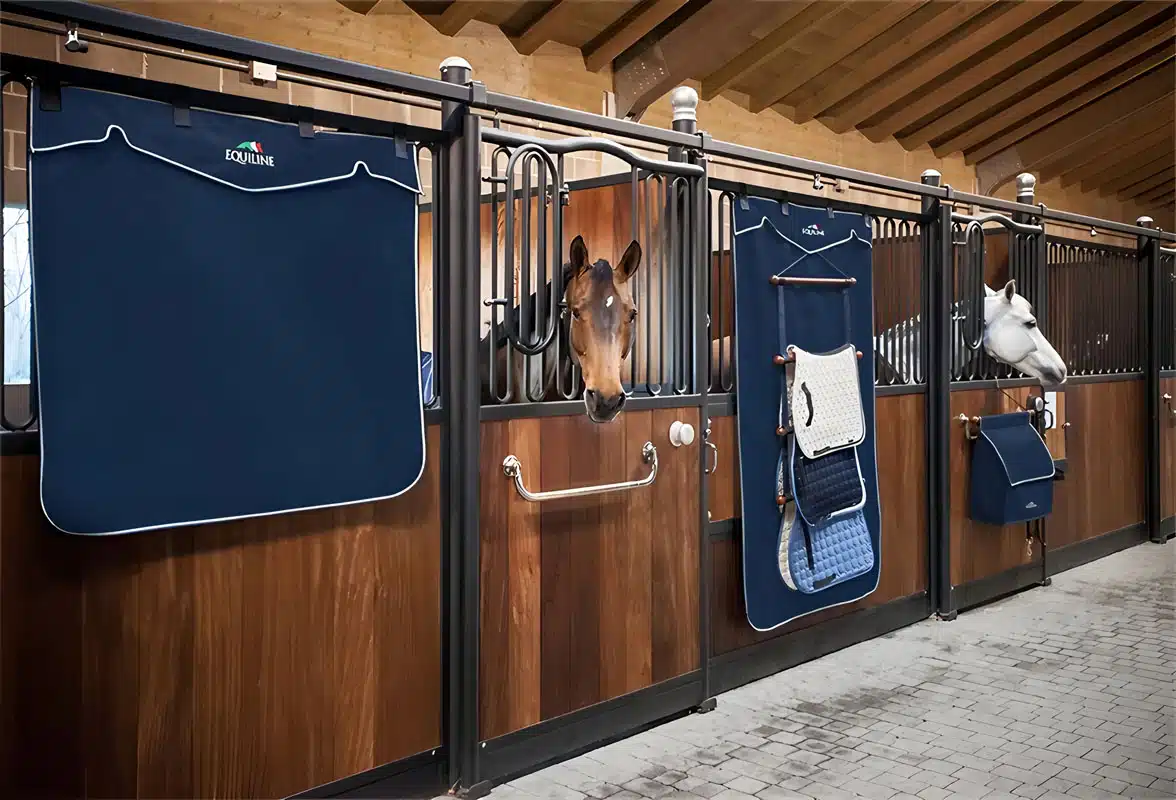
Proper airflow uses stack effect ventilation to exchange humid, stale air for fresh, dry air. This process dilutes fungal spores and prevents moisture buildup, protecting animal health.
The Role of Air Exchange in Diluting Pathogens
The goal is to dilute the concentration of airborne contaminants like fungal spores. Increasing the air change rate (ACH) inside a stable actively removes these harmful particles. Consistent airflow reduces the exposure risk for the animals inside, which is critical for maintaining a healthy respiratory environment, especially in humid regions where fungal threats are constant.
Erreichen Sie Kamineffekt-Belüftung with Open-Grill Stalls
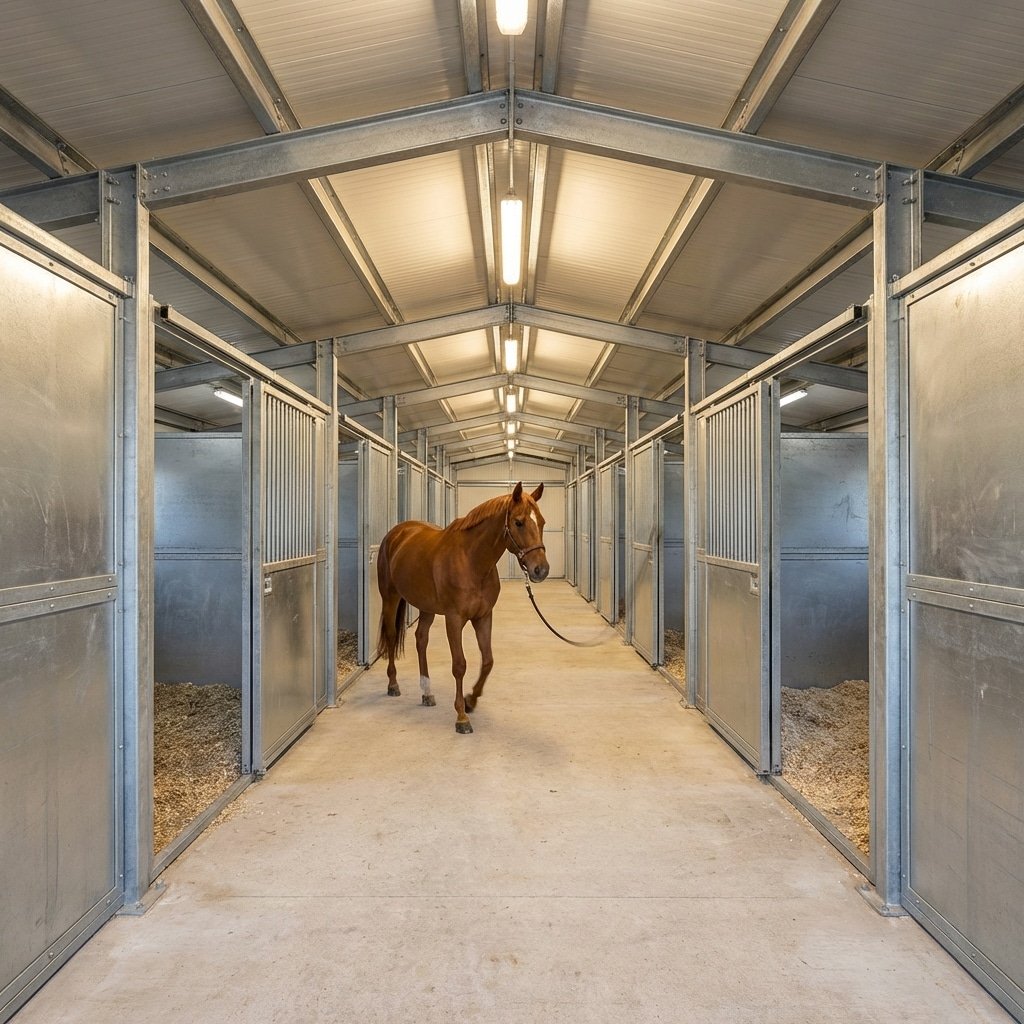
We use a principle called ‘Stack Effect Ventilation’ to create passive, continuous airflow. DB Stable systems are engineered with an open top grill for this purpose. This design allows warm, moist, and stale air—which is lighter—to naturally rise and exit through the top of the stall. As it escapes, cooler, fresher air is drawn in from below. This creates constant circulation without needing mechanical fans, which is a reliable way to manage humidity.
Frequently Asked questions
What are the best materials for stables in humid or coastal climates?
Material choice is everything in high-humidity areas. Our stables go through a ‘Hot-Dip After Fabrication’ galvanizing process that meets ISO 1461 standards. This coats everything, including all the welds, to stop rust before it starts. For the infill, you have two solid options: UV-stabilized HDPE, which absorbs no moisture and is zero-maintenance, or high-density strand-woven bamboo, which naturally resists mold and rot.
Will the bamboo panels rot or warp over time?
No. Our strand-woven bamboo is engineered specifically for durability. It is three times harder than oak and made using a high-pressure process that makes it extremely dense and resistant to moisture. Unlike standard wood, it won’t rot, warp, or grow mold, giving it a very long service life in tough conditions.
What type of steel should I choose for a very cold climate?
For regions with severe winters, we recommend our Q345B steel. It’s a low-alloy, high-strength steel with superior low-temperature impact toughness. This is critical because it prevents the metal from becoming brittle and fracturing if a horse kicks it in freezing temperatures, a common failure point for standard steel.
How do you ensure the stables are safe and prevent injuries?
Safety is engineered in, not added on. We use a ‘Cast-Proof’ design with minimal gaps at the bottom of the stall to stop a horse’s leg from getting trapped when rolling. The strong Q235B or Q345B steel frame combined with either impact-absorbing HDPE or ultra-hard bamboo gives us the confidence to offer a ‘Kick-Proof Guarantee’ that the structure will remain intact and secure.
How does your packaging reduce shipping costs for distributors?
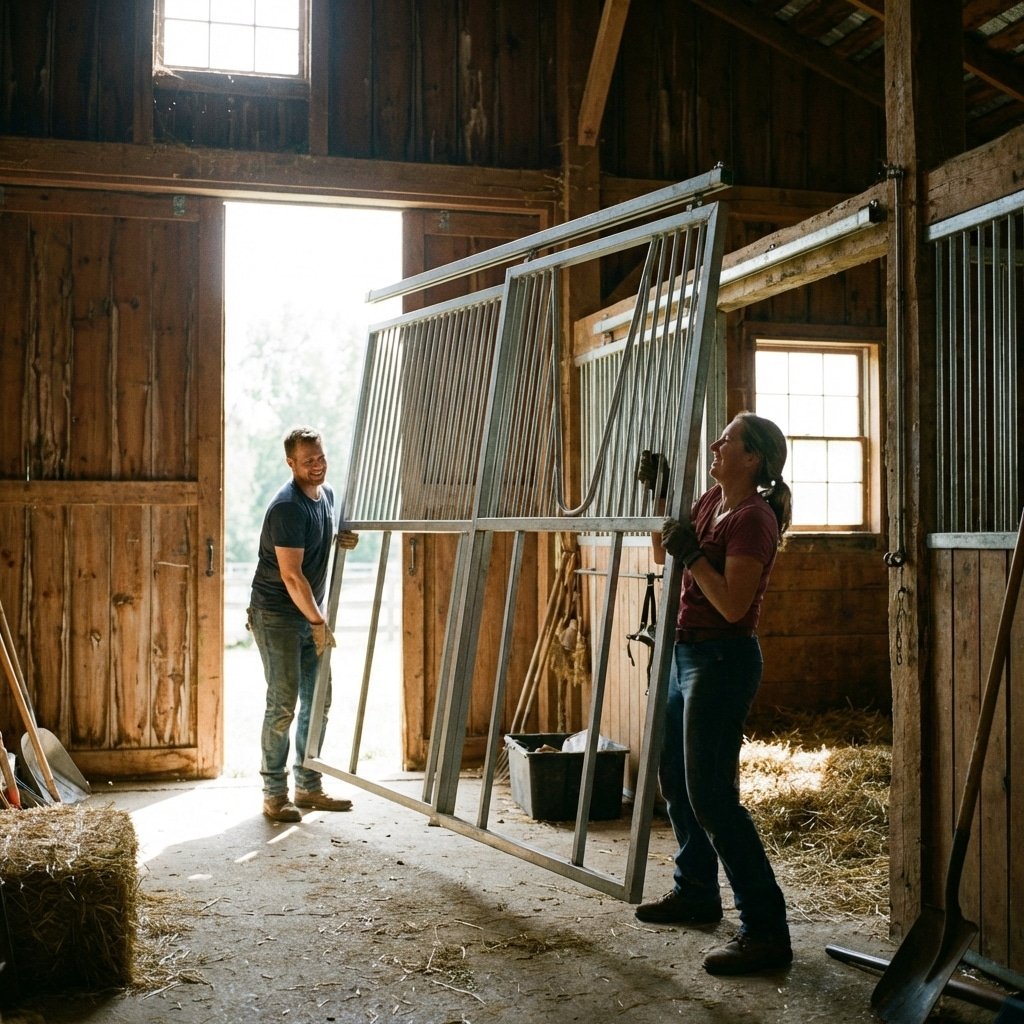
We developed a steel pallet flat-pack system for our B2B clients. A traditional, fully-welded stable panel lets you fit only 12-15 sets in a 40HQ container. Our flat-pack system gets 30-45 sets into that same container. This ‘Profit Protection’ feature cuts sea freight costs by over 60%, directly improving our distributors’ margins.
Abschließende Überlegungen
Specifying equipment on upfront cost alone creates unacceptable risk for police and military assets. Our standard—post-fabrication hot-dip galvanizing and kick-proof materials—is a one-time capital expense that removes long-term maintenance liabilities. This ensures operational readiness and protects your investment for decades.
Our engineering team provides full material certifications and technical drawings required for government tenders. Contact us to discuss your project specifications. We can facilitate a trial order to validate the build quality firsthand.

 German
  English
  Spanish
  French
  Arabic
0 Kommentare