


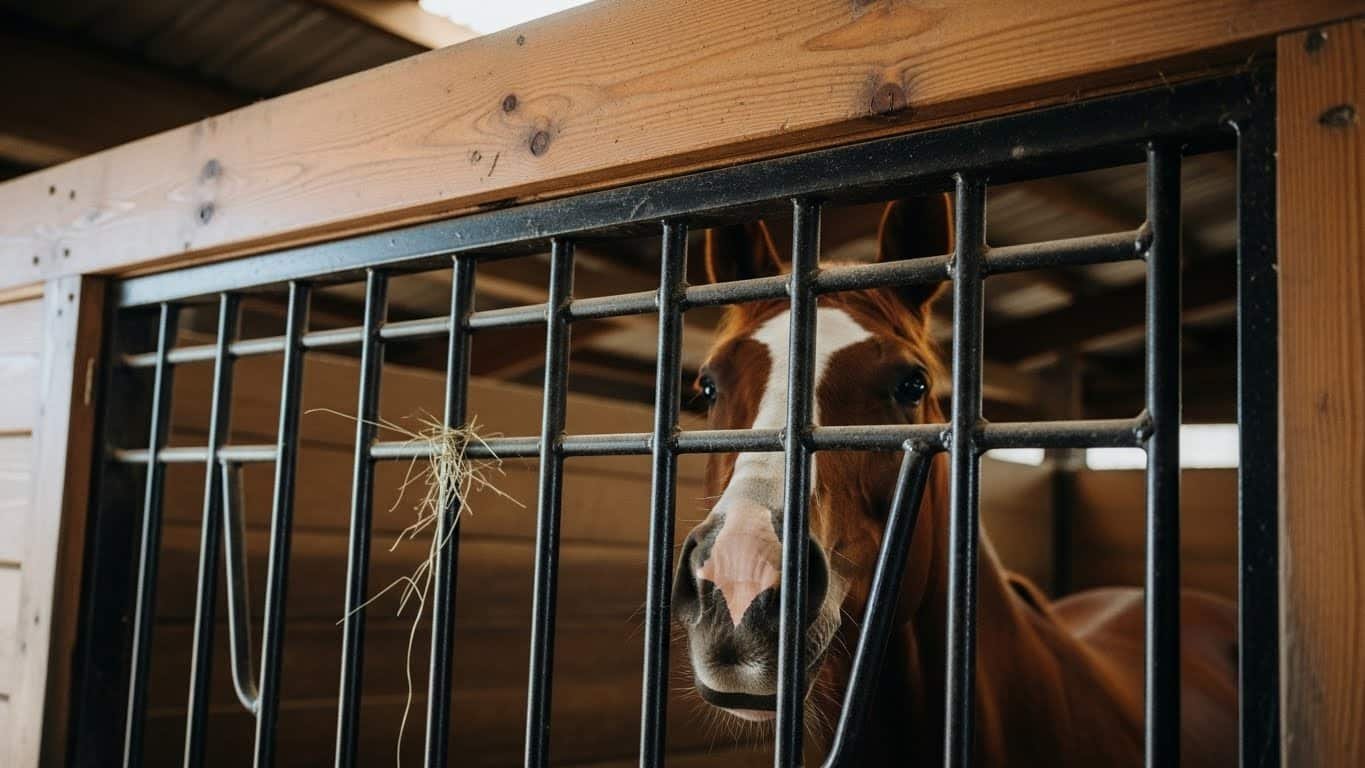
Housing Miniature Horses in standard 12×12 stalls is a common but costly mistake. Incorrect bar spacing and partition heights create significant entrapment risks, leading to vet bills that erode profit and damage a breeder’s reputation.
This guide outlines the correct engineering standards for mini-specific stables. We specify safe grill spacing, appropriate feeder heights, and why a cast-proof design with a 50mm bottom gap is critical for preventing leg injuries and ensuring animal welfare.
Das Mikroklima in einer Waschbucht: Wärme, Wasser und Gülle
A wash bay’s climate of heat, water, and manure demands smart design. Heated water ensures comfort, proper drainage prevents hazards, and galvanized steel fights corrosion for long-term safety.
Controlling Temperature and Moisture
The environment inside a horse wash bay is a constant battle against moisture. Integrating heated water systems is fundamental for the horse’s comfort and cooperation, especially in cooler regions where cold shocks can be dangerous. A comfortable animal is a safer animal.
Water management is just as critical. Floors must be sloped correctly, typically towards a central drain, to eliminate any standing water. Puddles create slip hazards and become breeding grounds for bacteria and mildew. Effective drainage is a non-negotiable part of facility hygiene.
Good insulation and ventilation are the final pieces of the puzzle. Together, they manage the high humidity generated by hot water sprays. This system actively reduces moisture in the air, preventing the growth of mold and protecting the building’s structural components from water damage over time.
Material Durability in Corrosive Conditions
The mix of constant water and ammonia from animal waste creates an intensely corrosive atmosphere that will destroy unprotected steel. Standard paint or pre-galvanized materials simply don’t last. Protecting the structural framework isn’t an option; it’s a core requirement for safety and long-term investment.
To guarantee longevity, specific material standards must be met.
- Stahl Schutz: All steel framework must be Hot-Dip Galvanized After Fabrication. This process coats every surface, including critical welds and cut edges, which are the first points of failure in cheaper, pre-galvanized systems.
- Coating Standard: The protective zinc coating must average over 70 microns (μm) and comply with ISO 1461. This thickness provides the necessary barrier to withstand daily exposure to moisture and corrosive agents.
- Hardware Integrity: All bolts, connectors, and fasteners must be 304 Stainless Steel. This prevents ugly rust streaks from forming on the framework and ensures connection points don’t become weak links in the structure.
Mauern aus Beton: Porosität, Risse und schwierige Reinigung
Concrete walls are porous and crack easily, creating sanitation risks. Modern HDPE offers a non-porous, impact-absorbing, and easy-to-clean alternative for a safer, healthier stable.
How Porosity and Hardness Create Sanitation Risks
Concrete’s fundamental weakness in a stable is its microscopic porosity. T
he surface acts like a sponge, absorbing moisture, urine, and ammonia. This creates an ideal breeding ground for bacteria deep within the material, making true disinfection almost impossible. Routine cleaning only addresses the surface, leaving contaminants embedded in the wall.
The material is also hard and unforgiving. A solid kick from a horse doesn’t just make a noise; it can cause hairline fractures or significant cracks. These cracks become new collection points for dirt and bacteria, worsening the sanitation problem. Broken concrete also creates dangerously sharp edges, posing a direct injury risk to the animals.
HDPE Infill: A Non-Porous and Impact-Absorbing Alternative
The engineered solution to concrete’s failures is High-Density Polyethylene (HDPE). DB Stable uses a 28mm-32mm thick HDPE infill that is completely non-porous. Unlike concrete, it cannot absorb moisture or harbor bacteria. Cleaning is as simple as wiping or hosing it down, ensuring a hygienic environment without intensive labor.
This material is also designed to absorb impact. It flexes when kicked, safely dissipating the force without cracking, splintering, or creating sharp hazards. This durability makes it a ‘Zero Maintenance’ surface that stands up to the daily rigors of a stable, protecting both the horse and the facility’s structural integrity.
Engineer Stables for 20+ Years of Durability
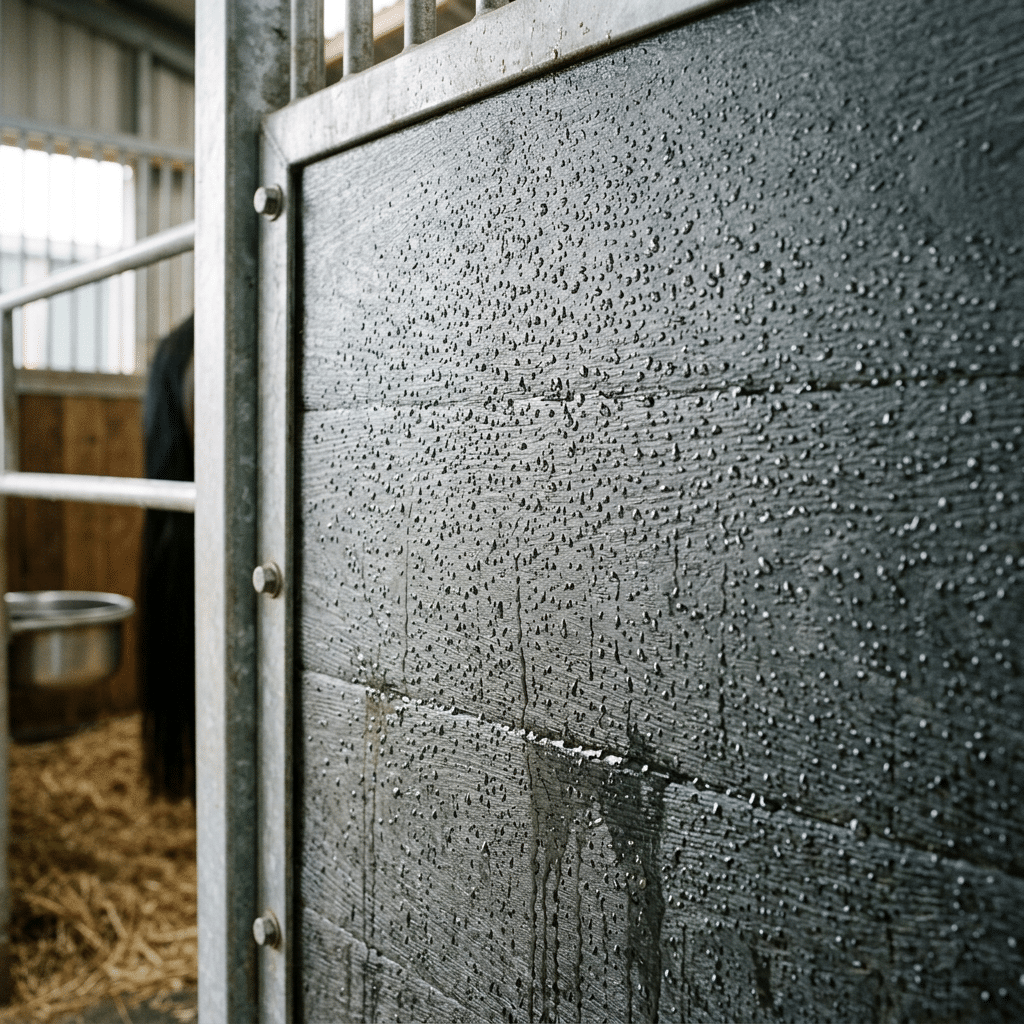
Gummimatten an Wänden: Die Schimmel- und Mehltau-Falle
Rubber mats on walls trap moisture from cleaning or humidity. Without airflow, this dark, damp space becomes a perfect breeding ground for mold, compromising air quality and stall integrity.
How Trapped Moisture Creates a Breeding Ground
Putting rubber mats on stall walls seems like a durable solution, but it creates a serious problem. Water from wash-downs, humidity, or even urine inevitably finds its way behind the mat through unsealed seams and edges. Once it’s in, it’s not getting out. The mat sits flat against the wall, cutting off all airflow and preventing the surface from ever drying completely. This creates a dark, constantly damp, and unventilated space—the exact conditions mold and fungi need to colonize and thrive.
The Advantage of Mold-Resistant Infill Panels
Purpose-built infill panels avoid this trap entirely. High-density strand-woven bamboo offers natural resistance to both mold and rot, making it an ideal choice for high-moisture environments. For a completely impervious barrier, HDPE (High Density Polyethylene) infill provides a non-porous, solid surface. It doesn’t absorb moisture, requires zero maintenance, and eliminates the hidden gaps where mold could ever get a foothold.
HDPE-Kunststoff: 100% Hydrophob und waschmaschinenfest
HDPE is non-porous plastic that repels water. This prevents moisture absorption, stopping mold and bacteria growth, and allows for damage-free power washing.
| Merkmal | HDPE Plastic Infill | Traditionelle Holzdielen |
|---|---|---|
| Wasserabsorption | Non-porous and hydrophobic; completely repels moisture. | Porous; absorbs urine and water, leading to saturation. |
| Hygiene | Prevents the growth of mold, mildew, and bacteria. | Traps moisture, creating a breeding ground for bacteria and ammonia. |
| style=”padding: 12px; border: 1px solid #ddd;”>Maintenance | Power-washable; requires no sealing, painting, or staining. | Requires regular sealing or painting to delay decay. |
| Long-Term Durability | Does not rot, warp, crack, or swell. Impact-absorbing. | Prone to rot, warping, and swelling, requiring eventual replacement. |
Why Non-Porous Surfaces Matter for Stall Hygiene
The core problem with materials like wood in a barn is their ability to absorb moisture. Urine and water soak into porous surfaces, creating the perfect environment for bacteria and ammonia to develop. A non-porous material like HDPE is hydrophobic, meaning it repels water entirely. Nothing soaks in.
This property completely changes stall maintenance. Instead of scrubbing a surface that traps grime, you can simply power wash it clean. The structural integrity of the plastic is unaffected by water, so it will not rot, warp, or swell over time. This reduces labor costs and eliminates the need to replace damaged boards, directly improving barn hygiene and operational efficiency.

DB Stable’s UV-Stabilized HDPE Infill
We engineer our HDPE infill specifically for the high-stress environment of a horse stall. It’s not just any plastic; it’s a purpose-built solution designed for zero maintenance and maximum durability. The material’s properties ensure it withstands daily abuse from horses and the elements without failing.
- Engineered Thickness: Our planks are 28mm to 32mm thick, providing an impact-absorbing buffer that is genuinely kick-proof.
- UV-Stabilisierung: We include UV stabilizers in the material composition. This is critical for preventing the plastic from becoming brittle or degrading from sun exposure, a non-negotiable feature for markets like Australia.
- Null Wartung: This is the key selling point for barn operators and distributors. Once installed, HDPE infill eliminates all future costs and labor associated with painting, sealing, or replacing rotten boards.
HDG Stahlzargen: Überleben in der Spritzwasserzone
Standard galvanization fails in splash zones because wet-dry cycles wash away the protective zinc. A dual-layer system combining galvanization with a powder coat is the only reliable solution.
The Challenge of Wet-Dry Cycles on Galvanized Steel
Splash zones, like wash bays, are considered the most aggressive environments for galvanized steel. The constant cycle of getting wet and then drying doesn’t allow the stable zinc patina to form correctly. Instead, this cycle mechanically washes away the protective layer, continuously exposing fresh zinc to corrosive elements. Research shows this can eat through the zinc coating at an accelerated rate of 50 to 100 micrometers per year, making standard galvanization inadequate for these areas.
Zweifacher Schutz: Pulverbeschichtung über Verzinkung
The engineered solution is a duplex system, which adds a durable powder coat layer over the hot-dip galvanized steel. This outer powder coat acts as a tough, physical barrier. It shields the underlying zinc coating, which meets ISO 1461 standards, from the abrasive wet-dry cycles. This dual-protection method is the standard for our Royal Series, and it extends the frame’s service life far beyond what galvanizing alone can offer in these demanding settings.
Abschließende Überlegungen
While stalls using pre-galvanized steel and untreated wood offer a lower entry price, they expose your business to predictable failures. Our standard of Hot-Dip Galvanization After Fabrication (ISO 1461) and non-porous HDPE infill is the engineered defense against rust claims and hygiene complaints. This level of quality protects your reputation and secures the long-term trust of your clients.
Don’t base a container order on pictures and promises; verify the engineering yourself. We recommend a small trial order to test our material quality and fitment firsthand. Contact our team to configure your trial shipment or discuss OEM specifications for your market.

 German
  English
  Spanish
  French
  Arabic
0 Kommentare