


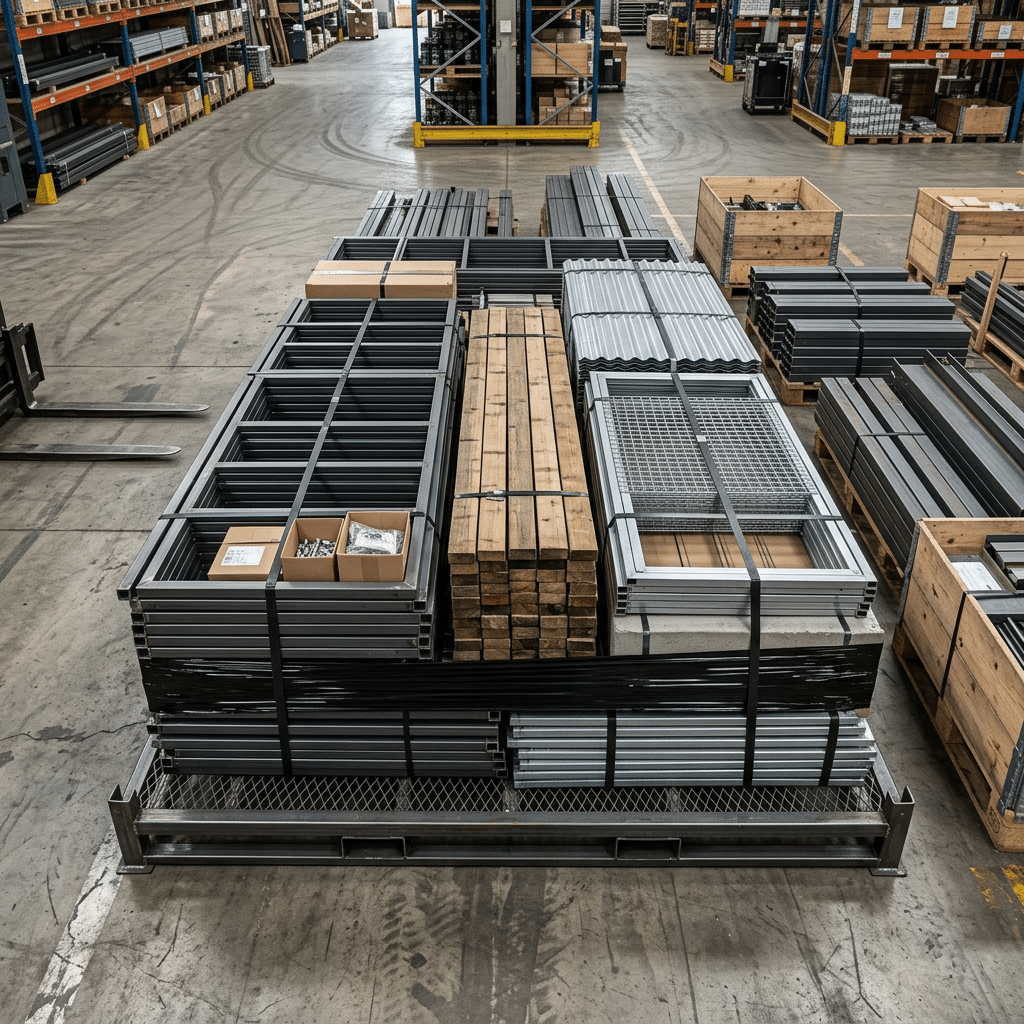
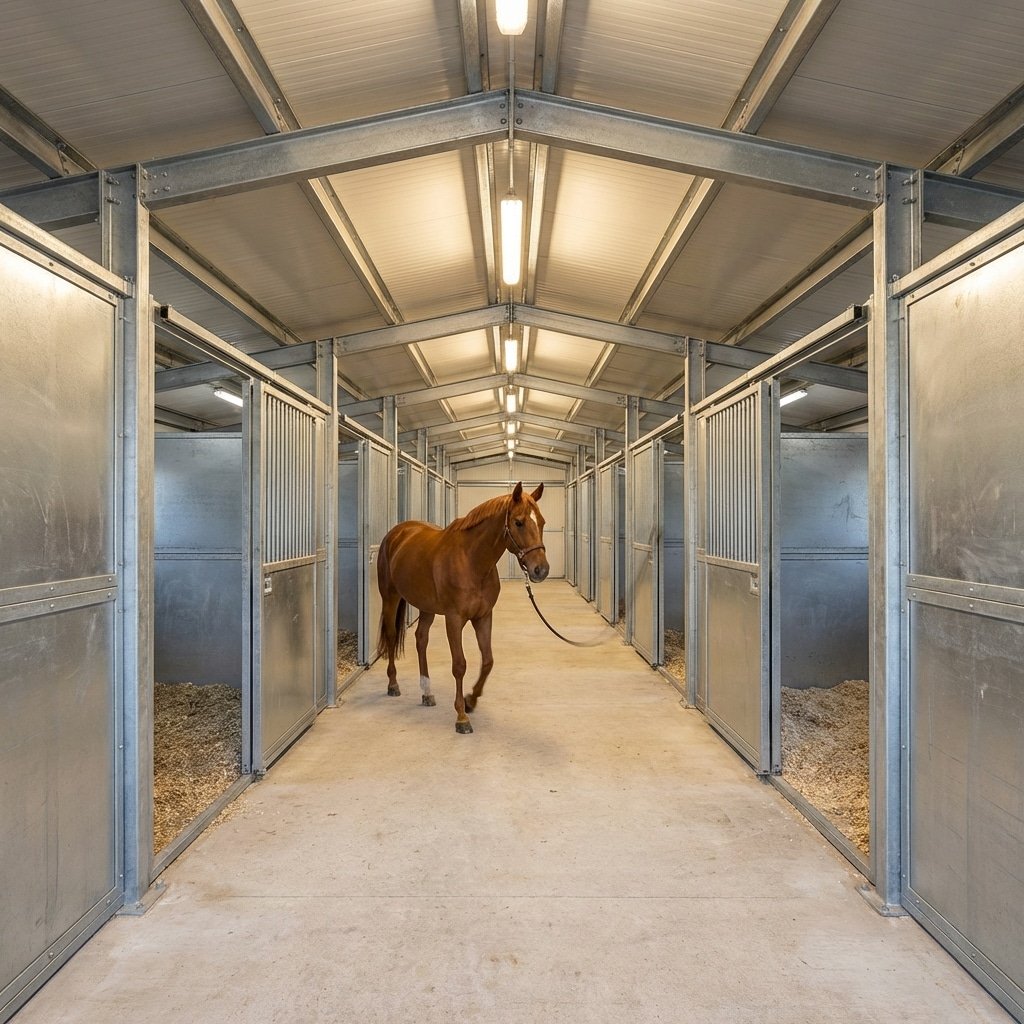
Specifying a Hurricane/High-Wind resistant stable is a direct defense against total structural failure and catastrophic liability. Standard barns are not engineered for the uplift forces of a Category 4 storm; roof separation and wall collapse are predictable outcomes. This failure is a direct result of inadequate steel gauges and improper anchoring.
This analysis breaks down the essential engineering specifications for survival. We cover the performance of Q345B structural steel versus standard tubing and detail the critical requirements for anchoring, hardware, and minimum 14-Gauge wall thickness to prevent catastrophic uplift.
The Reality of Category 4 Winds on Equestrian Structures
Category 4 winds (130-156 mph) cause catastrophic failure in standard barns. Survival hinges on engineered heavy-gauge steel framing and anchoring designed to resist extreme uplift forces.
Wind Loads and Common Points of Structural Failure
Sustained winds between 130 and 156 mph create massive pressure differentials across a building’s surfaces. The wind flowing over the roof generates powerful suction, or uplift, which is the most common initial point of catastrophic failure. Once the roof is compromised or peeled off, the remaining walls lose their structural integrity and are far more likely to collapse inward.
The danger isn’t just from the wind itself. Airborne debris turns into high-velocity projectiles that can puncture walls and windows, allowing pressure to build up inside the structure and magnifying the destructive uplift forces on the roof.
The Role of Heavy-Gauge Steel in Resisting Deformation
The ability of a stable to withstand these forces comes down to its core materials. An engineered framework built from Q235B structural steel is the baseline requirement for resisting the bending and shearing that occurs under extreme wind loads. The key specification is the material’s thickness.
All structural tubing must have a wall thickness of at least 14-Gauge (2.0mm – 2.5mm). Anything thinner simply lacks the mass and rigidity to prevent deformation and failure when subjected to the relentless pressure of hurricane-force winds. This isn’t a feature; it’s a fundamental engineering necessity for animal safety in high-risk zones.
Anchoring Systems: Deep Concrete Footings vs. Surface Bolts
The choice depends on the main local hazard. Deep concrete footings are ideal for flood-prone areas where structures may be elevated. Surface bolts are superior for high-wind zones, locking the stable to a heavy concrete slab.
Matching the Anchor Type to the Environmental Risk
Your anchoring strategy comes down to one question: is the bigger threat high winds or flooding? For regions prone to extreme winds, surface bolts are the clear choice. Fasteners like wedge anchors and J-bolts are designed to lock a structure’s frame directly to a heavy, solid concrete slab foundation. The sheer mass of the slab provides the immense stability needed to resist uplift forces.
If regular flooding is the primary concern, the approach changes. Deep anchoring systems, like auger-style anchors, are built to secure foundations that might be elevated off the ground. These anchors extend deep into the soil, gripping the earth to provide holding power that lets water pass underneath the structure without compromising its stability.
The Importance of 304 Stainless Steel Hardware
An anchoring system is only as strong as its weakest link, which is often the hardware itself. Every DB Stable installation kit includes a full set of 304 stainless steel anchor bolts for mounting the frame to the foundation. This isn’t an optional upgrade; it’s standard.
Using 304 stainless steel provides superior corrosion resistance against constant exposure to moisture and the elements. This ensures the structural integrity of the anchor points won’t degrade over time, which is absolutely critical for long-term safety and the stability of the entire building.
Custom-Engineered Stables for Any Global Climate.
Steel Framework: Why Q345B Outperforms Standard Tubing
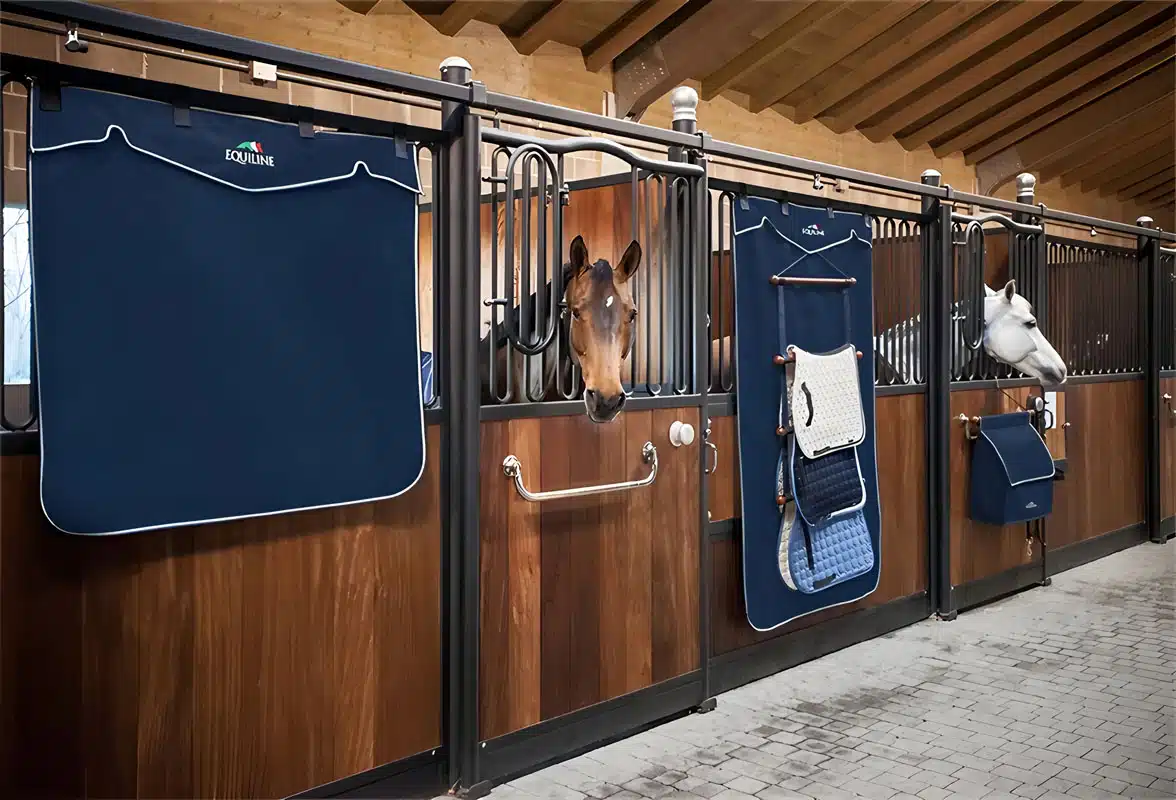
Q345B steel has higher yield strength and ductility, allowing it to absorb impacts from kicks or extreme weather without fracturing. This provides greater safety and longevity, especially in cold climates.
| Merkmal | Q345B High-Strength Steel | Q235B Standard Tubing |
|---|---|---|
| Streckgrenze | High (≥345 MPa) | Standard (≥235 MPa) |
| Ductility (Impact Resistance) | Superior ability to flex and absorb energy | Adequate for static loads, but brittle under sudden impact |
| Cold Climate Performance | Excellent low-temperature toughness; resists fracture | Can become brittle and fail in freezing temperatures |
| ASTM Equivalent | Grade 50 | A36 |
Yield Strength and Ductility: Resisting Force Without Fracture
Two material properties determine how a stable frame reacts to force: yield strength and ductility. Yield strength is the breaking point—the maximum stress steel can take before it bends permanently. Ductility is its ability to absorb energy and flex without shattering. It’s the difference between a material that bends and one that snaps.
Standard tubing, like Q235B steel, has enough yield strength for static loads like holding up a roof. But it lacks the ductility to handle dynamic forces. A powerful horse kick or a hurricane-force wind gust doesn’t apply slow, steady pressure. It’s a sudden, high-energy impact. Lower-grade steels can’t dissipate that energy and are prone to brittle failure, meaning they crack or shatter unexpectedly.
The Q345B Specification: Engineered for Impact and Cold Climates
For our heavy-duty stable systems, we use Q345B Low Alloy High Strength Steel, the equivalent of ASTM Grade 50. This isn’t just about being stronger; it’s about being tougher, especially when it gets cold. The primary advantage of Q345B is its superior low-temperature impact toughness. This property prevents the steel from becoming brittle in freezing weather, ensuring it can absorb the full force of a kick during winter without fracturing.
This enhanced resilience is also critical for structural integrity in extreme weather. A stable frame built with Q345B can be engineered to withstand wind resistance grades up to 300 km/h. This makes it a necessary specification for equestrian facilities in storm-prone regions where structural failure is not an option.
Roof Uplift Mitigation: The Weakest Link in Barns
High winds create powerful upward suction that can rip a barn’s roof from its walls. This failure happens at the roof-to-wall connection, the structure’s weakest link.
Understanding Uplift Forces and Primary Failure Zones
When high-velocity wind moves across a roof, it creates a pressure differential. This results in a strong upward suction force that tries to lift the entire roof assembly off the building. Think of it like an airplane wing, but on a much larger and less controlled scale.
The most critical stress point—and the most common point of failure—is where the roof framing connects to the top plate of the wall. If this connection is weak, the rest of the structure’s strength doesn’t matter. Gable overhangs, particularly those built with older, non-engineered framing styles, are also notorious for catching wind and acting as a lever, prying the roof structure apart.

Ensuring Load Path Continuity with Quality Hardware
The entire structural system depends on a continuous load path to work correctly. This path transfers uplift forces from the roof sheathing, through the trusses or rafters, down the walls, and finally into the foundation. A single weak link in that chain causes catastrophic failure.
This is why hardware specification is not a detail to overlook. Using the right materials prevents the slow, invisible degradation that compromises safety. Our hardware kits, for instance, include anchor bolts, connectors, and screws made exclusively from 304 Stainless Steel. This choice eliminates the risk of corrosion weakening these critical connections over time. Properly engineered hardware provides the necessary mechanical resistance right where uplift forces are most concentrated, keeping the roof attached to the building.
Post-Storm Rust: Surviving Saltwater Flooding with HDG
Hot-dip galvanization provides a sacrificial zinc barrier against saltwater. Meeting specific ISO standards ensures this coating is thick enough to survive the aggressive wet-dry cycles of post-storm flooding.
The Corrosive Power of Wet-Dry Cycles
Saltwater flooding creates a uniquely destructive environment for steel. It’s not the same as simple immersion. The situation mimics the highly aggressive conditions of a coastal “splash zone,” where repeated wetting and drying cycles dramatically accelerate corrosion. The washing action of floodwaters continuously strips away any passive scales that might form on a metal surface. This process constantly exposes fresh, unprotected metal to the salt and oxygen, causing coatings to fail much faster than they would if le
ft completely submerged.
Meeting ISO 1461 for Coastal Resilience
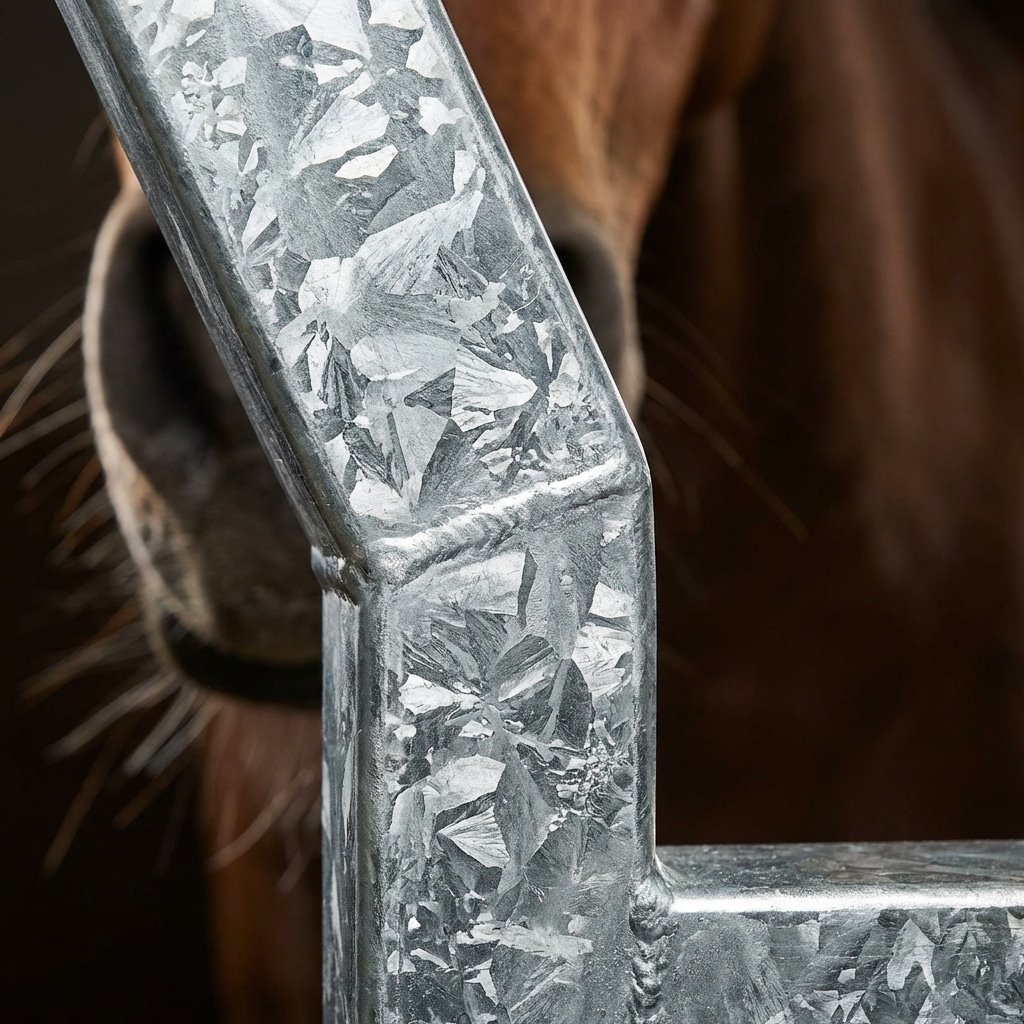
A reliable defense against this kind of accelerated corrosion comes from the manufacturing process itself. At DB Stable, every steel component is hot-dip galvanized *after* all welding and fabrication is complete. This ensures total coverage with no exposed seams. The entire process conforms to the BS EN ISO 1461 standard, which dictates minimum coating thickness and adhesion levels. For the steel tubing used in our stable systems, this results in an average zinc coating of over 70 microns. This thick, metallurgically bonded layer acts as a robust sacrificial barrier, built to withstand the harsh wet-dry cycles that follow a coastal storm.
Häufig gestellte Fragen
Can a steel stable be engineered to withstand hurricane-force winds?
Yes, steel stables can be engineered to resist hurricane-force winds, with some designs rated for speeds of 180 mph or higher. Resilience depends on critical factors like secure anchoring into a reinforced concrete foundation, the use of heavy-gauge steel, and a design certified for local wind load requirements. All components, including doors and windows, must also be hurricane-rated to ensure structural integrity.
What wind load rating is required for a horse stable?
The required wind load rating is determined by your local building codes and geographic location. While a baseline might be 80 mph in some inland areas, coastal regions prone to hurricanes can require ratings from 130 to 170 mph. Always consult your local building department to determine the specific engineering requirements for your property.
Which roof shape performs best in high-wind conditions?
Hip roofs are considered the most effective design for high-wind areas. Their four sloping sides allow wind to flow over the structure rather than pushing against a flat vertical surface, like on a gable roof. This design can reduce peak wind pressure by up to 50%, distributing forces more evenly and significantly lowering the risk of roof uplift.
How can a barn be protected from saltwater flooding?
The most effective protection against saltwater flooding is elevating the entire structure above the anticipated flood level. Additionally, using corrosion-resistant materials and sealants is critical, as salt will damage standard components. Proper site grading to direct water away, along with deployable, saltwater-compatible flood barriers, provides further layers of defense.
What is the correct way to anchor fixtures to a concrete stable floor?
For securing items like stall mats or dividers, using concrete anchors such as Tapcon screws is a reliable method. This involves pre-drilling a pilot hole into the concrete, then fastening the screw. Ensure the anchor length is appropriate for your slab thickness. For a less permanent solution, framing the area with lumber or using industrial-grade epoxy can also work.
Abschließende Überlegungen
Opting for cheaper, non-certified stables is a gamble against catastrophic failure in high-wind zones. The liability from a single structural collapse far outweighs any initial material savings. Specifying Q345B steel and ISO 1461 galvanization is a direct investment in your brand’s credibility and your clients’ safety.
Verify the engineering before committing to a container. A trial order is the most effective way to inspect our weld quality, galvanization thickness, and the precision of the flat-pack system. Contact our team to get the technical data sheets required for your region.

 German
  English
  Spanish
  French
  Arabic
0 Kommentare