


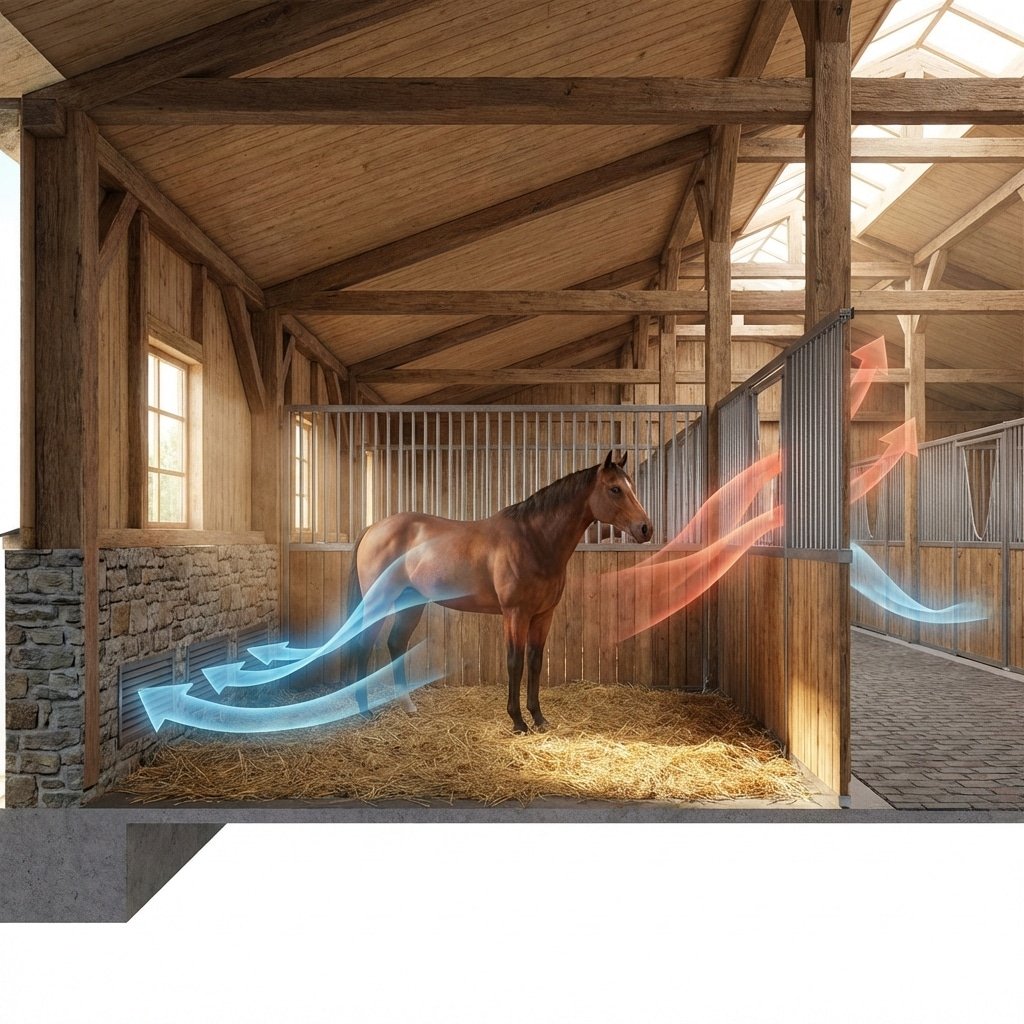
Optimizing Ventilation (Stack Effect) mechanics is the primary defense against ammonia-induced respiratory failure in high-value equines. While solid stall fronts provide isolation, they frequently sever the vertical airflow pathway, trapping toxic gases in the breathing zone and creating stagnant dead zones.
We engineer our Economy and Professional Series to harness thermal buoyancy through open top grills and calculated 50mm cast-proof intakes. This design removes physical barriers to the updraft, allowing facility managers to eliminate ammonia buildup without relying on expensive mechanical systems.
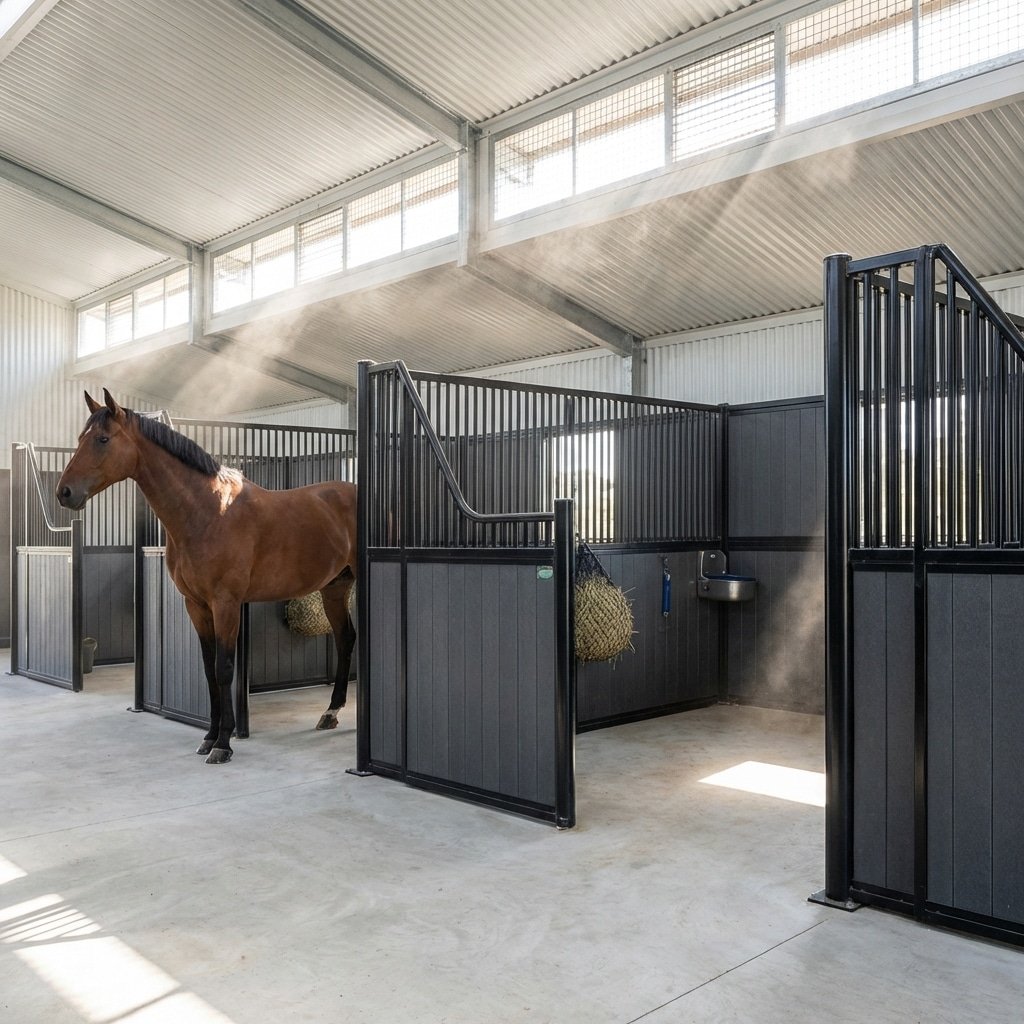
The Danger of Stagnant Air and Ammonia in Stables
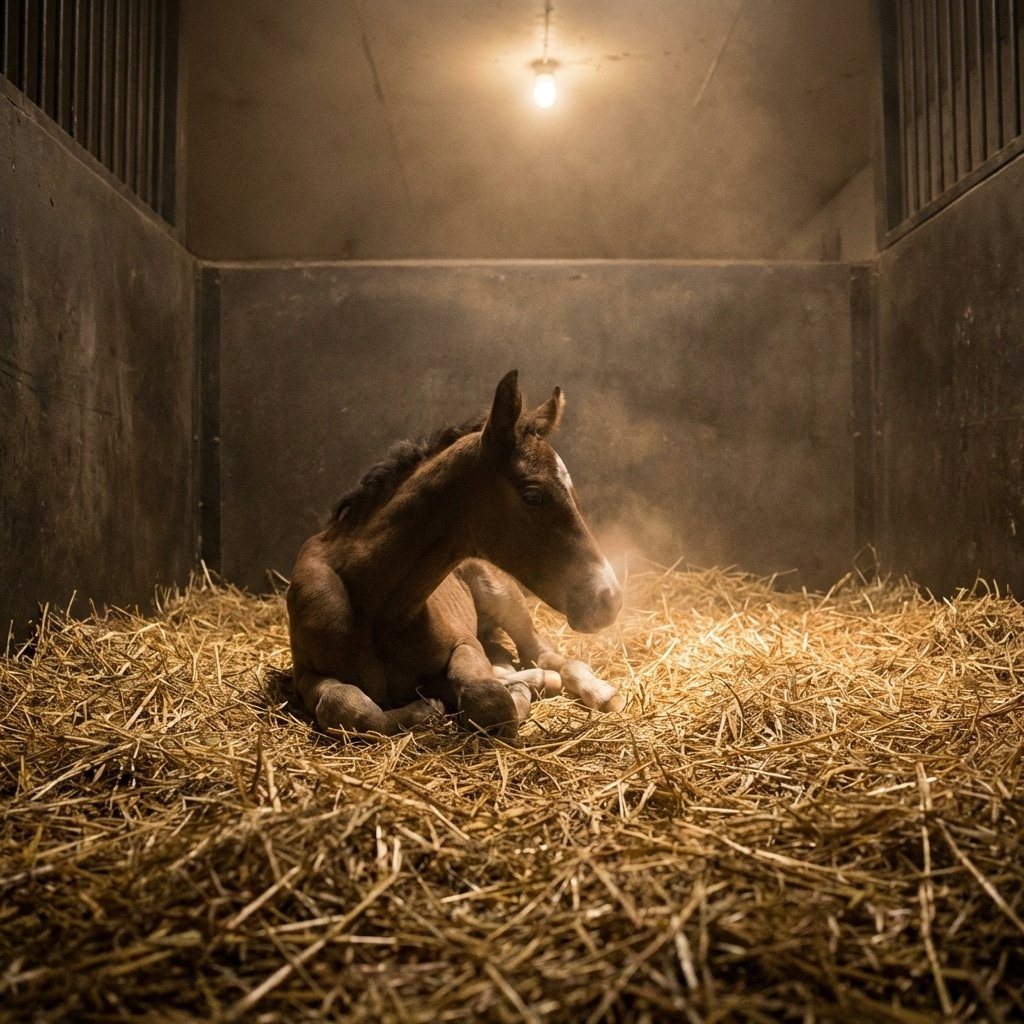
Ammonia gas concentrates heavily within 12 inches of the floor, directly attacking the respiratory systems of foals and sleeping horses. Porous materials like wood exacerbate this by trapping the bacteria that produce the gas.
Respiratory Hazards: Ammonia Concentration at the Equine Breathing Zone
Most stable managers measure air quality at human head height (5 to 6 feet). This is a mistake. Ammonia gas is water-soluble and concentrates significantly within 12 inches of the floor. While you might smell a faint odor while walking the aisle, a foal or a horse lying down often breathes in concentrations ranging from 80 to 450 ppm—levels that are toxic to equine lung tissue.
This exposure directly targets the respiratory cilia, the microscopic hairs in the lungs responsible for clearing out dust and pathogens. When ammonia burns these away, the horse loses its primary natural defense system, leaving them vulnerable to chronic respiratory infections. The risk spikes in winter when facility managers seal barns to conserve heat, inadvertently trapping moisture that accelerates the bacterial breakdown of waste.
Material Selection: Preventing Urine Retention with Impermeable HDPE
Ventilation moves air, but material selection dictates how much ammonia is generated in the first place. Traditional wooden boards are fundamentally porous. They act like a sponge, absorbing urine and moisture deep into the grain where no amount of scrubbing can reach. This creates a permanent, structural breeding ground for the bacteria that generate ammonia gas.
We engineered our systems to eliminate this biological reservoir. DB Stable utilizes high-density HDPE infills (28mm-32mm) that are completely non-absorbent. Unlike wood, fluids cannot penetrate the wall structure, ensuring the source of the smell is not the wall itself.
- Impermeable Surface: Urine and moisture stay on the exterior where they can be fully washed away.
- Sanitization Efficacy: Disinfectants actually kill surface bacteria instead of soaking effectively into a wooden core.
- Zero Maintenance: Requires no painting, treating, or sealing to maintain its resistance to biological waste.
The Physics of the “Stack Effect” in Barn Design
Thermal buoyancy drives natural ventilation. Warm air exits roof vents, creating a pressure vacuum that pulls fresh, cool air in through lower stable openings to remove ammonia.
Understanding Thermal Buoyancy and Air Density
Warm air rises because it is less dense than cold air. This fundamental physics principle acts as a passive engine for your stable’s ventilation system. As heat generated by the horses and solar gain lifts air toward the roof, it creates a pressure differential—essentially a vacuum—at the floor level.
You do not need mechanical fans to force this movement if the structure allows for it. The rising warm air naturally exits through فتحات التلال, and this upward momentum physically pulls cooler, fresh air into the barn through lower openings. The strength of this draft depends directly on the temperature contrast between indoors and outdoors, as well as the vertical height of the structure. Taller barns with proper venting generate a stronger “chimney” effect, cycling stagnant air out more efficiently.
Maximizing Circulation via Open Grill Designs
Physics fails if the air hits a solid wall. For the stack effect to function, the vertical pathway must remain unobstructed from the floor to the roof. Solid partitions block this flow, trapping stale air and ammonia in the stall. We engineer our stables to harness thermal buoyancy rather than fight it.
- Open Top Grills: Our Economy and Professional Series feature open grill designs on the upper half. This prevents heat from getting trapped at the stall level and allows the vacuum to pull air upward toward the roof vents.
- Cast-Proof Intake: The “Cast-Proof Design” includes a calculated bottom gap of approximately 50mm. While primarily a safety feature to prevent casting, this gap acts as a critical cold air intake, drawing fresh oxygen across the floor where ammonia concentrates.
- Ammonia Mitigation: By ensuring a clear path from the bottom intake to the top exhaust, the stack effect lifts heavy ammonia gases away from the horse’s breathing zone.
Engineered Stables Built For Any Climate
Why Solid Stall Fronts Kill the Updraft
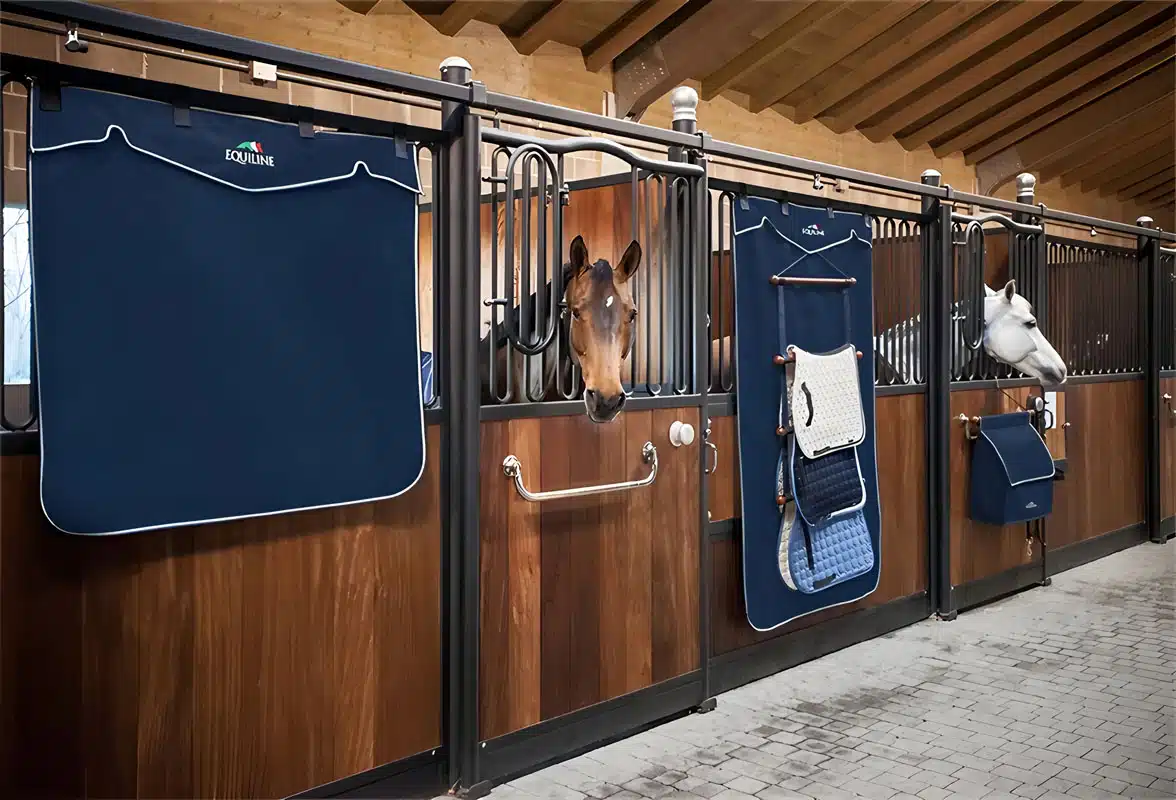
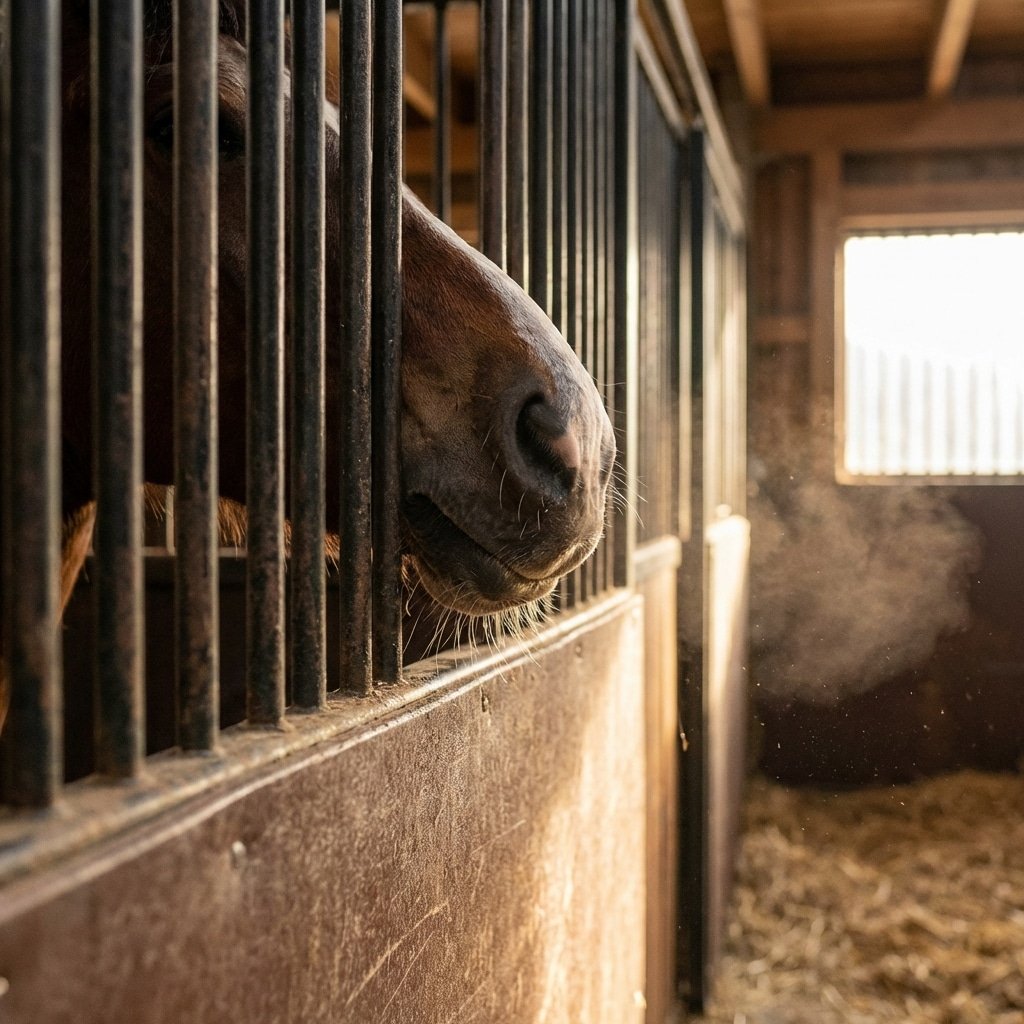
Solid stall fronts act as a physical barrier to thermal buoyancy, trapping ammonia and pathogens in the breathing zone by severing the natural “stack effect” airflow.
Severing the Vertical Airflow Pathway
Thermal buoyancy dictates that warm air naturally rises, carrying moisture and contaminants upward toward roof vents. In a properly engineered facility, this creates a continuous upward draft known as the “chimney effect” that passively clears the stable environment.
Solid stall fronts act as a physical dam against this movement. By sealing off the upper portion of the stall front, you sever the connection between the bedding layer (where ammonia generates) and the exhaust points at the ridge. Instead of rising and escaping, the warm, contaminated air hits the solid wall and recirculates back down into the stall, creating a closed loop of stale air.
The Failure of “Stack Effect Ventilation”
When the vertical pathway is blocked, the facility loses the benefit of Stack Effect Ventilation. Ammonia fumes, which concentrate heavily within 12 inches of the floor, accumulate directly in the horse’s breathing zone rather than being drawn upward. This creates stagnant “dead air” pockets that significantly increase the operational risk of respiratory conditions like COPD and Heaves.
- Ammonia Concentration: Stagnant air prevents the dilution of gas released from decomposing urine, keeping toxicity levels high at head height.
- Pathogen Trapping: Airborne viruses and dust remain suspended in the stall rather than venting out through the roof.
- The Engineering Fix: لدينا Economy and Professional Series designs utilize an Open Top Grill architecture specifically to restore this updraft, allowing unrestricted airflow from the intake to the ridge vent.

Using Fully Grilled Horse Stall Panels to Feed the Draft
Fully grilled panels remove physical barriers, allowing the stack effect to sweep ammonia from the floor. We secure these high-weld designs with hot-dip galvanization after fabrication.
| Ventilation Factor | Solid Partition Wall | DB Full-Mesh Panel |
|---|---|---|
| Air Pathway | Blocks lateral breeze from eaves | Continuous flow to breathing zone |
| Ammonia Control | Traps gas near bedding/floor | Permits gas migration & exhaust |
| Corrosion Risk | Low (Wood/Infill focus) | High (Weld points) without ISO 1461 |
| Steel Spec | Standard framing | Q235B Structural Steel (14-Gauge) |
Removing Airflow Barriers with Full-Mesh Designs
The primary failure in modern barn ventilation is not a lack of vents, but the obstruction of airflow paths inside the structure. When you install solid partitions, you effectively create a box that isolates the horse from the barn’s ventilation system. The “draft” refers to the calculated movement of fresh air entering from the eaves and sweeping across the floor before rising. Full-mesh designs facilitate this physics rather than fighting it.
- Continuous Air Pathways: Fresh air typically enters a barn through eave vents. Solid walls block this lateral movement, forcing air over the stall rather than through it. Fully grilled panels allow this cool air to penetrate the stall and reach the horse’s nose.
- Ammonia Displacement: Ammonia is heavier than fresh air and accumulates in the bottom 12 inches of the stall. Solid bottom panels trap this gas like a bucket. Open mesh or bar bottoms allow air currents to sweep these heavy gases out into the aisle where the stack effect can lift them to ridge vents.
- Supporting the Stack Effect: Natural ventilation relies on warm air rising (thermal buoyancy) to pull fresh air in. By reducing resistance within the stall using mesh, warm air rises more freely to the ridge vents, creating a stronger vacuum that pulls cooler air in behind it.
Engineering Durability: الجلفنة بالغمس الساخن بعد التصنيع
Manufacturing a fully grilled panel presents a specific engineering challenge: rust at the weld points. A standard mesh panel contains hundreds of intersecting bars, meaning hundreds of potential failure points if moisture penetrates the joints. Competitors often use pre-galvanized steel tubes, weld them together (burning off the zinc), and simply spray paint the joints. This leads to rust within months in a humid stable environment.
- The Corrosion Challenge: Every point where vertical bars cross horizontal rails creates a crevice that traps moisture and ammonia. In pre-galvanized manufacturing, these welded areas are exposed raw steel.
- The DB Solution: We strictly utilize الجلفنة بالغمس الساخن بعد التصنيع (ISO 1461 standard). We build the entire panel from raw black steel first, then submerge the complete unit into molten zinc. This process seals every weld, joint, and crevice with a zinc coating averaging over 70 microns.
- Structural Strength: Ventilation cannot come at the cost of safety. We construct these frames using Q235B Structural Steel with 50mm x 50mm RHS frames and 14-gauge (2.0mm minimum) tubing. This ensures the mesh remains rigid and kick-proof, even under heavy impact.
Half-Mesh Dividers for Ultimate Cross-Ventilation
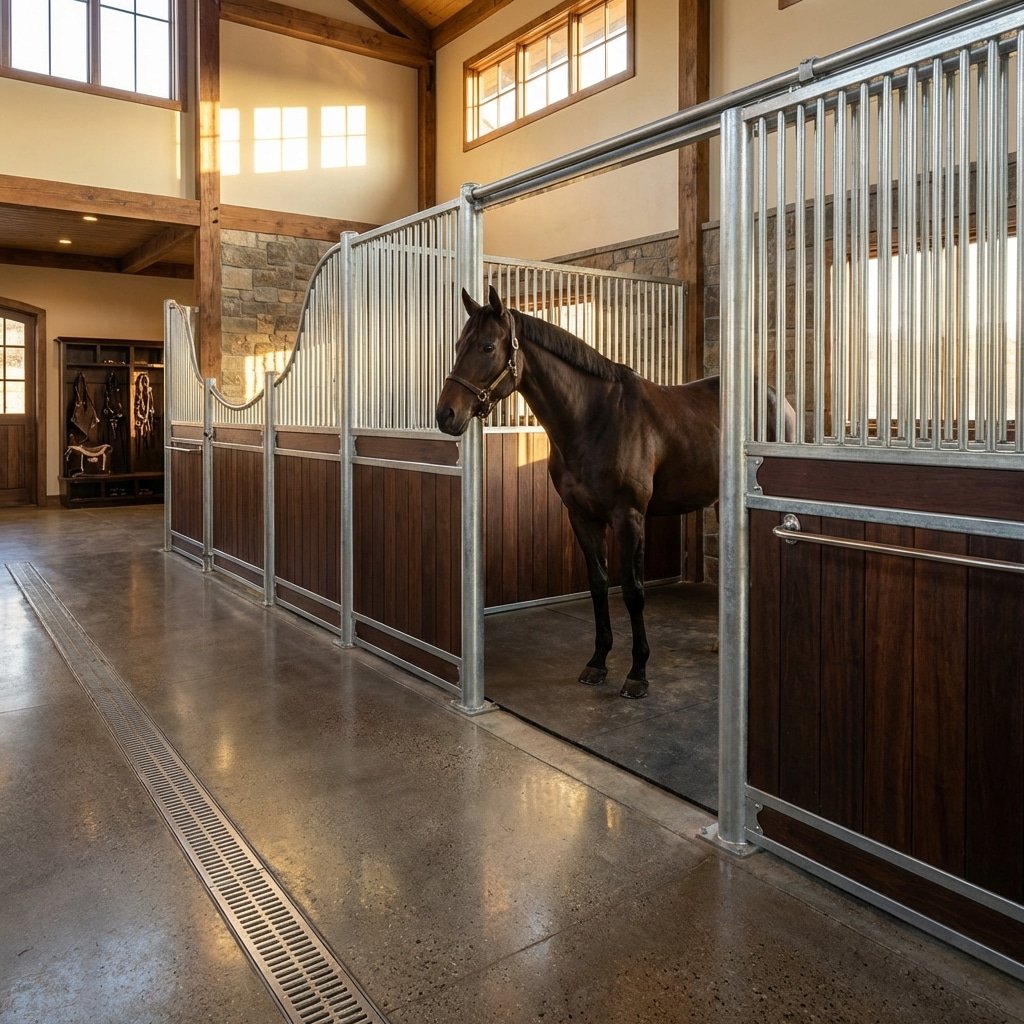
Half-mesh dividers significantly lower lateral air pressure resistance, allowing fresh air to sweep through the barn while protecting the bedding layer from direct drafts.
Reducing Air Resistance for Lateral Flow
Most ventilation issues in center-aisle barns stem from over-compartmentalization. Solid floor-to-ceiling partitions function as windbreaks, isolating each stall from the central airflow. Even if you have high-velocity fans in the aisle, the air cannot penetrate a solid wall. This creates a “dead zone” inside the stall where heat and ammonia accumulate, regardless of how fast the air moves in the walkway.
Half-mesh dividers solve this physics problem by lowering the pressure drop between stalls. By replacing the upper half of the partition with a grill, we create a permeable path for air to travel horizontally. Fresh air enters from the aisle, passes through the partition, and exits via exterior windows or eaves. This lateral movement supports the stack effect by ensuring the entire barn volume contributes to the updraft, rather than just the aisle space.
The DB Hybrid Profile: Galvanized Grills and HDPE Kick-Walls
We engineer our dividers to withstand both physical abuse and corrosive environments. A common failure point in competitor products is the use of pre-galvanized, thin-gauge steel that rusts at the weld points within a year. Our specification strictly prohibits tubing thinner than 2.0mm to ensure structural rigidity against leaning horses.
- Steel Framework: We use 14-gauge (2.0mm) tubular steel for the ventilation zone. This provides the strength to resist cribbing and impact while maintaining open airflow.
- Corrosion Protection: Every panel undergoes hot-dip galvanization after fabrication. We achieve a zinc coating average of >70 microns on tubing, which seals all weld points against the humid, ammonia-rich atmosphere of a stable.
- Kick-Proof Lower Infill: The bottom section utilizes 28mm-32mm solid HDPE (High-Density Polyethylene). This material blocks cold drafts at the bedding level to protect lying horses and absorbs kick impact without splintering or rotting like traditional softwood.
الأسئلة المتداولة
How does the ‘stack effect’ improve air quality in horse stables?
The stack effect is a passive ventilation cycle driven by thermal buoyancy. As horses generate body heat, the surrounding air warms and rises toward the ceiling. If the barn has proper ridge vents (exhaust) and lower eave openings (intake), this rising warm air escapes the top, naturally drawing fresh, cooler air in from the bottom. This continuous cycle flushes out ammonia and airborne pathogens without requiring mechanical fans.
Why are open grill stall fronts better for ventilation than solid walls?
Solid walls act as barriers that block airflow, creating stagnant pockets where dust and ammonia accumulate. Open grillwork allows fresh air to move freely between stalls, ensuring that the draft created by the stack effect reaches every horse. This design promotes cross-ventilation, preventing the “dead air” zones common in stables with solid partitions.
Do I need mechanical fans if I have a naturally ventilated barn?
In a well-designed facility, natural wind and the stack effect handle most air exchange needs. However, mechanical fans are useful supplements during extreme heat or in barns with low ceilings where thermal buoyancy is weak. Large circulation fans can reduce heat stress, while exhaust fans help remove moisture if roof venting is insufficient.
What is the biggest mistake regarding stable ventilation in winter?
The most common error is sealing the barn completely to retain heat. While this keeps the temperature up, it traps moisture, mold spores, and ammonia, which are far more damaging to equine respiratory health than cold air. A proper system maintains permanent, draft-free openings at the eaves and ridge to allow moisture to escape year-round.
How does the DB Stable panel design support the stack effect?
Our panels are engineered to maximize vertical airflow. The “Professional” and “Economy” series feature extensive top grillwork to allow rising warm air to pass through partitions easily. Additionally, our calculated bottom gaps (approx. 50mm) allow cool air intake at the floor level while maintaining a “Cast-Proof” safety standard, feeding the natural updraft required for a healthy barn.
الأفكار النهائية
Ignoring the physics of the ‘stack effect’ costs your clients in veterinary bills and damages your reputation when inferior steel creates rust claims. While solid partition walls offer a lower initial price point, only our Hot-Dip Galvanized After Fabrication (ISO 1461) open-mesh designs actively purge ammonia from the equine breathing zone. Stocking a ventilation-focused product line positions you as a solution provider for respiratory health, rather than just a commodity hardware supplier.
Do not rely on digital spec sheets to gauge structural integrity against ammonia corrosion. We invite qualified distributors to secure a Trial Order (LCL) of our Economy or Professional Series to verify our weld strength and flat-pack logistics efficiency firsthand. Contact our engineering team today to review your market’s specific airflow requirements and secure your production slot.


 Arabic
  English
  Spanish
  French
  German
0 تعليق