


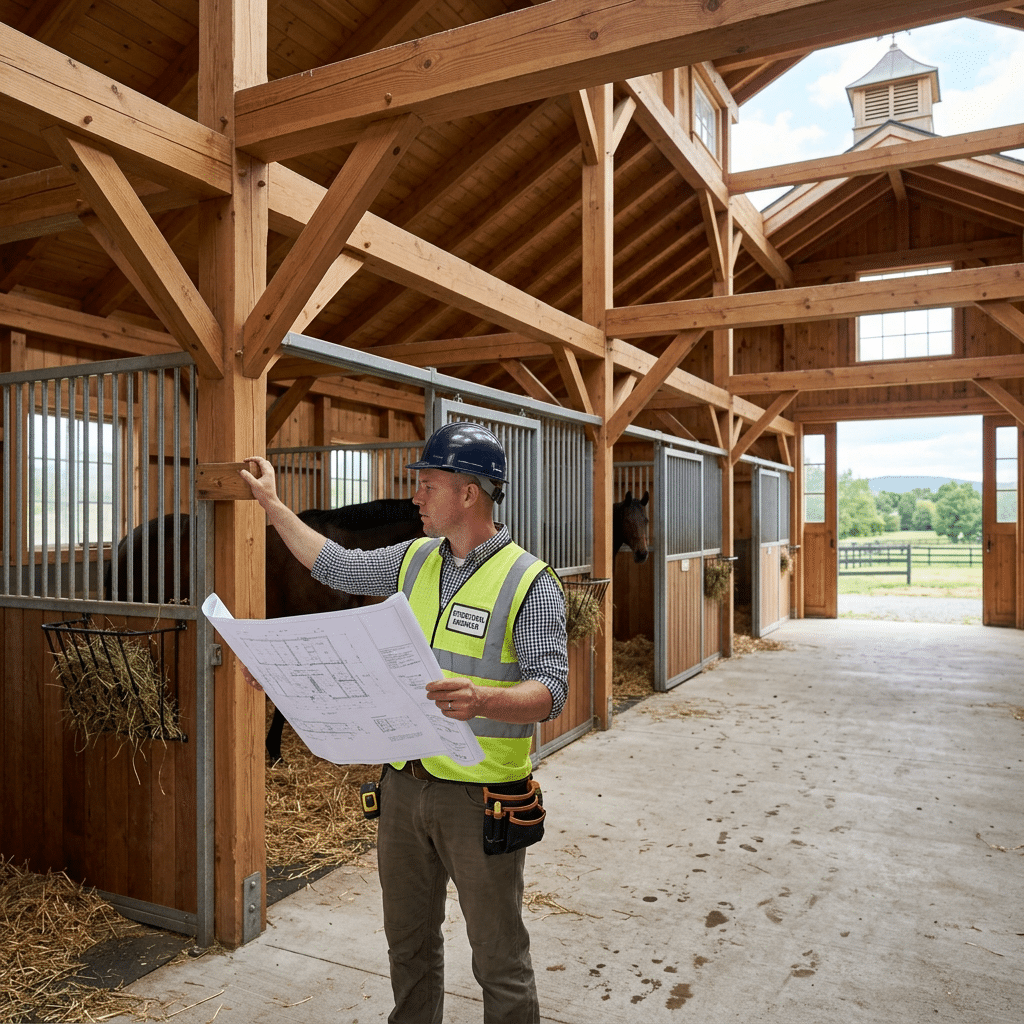
Selecting the right Fastener Types defines the difference between a lifetime installation and a high-liability failure. While standard lag screws reduce initial labor costs, they rely on wood friction that inevitably degrades when subjected to the kinetic energy of a 1,200lb animal. This structural vulnerability leads to loosened flanges, misaligned doors, and safety hazards that generate costly warranty claims for contractors.
This technical analysis benchmarks the shear strength of timber screws against industrial through-bolting methods. We examine why pairing pre-drilled Q235B steel flanges with 304 Stainless Steel hardware creates a mechanical clamp that survives the high-ammonia environment and heavy impact forces inherent to professional equine facilities.
The Pull-Out Strength of Standard Wood Lag Screws
Retention capacity relies on wood density and screw diameter. A 5/16″ screw holds 205–307 lbs/inch, but dynamic stable loads demand higher-grade stainless steel hardware.
Calculating Withdrawal Capacity and Wood Density
Screw retention isn’t guesswork; it is physics defined by the density of the substrate, known as Specific Gravity (SG
). Softwoods like Canadian Spruce (SG 0.45) offer significantly less grip than hardwoods, which directly impacts the safety of a stall installation. We calculate the allowable withdrawal load using the standard formula F = 2850 × SG² × D, where specific gravity is squared and multiplied by the screw diameter.
- Standard Performance: A typical 5/16″ lag screw yields 205–307 lbs of holding power per inch of embedment, depending on the wood species.
- Diameter Risks: While increasing diameter improves shear capacity, it creates a new risk. Larger screws exert more outward pressure on the wood fibers, which can split the timber if edge distances are insufficient.
Material Specs: Carbon Steel vs. 304 Stainless Steel
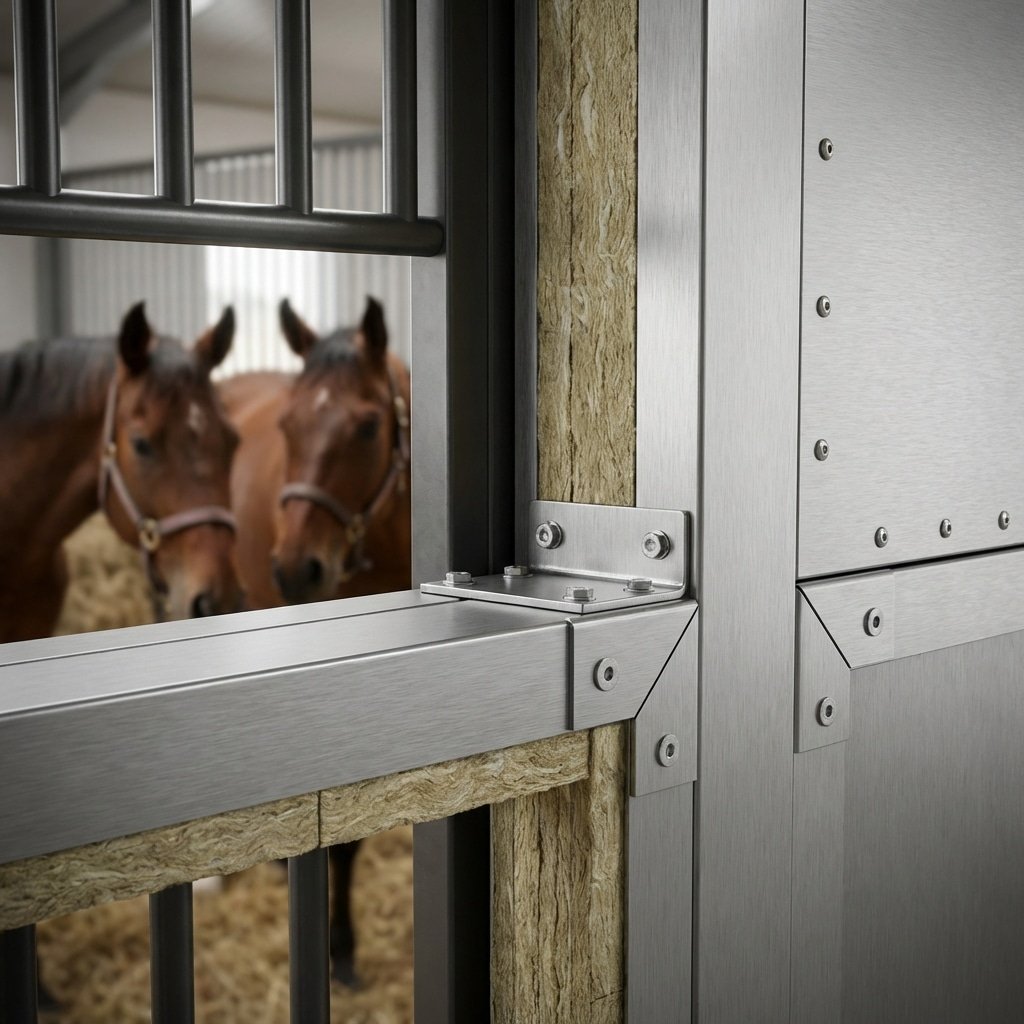
Most general hardware kits supply standard carbon steel lag screws. While acceptable for residential decks, carbon steel lacks the tensile strength and corrosion resistance required for equine facilities. DB Stable mandates فولاذ مقاوم للصدأ 304 hardware for all connection points to match the lifespan of our hot-dip galvanized structures.
- Tensile Strength Gap: Standard carbon steel lag screws generally rate at 60,000 psi. Our 304 Stainless Steel hardware reaches 100,000 psi, providing nearly double the failure resistance against kicking or cribbing forces.
- Ammonia Resistance: Stables are ammonia-rich environments due to urine. Carbon steel corrodes rapidly here. Stainless steel is essential for preventing rust-induced fastener failure.
- System Integrity: We pair these stainless fasteners with our hot-dip galvanized structural steel to ensure total system longevity, preventing the hardware from becoming the weak link in a “lifetime” product.
Why Heavy Sliding Doors Loosen Screws Over Time
Dynamic kinetic energy combined with massive static weight creates micro-movements that degrade threaded connections in wood, leading to inevitable fastener failure in standard setups.
Vibration Amplification from Daily Operation
The primary enemy of a secure stall door is kinetic energy. When a handler slides a heavy door open or closed, they generate significant momentum. Bringing that mass to a stop transfers immediate shock loads through the track, into the brackets, and finally into the fasteners. In a standard wood-framed barn, this energy dissipates by slightly compressing the wood fibers surrounding the screw threads.
- Dynamic Load Stress: The rapid acceleration and deceleration of the door create shear forces that standard lag screws are not designed to handle repeatedly.
- Micro-Movements: Imperceptible vibrations from rolling hardware slowly rotate screws backward, backing them out of the substrate over months of use.
- Impact Factors: External forces, such as a 1,200lb horse kicking the door or leaning against the grill, add sudden, high-force impact loads that strip soft wood grain instantly.
The “Dead Load” Impact of High-Density Bamboo and Steel
Standard pine doors are relatively light, but professional-grade equipment carries significant mass. DB Stable systems prioritize durability, using materials that drastically increase the “dead load”—the constant static weight pulling down on the installation hardware.
- System Mass: A complete DB Stable flat-pack door set weighs between 250kg and 450kg depending on the model. This is nearly double the weight of light-gauge competitors.
- Infill Density: We use High-Density Bamboo (Janka Hardness > 3000 lbf) or solid HDPE planks. These materials provide kick-proof resilience but add substantial weight compared to softwood infills.
- Thread Fatigue: Standard lag screws cannot sustain this combined static and dynamic load. The constant downward pull eventually crushes the wood fibers inside the pilot hole, causing the screw to lose grip even without rotation.
Premium Horse Stables Built for Extreme Climates

The Industrial Method: Through-Bolting with Washers
Unlike lag screws that rely on thread friction, through-bolting creates a mechanical sandwich, distributing impact loads and preventing loosening in high-vibration stable environments.
In the commercial stable industry, the difference between a 5-year stall and a 20-year stall often comes down to the fastening method. Many competitors use lag screws because they are cheaper and faster to install. However, lag screws rely entirely on the threads biting into the material (wood or plastic) to hold tension. In a dynamic environment where 1,200 lb animals kick, lean, and rub against the walls, these threads eventually crush the surrounding material, leading to “wallowed out” holes and loose boards.
We reject this method for professional applications. Through-bolting involves passing a bolt entirely through the steel profile and the infill material, securing it with a nut and washers on the opposite side. This relies on the shear strength of the steel bolt rather than the holding power of the infill material.
| مقياس الأداء | Standard Lag Screw | Industrial Through-Bolt |
|---|---|---|
| Mechanics | Relies on thread friction within material | Creates compression “sandwich” |
| Vibration Resistance | Loosens as threads crush material | Maintains tension via lock nuts |
| Impact Failure Mode | Stripping or Pull-out | Extreme Shear Strength (Bolt limit) |
| الصيانة | Requires re-drilling new holes | Simple re-tightening |
Engineering Load Distribution and Joint Safety
The primary engineering advantage of through-bolting is the protection of the infill material. When you tighten a standard screw directly into Bamboo or HDPE, the head applies point-load pressure that can crack or deform the surface. We utilize a specific washer configuration to mitigate this risk.
- Prevents Material Embedment: Washers significantly increase the surface area of the fastener. This prevents the bolt head from crushing softer infill materials like our HDPE or Bamboo planks during the tightening process.
- Vibration Resistance: Stables are high-vibration zon
es. When a horse kicks a wall, the impact energy travels through the board to the fastener. Washers maintain constant tension and protect the hole edges from ovalizing or deforming under repetitive stress.
- The ‘Sandwich’ Effect: By placing washers under both the bolt head and the nut, we create a clamping force that is evenly applied. This reduces stress concentrations that typically lead to cracks around the fastening points, ensuring the infill remains secure without being compromised.
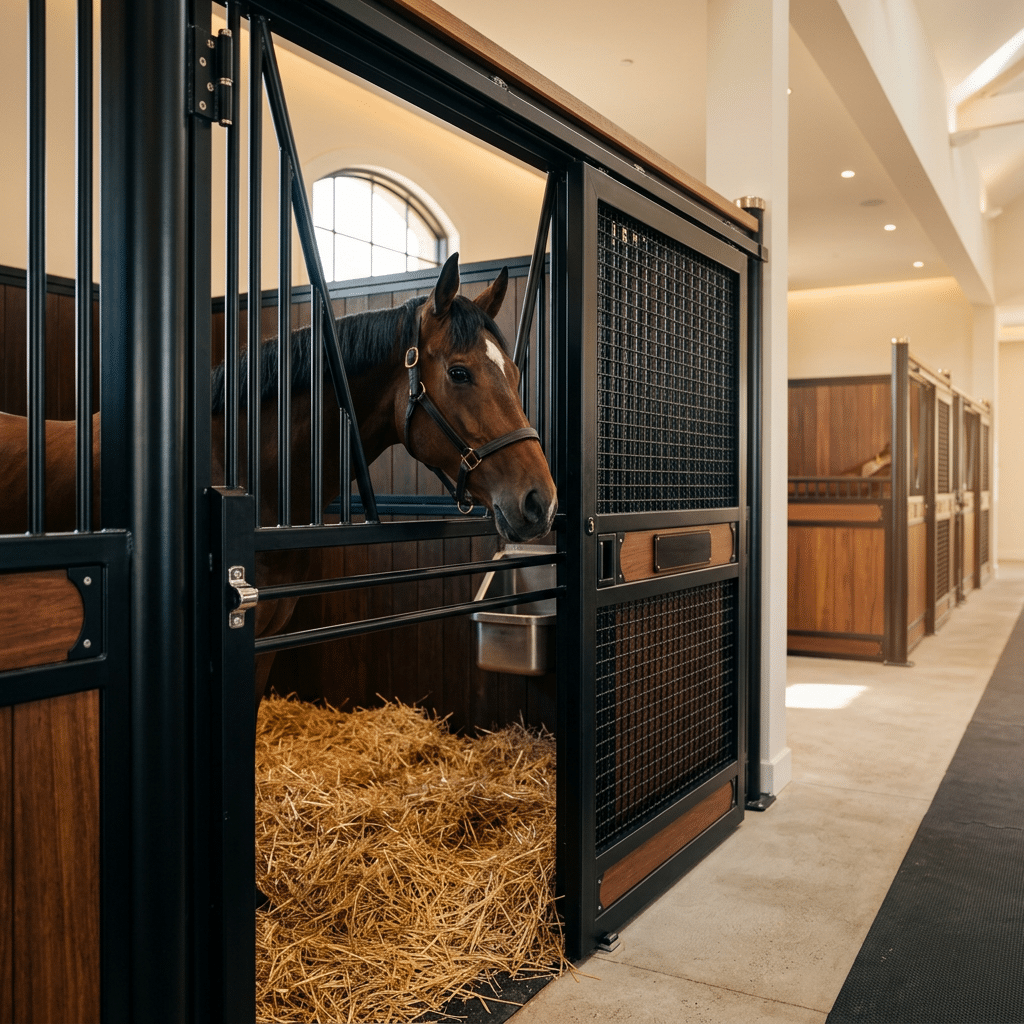
The 304 Stainless Steel Hardware Standard
A robust mechanical design fails if the materials corrode. Stables are chemically aggressive environments due to the presence of ammonia in urine and high moisture levels. Standard zinc-plated or black oxide hardware will rust within months, eventually seizing or snapping.
We standardize on 304 Stainless Steel for all installation kits to ensure the hardware matches the lifespan of our hot-dip galvanized frames.
- مقاومة التآكل: 304 Stainless Steel provides excellent resistance against the ammonia and humidity found in active barns, preventing the rust streaks that plague cheaper systems.
- Compatibility with Galvanized Steel: We engineer our systems to avoid galvanic corrosion. Stainless steel is compatible with our hot-dip galvanized frames (ISO 1461), ensuring that the contact point between the bolt and the frame does not degrade over time.
- السلامة الهيكلية: Using high-grade stainless steel ensures that the shear strength of the fasteners remains constant over decades. This aligns with our “Lifetime Standard,” guaranteeing that the bolts will not weaken or shear off unexpectedly after years of service.
DB’s Pre-Drilled Flanges for Maximum Securement
We laser-cut and pre-drill every connection point before galvanization, ensuring 100% zinc coverage inside the bolt holes and eliminating the structural weakness of field-drilled alignment.
Precision Alignment for Structural Through-Bolting
Most budget stable manufacturers ship blank frames, forcing contractors to drill holes on-site. This “field-fit” approach relies on manual accuracy, which often leads to misaligned panels and stripped screws. We eliminate this variable by laser-cutting connector plates and flanges during the fabrication stage.
Because our flanges align perfectly, installers can use heavy-duty through-bolts rather than relying on surface-mounted lag screws. A lag screw depends entirely on the material’s thread “bite” to hold tension, which weakens over time due to door vibration and hoof impact. A through-bolt, secured with a nut and washer on the opposing side, creates a mechanical clamp that remains secure under dynamic load.
This precision ensures a truly modular assembly. Panels fit together without the need for ratchets or crowbars to force frames into alignment, preserving the structural integrity of the Q235B or Q345B steel framework منذ اليوم الأول.
The “Drill-Before-Dip” Protocol for Rust Immunity
The single most common cause of stable rust is drilling after galvanization. When a contractor or factory drills a hole into a pre-galvanized tube, they expose raw steel to the atmosphere. Even with cold spray treatments, the inner bore of that hole remains vulnerable, eventually bleeding rust streaks down the front of the panel.
DB Stable adheres to a strict “Hot-Dip After Fabrication” process. We complete all cutting, punching, and drilling on the black steel frames first. Only then do we submerge the entire unit into the zinc bath. This sequence is critical for long-term durability:
- Internal Coating: Molten zinc flows through the pre-drilled holes, coating the inner bore surfaces.
- ISO 1461 Compliance: The bolt holes receive the same >70 micron zinc protection as the exterior frame.
- الحماية الكاثودية: The zinc layer creates a metallurgical bond with the steel, preventing rust creep even if the bolt torque scratches the surface.
الأفكار النهائية
Relying on friction-based lag screws in a high-impact equine environment is a liability that inevitably leads to structural failure and costly warranty claims. DB Stable enforces a strict standard of through-bolting with 304 Stainless Steel to match the decades-long lifespan of our hot-dip galvanized frames. This engineering choice safeguards your facility against rust and mechanical fatigue, ensuring your reputation for quality remains intact.
Do not compromise your structural integrity with residential-grade fasteners. Request our technical specification sheet or a sample hardware kit to verify the shear strength and corrosion resistance of our system firsthand. Contact our engineering team today to secure your inventory with the industry’s most durable connection standards.

 Arabic
  English
  Spanish
  French
  German
0 تعليق