


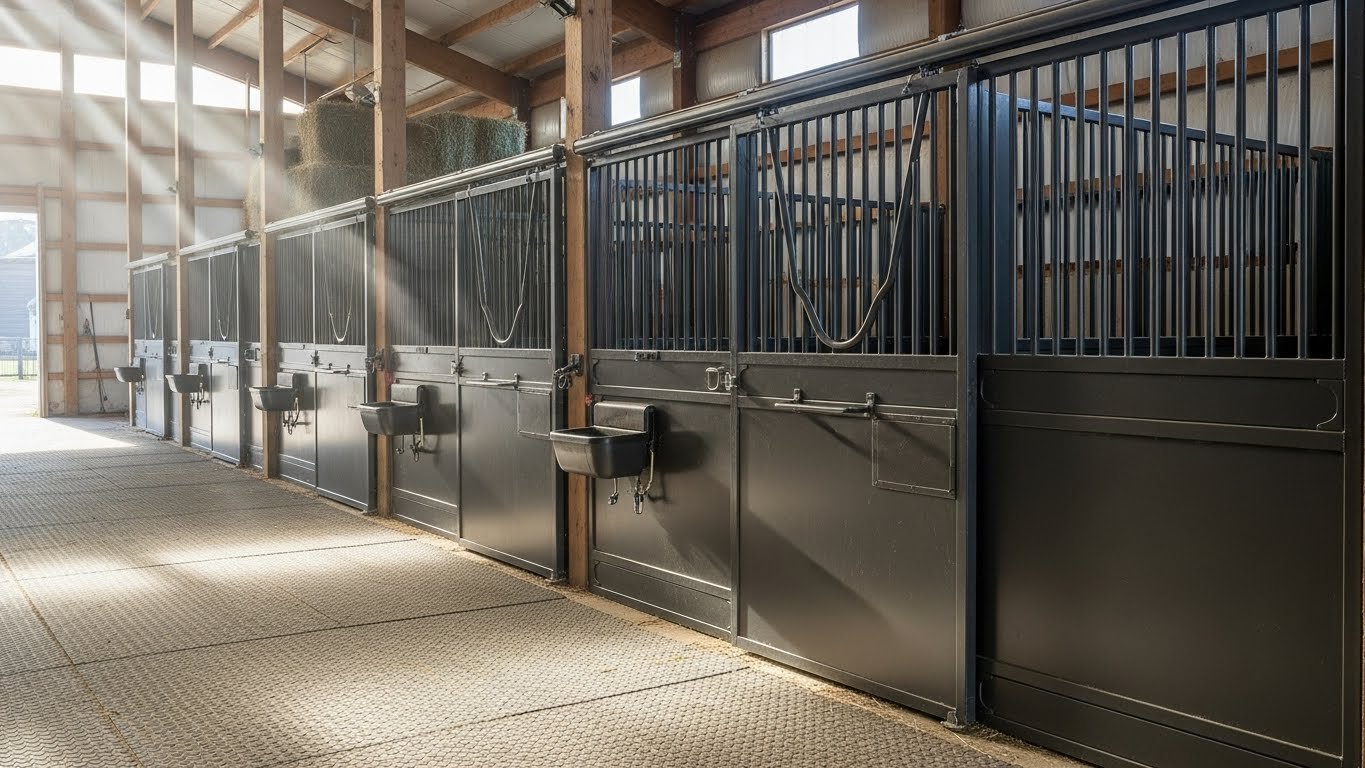
When you design or purchase horse stalls, the steel gauge you select directly impacts safety and durability. Overlooking this detail can lead to serious risks for horses and significant repair costs for your facility. What seems like a minor difference in material thickness can be the barrier between a secure enclosure and a dangerous structural failure.
This article explains why 14-gauge steel is the critical minimum for ensuring safety in horse stalls. We look at why thinner materials, like 16-gauge tubing with its nominal wall thickness of 0.065″ (1.65mm), simply don’t stand up to the القوات involved. You’ll understand how factors like a horse’s kick, which can reach up to 7 feet high, demand specific material strength to prevent injury and ensure your investment lasts.

فهم مقياس الفولاذ (الرقم الأقل # = أكثر سمكًا)
The steel gauge system, established to categorize sheet metal by weight and thickness, operates inversely: a lower gauge number indicates a thicker, heavier, and generally stronger material. This crucial principle guides material specifications, ensuring appropriate strength for structural applications like horse stalls.
The Inverse Principle of Steel Gauge
The common ‘Manufacturer’s Standard Gage for Sheet Steel’ originates from steel weighing 41.82 lb/ft² per inch of thickness.
A lower gauge number consistently means a greater thickness and weight per square foot of steel.
This system ensures that 10 gauge steel is significantly thicker and more substantial than 16 gauge steel.
Commercial steel sheet gauges typically range from approximately 7 ga (≈4.5 mm) to 30 ga (≈0.30 mm).
Specific Thicknesses and Material Variations
Common carbon steel examples include 10 ga (3.429 mm), 12 ga (2.677 mm), 14 ga (1.905 mm), and 16 ga (1.524 mm).
While gauge numbers are shared, actual thicknesses vary slightly across steel types; for example, 16 ga standard steel is 1.52 mm, galvanized is 1.61 mm, and stainless is 1.59 mm.
The U.S. ‘Standard gauge for sheet and plate iron and steel’ is legally codified in 15 U.S. Code § 206, providing precise nominal thickness values.
Understanding these precise measurements, not just the gauge number, is critical for impact resistance and structural integrity.

خطر الأنابيب ذات القطر 1.5 مم (16ga)
1.5mm (16ga) steel tubing, with a nominal wall thickness of 0.065″ (1.65mm) and significant manufacturing tolerances, is generally too thin for robust equine structures. Its inherent lack of strength and susceptibility to deformation under impact or compression make it a safety concern, falling short of the thicker gauges recommended for durable structural applications.
| الخاصية | Value/Range | Standard/Notes |
|---|---|---|
| 16ga Nominal Wall Thickness | 0.065 بوصة (1.65 مم) | ASTM A513 tolerances: min 0.049″-0.058″, max 0.056″-0.072″ |
| ASTM A513 Round Tubing Tolerances (OD) | 0.75″-1.125″ ±0.0035″; over 1.125″-2.0″ ±0.005″; over 2.0″-2.5″ ±0.006″ | For 16ga |
| ASTM A513 Rectangular/Square Tolerances (OD) | over 1.5″-2.0″ inc. 16ga-7ga ±0.008″; over 2″-3″ inc. 16ga-7ga ±0.010″ | For 16ga-7ga |
| 16ga Stainless (304/316) | ~0.0625″ (1.59mm) wall; Tensile 515 MPa min | Yield 205/170 MPa min; Elongation 40% min (ASTM A269/A312) |
| Relevant Structural Standards | ASTM A513, A500, A554, A653 | Carbon/Alloy Mechanical, Cold-Formed Structural, Welded Stainless Mechanical, Galvanized Structural |
Inherent Weaknesses of 1.5mm (16ga) Tubing
Nominal wall thickness for 16ga is 0.065″ (1.65mm), with ASTM A513 tolerances allowing variations from 0.049″ to 0.072″.
Primarily categorized under ASTM A513 for electric resistance welded (ERW) carbon steel mechanical applications.
Its thinness significantly reduces moment of inertia and yield strength, making it prone to buckling and deformation.
Considered a lightweight option, 16ga tubing requires reinforcement to prevent failure in load-bearing scenarios.
Structural Limitations and Equine Safety Risks
Manufacturing tolerances can widen, with OD variations up to ±0.010″ for larger profiles (e.g., 2″-3″), further weakening the structure.
Even stainless variants (like 304/316 per ASTM A269/A312) with 515 MPa tensile strength are inadequate for high-impact applications due to thin walls (0.0625″).
Industry standards generally recommend thicker gauges (14ga-7ga) for structural shapes over 1.5″ to meet mechanical demands.
There is a lack of specific PSI ratings or equine-specific load data, but the 10-20% wall variation implied by tolerances poses a significant risk for animal safety.
Research Summary:
1.5mm (≈16ga, 0.059″-0.065″ nominal) steel tubing falls under ASTM A513 for electric resistance welded (ERW) carbon steel mechanical applications, with tight wall thickness tolerances (e.g., min 0.058″ for certain sizes) to ensure structural integrity in load-bearing uses like horse stalls; deviations risk buckling under impact or compression, as thinner walls reduce moment of inertia and yield strength[1][6]. For rectangular/square profiles common in stalls, ASTM A500 and A554 apply, specifying cold-formed welded carbon or stainless tubing up to 16″ dimensions with min walls from 0.095″, positioning 16ga as a lightweight option prone to deformation without reinforcement—e.g., OD tolerances widen to ±0.010″ over 2″-3″, amplifying failure in dynamic animal environments.
Stainless variants (304/316 per ASTM A269/A312) offer corrosion resistance with 515 MPa tensile min but similar thin walls (0.0625″), inadequate for high-impact per MIL/AMS specs emphasizing Rockwell 90B max hardness and low-stress use to 1200°F; galvanized A653 16ga tubing suits outdoor stalls but lacks explicit min thickness for سلامة الخيول, implying vulnerability to kicks (yield drops under localized PSI). No direct “danger” failure rates found, but standards prioritize thicker gauges (14ga-7ga) for shapes over 1.5″ to meet mechanical tubing demands in structural/ornamental apps.
Physics gap: No PSI ratings or equine-specific load data; infer 16ga risks from tolerances indicating ~10-20% wall variation, critical for risk-averse safety officers per ASTM structural tubing hierarchies.

لماذا نستخدم 3.0 مم+ للإطارات
Utilizing 3.0mm+ (equivalent to 12-gauge or heavier) steel for horse stall frames significantly enhances structural integrity, impact resistance, and overall safety. This thicker material provides superior section modulus, buckling resistance, and dent protection compared to the lighter 14-gauge options, ensuring frames withstand equine forces and corrosive environments for decades.
Beyond Minimums: Structural Integrity for Equine Safety
Frame members in the 2.5-3.0 mm wall thickness class (12-13 gauge) are selected for areas with highest structural demand and safety margins in 2026.
Increased section modulus and buckling resistance are crucial for withstanding compression, bending, and impact scenarios from horses.
Materially increases resistance to denting, bar spreading, and frame racking, preventing dangerous deformations under equine impact.
Ensures long-term coating integrity, maintaining corrosion protection over decades in corrosive barn environments, vital for الجلفنة بالغمس الساخن.
Engineering for Extreme Loads: Industry Benchmarks
Triton Barns utilize 12-gauge steel (approx. 2.7 mm) for high-load channels and connection plates, with 3/16 inch (approx. 4.75 mm) plate for critical load transfer points.
14-gauge steel (approx. 2.1 mm) is widely considered the absolute minimum acceptable frame thickness by reputable stall system manufacturers.
12-gauge tubing (approx. 2.74 mm) is recommended for larger spans (e.g., 32-40 feet) and structures facing high wind or snow loads.
Compliance with rigorous standards such as ASTM A36 for structural plate, ASTM A513 for tubing strength, and ASTM A123 for الجلفنة بالغمس الساخن, ensures material quality for heavy-duty applications.
Durable Horse Stables, Custom-Engineered for Your World

فيزياء تأثير الركلة
A horse kick is a high-energy, localized impact that can reach 7 feet high. Stall designs in 2026 account for this by using robust materials like 12-14 gauge steel and specific structural features to prevent injury and ensure durability.
| Feature/Component | Specification/Material | Engineering Rationale/Benefit |
|---|---|---|
| Horse Kick Height | حتى 7 أقدام (2.1 متر) | Establishes critical vertical impact zone for all stall components. |
| ركوب الخيل التقسيم Height | Minimum 7.5 ft (standard 8 ft) | Ensures containment of kicks and prevents legs from going over walls. |
| Primary Structural Steel | 12–14 gauge (2.1–2.6 mm wall thickness) | Provides impact resistance and energy absorption for frames and grillwork. |
| Structural Joints | Fully welded | Eliminates stress concentrations from bolted connections, enhancing impact durability. |
| Grille Bar Configuration | 1 inch tubing on 4 inch centers (2–3 inch clear gaps) | Minimizes bending span, increases resistance to deformation, and prevents hoof entrapment. |
| Critical Hardware (Latches, Hinges) | فولاذ مقاوم للصدأ 304 | Prevents brittle failure, corrosion, and maintains integrity under secondary impacts. |
| Safety Profile | Rounded, smooth steel sections | Reduces risk of injury to horses. |

Understanding Localized Impact Forces
A horse kick is primarily a high, localized impact, distinct from a uniform load across a surface.
Kicks can reach up to 7 feet (2.1 meters) above ground level, defining the critical impact zone for stall partitions and doors.
معايير التصميم for 2026 specify stall partitions at least 7.5 feet high, with 8 feet as the typical standard height, to contain kicks and legs.
Material and Design Strategies for Resistance
High-quality commercial stall systems in 2026 commonly use 12–14 gauge steel (approximately 2.1–2.6 mm wall thickness) for structural components like واجهات الأكشاك and grillwork.
Fully welded joints are crucial to avoid stress concentrations common in bolted connections during high-impact events.
Small bar spacing, such as 1 inch tubing on 4 inch centers (resulting in 2–3 inch clear gaps), reduces bending span per bar and prevents hoof entrapment.
Safety-oriented designs incorporate rounded, smooth steel sections and 304 stainless steel for latches and critical hardware to ensure long-term integrity and prevent injury.
الأفكار النهائية
للخيول stall safety, 16 gauge steel tubing is simply too thin, creating significant risks. 14 gauge steel forms the absolute minimum requirement, offering enough strength to resist typical equine impacts. Moving to 12 gauge steel for primary frames and components delivers even greater protection and durability.
Choosing the right steel gauge goes beyond just a number; it directly impacts horse safety and facility reliability. Properly specified materials, especially 14 gauge or heavier, protect against the force of a kick and maintain structural integrity over time. This careful selection ensures a safer space for horses and provides lasting value for barn owners.
الأسئلة المتداولة
ما هو أفضل قياس للفولاذ المستخدم في صناديق الخيول؟
For permanent horse stalls, 12–14 gauge steel is the accepted heavy-duty range, with many premium systems using 12 gauge for main frames and 14–16 gauge for grill bars or secondary members. Portable or light-duty stall systems commonly use 14–16 gauge steel tubing.
ما هو السماكة المثالية لقضبان الحظيرة؟
Horse stall bars (grill bars) should be 16-gauge to 14-gauge steel with diameters of 7/8 inch to 1 inch, as these are the standard specifications from leading manufacturers for strength and safety in equine environments.
هل يمكن للحصان أن يركل حظيرة فولاذية؟
A horse can break wood stall boards but cannot realistically kick through a properly designed steel-framed stall with 12–16 gauge steel members and 2-inch lumber infill built to common industry specifications. Standard practice is to design partitions to withstand kicks up to about 7 ft (2.1 m) high.
هل المقياس 14 أقوى من المقياس 16؟
Yes. For sheet steel, 14 gauge is thicker and therefore stronger and more impact- and bend-resistant than 16 gauge. 14 gauge has roughly 25%–30% more thickness and section than 16 gauge, which directly increases stiffness and load capacity in stall اللوحات.
What is the standard steel thickness for barns?
For modern steel barns, the de facto industry standard is 29-gauge wall/roof اللوحات (~0.017 in / 0.43 mm thick) on light-duty/post-frame buildings, with 26-gauge (~0.022 in / 0.55 mm) specified where higher impact, wind, or snow loads are a concern. Structural frames are typically 12–14 gauge (~0.097–0.068 in / 2.5–1.7 mm) tube or cold-formed members.
لماذا يعتبر الفولاذ الثقيل مهمًا؟
Heavy gauge steel is important because lower-gauge (thicker) sheet—typically around 10–14 gauge, and specifically ~12 gauge ≈ 0.105 in (2.66 mm)—provides significantly higher load-bearing capacity, impact resistance, and resistance to deformation, which are critical to preventing stall wall failure, kick-through, and panel buckling under animal impact and building loads. Thicker steel also improves durability against wear, corrosion, and الطقس القاسي.

 Arabic
  English
  Spanish
  French
  German
0 تعليق