horse stable buying mistakes is the first checkpoint buyers should lock before they approve a supplier, budget, or production slot. You ask the supplier: ‘Why did the pre-production sample look perfect, but the full shipment of 20 stalls has door panels that are visibly thinner?’ The answer reveals a classic horse stable buying mistake: the supplier swapped steel gauges to keep FOB pricing competitive. The sample approval you signed off on means nothing now.
That $50,000 order is a real scenario many buyers face. The gap between sample approval and mass production quality tolerance is where the real horse stable buying mistakes happen. Understanding that gap — and how to close it — is what separates a smooth project from a costly retrofit.
Accepting ‘Galvanized’ Without Checking the Type
70% of rust complaints trace back to pre-galvanized steel — not the supplier’s fault, yours.
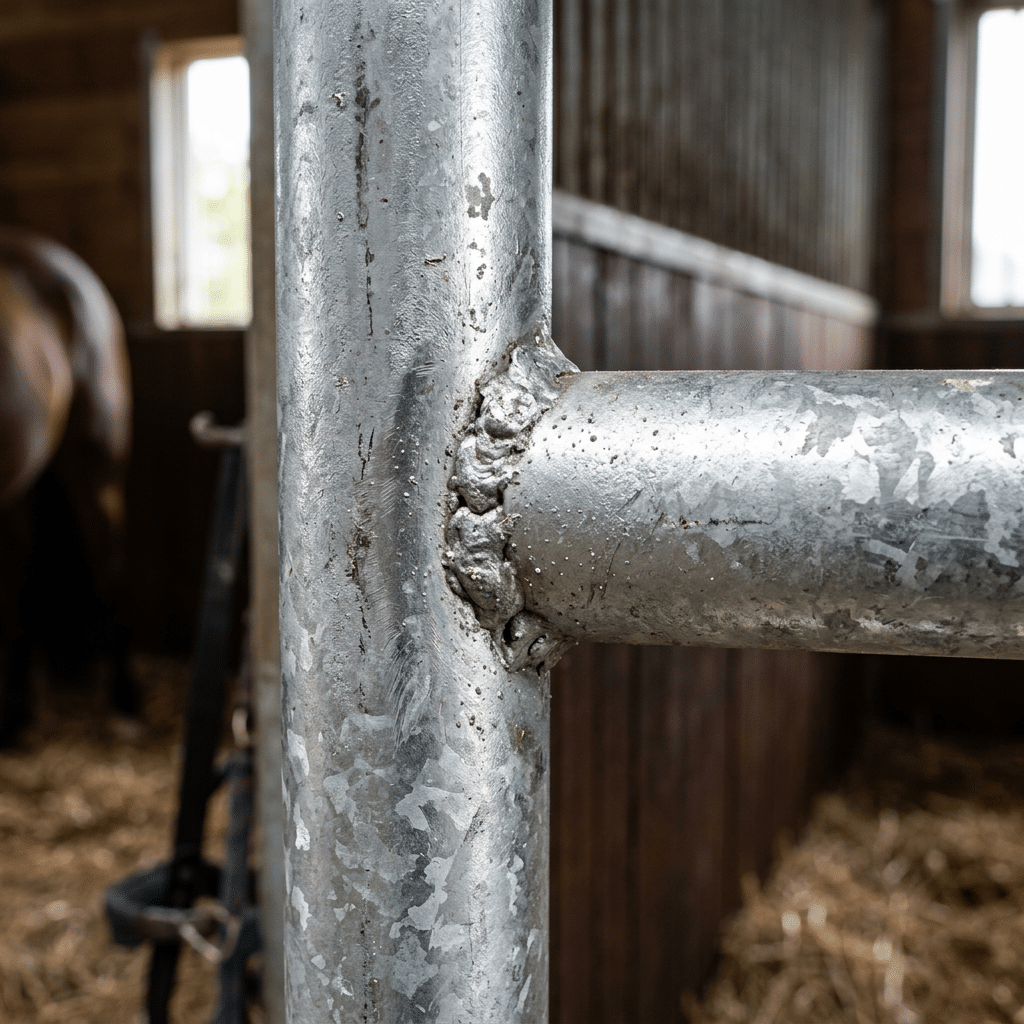
A buyer in Queensland signed off on a 50-stall order labeled ‘galvanized.’ Eighteen months later, every weld joint bled orange. The supplier shrugged. The certificate said galvanized. What the buyer missed was the difference between pre-galvanized sheet metal and hot-dip galvanizing after fabrication. Pre-galvanized coils come with a zinc coating under 100 g/m² — fine for ductwork, useless for horse stalls that get pressure-washed weekly.
How to tell them apart without a lab
The magnet test works because hot-dip galvanizing deposits a thicker alloy layer — typically 42 microns minimum (600 g/m²) — which reduces magnetic attraction noticeably compared to bare steel or thin pre-galvanized sheet. A pocket magnet sticks firmly to pre-galvanized surfaces but slides off or feels weaker on properly hot-dipped material. Faster still: demand an XRF coating certificate from the mill batch record before you issue the PO.
What internal tracking reveals
DB Stable’s own complaint log shows over 70% of rust-related issues come from stables supplied by trading companies using pre-galvanized coil stock. Those suppliers cut and weld the panels, which burns away the thin zinc layer at every joint and cut edge. Hot-dip galvanizing happens after all cutting and welding are done, so every surface — including drilled holes and weld seams — gets full coverage. That single process difference separates a 20-year asset from a three-year replacement cycle.
الميزة
Pre-Galvanized
Hot-Dip Galvanized (Recommended)
Why It Matters
Coating Weight
<100 g/m² (approx. 7–14 microns)
≥600 g/m² (approx. 42 microns)
Thinner coating fails at cut edges; XRF test reveals true spec.
Rust Resistance
Rusts from inside out in <3 years in humid climates
Proven >20 years with no structural corrosion
<< tdstyle = “padding :12 px 15 px ;border :1 px solid# eoeoeo ;color:#333” >> Pre – galvanized leads to premature stall failure and safety hazards .< / td >
<< tr >
<< tdstyle = “padding :12 px 15 px ;border :1 px solid# eoeoeo ;color:#333” >> Lifespan in Outdoor Use< / td >
<< tdstyle = “padding :12 px 15 px ;border :1 px solid# eoeoeo ;color:#333” >>3 –5 years before visible rust ( joints and edges )< / td >
<< tdstyle = “padding :12 px 15 px ;border :1 px solid# eoeoeo ;color:#333” >>20 + years ( industry benchmark for commercial stables )< / td >
<< tdstyle = “padding :12 px 15 px ;border :1 px solid# eoeoeo ;color:#333” >> Long – term cost of replacement far exceeds upfront savings .< / td >
<< tr >
<< tdstyle = “padding :12 px 15 px ;border :1 px solid# eoeoeo ;color:#333” >> Suitability for Cutting / Welding< / td >
<< tdstyle = “padding :12 px 15 px ;border :1 px solid# eoeoeo ;color:#333” >> Zinc burns off at weld points , creating bare steel< / td >
<< tdstyle = “padding :12 px 15 px ;border :1 px solid# eoeoeo ;color:#333” >> After – fabrication dipping protects all cut / weld areas< / td >
<< tdstyle = “padding :12 px 15 px ;border :1 pxsolid# eoeoeo ;color:#333” >> Pre – galvanized panels become vulnerable at every joint ;
field repairs are weak .< / td >
<< tr >
<< t dstyle =” padding :12 p x 15 p x ;b order :1 p x s olid# e oe oe o ;c olor:#33
3″>Cost Impact on Bulk Order (10–20 units)
<< t dstyle =” padding :
Falling for the ‘Steel Gauge Scam’
A 0.5mm steel difference turns a 20-year stable into a 5-year repair bill.
إن steel gauge scam is the most common trap in equestrian building procurement. A supplier quotes a competitive price per stall, but the door panels are stamped from 1.2mm sheet instead of the required 2.0mm. Within the first year, horses leaning against the partition cause visible bowing. By year two, the door frames warp, hinges pull loose, and you’re submitting warranty claims for a product that was never designed to take the load.
This isn’t a corner-cutting problem limited to budget imports. It happens with suppliers who claim to be factories but are actually trading desks passing thin-gauge material as ‘heavy-duty’. The real cost shows up not in the initial invoice, but in the doubled warranty claims after year one, the replacement labor, and the downtime when a stall is out of service.
The minimum specs that separate a 20-year stable from a 5-year fix
Stall posts: Minimum 2.0mm thick Q235 or Q345B steel. Anything thinner flexes under the weight of a horse leaning or kicking during loading.
Kick panels: Minimum 1.5mm thick with full structural welds, not spot welds. Spot welds crack under repeated impact — a single hard kick can pop the panel loose.
Welding method: Full 360° automated welding (robotic) eliminates weak points. Hand-welded joints vary in penetration and leave gaps where moisture starts corrosion.
A genuine manufacturer like DB Stable runs CNC machinery and automated 360° welding in-house, with a monthly capacity exceeding 500 units. They use hot-dip galvanized steel — not the pre-galvanized sheet that rusts from the cut edges within three years. The coating thickness meets 42 microns (600 g/m²) minimum, which is the difference between a 20-year rust resistance and a constant maintenance cycle.
When comparing commercial horse stable suppliers across Europe and Australia, a thickness report and a coating certificate should be table stakes, not optional extras. Any supplier that hesitates to provide a digital caliper reading or an XRF coating test is giving you a reason to walk.
Ignoring Hidden Middlemen Markups
Trading desks mark up 30% before you ever see a quote.
You get a quote that looks competitive. The supplier has a polished website, responsive sales staff, and claims to be a factory. But the price is still 25–35% higher than what the actual manufacturer charges. That gap is the middleman’s margin. In the equestrian infrastructure supply chain, the person you’re negotiating with is often a trading desk, not a production team.
How the markups stack
A typical trading company in Anping sources from three or four different workshops. They add 15–20% for their sales margin, then a logistics agent adds another 10–15% for handling export documentation and freight coordination. By the time the quote lands on your desk, you’re paying 30% above the factory’s direct FOB price. That’s $150–$400 per stall on a 10–20 unit order, depending on the spec.
Direct communication skips two layers
When you work directly with a manufacturer like DB Stable, you eliminate the trading desk and the logistics middleman. The engineering team takes your spec, the production scheduler confirms the timeline, and the export coordinator handles the documentation. One chain of communication replaces three. The result is a cleaner quote, faster problem resolution, and no margin leakage.
Verify the production team, not the sales office
A real factory will show you the production floor. Ask for a live video tour of the CNC machining station, the 360° automated welding line, and the hot-dip galvanizing bath. Trading companies cannot do this because they don’t own the equipment. DB Stable, for example, has a stated monthly capacity of over 500 units across seven product categories. That kind of throughput requires real machinery, not a rented office with a sample rack.
During the tour, ask to see the material stock. A genuine manufacturer holds inventory of Q235 steel, zinc ingots for the galvanizing line, and bamboo or HDPE infill panels. A trading desk keeps nothing but a catalog. If the salesperson hesitates or redirects to a pre-recorded video, you’re talking to a middleman.
The difference between a 30% markup and direct factory pricing shows up in your project’s bottom line on delivery day. Verify who you’re paying before you issue the PO.
Under-Specifying Bamboo Infill Density for Stall Walls
Specify bamboo density above 700 kg/m³ or budget for panel replacement inside two years.
A facility manager near Manchester approved 24 stalls with bamboo infill panels based on a supplier sample that looked fine in dry warehouse light. Eighteen months later, black mold colonies appeared along six panel bottoms where moisture crept up from daily wash-down runoff against concrete stall bases.
Low-density bamboo under 650 kg/m³ behaves like an open-cell sponge once relative humidity stays above sixty percent longer than a few days running—exactly what happens inside occupied barns during English winters or New Zealand’s wet season. The porous fiber structure traps urine vapor and wash water alike; spore germination follows within weeks at certain thresholds.
The Density Threshold That Separates Furniture Board From Stall Panels
Stable-grade bamboo must register above 700 kg/m³ measured at twelve percent moisture content—that single number determines whether your paneling behaves like structural cladding or decorative shelving stock when exposed to ammonia-rich stable air day after day.
Carbonization Closes The Biological Loop
Overlooking Regional Compliance Documents
A missed ventilation grille can fail a BHS inspection on the first walkthrough.
Central stalls — those with no exterior walls on two or more sides — create a sealed box unless you deliberately engineer an air path. The natural cross-ventilation that happens through windows or wall gaps disappears. What remains is a stagnant pocket that traps ammonia, moisture, and airborne dust. Several European national standards now require measured air exchange rates in equine housing, and the UK’s BHS inspection checklist specifically flags stalls without open grille panels at the bottom or waist height as a non-compliant condition.
What the Standards Actually Require
EU Directive 98/58/EC mandates that all confined livestock housing must have adequate ventilation to prevent harm to the animals. That directive is interpreted differently in each member state. In Germany, the threshold is 50 cubic meters of air exchange per horse per hour during peak summer conditions. The BHS in the UK goes further — it requires that every stall, including central configurations, must have at least two open grille sections totaling no less than 0.15 square meters of unobstructed vent area. These are not recommendations. They are pass-fail criteria during facility certification.
The Grille Design That Passes Inspection
A grille section at kickboard height — roughly 300mm above the floor — paired with a second at waist height creates a natural convection loop. Cool air enters at the bottom, warm ammonia-laden air exits at the top. The bar spacing should be 50mm to 70mm center-to-center. Anything wider risks hoof entrapment. Anything narrower traps bedding dust and reduces airflow by up to 40%. DB Stable integrates these grille panels as a standard option in their central stall configurations, and the steel frame is hot-dip galvanized with a 42-micron coating, so the exposed grille bars do not rust in the high-humidity microclimate of a stall interior.
If your supplier does not offer a grille insert for central stalls as a standard line item, you are looking at a post-delivery fabrication cost of roughly $80 to $150 per stall to cut and fit one. That assumes the structural frame allows for it. Some pre-galvanized, thin-gauge stalls cannot be retrofitted without compromising the weld integrity of the kick panel. The benchmark for any procurement manager evaluating a supplier’s compliance documentation is simple: request the grille section drawing with the stall layout. If the drawing does not show a ventilation path through every interior stall, the design does not meet the BHS standard or EU Directive 98/58/EC.
Explore the Complete Horse Stable Standards Collection.
This page offers a comprehensive guide to equine facility design codes across USA, UK, Australia, and EU. Browse our range of certified stable products with transparent pricing and customization options to meet your project needs. Certified Quality | Competitive Pricing | Custom Designs.
This page offers a comprehensive guide to equine facility design codes across USA, UK, Australia, and EU. Browse our range of certified stable products with transparent pricing and customization options to meet your project needs. Certified Qualityالتسعير التنافسيCustom Designs.
Request a Digital Thickness & Coating Report Before PO
A written spec means nothing without a third-party coating report.
The two most expensive mistakes on the list — accepting pre-galvanized steel and falling for the gauge scam — share one root cause: the buyer trusted a verbal or written claim without independent verification. A supplier can say “hot-dip galvanized” and “2mm wall thickness” all day long. The container arrives with pre-galvanized sheet metal and 1.2mm posts. The only way to kill both risks simultaneously is to demand a digital thickness and coating report before you issue the purchase order.
What the Report Must Show
Ask for an XRF coating thickness certificate or a lab-issued report with a clear traceable batch number. The zinc coating on hot-dip galvanized steel must meet a minimum of 42 microns (600 g/m²) . Anything below that range is pre-galvanized material — the kind that rusts from the inside out within three years in a humid stable environment. For the steel gauge, the report should confirm that stall posts are at least 2mm thick Q235/Q345B steel and kick panels are 1.5mm minimum with full structural welds, not spot welds. These numbers are the baseline for a facility that lasts 20 years.
Why Digital Reports Beat Verbal Promises
A real manufacturer — one with CNC machinery and automated 360° welding on the floor, like DB Stable’s facility in Anping — will have the digital records from the production line. They can send you a PDF with the exact coating weight per batch and the caliper measurements from the laser-guided cutting system. Trading companies posing as factories cannot produce this data because they don’t control the production. If the supplier hesitates or offers a “typical value” instead of a batch-specific report, you’re looking at a middleman. Walk away.
The cost of skipping this step is brutal. Pre-galvanized stalls installed in a UK or New Zealand climate will show rust at the cut edges and welded joints within 18 months. Thin-gauge panels bow under horse pressure, and warranty claims double after year one. A digital report costs you nothing to request and saves you $150–$400 per stall in replacement materials down the line. Make it a non-negotiable line item in your procurement checklist.
Verify Factory Ownership via Live Production Tour
A live production tour exposes whether you’re dealing with the factory floor or just its sales desk.
Two horse stable quotes land on your desk within hours of each other. One supplier claims direct-from-manufacturer pricing out of Anping. The other edges slightly higher with similar spec sheets. The price gap looks like normal negotiation room until you trace both orders back to the same production line — except one quote came from the company that owns it, while the other passes through two layers of intermediaries who never touch steel.
Why Recorded Tours Don’t Prove Ownership
A polished video walk-through of CNC machines running panels means nothing when trading desks can rent access to third-party floors by the hour or splice together footage from multiple factories. The distinction between direct from manufacturer horse stables vs middleman supply shows up only when you ask for specifics that require real-time access to active equipment.
Three Checks That Confirm Factory Control
Welding station verification: Request a live video walk-through of automated 360° welding equipment running current production stock, not staged demo pieces.
Raw material audit: Ask for close-up shots of steel coil tags showing gauge thickness and hot-dip galvanization coating weight — pre-galvanized stock has visibly different mill labels.
Certification cross-match: Take any ISO 9001 claim and verify it against the issuing body’s public registry using the physical street address of the claimed facility.
Buyers who skip these steps are prime candidates for avoid fake certifications horse stable supplier China warnings they read later but acted too late on. The same verification process applies when running a commercial horse stable supplier comparison Europe Australia — geography changes logistics but does not change whether your contact owns CNC tooling.
Benchmark this response time during your next supplier call: ask for a live production walk-through scheduled within 48 hours covering three zones — raw material storage, active fabrication floor, and finished goods staging area. Any hesitation longer than two business days signals coordination between separate entities rather than one unified manufacturing operation.
Match Materials To Regional Climate Profile
One climate profile mismatch can halve a stable’s service life.
A stable built for the UK’s damp winters will fail within three years in the Australian outback if the material spec doesn’t shift. The same galvanized panel that holds up in Poland’s dry cold will corrode at weld points inside 18 months in coastal New Zealand. Material science isn’t academic here — it determines whether your facility survives its first decade without structural replacement.
Zinc Coating Check
The single most overlooked spec in cross-border procurement is the zinc coating weight. Pre-galvanized sheet metal carries less than 100 g/m² of zinc — enough for indoor storage, not for an open-sided barn in a humid zone. Hot-dip galvanizing, which DB Stable applies to all structural steel, deposits a minimum of 600 g/m² (roughly 42 microns). The difference shows up fast: pre-galvanized rusts from cut edges and weld points within months; hot-dip forms a protective alloy layer that self-heals minor scratches.
Ask your supplier for an XRF coating thickness certificate before you issue a PO. If they can’t produce one, or if the number sits below 450 g/m², you’re buying pre-galvanized steel labeled as heavy-duty. That’s the pre-galvanized lie that forces buyers into premature replacement cycles.
DB Compliance Protocol
DB Stable builds regional variation into every production run. For Australia and Spain, where summer surface temperatures hit 40°C, the PVC components are formulated with UV stabilizers that extend lifespan to 15 years instead of the standard 5-7. For Poland and northern Europe, frost-resistant steel grades and drainage-optimized base frames prevent freeze-thaw cracking at -10°C. The UK and New Zealand orders get high-drainage infill panels and BHS-compliant ventilation grilles as standard.
This isn’t optional customization — it’s baked into the manufacturing workflow using CNC machinery and automated welding that holds tolerances across climate variants. Every unit shipped carries ISO 9001 traceability back to the specific material batch used. If you’re comparing commercial horse stable suppliers across Europe or Australia, ask how their standard product differs between a desert installation and a coastal one. If the answer is “it doesn’t,” you’ve found a supplier who ships one spec globally — and leaves durability risk on your balance sheet.
Buyers who check coating type, steel gauge, and factory origin avoid the most common failure points. These five specifications separate a reliable stable from a recurring cost burden.
Hot-dip galvanized steel with 42 micron coating lasts 20+ years.
Stall posts must be at least 2mm thick structural steel.
Direct manufacturer pricing saves $150 to $400 per stall.
Bamboo infill needs density above 700 kg/m³ with carbonization.
Before placing your next order, request a digital coating thickness report and a live factory tour video. Compare your specifications against the direct-from-manufacturer catalog to ensure you are getting the right materials for your climate and budget. Visit the product page to review stabling systems that meet international compliance standards.
الأسئلة المتداولة
What is the steel gauge scam?
The steel gauge scam is when a supplier quotes a thick gauge but ships thinner material, turning a 20-year stable into a 5-year repair bill. Always request a material thickness report or use a. Verify gauge with a micrometer before accepting shipment.
How do I avoid hidden middleman markups?
Buy direct from a manufacturer like DB Stable to eliminate two layers of distributor markups, saving $150 to $400 per stall. Trading desks often add 30% before you see a quote. Request factory pricing and production line proof to cut out middlemen.
What is the difference between pre-galvanized and hot-dip galvanized?
Pre-galvanized steel has a thin coating under 100 g/m² that rusts within three years at cut joints, while hot-dip galvanizing provides over 600 g/m² for 20-year rust resistance. Always request an XRF certificate or perform a magnet test to confirm hot-dip quality.
What MOQ should I expect for bulk horse stables?
Minimum order quantities typically start at 10 stables or 50 fence panels for direct factory orders. Tiered discounts from 5% to 15% apply as volume increases, so plan your project. Plan your order volume upfront to qualify for the best tier discount.
مرحباً، أنا فرانك تشانغ، مؤسس شركة DB Stable، شركة تديرها عائلة، خبير متخصص في إسطبلات الخيول. في السنوات الـ 15 الماضية، ساعدنا 55 دولة وأكثر من 120 عميلاً مثل المزرعة والمزرعة لحماية خيولهم. الغرض من هذه المقالة هو مشاركة المعرفة المتعلقة بإسطبلات الخيول للحفاظ على سلامة حصانك.




 Arabic
  English
  Spanish
  French
  German
0 تعليق