

Sourcing modular horse stall kits in the USA often exposes builders to the hidden risks of under-spec 16-gauge tubing. Installing these lighter frames invites catastrophic kick-through failures within the first two years, turning a profitable contract into a significant liability claim.
We enforce the industry benchmark for safe containment: 14-gauge Q235B structural steel with hot-dip galvanization after fabrication. This guide details how the 2.0mm minimum thickness and flat-pack logistics protect your margins against both material failure and excessive freight charges.
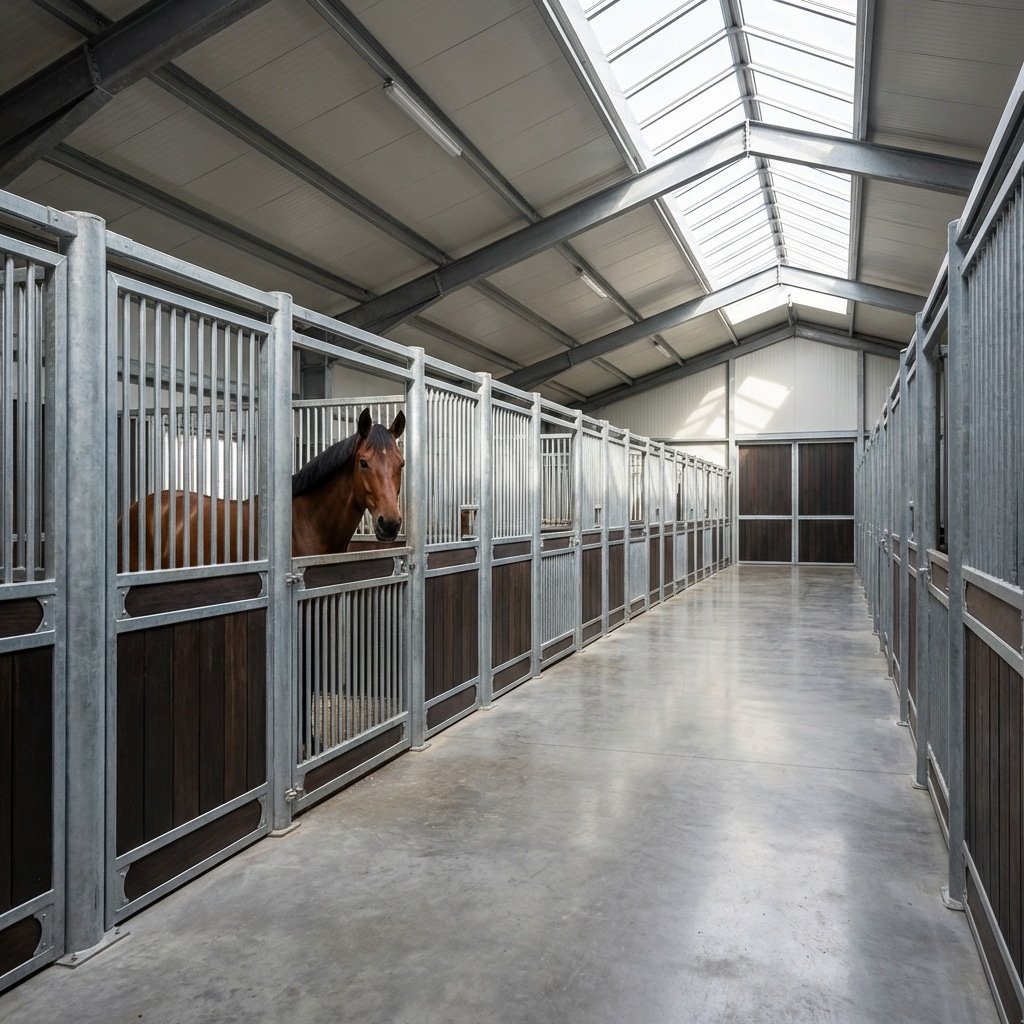
The American Standard: 12×12 Horse Stall Kits
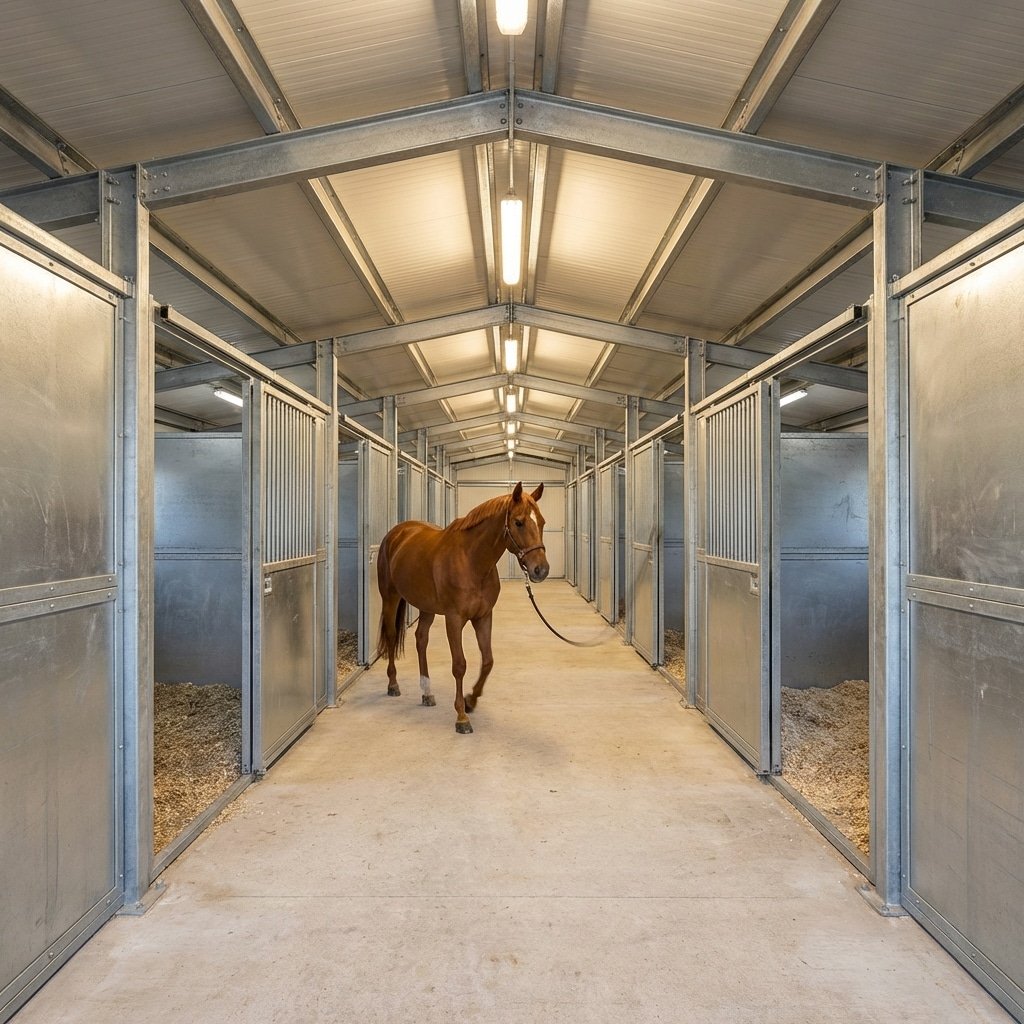
The 12×12 dimension is the North American safety benchmark. Our modular kits adhere to this grid, utilizing hot-dip galvanized steel and 304 stainless hardware for zero-maintenance longevity.
Defining the 12’x12′ Spatial Benchmark
The 12-foot by 12-foot stall isn’t just a round number; it is the calculated safety minimum for an average 1,000 lb horse. This square footage provides the necessary turning radius for an animal to lie down and stand back up without “casting”—getting legs trapped against a wall. Smaller dimensions significantly increase injury risk and veterinary liability for facility owners.
From a construction perspective, this dimension drives ROI. American pole barns and clear-span metal buildings typically utilize structural columns spaced on 12-foot centers. Our kits drop directly into these existing framed bays. This eliminates the need for custom fabrication or moving structural posts, drastically reducing installation labor costs for your clients.
Kit Inclusions: Panels, Infill, and 304 Stainless Hardware
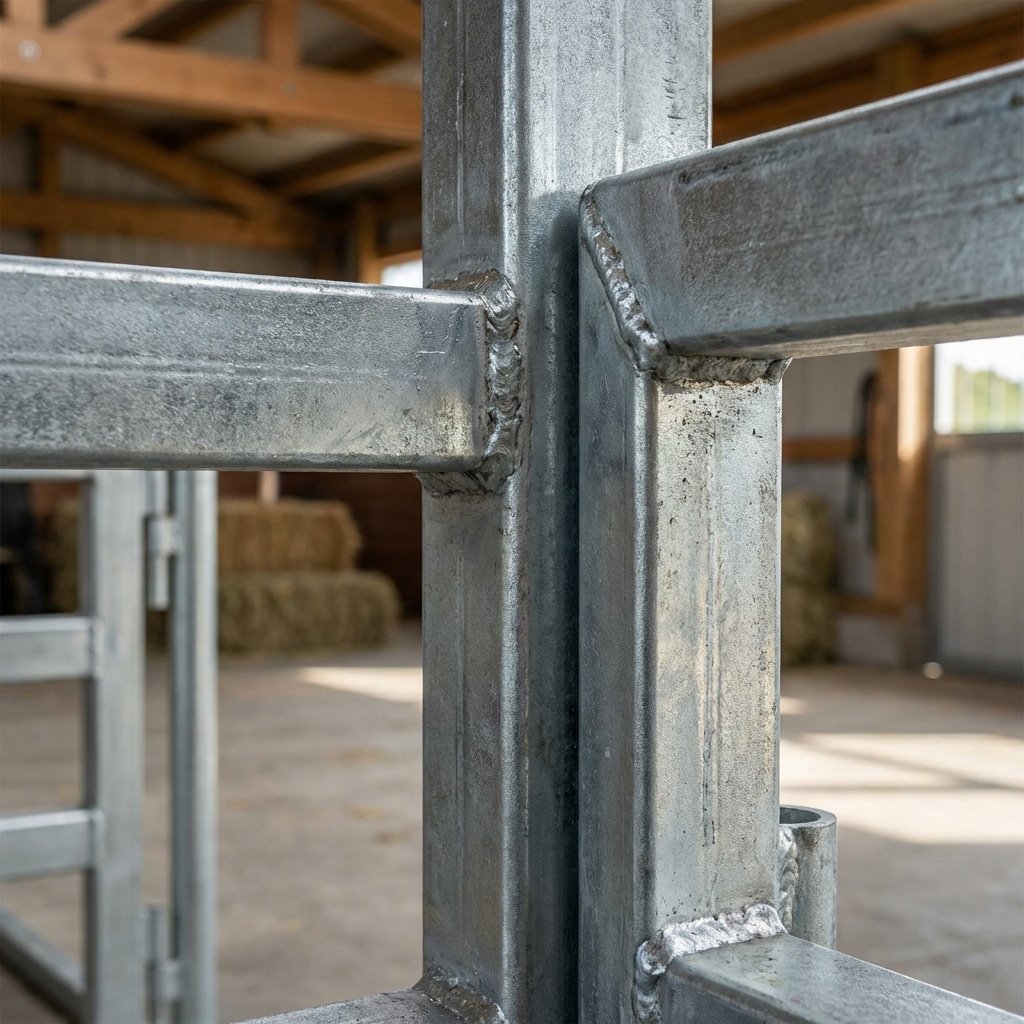
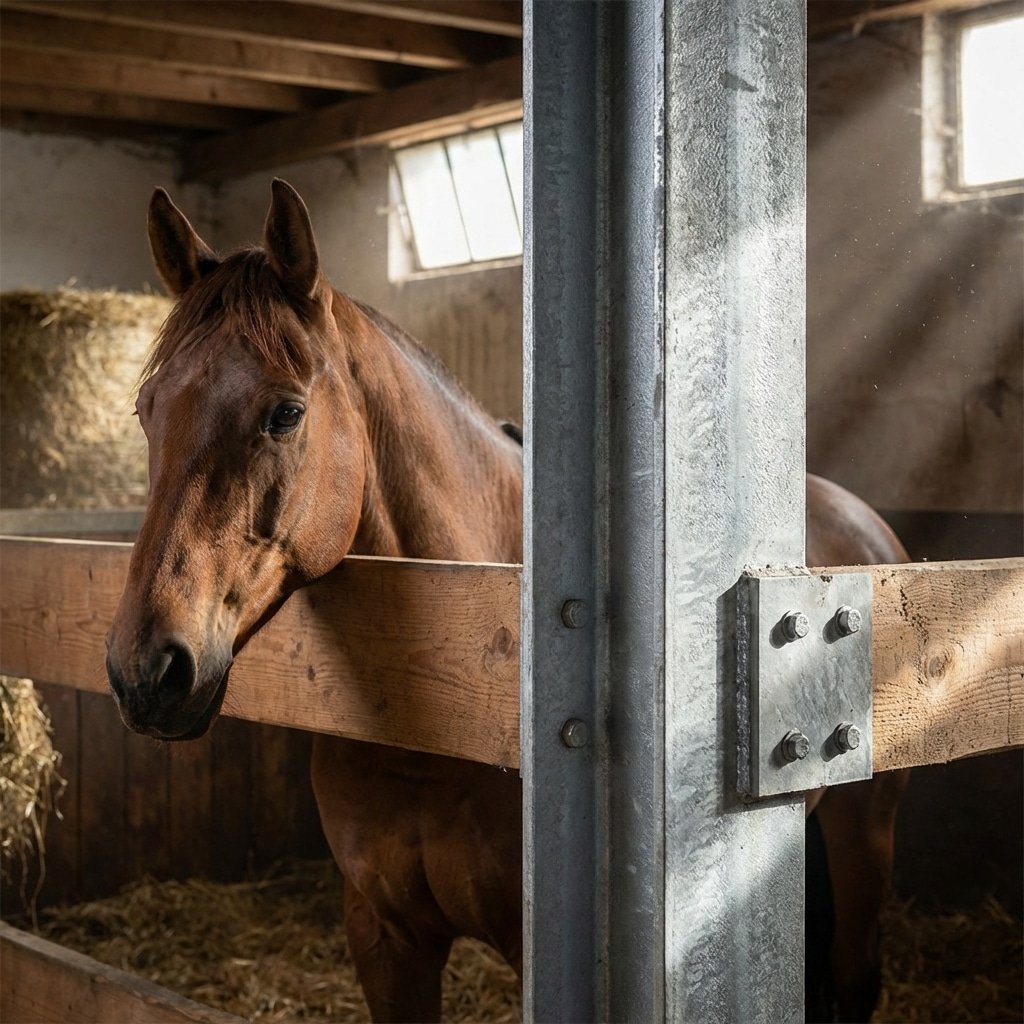
We do not supply “weld-it-yourself” projects. DB Stable kits arrive as finished, flat-pack systems designed for rapid bolt-together assembly. Every steel component undergoes Hot-Dip Galvanization بعد fabrication, sealing all welds and joints against ammonia corrosion.
- Structural Core: Includes 1x Front Panel (sliding or hinged) and required Side Partitions made from 14-gauge Q235B or Q345B steel.
- Infill Materials: Pre-cut 28mm-38mm HDPE or High-Density Bamboo planks. These slot immediately into the frame channels—no cutting required.
- Hardware Package: We exclusively supply 304 Stainless Steel anchor bolts, connectors, and screws. Unlike standard zinc-plated hardware, stainless steel prevents the brown rust streaks that plague inferior stalls after a few months.
- Completion Items: Includes a can of cold galvanizing spray to treat any scratches caused during the installation process.

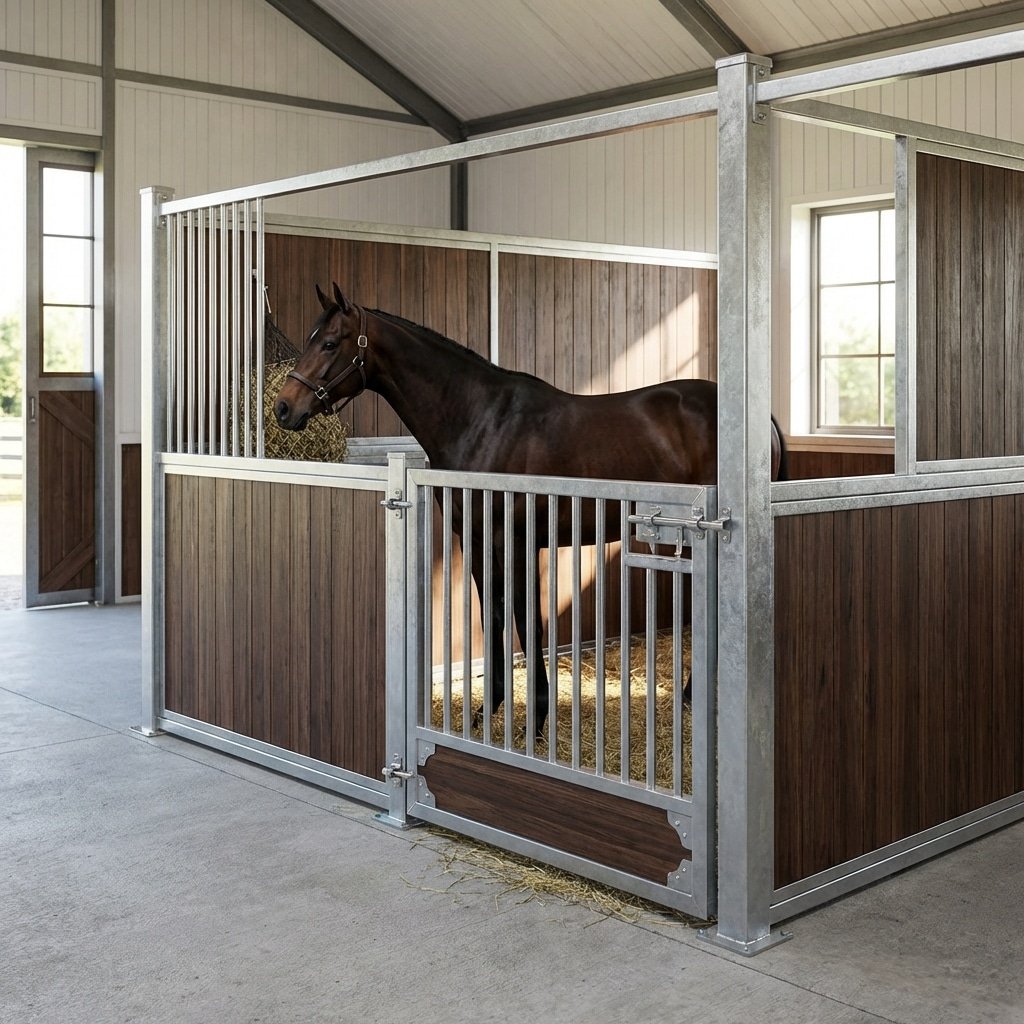
Unmasking “Heavy Duty”: The 14-Gauge Minimum
14-gauge steel (approx. 2.0mm) is the absolute safety floor for equine housing. Anything thinner risks catastrophic failure when impacted by a 1,000lb animal.
| Steel Gauge | Approx. Thickness | Industry Classification | مخاطر التأثير |
|---|---|---|---|
| مقاس 14 | ~2.0mm | Structural / Heavy Duty | Low (Safety Standard) |
| 16-Gauge | ~1.5mm | Light Duty / Residential | Moderate (Deformation Likely) |
| 18-Gauge | ~1.2mm | Cosmetic / Economy | High (Buckling Hazard) |
Defining the Industrial Standard: 14-Gauge vs. Light-Duty Tubing
The steel gauge system works inversely: lower numbers mean thicker metal. While marketing brochures often bury these specs, the difference between 14-gauge and 16-gauge determines whether a stall contains a horse or crumples under pressure. Engineering data identifies 14-gauge (approx. 2.0mm) as the strict dividing line between “light-duty” cosmetic tubing and “heavy-duty” structural framing.
Economy manufacturers frequently substitute 16-gauge or even 18-gauge steel to cut material costs. This reduction compromises the structural mass required to absorb kinetic energy. When a 1,000lb animal kicks a panel, materials thinner than the 2.0mm threshold face a high risk of catastrophic buckling or bending. Safe containment relies on mass, not just geometry.
The Kick-Proof Guarantee: Strict 2.0mm Structural Steel Protocols
We enforce a zero-tolerance policy on tubing thinner than 2.0mm for all structural posts and frames. DB Stable protocols dictate that every primary load-bearing component must meet or exceed this 14-gauge specification. This standard supports our “Kick-Proof Guarantee,” ensuring the stable front absorbs impact energy without the deformation common in cheaper pre-galvanized systems.
- Standard Material: Q235B Structural Steel (Equivalent to ASTM A36) for general applications.
- Cold Climate Material: Q345B High Strength Steel (Equivalent to ASTM Grade 50) to prevent brittle fractures in freezing temperatures.
- Minimum Thickness: Strict 2.0mm – 2.5mm floor for all tubing profiles.
Manufacturer-Direct Stables Built for 20+ Years
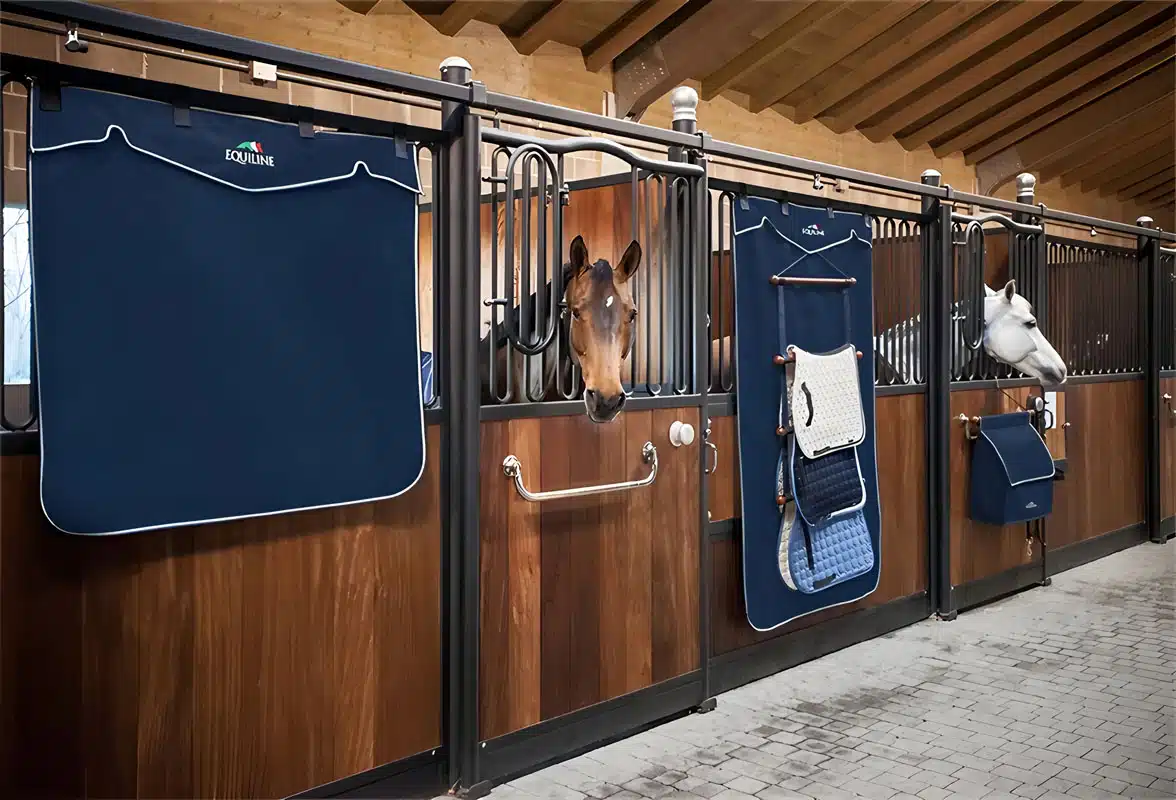
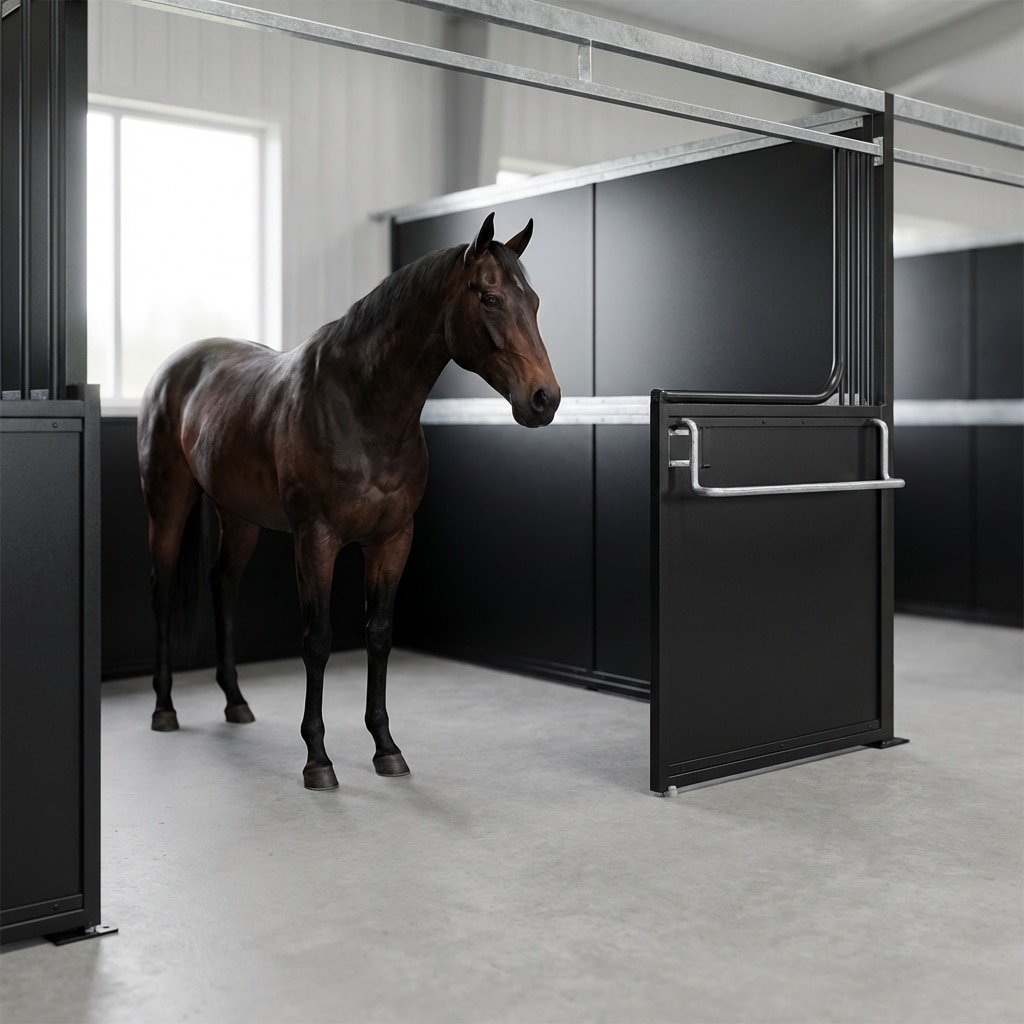
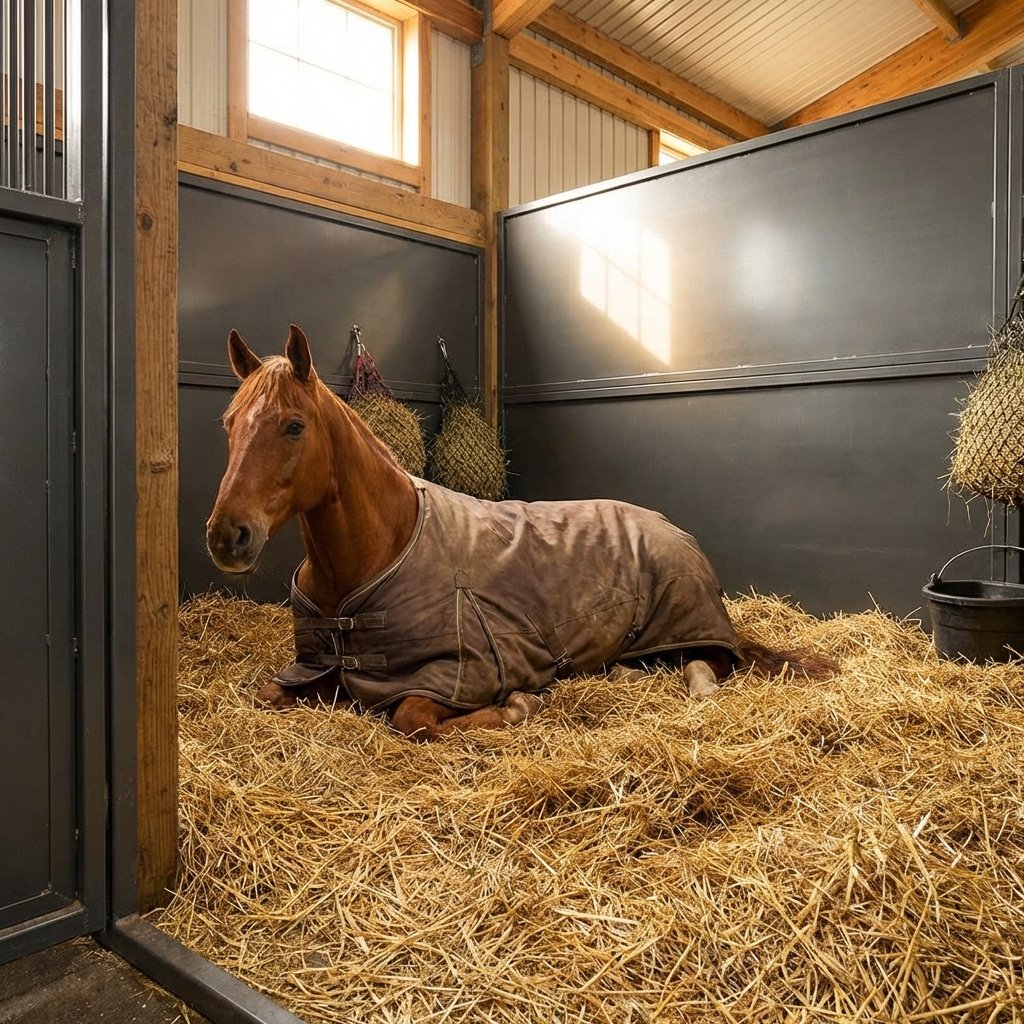
Bolt-Together Modularity: No Welder Required
Bolt-together systems eliminate fire hazards and hot work permits, reducing installation time by up to 60%. This allows general crews to assemble heavy-duty structures using standard hand tools.
Rapid Assembly Without Hot Work Permits
Traditional stall fabrication forces you to bring heavy welding equipment into a barn environment filled with hay, dust, and sawdust. This creates a massive fire risk and often triggers the need for expensive “hot work” permits and insurance adjusters. We engineered the DB Stable system to bypass this entire headache. By shifting from field welding to precision-engineered mechanical connections, we turn a complex fabrication job into a straightforward assembly task.
- Speed Efficiency: Crews can install these systems 40-60% faster than welded alternatives, significantly reducing labor hours per stall.
- Labor Flexibility: You do not need certified welders. General contractors or farm hands can complete the build using standard wrenches and impact drivers.
- Future-Proof Layouts: Unlike permanent welded fixtures, bolt-together panels allow you to easily disassemble and reconfigure stall layouts as your business evolves.
- Safety Compliance: Eliminates the administrative burden and safety liability of securing hot work permits for on-site construction.
The DB Hardware Kit: 304 Stainless Steel Components
Most competitors cut costs by supplying zinc-plated hardware that rusts within two years of exposure to ammonia and moisture. We refuse to compromise the system’s longevity at its weakest points. Every DB Stable installation kit is stocked strictly with 304 Stainless Steel components to match the lifespan of our hot-dip galvanized frames.
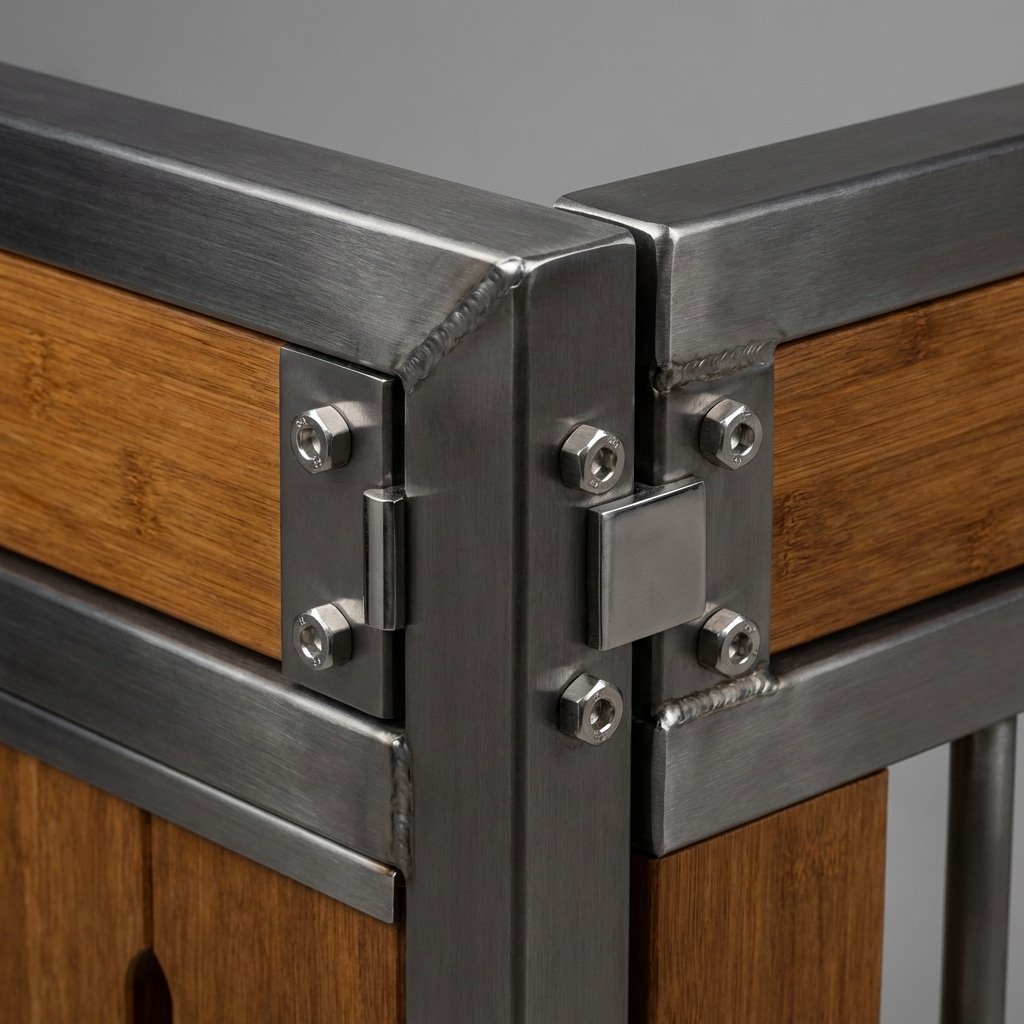
- Rust Defense: All screws, anchor bolts, and connectors are 304 Stainless Steel, preventing corrosion at critical stress points.
- Rattle-Free Locking: We use heavy-duty 40mm square tube connector pins that lock panels securely, ensuring the structure feels solid and quiet.
- Structural Parity: The precision fitment ensures structural integrity matches welded units, without the heat-induced metal fatigue common in field welding.
- Finish Protection: We include a complimentary cold galvanizing spray to instantly seal any scratches that occur during the assembly process.
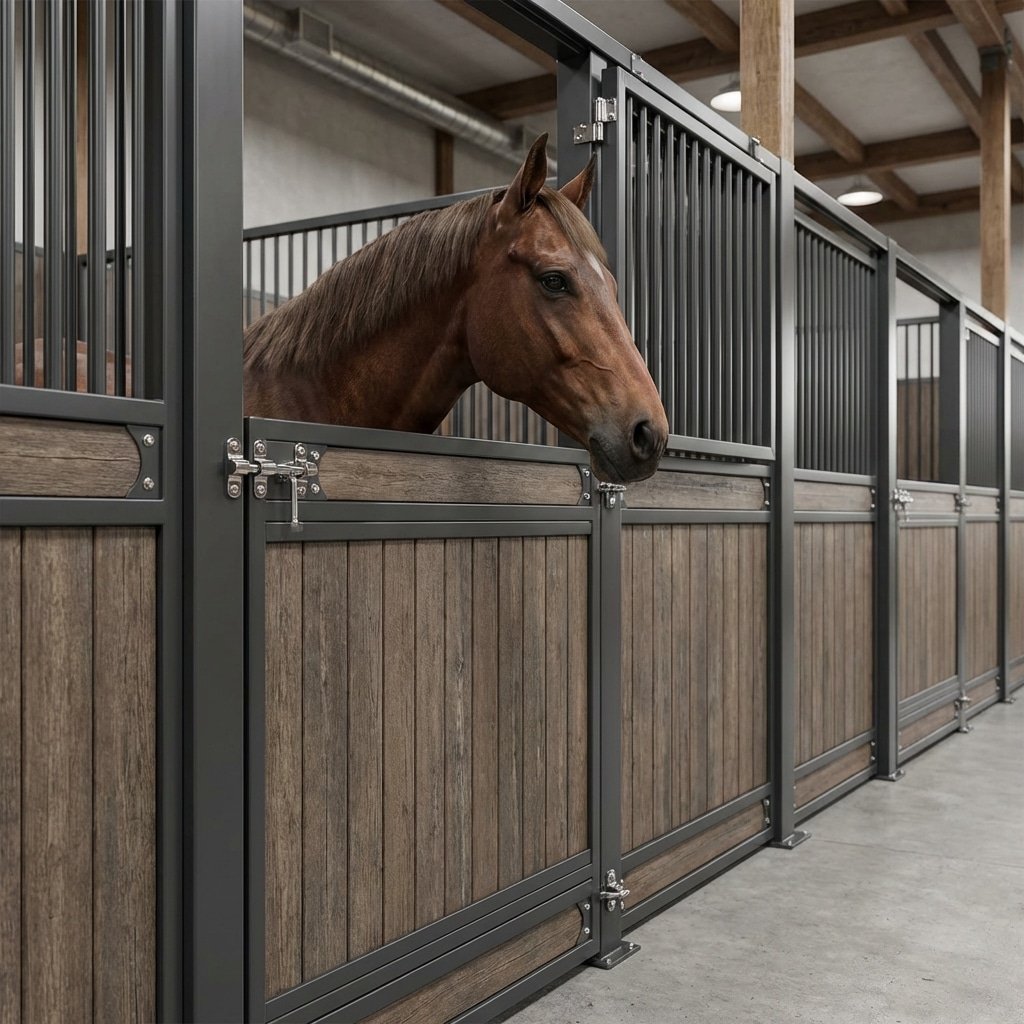
Sliding vs Hinged Horse Stall Doors for US Aisles
Sliding doors dominate US center-aisle barns by eliminating swing radius and wind hazards. Hinged options require heavy-duty Q345 steel frames to prevent long-term sagging.
Aisle Clearance and Workflow Efficiency
The choice between sliding and hinged doors is rarely about aesthetics; it is an operational decision dictated by your barn’s footprint. In a standard American barn with a 12-foot center aisle, a hinged door demands a 48-inch swing radius. When open, this effectively reduces your usable workspace by four feet, creating a bottleneck that complicates moving equipment or leading horses. Sliding doors remove this variable entirely, maintaining the full width of the aisle regardless of whether stalls are open or closed.
Safety in high-traffic facilities also drives the shift toward sliding systems. Open hinged doors in a breezeway act like sails during wind gusts, creating a risk of the door slamming on a handler or animal. Sliding doors remain secure within their tracks, immune to sudden drafts. Furthermore, protruding latches on open hinged doors are notorious for catching on blankets, halters, or human clothing. Sliding systems keep all hardware flush against the stall front, preventing snagging accidents in busy corridors.
Hardware Integrity: Hidden Track Systems vs. Stainless Hinges
The mechanical failure points differ significantly between the two systems, and generic hardware often leads to early replacement. For sliding doors, the primary enemy is dust accumulation in the track, which eventually jams the rollers. To counter this, DB Stable’s Professional Series utilizes a proprietary “Hidden Track System.” This design shields the rollers and track from bedding dust and debris, ensuring smooth operation without the constant maintenance required by exposed open-trolley systems.
Hinged doors face a different challenge: gravitational torque. Traditional wood or light-gauge steel doors will inevitably sag over time due to their own weight. We address this by engineering our hinged options with reinforced Q345 steel frames—significantly stronger than standard Q235 or wood—and utilizing 304 Stainless Steel connectors. This structural rigidity resists the twisting forces that cause dragging.
- Corrosion Defense: All components undergo Hot-Dip Galvanization After Fabrication (BS EN ISO 1461) to withstand ammonia exposure.
- Roller Protection: Hidden Track Systems prevent debris buildup common in active stables.
- Structural Steel: Q345 Low Alloy High Strength Steel prevents frame distortion and sagging.
Sourcing Direct: How B2B Ordering Saves Farm Builders Money
Buying direct removes retail markups. Our flat-pack system fits 30-45 sets per container, cutting freight costs by over 60% compared to pre-welded alternatives.
Eliminating Retail Markups with Volume Procurement
Local importers and retailers typically operate on margins between 30% and 50% to cover their overhead and warehousing risks. When you source directly from the manufacturer, those points stay on your balance sheet. You are not paying for someone else’s storage fees; you are paying for the product.
Accessing OEM pricing tiers does not require purchasing hundreds of units. We structure our Project Order MOQs specifically for farm builders and mid-sized projects:
- Project Order MOQ: 1x 20GP Container (Approx. 10-15 sets).
- Procurement Consolidation: We combine hardware, lumber (Bamboo/HDPE), and steel frames into a single factory shipment.
- Direct Savings: Bypassing the local middleman secures the factory-gate price.
The Logistics Advantage: Flat-Pack Loading Efficiency
Freight often kills the margin on heavy steel structures. The industry standard “fully welded” stall allows only 12 to 15 sets in a 40HQ container because the volume is mostly empty air. You end up paying to ship oxygen across the ocean.
We use a proprietary Flat-Pack System to solve this. By designing components that nest perfectly, we fit 30 to 45 sets in the same 40HQ container. This density reduces per-unit shipping costs by approximately 60%. We call this “Profit Protection” because it safeguards your margins against fluctuating freight rates.
- Capacity: 30-45 sets per 40HQ (vs. 12-15 standard welded sets).
- Site Efficiency: Steel pallet packaging ensures safe, forklift-ready unloading.
- الحد من الأضرار: No loose loading prevents transit damage common in hand-loaded shipments.
الأسئلة المتداولة
What is the recommended steel gauge for professional horse stalls?
For structural integrity and safety, 14-gauge (2.0mm to 2.5mm) steel is the minimum requirement for stall fronts and partition frames. While economy market options often risk safety by using thinner 16-gauge or 18-gauge metal to cut costs, professional-grade systems strictly adhere to a 14-gauge standard using Q235B or Q345B structural steel. This thickness withstands heavy impact and prevents the tubing from buckling or shearing if a horse kicks the panel.
Is 12×12 feet the only standard size available?
No. While 12’x12′ (approx. 3.6m x 3.6m) is the most common industry standard for typical riding horses, modular manufacturing supports complete flexibility. Facilities frequently configure 10’x10′ stalls for ponies or isolation units, and larger 12’x16′ units for warmbloods and foaling mares. The modular panel design adapts to your specific barn layout rather than forcing you to construct your facility around rigid dimensions.
Do I need a welder to install the stall kits?
You do not need a welder. Modern stall systems utilize a bolt-together design that eliminates on-site hot work. The kits arrive with pre-drilled holes and 304 stainless steel connectors, allowing for assembly using standard hand tools. This approach reduces fire hazards during construction and simplifies future repairs or reconfigurations if you need to move the stable partitions.
ما هو الفرق بين ‘المجلفن مسبقًا’ و‘الغمس الساخن بعد التصنيع’؟
This distinction determines the lifespan of your investment. “Pre-galvanized” tubes are coated at the steel mill before welding, which leaves the new weld seams burned and exposed to rust immediately after fabrication. “Hot-Dip After Fabrication” involves welding the raw black steel frames first, then dipping the entire structure into molten zinc (conforming to ISO 1461 standards). This process seals every weld joint and interior surface with a thick zinc coating (typically >85 microns), offering superior longevity in corrosive stable environments.
How does the flat-pack delivery system work?
To minimize freight costs, we package stalls on steel pallets in a flat-pack format rather than shipping bulky, fully-welded cubes. This method allows for significantly higher container density—approximately 30-45 sets fit in a 40HQ container compared to just 12-15 sets with traditional loading. This protects your profit margins on logistics. Recipients must have a forklift available to unload the heavy steel palettes safely upon delivery.
الأفكار النهائية
Selecting between generic 16-gauge tubing and our industrial 14-gauge standard is a choice between immediate savings and long-term liability. Only hot-dip galvanization after fabrication seals the steel against ammonia, protecting your structure from the rust that destroys inferior pre-galvanized welds. Your reputation as a builder depends on installing containment systems that absorb impact rather than buckling under pressure.
Stop paying to ship empty air; our flat-pack logistics maximize container density to safeguard your margins against freight volatility. Contact our engineering team today to review your barn plans and verify our 12×12 modular fitment. Secure the factory-direct pricing necessary to compete in the US market without compromising on safety standards.

 Arabic
  English
  Spanish
  French
  German
0 تعليق