


Therapeutic Riding facility design demands engineering that exceeds standard agricultural specifications to mitigate liability risks. Installing generic stable fronts often results in accessibility bottlenecks and increased injury claims from catching mobility devices on narrow thresholds.
This analysis benchmarks manufacturers against the ISO 1461 hot-dip galvanization standard and the requirement for kick-proof Q345B structural steel. We evaluate suppliers based on their ability to deliver zero-threshold track systems and flat-pack logistics to ensure your non-profit or commercial project remains within budget while meeting rigorous ADA compliance.
تصميم الإسطبلات لتناسب الكراسي المتحركة (ADA)
مقارنة سريعة
| Feature Name | مجال التطبيق | المتطلبات الرئيسية | الحكم |
|---|---|---|---|
| Accessible Routes and Pathways | Infrastructure Layout | Min. 36″ width; Stable, slip-resistant surfaces (Max 1:20 slope) | Foundational: Ensures independent navigation and reduces trip hazards via firm surfaces. |
| Maneuvering Spaces | Space Planning | 30″ x 48″ clear ground space; Turning radius clearance | Functional: Critical for prevents entrapment in confined areas like tack and feed rooms. |
| Ramps for Elevation Changes | Accessibility Features | Max 1:12 slope; 60″ landings; Dual handrails | Mandatory: Enables safe access across levels and supports semi-ambulatory users. |
| Assembly and Viewing Areas | Spectator Zones | Inclusive Seating; Unobstructed sightlines | Inclusive: Promotes family participation and meets capacity-based legal compliance. |
| Accessible Amenities | Facility Amenities | Hi-lo drinking fountains; Wheelchair-operable coolers | Supportive: Provides hydration independence and enhances user experience. |
Accessible Routes and Pathways
**Foundational accessibility feature** ensuring independent navigation through wide, stable, and slip-resistant infrastructure.
Foundational accessible design requiring pathways to be at least 36 inches wide continuously. To ensure safety for all users, surfaces must be kept stable, firm, and slip-resistant.
Running slopes must not exceed 1:20 to safely accommodate mobility aids. This specification is critical for reducing physical barriers within the facility’s infrastructure layout.
📊 لمحة سريعة:
- 📍 Category: Infrastructure Layout
- 🏭 التركيز الأساسي: Safe Mobility, Slip-Resistant Surfaces
- 🌍 Standard: عالمي
لماذا اخترناه؟
| ✅ المكاسب | ⚠️ المبادلات ⚠️ |
|---|---|
|
|
Maneuvering Spaces
**Mandatory spatial design** that prevents entrapment and ensures functional usability in confined stable zones.
Critical floor planning that dictates a minimum clear ground space of 30 by 48 inches for a single wheelchair. This baseline dimension ensures that mobility aids can fit into designated zones without obstruction.
Additional clearance is required in confined operational areas, such as tack and feed rooms, to allow for turning. Without these calculated dimensions, a user may enter a space but be physically unable to exit safely.
📊 لمحة سريعة:
- 📍 Category: Space Planning
- 🏭 Key Specs: Clear Floor Space, Turning Radius
- 🌍 Standard: عالمي
لماذا اخترناه؟
| ✅ المكاسب | ⚠️ المبادلات ⚠️ |
|---|---|
|
|
Ramps for Elevation Changes
Mandatory infrastructure for safe, legal accessibility over any elevation gap exceeding ½ inch.
Ramps are a foundational requirement for stable accessibility, necessary whenever the ground level changes by more than ½ inch. To ensure usability, the design must strictly adhere to a maximum 1:12 slope ratio.
Beyond the slope, safety dictates specific structural additions. Plans must include level landings at least 60 inches long and handrails on both sides to support users with varying mobility needs.
📊 لمحة سريعة:
- 📍الموقع: Accessibility Features
- 🏭 القوة الأساسية: Ramps, Handrails
- الأسواق الرئيسية: عالمي
لماذا اخترناهم:
| ✅ المكاسب | ⚠️ المبادلات ⚠️ |
|---|---|
|
|
Assembly and Viewing Areas
Delivers **inclusive engagement** by integrating accessible seating with unobstructed sightlines into the main spectator zones.
Designated wheelchair seating is calculated based on total venue capacity, such as reserving two specific spaces for crowds of 26 to 50 people. This planning aligns facilities with legal standards while actively accommodating mobility aids within the primary event space.
Operational success relies on providing lines of sight comparable to standard seats. Planners must weave these zones into the general layout to facilitate social interaction, preventing the segregation of users to the fringes of the arena.
📊 لمحة سريعة:
- 📍الموقع: Spectator Zones
- 🏭 القوة الأساسية: Inclusive Seating, Sightlines
- الأسواق الرئيسية: عالمي
لماذا اخترناهم:
| ✅ المكاسب | ⚠️ المبادلات ⚠️ |
|---|---|
|
|
Accessible Amenities
Designed for **hydration independence**, requiring specialized hi-lo designs and wheelchair-operable fixtures.
Support facilities such as drinking fountains must be designed for wheelchair operation.
Solutions often include hi-lo designs or supplementary water coolers to ensure usability for all.
📊 لمحة سريعة:
- 📍الموقع: Facility Amenities
- 🏭 القوة الأساسية: Drinking Fountains, Water Coolers
- الأسواق الرئيسية: عالمي
لماذا اخترناهم:
| ✅ المكاسب | ⚠️ المبادلات ⚠️ |
|---|---|
|
|
Wholesale Horse Stables With 20-Year Durability

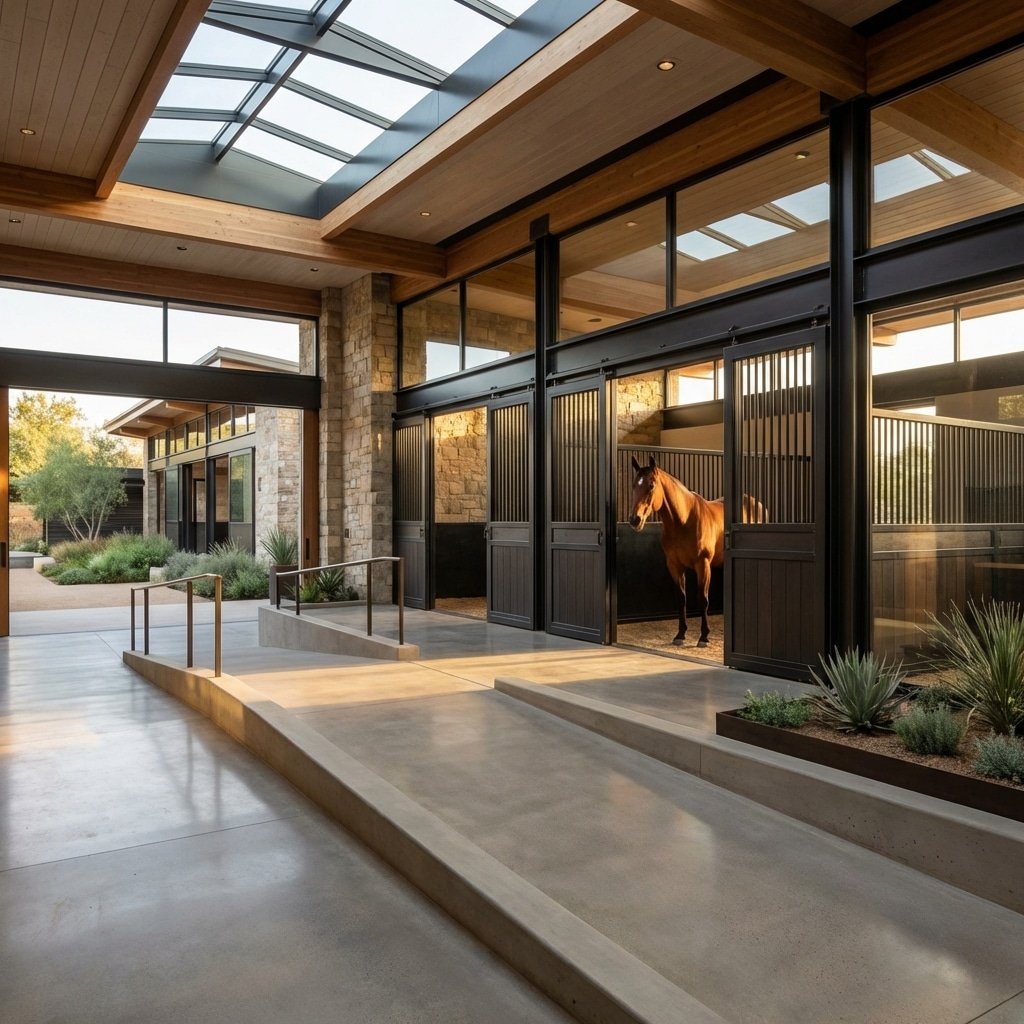
تصميم الإسطبلات لتناسب الكراسي المتحركة (ADA)
Creating a therapeutic riding environment requires engineering that goes beyond standard agricultural specifications. We prioritize barrier-free movement by integrating wider clearances, accessible hardware placement, and “Kick-Proof” materials to ensure independence for riders with mobility challenges while maintaining rigorous safety standards for horses.
Configuring Dimensions for Barrier-Free Access
Standard agricultural door widths often create bottlenecks for mobility devices. We recommend planning stable door openings that exceed the standard 36-inch ADA minimum, targeting a clear width of 48 inches (approx. 1.2m). This expanded clearance allows a wheelchair user to maneuver safely alongside a horse, preventing the sensation of entrapment and reducing the risk of accidents during entry and exit.
True accessibility empowers users to manage their environment independently. We install door latches and operating hardware at a designated height of 34 to 48 inches. This ensures mechanisms remain reachable for seated users, enabling them to open and close stalls without assistance. Our sliding door systems are particularly effective here, as they eliminate the need for the user to back up or maneuver around a swinging door radius.
Fluid movement is critical in high-traffic aisles. We ensure the facility layout includes a minimum clear floor space of 30 by 48 inches adjacent to every stall entry. This specific dimension facilitates the necessary turning and positioning for wheelchairs, ensuring users can approach the stall head-on or parallel without obstruction from structural columns or tack lockers.
Material Selection for High-Traffic Therapeutic Barns
The tactile quality of stable surfaces is a major safety factor in therapeutic settings. We specify hot-dip galvanized steel frames conforming to BS EN ISO 1461. Our “Hot-Dip After Fabrication” process ensures that every weld and joint is coated in a smooth, protective layer of zinc. This guarantees burr-free surfaces that prevent injury to sensitive skin or snagging on clothing and mobility equipment.
Barns housing both horses and medical equipment face unique physical demands. We utilize impact-resistant Q345B low alloy high-strength steel profiles to withstand accidental bumps from electric wheelchairs or therapy lifts. Unlike standard structural steel, Q345B offers superior toughness, ensuring that door frames do not dent or warp upon impact, which preserves the smooth operation of the sliding track system.
For stall walls, we select HDPE infill planks to create a “Kick-Proof” and shatter-resistant barrier. Unlike wood, which can splinter and pose a laceration risk to clients and therapy horses, HDPE absorbs impact without breaking. This material choice supports a “Zero Maintenance” facility, as the planks are impervious to moisture and easy to sanitize, meeting the higher hygiene standards required for therapeutic programs.
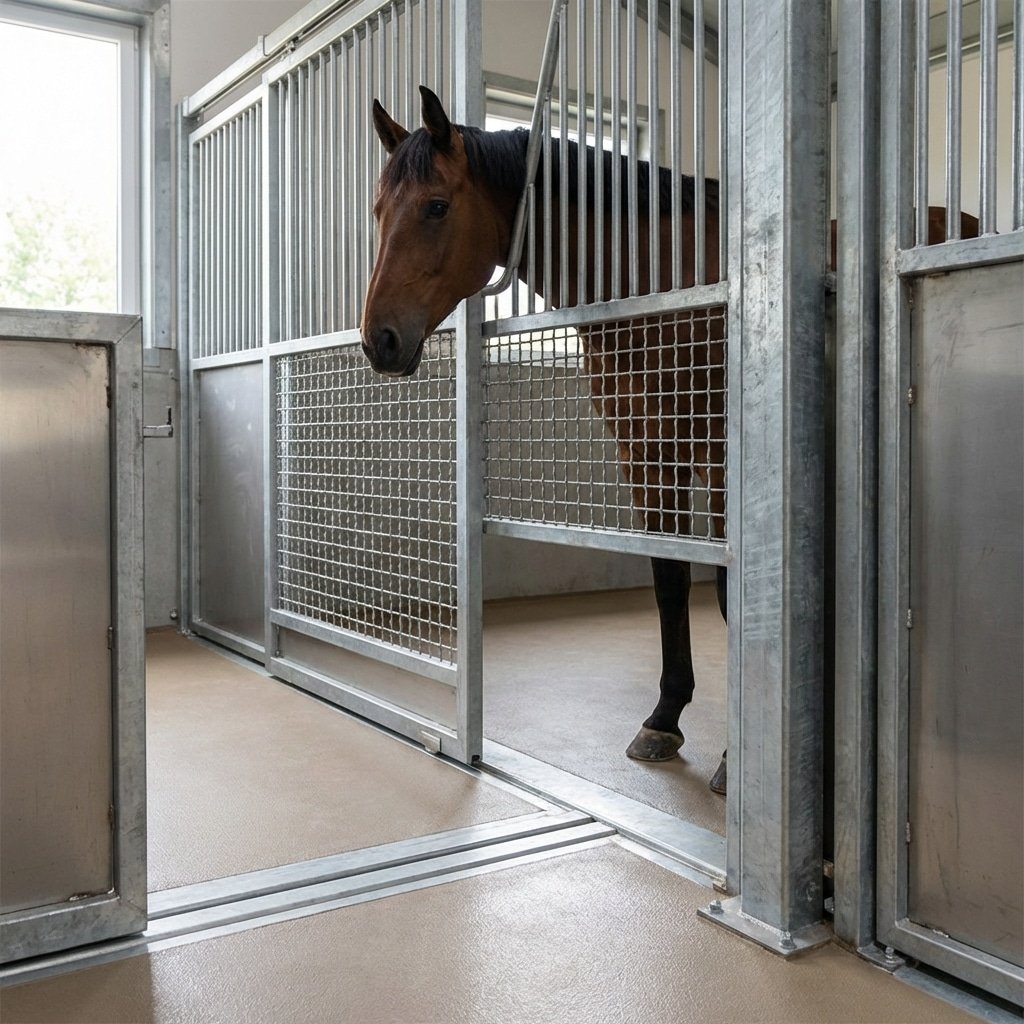
تجربة الممر: الأبواب المنزلقة العريضة مقابل الأبواب المتأرجحة
Selecting the right door architecture is critical for managing barn workflow and safety. While swing doors offer a traditional aesthetic, our sliding door systems eliminate the hazardous 48-inch swing radius, reclaiming valuable aisle width for machinery and handling while utilizing heavy-duty tracks to ensure effortless, one-handed operation.
Maximizing Usable Aisle Space
Traditional hinged doors typically require a 48-inch clearance to open fully, creating a significant “dead zone” within the barn aisle. Our sliding doors are engineered to retract parallel to the stall front, completely eliminating this swing radius. This space-saving design keeps the central aisle clear for tractors, feed carts, and wheelchairs, preventing bottlenecks during busy stable hours and maximizing the functional square footage of your facility.
To support this efficiency, we implement a specific “Hidden Track System” in our السلسلة الاحترافية. This overhead track design ensures the door glides smoothly without the need for protruding hardware or bottom guides that could snag equipment or pose a tripping hazard. By keeping the mechanical components enclosed and protected, we ensure that the aisle remains a safe, unobstructed thoroughfare for both equine and mechanical traffic.
Safety Mechanisms and Handler Accessibility
Beyond space savings, the choice of door impacts daily safety. Swing doors pose a significant risk of catching wind gusts or accidentally trapping handlers against aisle walls, particularly in narrow breezeways. Sliding doors resolve this by remaining safely contained within the stall facade at all times. This configuration allows for easier one-handed operation, enabling handlers to maintain control of the horse with one hand while safely opening the stall with the other.
Structural integrity is the foundation of this safety. Our manufacturing process uses الفولاذ الهيكلي Q345B (or standard Q235B), which is Hot-Dip Galvanized After Fabrication. This method ensures the door frame remains rigid and kick-proof, preventing the warping that often causes lesser doors to jam or derail. The result is a system that moves effortlessly on its rollers while providing a secure barrier against impact.
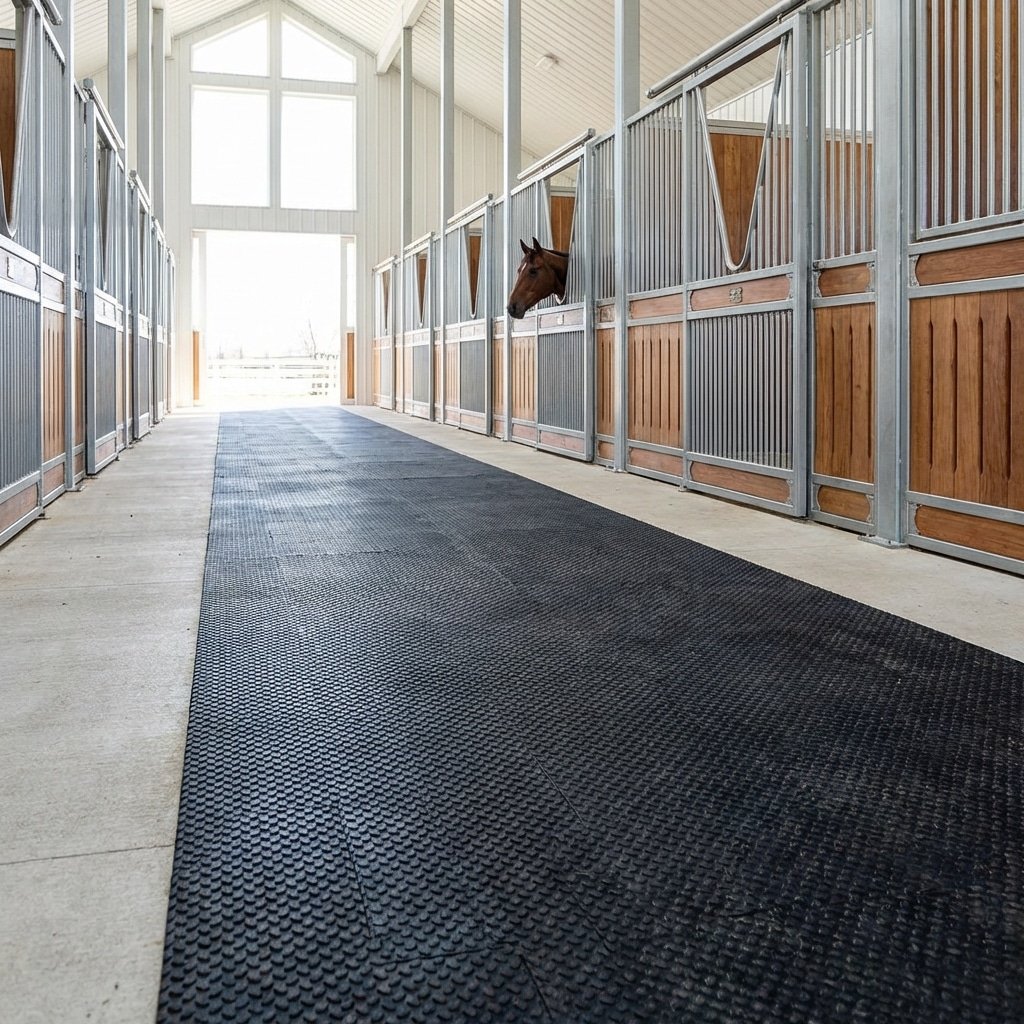
الأرضيات ذات العتبة الصفرية: القضاء على مخاطر التعثر
Eliminating raised flooring barriers is a non-negotiable standard for therapeutic riding centers and adaptive equestrian facilities. By engineering stall fronts that do not rely on a bottom threshold bar for structural stability, we create seamless transitions that accommodate wheelchairs, walkers, and volunteers while reducing trip hazards in high-traffic zones.
Optimizing Accessibility for Therapeutic Programs
For facilities serving veterans or children with cerebral palsy and autism, the barn environment must be as navigable as it is welcoming. Many of these participants rely on mobility aids, and even a small 2-inch door track can become a significant obstacle. Removing these raised barriers reduces the physical energy required to navigate the barn, allowing participants to reserve their strength for therapeutic riding activities rather than fighting architectural hurdles.
Safety extends beyond the riders to the support staff. Therapeutic sessions often involve sidewalkers who guide the horse while walking backward or sideways. A level, zero-threshold floor prevents dangerous trips and falls for these volunteers, ensuring their focus remains entirely on the safety of the rider. This seamless design also supports greater independence, enabling participants with limited balance or coordination to move freely between tack rooms, stalls, and arenas without constant assistance.
Technical Considerations: Materials and Door Integration
Creating a functional zero-threshold stable requires aligning the flooring material with the structural engineering of the stall front. We recommend smooth concrete or interlocking rubber bricks for aisleways to ensure low rolling resistance for wheelchairs while providing necessary traction for shod horses. Thick, loose rubber mats should be avoided at entry points, as their edges can curl and impede wheel movement; recessed mat systems or glued-down rubber bricks are superior alternatives.
From an engineering perspective, the challenge with zero-threshold designs is maintaining the rigidity of the stall front without a bottom bar connecting the door posts. We solve this by using **Q345B Low Alloy High Strength Steel** for our framework. This material offers superior tensile strength compared to standard steel, allowing the door frame to remain rigid and secure purely through its top-hung track and side anchorage. This design enables our sliding door systems to operate smoothly without a raised bottom track, preserving a completely flat surface across the doorway.
نظام الجنزير المغلق السلس الانزلاقي السلس من DB
Our Smooth-Glide system integrates a fully enclosed, self-cleaning header with heavy-duty 304 stainless steel rollers to ensure effortless operation. By removing bottom guides and relying on overhead suspension, we create a zero-threshold entry that meets the accessibility and safety standards required for the Professional Series.
Mechanics of the Hidden Track Design
The system utilizes a fully enclosed upper header that completely shields the roller mechanism from bedding, dust, and environmental debris. We engineer the rollers using heavy-duty 304 stainless steel, which prevents rust and ensures the door glides with minimal physical effort, a critical feature for users with limited upper body strength. Unlike exposed track systems that gather grit and become difficult to move, this self-cleaning design maintains consistent performance without frequent maintenance.
Eliminating Trip Hazards for Accessibility
By relying entirely on the overhead suspension, we eliminate the need for a bottom floor track, creating a true zero-threshold entryway suitable for wheelchairs and walkers. The design includes internal stops and anti-jump guards that keep the door securely anchored to the header, preventing derailment even if the stall receives a heavy impact. This integration supports our Professional Series layout, allowing for wide, obstruction-free aisles that comply with safety standards for therapeutic riding centers.
الأفكار النهائية
Standard agricultural specs fail in therapeutic settings where rider safety and accessibility are non-negotiable. We engineer our السلسلة الاحترافية using الفولاذ الهيكلي Q345B و الجلفنة بالغمس الساخن بعد التصنيع to eliminate sharp edges and withstand heavy impact from mobility aids. This investment in barrier-free, kick-proof infrastructure safeguards your facility against liability while meeting rigorous PATH Intl standards.
Do not rely on generic, off-the-shelf solutions for complex ADA layouts that require precise clearances. Contact our engineering team today to configure a custom accessible stable package or request a Production Sample to test our zero-threshold track system firsthand. We provide direct-from-factory pricing to help you build a compliant, high-performance facility without the middleman markup.
الأسئلة المتداولة
كيف تصمم حظيرة خيول متوافقة مع معايير ADA؟
We recommend prioritizing wide, obstruction-free aisles and level, zero-threshold flooring to accommodate wheelchairs comfortably. Stall fronts should feature lower viewing grills for visibility and accessible latches. Our design team focuses on eliminating trip hazards using our hidden overhead track system and ensuring ample turning radius for mobility devices.
الحد الأدنى لعرض الباب للوصول إلى الكراسي المتحركة في الحظائر؟
While standard accessibility guidelines often cite 32 to 36 inches, we engineer our stable door openings to be significantly wider—typically 4 feet (1.2m) or more. This ensures safe clearance for a horse and a handler using a wheelchair to pass through simultaneously without feeling cramped.
أفضل أبواب الإسطبلات لمراكز ركوب الخيل العلاجية؟
Sliding doors are superior for therapeutic centers because they do not swing out into the aisle, keeping walkways clear for students and side-walkers. We recommend our Hot-Dip Galvanized fronts with heavy-duty Q345 steel and smooth-gliding enclosed track systems to ensure effortless operation for volunteers of all physical abilities.
هل أبواب الأكشاك المنزلقة أسهل في الفتح؟
Yes, provided they utilize a high-quality track system. We use a debris-resistant enclosed overhead track with precision heavy-duty rollers, allowing the heavy steel doors to glide open with minimal force. This operational ease is crucial in settings where staff or riders may have limited upper body strength, while our cast-proof design protects horses from getting stuck.
معايير السلامة في حظيرة "باث" الدولية؟
PATH standards emphasize strict injury prevention and accessibility. Our manufacturing aligns with these protocols by using kick-proof 14-gauge steel, eliminating sharp edges via post-weld hot-dip galvanization, and installing impact-absorbing HDPE or high-density bamboo infills. We engineer our structures to exceed these rigorous safety benchmarks.

 Arabic
  English
  Spanish
  French
  German
0 تعليق