


Sourcing effective Multi-Species Modular stabling demands a rigorous balance between equine containment strength and small-stock safety. Standard 3-inch bar spacing creates lethal entrapment risks for alpacas and foals, rapidly converting a versatile barn investment into a serious liability hazard. Failing to secure specific 50mm anti-wedge designs endangers livestock and exposes operators to avoidable veterinary costs and operational downtime.
This guide benchmarks manufacturers against the Q345B structural steel standard and critical 50mm vertical bar spacing requirements. We evaluate fabrication methods, specifically Hot-Dip Galvanization to ISO 1461, to ensure high-density welds withstand the corrosive ammonia load of mixed farming. Our analysis focuses on modular adjustability and Zero Maintenance HDPE infills to secure your long-term operational margins.
The Challenge of Housing Mixed Livestock in One Barn
مقارنة سريعة
| نوع النظام | الأفضل لـ | الميزات الرئيسية | الحكم |
|---|---|---|---|
| Lab-Scale Systems | Small Animal Housing (Rabbits, Ferrets, Poultry) | Noise-dampening thermoplastic flooring, Slotted ventilation panels | Ideally suited for smaller species with ergonomic, modular designs that prioritize ventilation and ease of cleaning. |
| Large Animal Kenneling | Large Livestock Housing (Pigs, Sheep, Dogs) | Customizable configurations, Socialization panels | Best for facilities requiring made-to-order dimensions and features that encourage animal socialization. |
Lab-Scale Systems
These systems offer superior **modular versatility**, featuring interchangeable floors and precise ventilation controls essential for specialized small animal care.
Lab-scale systems utilize modular cage designs equipped with removable dividers, interchangeable floors, and integrated feeders to maximize versatility. This flexible approach allows facilities to adapt housing configurations quickly to meet changing requirements without compromising structural integrity.
The design prioritizes ergonomic stainless steel construction for durability and hygiene, paired with advanced ventilation mechanisms. Additionally, the integration of noise-dampening thermoplastic flooring significantly improves animal welfare by minimizing environmental stress factors.
📊 لمحة سريعة:
- 📍الموقع: Small Animal Housing
- 🏭 القوة الأساسية: Noise-dampening thermoplastic flooring, Slotted ventilation panels
- الأسواق الرئيسية: Rabbits, Ferrets, Poultry, Cats
لماذا اخترناهم:
| ✅ المكاسب | ⚠️ المبادلات ⚠️ |
|---|---|
|
|
Large Animal Kenneling
The optimal choice for facilities requiring **made-to-order dimensions** and modular flexibility.
Large animal kenneling focuses on made-to-order modular solutions tailored strictly to specific facility dimensions. Industry providers like Britz & Company and Lenderking engineer these systems to maximize spatial efficiency while ensuring secure containment.
These configurations prioritize adaptability, featuring socialization panels that allow for controlled interaction between animals. The design specifically addresses the complex needs of housing mixed species, such as sheep, goats, and pigs, within a single barn environment.
📊 لمحة سريعة:
- 📍الموقع: Large Livestock Housing
- 🏭 القوة الأساسية: Customizable configurations, Socialization panels
- الأسواق الرئيسية: Pigs, Sheep, Goats, Dogs
لماذا اخترناهم:
| ✅ المكاسب | ⚠️ المبادلات ⚠️ |
|---|---|
|
|
Premium Custom Stables For Extreme Climates
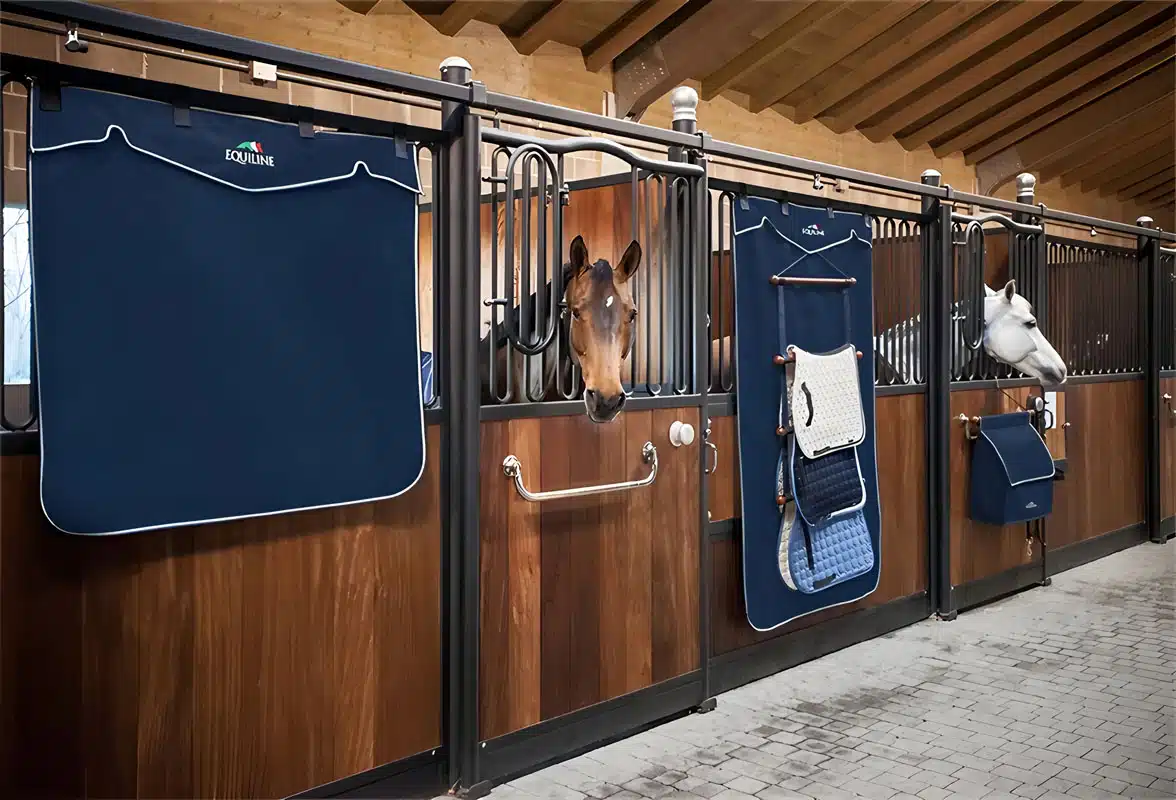
The Challenge of Housing Mixed Livestock in One Barn
Accommodating diverse species in a single facility requires balancing the high-impact containment needs of equines with the safety requirements of smaller livestock. To prevent entrapment and ensure biosecurity, we utilize Q345B structural steel for maximum resilience while engineering “Cast-Proof” bottom clearances and integrating impermeable HDPE infills that prevent pathogen transfer between species.
Structural Incompatibility and Entrapment Risks
Housing diverse species creates a safety paradox where heavy livestock require high-impact structural steel—such as our Q345B Low Alloy High Strength Steel—yet these standard equine designs often present entrapment hazards for smaller animals like goats or alpacas. A framework built to withstand the “Kick-Proof” demands of a warmblood may inadvertently feature bar spacing or ground gaps that pose risks to smaller heads and limbs.
Standard horse stall partitions typically feature bottom gaps that allow smaller livestock to roll and get stuck. We address this with a specialized “Cast-Proof Design” that maintains minimal clearance (approximately 50mm). This engineering ensures that while the 14-gauge steel tubing holds the largest animals securely, the physical gaps remain too narrow for smaller stock to become entrapped.
Operational flexibility is also a frequent hurdle. Traditional fully welded stable systems prevent operators from adjusting layouts, making it difficult to reconfigure stall sizes when shifting from large equines to smaller stock. Our modular flat-pack system allows for the removal or adjustment of partition panels, giving facility managers the ability to resize containment areas based on the current livestock population without requiring heavy construction work.
Hygiene Management and Cross-Contamination
Mixed livestock environments significantly increase bio-security risks, as porous materials like traditional softwoods absorb moisture and harbor pathogens that transfer easily between species. In a multi-species barn, the bacterial load from one animal type can prove detrimental to another, making surface sterility a priority over aesthetics.
Effective multi-species barns rely on our “Zero Maintenance” HDPE infill planks. Unlike wood or bamboo, this 28mm-32mm UV-stabilized material provides an impermeable surface that withstands rigorous power washing and prevents bacterial growth. This allows specific stalls to be sanitized completely between occupants, ensuring a clean slate for the next animal regardless of species.
Controlling air quality is equally critical in shared spaces. Our designs utilize open grill tops to promote “Stack Effect Ventilation,” ensuring ammonia buildup clears rapidly to protect the respiratory health of sensitive animals. To support this intensive cleaning and high-humidity environment, all steel components undergo Hot-Dip Galvanization after fabrication to BS EN ISO 1461 standards, protecting the structural integrity of the barn against rust and corrosion for decades.
Safety Grills: Why Standard 3-Inch Gaps Trap Foals and Alpacas
Standard 76mm (3-inch) or 100mm (4-inch) bar spacing creates lethal risks for smaller livestock like foals and alpacas due to the “wedge effect.” To eliminate this liability in breeding and mixed-species facilities, we engineer vertical bar spacing down to 50mm using heavy-duty Q235B structural steel. This modification blocks head entry completely while maintaining the visibility and airflow essential for animal welfare.
The “Wedge Effect”: Mechanics of Entrapment for Small Heads
While standard 76mm or 100mm bar spacing caters effectively to adult horses, it inadvertently creates a trap for smaller livestock such as alpacas and foals. Curious animals naturally investigate activity in the aisle, easily pushing their narrow muzzles through these wider gaps.
Once the head is through, the animal’s jawbone or ears act as a wedge, locking the head between the bars when they attempt to pull back. This mechanical locking is often impossible for the animal to reverse on its own, turning a standard safety feature into a hazard.
The immediate reaction to entrapment is panic. This triggers violent thrashing, which frequently results in cervical fractures, suffocation, or severe neurological damage before handlers can intervene. For facility managers, this represents a significant operational risk that standard equine designs fail to address.
Mitigating Risk: Engineering 50mm Spacing Solutions
We recommend reducing vertical bar spacing to 50mm (approximately 2 inches) for nursery stalls and mixed-species facilities. This tighter specification blocks head entry completely, neutralizing the wedge effect at the source while preserving the “Stack Effect Ventilation” required for respiratory health.
To support this density, we utilize heavy-duty Q235B structural steel for these tighter grills. This ensures the bars remain rigid against kicks from protective mares or impact from larger animals sharing the space, upholding our “Kick-Proof Guarantee” even with modified spacing.
Our OEM manufacturing process allows distributors to specify these narrower gaps for specific isolation units while matching the visual style of the main barn. This flexibility protects your inventory strategy, allowing you to offer specialized safety solutions without stocking incompatible systems.
Crucially, the increased number of weld joints in these high-density grills makes rust protection vital. We apply our standard hot-dip galvanization after fabrication, fully sealing every joint against corrosion and ensuring the longevity of these specialized panels matches our standard stabling.
Custom OEM Spacing: Specifying 2-Inch Grills for Small Heads
Standard equestrian stalls often use 3-inch spacing, which poses entrapment risks for foals, alpacas, and miniature breeds. We engineer custom 50mm (2-inch) vertical bar configurations using heavy-duty 14-gauge steel to ensure physical safety while maintaining essential airflow.
Engineering the 50mm Gap for Foal and Alpaca Safety
Standard equestrian stalls typically feature 75mm (3-inch) to 100mm (4-inch) spacing. While sufficient for adult horses, this gap creates significant entrapment risks for smaller livestock like alpacas, goats, or miniature horses. A foal or alpaca can easily push a head through a standard grill, leading to panic and potential injury if they cannot retract it quickly.
To eliminate this risk, we modify our welding jigs to set vertical bars at strict 50mm (approx. 2-inch) intervals. This dense configuration utilizes our standard 14-Gauge (2.0mm minimum) steel tubing. Unlike thinner wire mesh solutions that deform under pressure, our structural steel barrier withstands direct impact from kicking or leaning. This design physically secures mixed-species occupants while preserving the “Stack Effect Ventilation” necessary to prevent respiratory issues in confined spaces.
Manufacturing Precision and Zinc Protection
Increasing the density of vertical bars significantly increases the number of weld points on a stable front. In pre-galvanized systems, where pre-coated tubes are welded together, every weld burns off the zinc protection, leaving the steel vulnerable to rapid rust. The tighter spacing also creates more crevices where moisture and ammonia accumulate, accelerating corrosion in lesser products.
We address this vulnerability through our “Hot-Dip After Fabrication” process (ISO 1461). We weld the high-density grill in raw black steel first, then submerge the entire panel into molten zinc. This ensures that every tight joint and crevice receives a zinc coating averaging over 70 microns. This seals the steel against the aggressive ammonia environment found in breeding farms and veterinary clinics. Distributors can confidently specify this modification for Professional Series orders intended for diverse agricultural projects.
DB’s V-Drop Doors: Adjustable Heights for Different Breeds
We engineer our V-Drop doors to adapt to mixed-breed facilities, allowing managers to define specific yoke heights during manufacturing. By utilizing heavy-duty structural steel and post-fabrication galvanization, we ensure these moving mechanisms resist deformation and corrosion, delivering a “Lifetime” standard of operation for high-traffic barns.
Optimizing Neck Clearance with Custom V-Yoke Designs
Unlike static mass-market doors that force a single height standard, we engineer our V-Drop mechanism with variable pivot points. This OEM customization capability allows facility managers to specify lower clearance heights for smaller livestock, such as miniature horses, or standard heights for Warmbloods during the manufacturing phase. By tailoring the drop height to the specific animal demographic, we prevent injury risks associated with improper clearance.
This V-style opening also plays a critical role in barn climate control. It promotes our “Stack Effect” ventilation strategy by allowing unobstructed airflow through the stall front. Simultaneously, it enables safe socialization, encouraging animals to extend their necks comfortably over the door without straining against a high horizontal bar. This design reduces the behavioral stress often observed in mixed-species barns where isolation is a concern.
Heavy-Duty Engineering for Frequent Use
Adjustable doors introduce moving parts, which are often the first points of failure in lighter-duty systems. We address this by framing the V-Drop section with **Q235B structural steel** (or **Q345B** for cold climates) and strictly using 14-gauge (2.0mm+) tubing. This rigid construction ensures the drop-down component resists deformation, even when heavier breeds lean their full weight against the open yoke, maintaining our “Kick-Proof Guarantee.”
Friction leads to rust, particularly in adjustable mechanisms exposed to animal saliva. We solve this by applying **Hot-Dip Galvanization (ISO 1461)** *after* fabrication. This process ensures that hinges, latches, and pivot points are coated in zinc with a thickness exceeding 70 microns. This creates a self-healing barrier that prevents the corrosion typical of painted or pre-galvanized alternatives, ensuring the mechanism remains smooth and functional for decades.
الأفكار النهائية
Sourcing standard equine stalls for mixed-species farms creates significant liability risks, as wide bar spacing poses lethal entrapment hazards for smaller livestock. Our Professional Series mitigates this through custom 50mm “Cast-Proof” spacing and impermeable HDPE infills that prevent pathogen transfer between breeds. Investing in these Q345B structural steel systems ensures your inventory delivers the safety and versatility required by modern ag-tourism operators and breeding facilities.
Don’t leave your reputation to chance; verify our safety engineering and ISO 1461 galvanization standards directly. We recommend commissioning a trial container of our modular flat-pack systems to test the adjustable V-Drop mechanisms and “Zero Maintenance” durability firsthand. Contact our OEM engineering team today to configure a specification sheet tailored to your market’s diverse livestock needs.
الأسئلة المتداولة
Can you keep alpacas in a horse stall?
Yes, alpacas can stay in horse stalls if we modify the design to suit their smaller stature. Standard horse viewing heights are often too high for alpacas, which can cause isolation stress. We suggest adding lower V-drop yokes or mesh bottoms to our standard panels. This modification keeps them secure while allowing them to see out. Our custom OEM capabilities allow us to adjust these profiles while maintaining the structural integrity of the Q235B steel frame.
Safe bar spacing for miniature horses and goats?
Standard 76mm (3-inch) spacing poses a significant trap hazard for the small heads of miniature horses and goats. We engineer custom grill spacing at 50mm (2 inches) specifically for these breeds. Unlike competitors who cut pre-galvanized tubes—leaving raw, sharp edges—we weld the black steel to these exact dimensions first. We then dip the entire unit in zinc (Hot-Dip After Fabrication), ensuring the bars are smooth and fully protected against rust.
Best modular barns for multi-species farms?
Our “Professional Series” serves multi-species farms best. It features heavy-duty Q345B steel frames that withstand different impact levels, from cattle rubbing to horse kicks. The modular flat-pack design allows you to adjust stall sizes easily as your livestock needs change. Furthermore, our hot-dip galvanized finish (ISO 1461) provides superior rust protection against the varied acidity levels of different animal waste, ensuring longevity regardless of the species housed.
How to customize stable grills?
Customizing is a standard part of our OEM service. During the design phase, you simply specify the bar spacing, feed opening size, or height requirements. We then weld the black steel to these exact specifications before dipping the entire unit in molten zinc. This process guarantees our “Lifetime” rust protection standard applies even to custom dimensions, providing a seamless finish that off-the-shelf modifications cannot match.
Multi-purpose livestock stabling?
Durability and hygiene are key for mixed livestock. We recommend our HDPE infill options for multi-purpose stabling. These planks are “Zero Maintenance,” rot-proof, and impervious to moisture, making them easy to sanitize between different species to prevent cross-contamination. Combined with our “Kick-Proof” steel framework, this system withstands the diverse physical behaviors of mixed livestock, from chewing to cribbing.

 Arabic
  English
  Spanish
  French
  German
0 تعليق