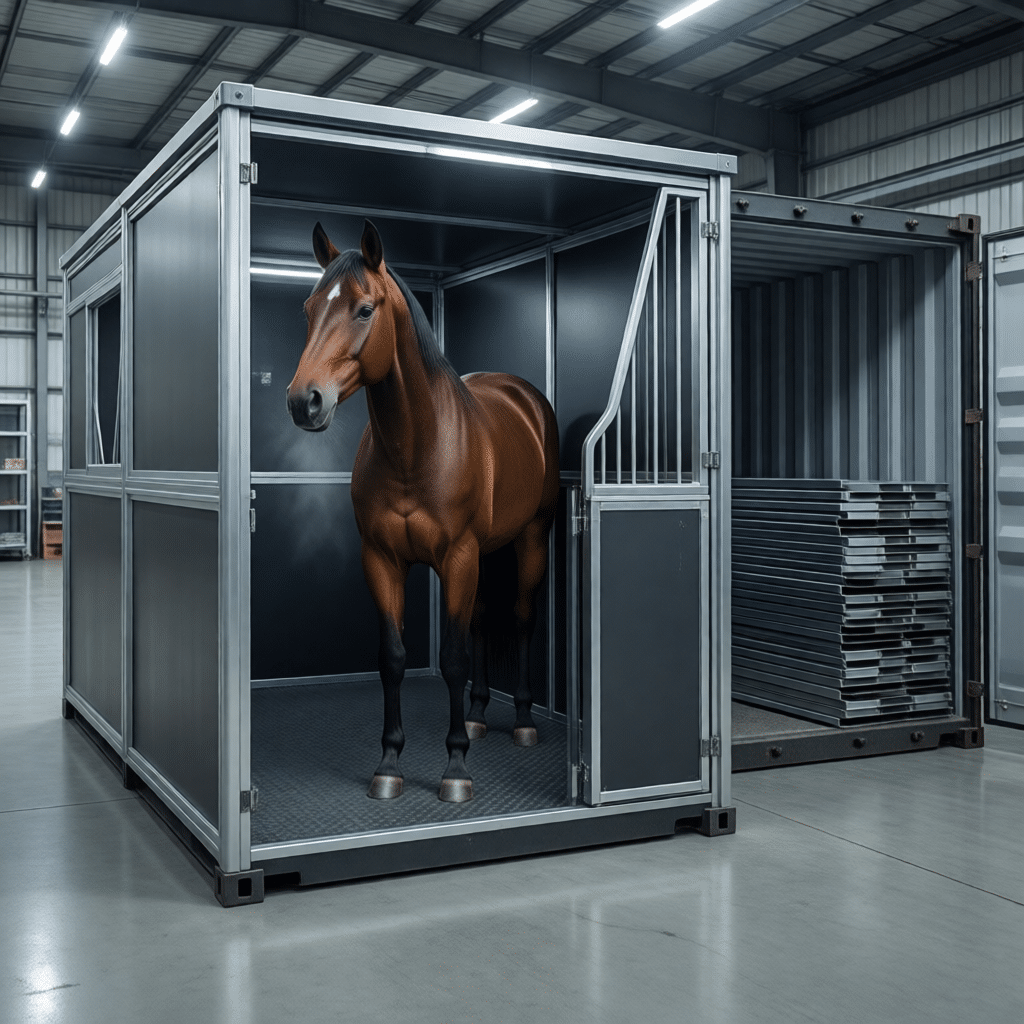
Touring Show Logistics demand absolute efficiency when moving 200 stalls between international venues. Every cubic meter of unused space in a container represents lost profit for event organizers. Traditional fully welded stalls cap loads at just 12 sets per 40HQ container, forcing logistics teams to book unnecessary freight and bloat their operational budget.
This report benchmarks the DB Stable flat-pack system against standard welded alternatives. We analyze how increasing load density to 45 sets per container and utilizing Q235B structural steel reduces shipping costs by over 60 percent while maintaining the durability required for repetitive assembly cycles.
صعود الحوكمة البيئية والاجتماعية وحوكمة الشركات في مجال الإنشاءات
By 2026, ESG has shifted from voluntary reporting to mandatory compliance. Construction firms must now quantify supply chain carbon, favoring high-density logistics and extended product lifecycles.
<
/blockquote>
From Voluntary Guidelines to Mandatory Scope 3 Compliance
The era of vague “green” mission statements is over. By 2026, the construction industry has moved from narrative sustainability reports to legally mandated disclosures backed by third-party verification. Regulators and investors now require hard data, and the focus has shifted aggressively toward Scope 3 emissions—the indirect emissions that occur in your supply chain.
For project managers and developers, tracking direct operations (Scope 1 and 2) is no longer sufficient. You are now responsible for the carbon footprint of the materials you buy and how they get to your site. This operational necessity impacts mid-market suppliers heavily. Suppliers who cannot provide specific emissions data or demonstrate logistics efficiency risk losing contracts to competitors who can validate their carbon impact.
Reducing Supply Chain Carbon with DB Flat-Pack Systems
Logistics efficiency is the fastest way to reduce Scope 3 emissions in large-scale equestrian projects. We designed the DB Stable supply chain to directly support these mandatory carbon reduction goals through optimized density and product longevity.
Solving the “Shipping Air” Problem: Traditional fully welded stalls utilize container space poorly, capping loads at just 12-15 sets per 40HQ container. This inflates the fuel consumption and carbon emissions allocated to each unit.
High-Density Logistics: Our Steel Pallet Flat-Pack system allows us to load 30-45 مجموعة لكل 40HQ حاوية 40HQ. By doubling or tripling the volume per shipment, we significantly lower the transport emissions per stable.
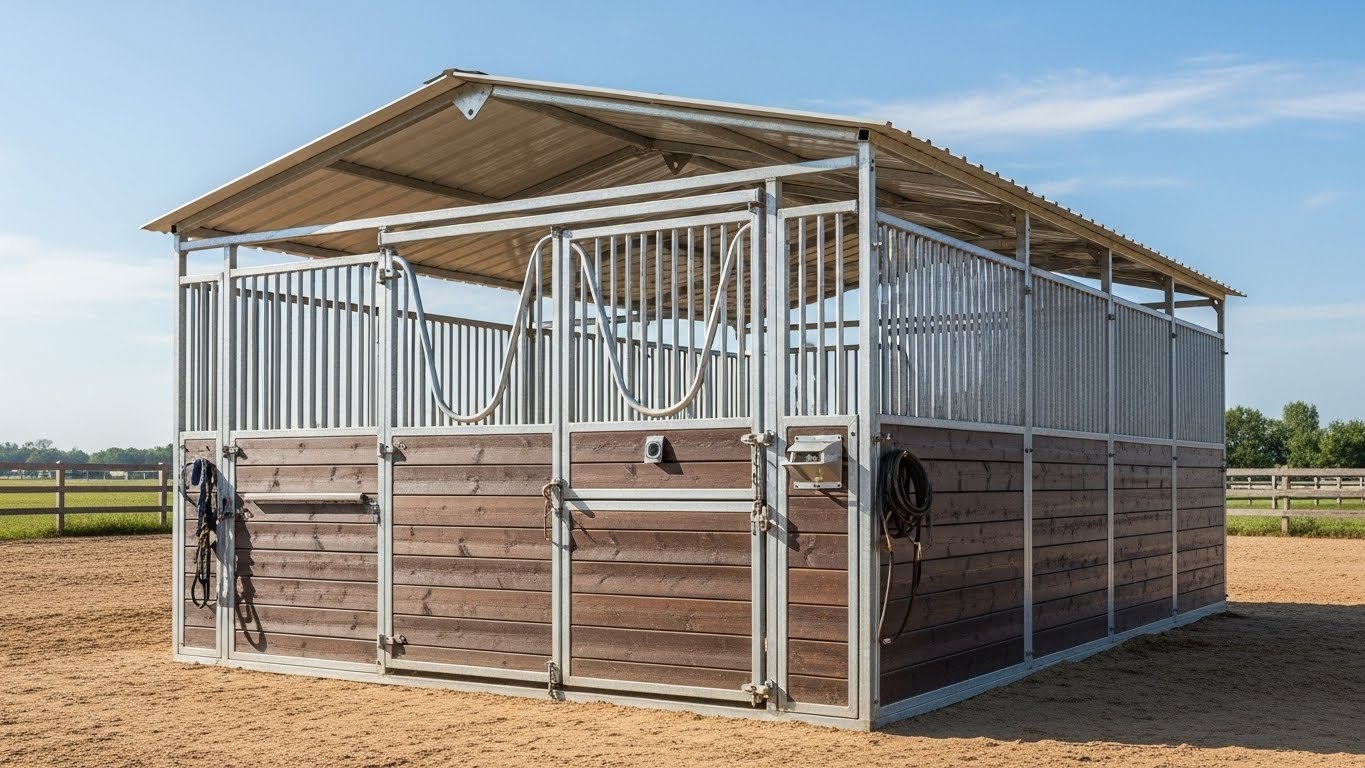
Extended Lifecycle Reduces Waste: ESG isn’t just about shipping; it’s about replacement frequency. We apply الجلفنة بالغمس الساخن (ISO 1461) after fabrication. This prevents rust and extends the product lifespan to 20+ years, aligning with waste reduction goals by eliminating the need for frequent replacements common with painted or pre-galvanized alternatives.
The equestrian industry is abandoning slow-growth Oak and Pine for Strand Woven Bamboo and HDPE. These alternatives offer superior impact resistance and mature in years, not decades.
The Ecological and Practical Limits of Hardwood
For decades, stable construction relied heavily on Oak and Pine. While aesthetically classic, these materials present significant liabilities for modern commercial facilities. The primary bottleneck is regeneration time. Hardwoods require 30 to 50 years to reach harvest maturity, creating a supply chain that cannot keep pace with current construction demands without contributing to deforestation concerns.
Beyond the environmental cost, natural timber fails the durability test in active stable environments. Softwoods like Pine are highly susceptible to “cribbing” (horses chewing on wood) and moisture rot from daily washdowns. Even harder woods suffer from inconsistent grain density. This natural variation often leads to dangerous splintering under heavy impact, posing a direct safety hazard to the animals.
High-Density Bamboo: The 3,000 Janka Standard
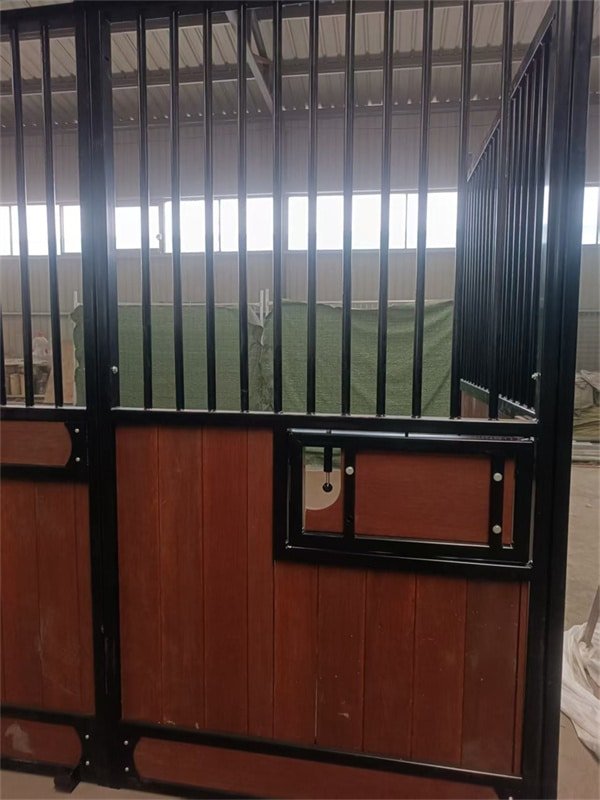
We have shifted our production focus to Strand Woven Bamboo to solve these durability issues. Unlike traditional timber, this material is engineered under extreme pressure to achieve a density that creates a true “Kick-Proof” barrier. It outperforms traditional wood in every mechanical metric that matters to stable managers.
Extreme Hardness: Our bamboo infills rate over 3,000 lbf on the Janka Hardness scale, making them three times harder than Oak.
Rapid Regeneration: Bamboo reaches maturity in just 3-5 years, aligning with sustainable manufacturing goals without the supply lags of old-growth forests.
مقاومة الرطوبة: The high-density compression prevents water absorption, effectively eliminating the rot and mold risks common in pine stables.
Premium Stables Built For 20-Year Durability
Maximize your facility’s ROI with hot-dipped galvanized steel stables that resist rust for decades in any climate. Our modular systems cut installation time by 30%, ensuring rapid deployment and long-term value.
ملخص تنفيذي: True industrial sustainability isn’t just about solar panels on the roof; it’s about material circularity. Leading factories prioritize Q235B recyclable steel and rapid-growth bamboo to maximize product lifespan and minimize resource depletion.
The definition of a “top factory” has shifted. Ten years ago, output speed defined the leader. Today, regulatory mandates and B2B buyer demand have forced a pivot toward Lifecycle Assessment (LCA). Factories are no longer isolated production units; they are audited nodes in a global supply chain where carbon footprints are measured from cradle to grave. While global giants like First Solar and Metso Outotec lead the headlines with renewable energy integration, the heavy manufacturing sector—specifically in structural engineering and equestrian infrastructure—is achieving sustainability through material science.
Sustainability Factor
B2B Advantage
Recyclability
Q235B Structural Steel
Infinite Re-smelting
High strength-to-weight ratio
100% (Closed Loop)
خيزران منسوج من الخيزران
Carbon Sequestration
3x Harder than Oak
Biodegradable / Fuel
Hot-Dip Galvanization (ISO 1461)
50+ Year Lifespan
Eliminates replacement costs
Zinc is 100% Recyclable
الأخشاب التقليدية
Slow Regrowth (Decades)
Traditional Aesthetic
Low (Rot/Chemicals)
The Steel Framework: Q235B as the Circular Standard
In the B2B sector, “sustainability” often gets confused with “biodegradability.” But for structural applications, durability is sustainability. The most responsible thing a factory can do is build a product that doesn’t need to be replaced for 50 years. This is why top-tier manufacturers strictly adhere to Q235B structural steel (or Q345B for cold climates) rather than cheaper, non-standard composites.
Q235B steel acts as a zero-waste asset. Unlike concrete, which ends up in landfills, or treated lumber which releases chemicals, Q235B can be resmelted indefinitely without losing its material properties. Current industry data suggests that approximately 70% of steel produced today is already recycled. Factories utilizing this material are effectively participating in a closed-loop system where the “waste” from a demolished warehouse becomes the raw material for a new equestrian facility.
The Move from Old-Growth to Engineered Bamboo
The reliance on old-growth hardwoods like Oak and Pine is fading. These trees take 30 to 50 years to mature, and their harvest disrupts deep-root carbon storage. Forward-thinking factories have transitioned to High-Density Strand Woven Bamboo. This material offers a pragmatic solution to the ESG dilemma: performance vs. preservation.
Rapid Regeneration: Bamboo reaches maturity in 3-5 years, compared to decades for hardwood.
Carbon Sink: Moso bamboo forests sequester up to 40 tons of carbon per acre annually—significantly higher than pine plantations.
صلابة فائقة: With a Janka hardness rating exceeding 3000 lbf, strand-woven bamboo outperforms traditional oak, resisting hoof impact and chewing damage.
Process Sustainability: Galvanization & Logistics
Material choice is only half the equation. The processing method dictates the true environmental footprint. Leading manufacturers have moved away from painting—which requires frequent re-application and releases VOCs—in favor of Hot-Dip Galvanization (BS EN ISO 1461). By dipping steel into molten zinc بعد fabrication, the steel is bonded with a protective coating exceeding 85 microns. This extends the service life to over 50 years, drastically reducing the carbon cost associated with manufacturing replacement parts.
Logistics also play a massive, often overlooked role in factory sustainability. Shipping air is expensive and carbon-intensive. Smart factories utilize flat-pack engineering to optimize container loads. While traditional welded units fill a 40HQ container with just 12 sets, optimized flat-pack systems fit 30-45 sets. This single engineering decision reduces shipping-related emissions by over 60% per unit, proving that profit protection and environmental responsibility often align.
خيزران منسوج من الخيزران: بالوعة كربون عالية الإنتاجية
Bamboo forests absorb up to 12 tons of carbon per hectare annually. Our strand woven process locks this carbon into boards 3x harder than oak, creating a durable, long-term sink.
Rapid Carbon Absorption in Bamboo Forests
Biologically, bamboo acts as a massive vacuum for atmospheric CO2. While traditional hardwood forests take decades to mature and sequester carbon, bamboo operates on a rapid 3-5 year regeneration cycle. This allows for continuous harvesting without the deforestation associated with timber.
Data shows that managed bamboo plantations absorb up to 12 tons of carbon per hectare annually—nearly double the rate of standard mixed forests. A single culm can sequester roughly 50–60 kilograms of CO2 over its lifespan. Because the root system remains intact after harvesting, the soil continues to store carbon while the plant regenerates, making the raw material a net-negative carbon asset before it even enters the factory.
Locking Carbon via High-Density Strand Woven Technology
Capturing carbon is only half the battle; keeping it locked away is where manufacturing plays a critical role. If bamboo decays, that stored carbon is released back into the atmosphere. We prevent this through our strand woven manufacturing process, which compresses fibers into high-density boards.
Carbon Locking: The compression process effectively freezes the stored carbon into the product for the entirety of its lifespan.
Extreme Durability: With a Janka Hardness > 3000 lbf (3x harder than Oak), these boards resist the physical wear that breaks down softer woods.
Decay Resistance: High density prevents moisture ingress and rot, ensuring the product remains a stable carbon store rather than decomposing.
الأسئلة المتداولة
كيف تبني مركزاً للفروسية متوافقاً مع المعايير البيئية والاجتماعية والمؤسسية؟
Building for ESG compliance requires a structured approach across three pillars. For Environmental impact, prioritize renewable energy (solar can cover 80% of consumption) and closed-loop water systems for wash bays. Social responsibility demands strict safety protocols for staff and animals, alongside fair labor practices. Governance involves documenting these policies and tracking data year-over-year. You cannot claim compliance without measuring your baseline emissions and setting specific reduction targets.
هل الخيزران مادة بناء مستدامة؟
Yes, but the processing method matters. Bamboo is highly sustainable due to its rapid 3-5 year growth cycle and ability to regenerate without replanting. It absorbs significantly more CO2 than traditional timber. However, raw bamboo is prone to rot. To be a viable, long-lasting building material, it must be processed into Strand Woven Bamboo. This engineered process increases density and hardness (Janka > 3000 lbf), giving it the durability to act as a long-term carbon sink in construction applications.
التأثير البيئي للحظائر الفولاذية مقابل الحظائر الخشبية؟
The trade-off is between embodied carbon and lifecycle longevity. Wood typically has lower initial embodied carbon because trees grow naturally. However, steel (specifically Q235B) is 100% recyclable and supports a circular economy. Steel structures do not rot, warp, or require toxic chemical treatments to survive, often resulting in a longer lifespan with zero landfill waste at the end of the building’s life. For high-traffic industrial or equestrian use, steel’s durability often outweighs the initial manufacturing carbon cost.
الشهادات الخضراء لإسطبلات الخيول؟
There is no specific “Green Stable” certification. However, facilities often apply LEED (Leadership in Energy and Environmental Design) standards or adhere to regional codes like California’s CalGreen. These frameworks focus on stormwater management, using recycled materials (like steel), and energy efficiency. To achieve recognition, stable owners should document their use of sustainable materials, water recycling systems, and renewable energy integration during the design phase.
الشركات المصنعة لحظائر الخيول الصديقة للبيئة؟
Several manufacturers prioritize sustainability through different methods. هياكل العاصمة focuses on responsibly sourced heavy timber. MD Barnmaster و WYO Custom Builders utilize modular steel designs that minimize construction waste and offer high recyclability. At the component level, مستقر دي بي supplies high-density strand woven bamboo infills and hot-dip galvanized steel to builders, ensuring the core materials of the stable resist decay and support long-term environmental goals.
فولاذ Q235B: إطار 100% القابل لإعادة التدوير
Q235B steel is a fully recyclable ferrous alloy that retains structural integrity through multiple cycles. When hot-dip galvanized, it offers a sustainable, high-strength alternative to disposable composite materials.
The Circular Lifecycle of Ferrous Alloys
Sustainability in industrial manufacturing often comes down to the exit strategy of the material. Q235B is a ferrous metal alloy (equivalent to ASTM A36) that retains its mechanical properties through indefinite recycling cycles. Unlike composite building materials or treated timber, which often degrade into landfill waste, steel components can be melted down and repurposed without losing strength.
The production method itself drives waste reduction. We utilize prefabricated factory production for our stable systems. This controlled environment minimizes the material loss inherent in on-site concrete or timber construction. For events and temporary installations, this modularity supports a circular logistics model—structures are disassembled and reused rather than demolished.
Extending Service Life via ISO 1461 Galvanization
Recyclability is the backup plan; longevity is the primary environmental goal. To ensure the Q235B core lasts, we apply Hot-Dip Galvanization بعد Fabrication. This creates a metallurgical bond that cheap pre-galvanized alternatives cannot match.
Standard Compliance: Process conforms strictly to BS EN ISO 1461.
سُمك الطلاء: Achieves an average zinc coating of > 85 microns on structural parts (>6mm).
العمر الافتراضي: Protects the steel core for a 50-year potential service life.
Resource Efficiency: Prevents early disposal and reduces the frequency of remanufacturing.
الأسئلة المتداولة
كيف تبني مركزاً للفروسية متوافقاً مع المعايير البيئية والاجتماعية والمؤسسية؟
Building an ESG-compliant facility requires a three-pronged approach. Environmentally, focus on renewable energy (leading hospitals generate 80% of electricity via solar) and closed-loop water systems that harvest rainwater. Socially, you must formalize safety protocols and improve staff work-life balance to combat industry-wide turnover. Governance involves setting clear, data-driven targets for emissions and waste reduction rather than vague promises. Start by auditing your current energy use and establishing a baseline before pursuing external certifications.
هل الخيزران مادة بناء مستدامة؟
Yes, bamboo is highly sustainable due to its rapid regeneration cycle—it matures in 3-5 years compared to decades for hardwood. It also sequesters significantly more carbon and releases more oxygen than equivalent tree stands. However, raw bamboo has poor natural durability. For equestrian use, we use high-density strand-woven bamboo (Janka Hardness > 3000 lbf), which is processed to resist rot and impact while maintaining the material’s eco-friendly profile.
التأثير البيئي للحظائر الفولاذية مقابل الحظائر الخشبية؟
This is a tradeoff between embodied carbon and lifecycle durability. Wood barns typically have lower upfront carbon emissions during production since trees grow naturally. However, steel barns—specifically those using Q235B/A36 equivalents—are 100% recyclable and maintain their integrity indefinitely. Steel resists warping, rot, and pests without chemical treatments, often resulting in a longer operational lifespan and lower maintenance burden, which can offset the higher initial production energy over time.
الشهادات الخضراء لإسطبلات الخيول؟
There is no specific “Green Stable” certification. Instead, facilities adapt broader commercial standards like LEED (Leadership in Energy & Environmental Design) or adhere to regional codes like California’s CalGreen. Key areas for compliance include stormwater management (bioswales, permeable pavers), energy efficiency (LED lighting, solar integration), and the use of recycled construction materials.
الشركات المصنعة لحظائر الخيول الصديقة للبيئة؟
The market is split between timber specialists and modular steel fabricators. For timber, companies like هياكل العاصمة focus on responsibly sourced heavy timber. For steel, manufacturers like MD Barnmaster و WYO Custom Builders utilize modular designs that reduce construction waste. At DB Stable, we align with the latter approach, utilizing flat-pack logistics and recyclable Q235B steel to minimize the carbon footprint of transport and assembly.
الأفكار النهائية
Logistics efficiency is no longer just a cost-saver; it is a mandatory component of Scope 3 compliance. Sticking with traditional fully welded stalls caps your shipping volume at 12 sets per container, inflating your carbon footprint and freight costs. By switching to the DB Flat-Pack system, you triple your logistics density to 45 sets per load, directly aligning your operation with 2026 ESG mandates while protecting your bottom line.
Sustainability claims demand physical verification before you commit to a full fleet upgrade. We recommend initiating a Trial Order (3-5 sets) to inspect our high-density packaging and ISO 1461 galvanization quality firsthand. Contact our engineering team today to configure a sample shipment that fits your specific touring or distribution logistics.
مرحباً، أنا فرانك تشانغ، مؤسس شركة DB Stable، شركة تديرها عائلة، خبير متخصص في إسطبلات الخيول. في السنوات الـ 15 الماضية، ساعدنا 55 دولة وأكثر من 120 عميلاً مثل المزرعة والمزرعة لحماية خيولهم. الغرض من هذه المقالة هو مشاركة المعرفة المتعلقة بإسطبلات الخيول للحفاظ على سلامة حصانك.




 Arabic
  English
  Spanish
  French
  German
0 تعليق