

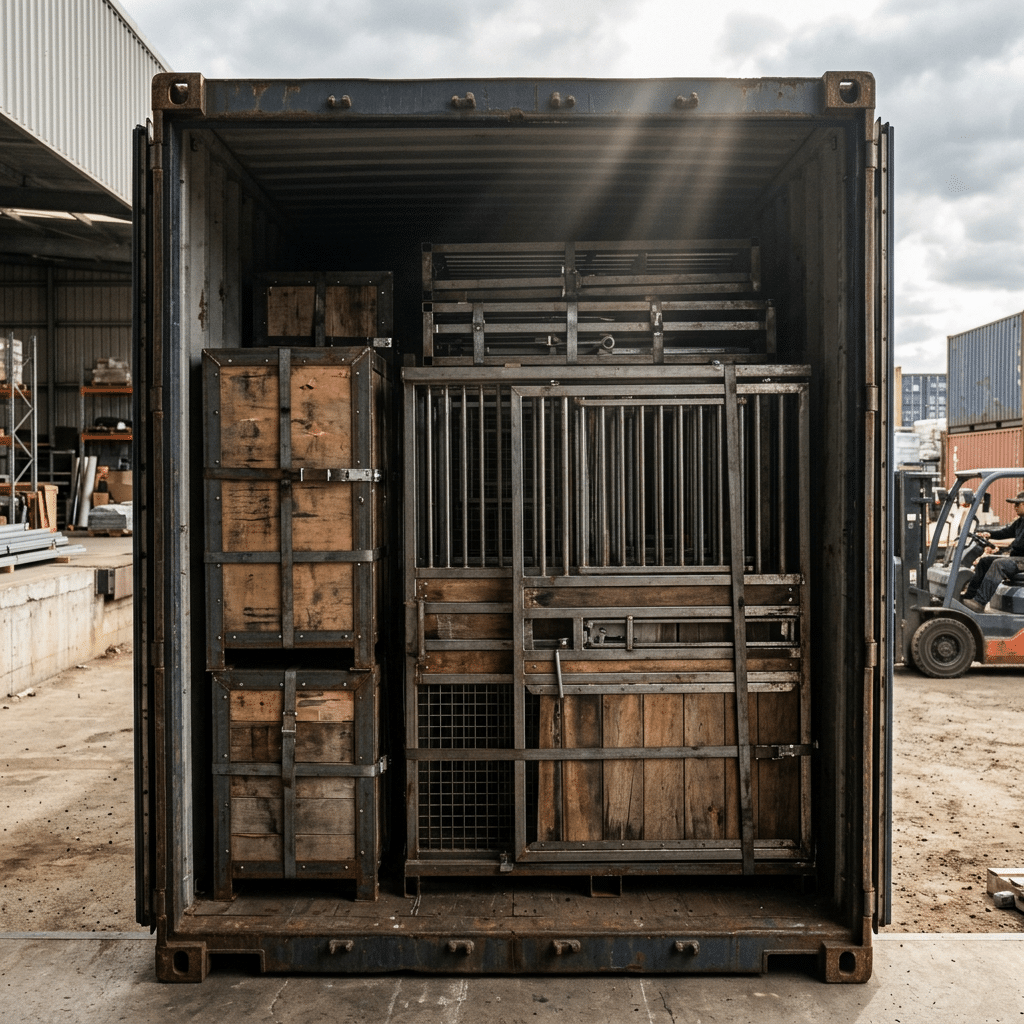
Procuring infrastructure for Mounted Police Units demands rigorous adherence to safety protocols beyond standard recreational specifications. Utilizing standard Q235B steel often leads to structural failure under the impact of heavy draft-cross breeds, resulting in immediate veterinary liabilities and costly early asset replacement for tax-funded agencies.
This analysis benchmarks manufacturers based on the critical Q345B Low Alloy High Strength Steel standard essential for cold-climate resilience. We evaluate fabrication compliance against BS EN ISO 1461 hot-dip galvanization protocols and Cast-Proof design requirements to help contractors secure compliant, low-maintenance government tenders.
The Unique Demands of Institutional Mounted Units
مقارنة سريعة
| Operational Aspect | Department | Key Resources | الحكم |
|---|---|---|---|
|
Personnel Requirements & Selection |
Human Resources | Specialized Officers, Vetted Personnel | Requires full-time sworn personnel with elevated vetting, fitness standards, and specialized equestrian training. |
|
Training Infrastructure & Commitment |
Facilities & Education | Ongoing Training, Equestrian Facilities | Demands dedicated infrastructure (like the Ahmanson Facility) and mandatory monthly sessions for officer-horse dynamics. |
|
Equipment & Asset Management |
Logistics | Horses, Transport Vehicles, Tack | Operations necessitate significant capital investment for high-quality horses, trailers, and stable maintenance. |
|
Operational Specialization |
Tactical Operations | Crowd Control, Search & Rescue | Serves as a force multiplier in crowd control and special events due to size and intimidation value. |
|
Structural Complexity |
Administration | Command Structure, Oversight | Involves multiple administrative layers and dedicated supervision to ensure proper institutional oversight. |
Personnel Requirements & Selection
Demands **highly vetted sworn officers** with superior physical fitness and a commitment to rigorous, specialized training.
Mounted units function differently than standard patrols, requiring full-time sworn personnel who have successfully completed their probationary periods. These roles demand elevated vetting protocols and strict physical fitness standards to ensure operational safety.
Beyond basic policing skills, candidates must demonstrate flexibility for irregular work schedules. Comprehensive preparation is mandatory, often involving intensive regimens like the LAPD’s 200-hour equestrian course to solidify horse-and-rider coordination.
📊 لمحة سريعة:
- 📍 Department: Human Resources
- 🏭 Core Output: Specialized Officers, Vetted Personnel
- 🌍 Sector: Law Enforcement
Why It Matters:
| ✅ المكاسب | ⚠️ المبادلات ⚠️ |
|---|---|
|
|
Training Infrastructure & Commitment
Requires **dedicated real estate** and rigorous monthly schedules to ensure officer-horse dynamics hold up under pressure.
Effective mounted units rely on specialized physical infrastructure, exemplified by the LAPD’s two-acre Ahmanson Equestrian Facility. These dedicated grounds are critical not just for housing assets, but for providing a controlled environment to simulate operational challenges.
Beyond physical space, operational readiness demands a heavy time investment significantly higher than standard patrol duties. Mandatory monthly training sessions are enforced to solidify the complex bond between officer and horse, ensuring safety during high-stress deployments.
📊 لمحة سريعة:
- 📍الموقع: Facilities & Education
- 🏭 القوة الأساسية: Ongoing Training, Equestrian Facilities
- الأسواق الرئيسية: Institutional Training
لماذا اخترناهم:
| ✅ المكاسب | ⚠️ المبادلات ⚠️ |
|---|---|
|
|
Equipment & Asset Management
Operations require significant **capital investment** to support rigorous horse selection and complex transport logistics.
Operations demand substantial financial commitment for a wide array of specialized assets. This includes the procurement and maintenance of horses, heavy transport trucks, trailers, tack, and dedicated stable facilities.
The selection process for service animals is strictly rigorous. Candidates must meet specific conformation standards, demonstrate high stamina, and possess well-muscled backs to endure the physical demands of police work.
📊 لمحة سريعة:
- 📍 Category: Logistics
- 🏭 Key Assets: Horses, Transport Vehicles, Tack
- 🌍 Focus Area: Asset Management
لماذا اخترناهم:
| ✅ المكاسب | ⚠️ المبادلات ⚠️ |
|---|---|
|
|
Operational Specialization
**Force multiplier effect.** Mounted units leverage size and intimidation to effectively move large crowds with minimal personnel.
Mounted units are deployed for specific high-value functions such as crowd control, searches in limited-access areas, and special events. Operations focus on scenarios where standard patrol vehicles or foot officers cannot operate effectively.
Horses provide distinct advantages in moving large groups with few personnel due to their size and intimidation value. This unique capability allows agencies to manage volatile situations with a reduced officer footprint compared to traditional methods.
📊 لمحة سريعة:
- 📍الموقع: Tactical Operations
- 🏭 القوة الأساسية: Crowd Control, Search & Rescue
- الأسواق الرئيسية: Public Safety
لماذا اخترناهم:
| ✅ المكاسب | ⚠️ المبادلات ⚠️ |
|---|---|
|
|
Structural Complexity
**Strict supervisory infrastructure** is mandatory to manage the high-liability nature of mounted operations effectively.
Even the smallest mounted units require a dedicated chain of command involving lieutenants, sergeants, and lead training officers. This specialized oversight is essential for maintaining safety standards and adherence to rigorous operational protocols.
Unlike standard patrol squads, this structure introduces multiple administrative layers. These layers are critical for ensuring proper institutional control over complex officer-horse dynamics and ongoing training requirements.
📊 لمحة سريعة:
- 📍الموقع: Administration
- 🏭 القوة الأساسية: Command Structure, Oversight
- الأسواق الرئيسية: Police Management
لماذا اخترناهم:
| ✅ المكاسب | ⚠️ المبادلات ⚠️ |
|---|---|
|
|
إسطبلات مصممة بدقة متناهية مع متانة تدوم 20 عاماً

The Unique Demands of Institutional Mounted Units
Institutional mounted units operate under strict public scrutiny and operational urgency, requiring infrastructure that far exceeds recreational standards. By utilizing Q345B structural steel and hot-dip galvanization, we ensure facilities can withstand the high impact of draft-cross breeds while minimizing long-term maintenance costs for tax-funded agencies.
Heavy-Duty Infrastructure for High-Asset Equines
Mounted police units typically utilize large draft-cross breeds selected for their imposing physical presence and calm temperament in crowd control scenarios. These animals, often weighing over 650kg (1,400 lbs), generate impact forces significantly higher than standard riding horses. To mitigate structural failure, we specify فولاذ Q345B منخفض السبائك عالي القوة (equivalent to ASTM Grade 50) for all institutional frameworks. This material choice offers superior low-temperature impact toughness, ensuring our “Kick-Proof Guarantee” holds even during harsh winters when standard steel might become brittle.
Public funding demands rigorous asset protection and a demonstrably long service life. Standard powder coating often fails under the high-ammonia conditions of a busy police barn, leading to rapid corrosion and costly early replacement. We implement الجلفنة بالغمس الساخن بعد التصنيع, strictly adhering to BS EN ISO 1461 standards. This process ensures an average zinc coating above 85 microns on structural parts, providing a metallurgical bond that resists urine corrosion and physical abrasion for decades, safeguarding the taxpayer’s investment.
Operational efficiency is equally critical; sworn officers must focus on patrol duties and training rather than facility repairs. We recommend HDPE infill planks for these high-traffic environments. Unlike traditional wood, which rots and encourages cribbing, our UV-stabilized HDPE offers a “Zero Maintenance” solution that absorbs impact and resists chewing. This allows personnel to allocate their time to policing rather than carpentry.

Operational Safety and Facility Layout Requirements
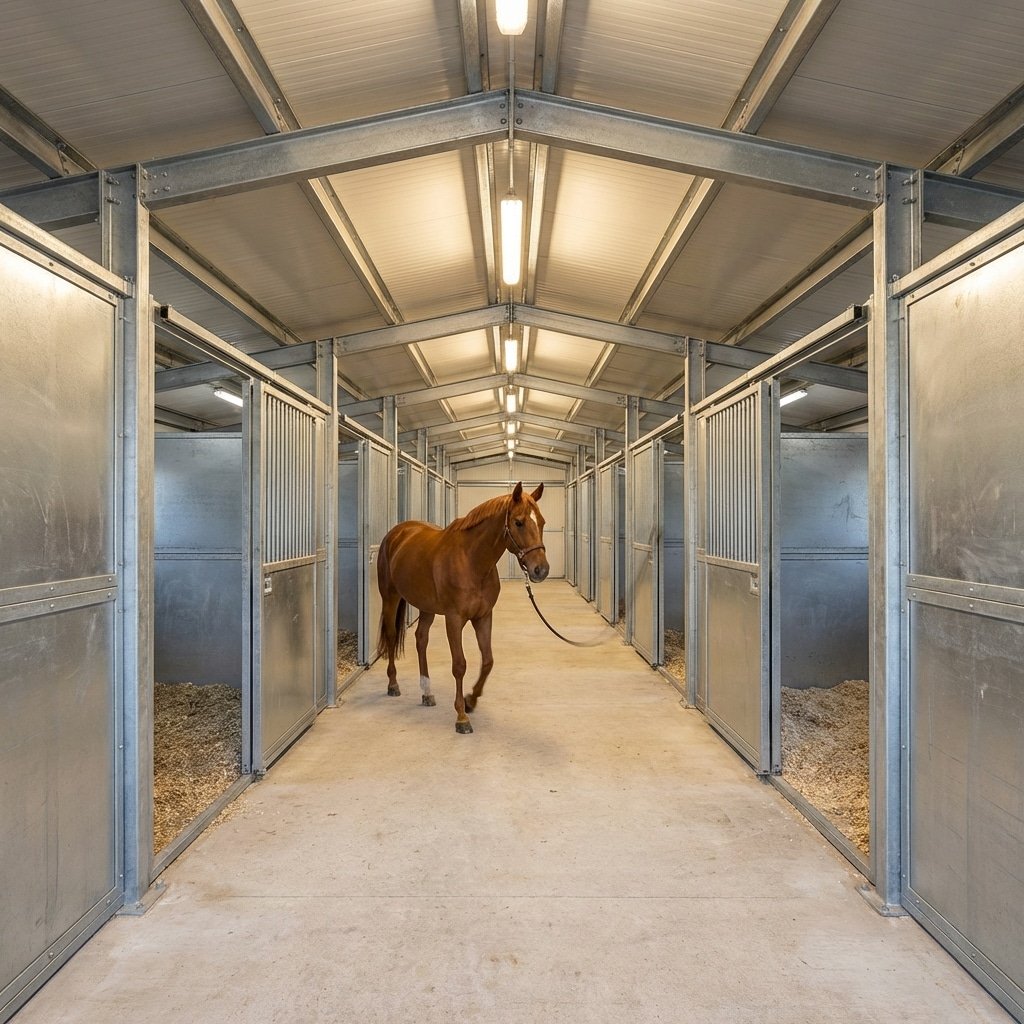
Rapid deployment capabilities are essential during emergency call-outs. Traditional hinged doors can obstruct narrow aisleways, slowing down the tacking-up process when multiple officers are mobilizing simultaneously. We design stable fronts with heavy-duty sliding tracks—central to our Professional Series—to keep aisleways entirely clear. This layout facilitates the safe, unobstructed movement of officers and equipment during high-pressure departures.
Protecting high-value animals from injury is a fiscal priority for the department. Our engineering team utilizes a “Cast-Proof Design,” limiting bottom gaps to approximately 50mm. This specific clearance prevents horses from trapping their legs if they roll—a common cause of career-ending injuries in older, less specialized facility designs. This attention to detail reduces veterinary liabilities and preserves the unit’s operational capacity.
Veterinary isolation is often a mandate for managing large herds within a government facility. We recommend physically separating the main barn from a dedicated quarantine wing. For this specific application, the السلسلة الاقتصادية serves as an ideal solution, providing a fully hot-dip galvanized frame and hygienic HDPE infill to manage biosecurity effectively without the higher cost basis of the main operational stalls.
Steel Yield Strength: Q235B vs. Q345B for Draft Crosses
For draft crosses and institutional mounted units, standard Q235B steel often falls short of safety requirements. We recommend upgrading to Q345B low-alloy structural steel, which delivers a minimum yield strength of 345 MPa—47% stronger than standard carbon steel. This material specification is critical for preventing structural deformation from heavy leaning and eliminating brittle fractures in freezing conditions.
Yield Strength Analysis: 345 MPa vs. 235 MPa for High-Impact Zones
When housing Draft Crosses, the static load an
d impact force exerted on stall fronts significantly exceed those of light riding breeds. Standard Q235B steel (equivalent to ASTM A36) operates with a yield strength of 235 MPa. While this is sufficient for general boarding, it risks permanent bending or “bowing” under the sustained weight of a 1,600+ lb animal leaning against a grill.
To mitigate this, our Professional Series mandates the use of Q345B (equivalent to ASTM Grade 50). This alloy increases the yield strength to 345 MPa, providing a 47% boost in structural resilience. This additional strength allows the framework to absorb the high kinetic energy of large police horses without warping, ensuring that sliding doors and partitions remain functional and aligned over decades of heavy institutional use.
Low-Temperature Toughness: Preventing Brittle Fracture in Winter
Steel behavior changes drastically in cold climates, a critical factor for stables in Northern Europe and North America. Standard carbon steel (Q235B) can lose ductility in freezing temperatures, becoming brittle. If a horse kicks a frozen bar made of inferior steel, it faces a higher risk of snapping sharply rather than bending, creating dangerous jagged edges.
We utilize Q345B because it incorporates microalloying elements like vanadium and titanium. These elements refine the steel’s grain structure, ensuring it retains superior impact toughness even in unheated facilities during severe winters. This specific alloy composition supports our “Kick-Proof Guarantee,” ensuring that a high-impact kick in sub-zero temperatures results in structural resistance rather than a catastrophic fracture.
Tamper-Proof Hardware and Flush-Mounted Latches
Mounted police operations require specialized equipment that eliminates gear snagging risks while securing high-value animals. We engineer our latch systems to integrate directly into the structural framework, creating a flush profile that prevents injury and resists tampering by intelligent working horses.
Flush-Mounted Interfaces for Officer and Animal Safety
Mounted police units operate with specialized tack and tactical gear that can easily snag on the protruding handles found on traditional stable doors. To mitigate this risk, we engineer our latches to sit flush within the 50mm RHS or 114mm round posts. This design eliminates dangerous catch points in the aisle, allowing officers to move quickly during rapid tack-up procedures without their equipment becoming entangled in the stall front.
This flush integration is a critical component of our “Cast-Proof Design” philosophy. Horses often rub against stall fronts or roll near the door, and exposed metalware poses a significant laceration risk. By recessing the mechanism, we ensure that the animal encounters only a smooth, hot-dip galvanized surface. This protects the physical well-being of the mount and preserves the integrity of the officer’s saddlery.
Tamper-Resistant Mechanisms with 304 Stainless Steel
Institutional horses, particularly the intelligent draft crosses frequently selected for patrol work, often attempt to manipulate door bolts with their lips. Standard sliding latches frequently fail to contain these animals. We utilize gravity-assisted and spring-loaded locking systems that require human manual dexterity to operate. This effectively tamper-proofs the stall against animal escape artists, ensuring secure containment when the unit is not on duty.
Reliability in a high-ammonia environment is non-negotiable. We manufacture every component of the hardware kit—including anchor bolts, screws, and connectors—from 304 Stainless Steel. Unlike standard zinc-plated hardware which corrodes rapidly under daily washing and exposure to animal waste, 304 Stainless Steel ensures that the security mechanisms remain rust-free and fully functional throughout the operational lifespan of the facility.
DB’s ISO 9001 Traceability for Gov Contracts
Government tenders for mounted unit infrastructure require rigorous documentation to satisfy public liability audits and procurement regulations. We support institutional clients by providing comprehensive Mill Test Reports (MTRs) and ISO-certified manufacturing logs, creating a verifiable chain of custody from raw steel smelting to final hot-dip galvanization.
Verifiable Material Sourcing: Q345B and ISO 1461 Logs
Public sector projects cannot rely on verbal assurances regarding material quality; they demand documented proof to mitigate liability risks associated with infrastructure failure. We address this by providing full Mill Test Reports (MTRs) for every batch of steel used in production. These reports verify the chemical composition and mechanical properties of our Q345B Low Alloy High Strength Steel, confirming it meets or exceeds ASTM Gra
de 50 equivalents for impact toughness.
This traceability extends to our “Lifetime” rust protection standards. Unlike competitors who use pre-galvanized tubing that rusts at the weld points, we utilize a “Hot-Dip After Fabrication” process. Our manufacturing logs confirm that every structural component undergoes immersion according to BS EN ISO 1461 standards, achieving an average zinc coating thickness exceeding 85 microns. This data provides procurement officers with the evidence needed to reject inferior substitutions and validate the longevity of the investment.
Audit-Ready Quality Control for Institutional Compliance
Our ISO 9001:2015 certification establishes a clear data trail for every production run, which is essential for government audits that may occur months or years after installation. We record critical performance metrics for each batch, including ASTM B117 Salt Spray Test results that demonstrate over 96 hours of resistance without red rust. This level of documentation ensures that the safety standards promised in the tender are physically delivered to the facility.
Operational consistency is vital for long-term projects where stables may be installed in phases. Whether you are ordering a trial set of 3-5 stables or a full 40HQ container load of 30-45 sets, our quality management system ensures identical specifications. We maintain archive data for all government projects, guaranteeing that if a facility expands five years from now, the new “Professional Series” fronts will integrate seamlessly with the existing infrastructure.
الأفكار النهائية
Selecting generic infrastructure for mounted units is a liability risk that outweighs any upfront savings. Our Q345B “Kick-Proof” steel and ISO 1461 galvanization provide the structural certainty required to house high-value draft crosses safely. Invest in a facility that withstands public scrutiny and operational abuse for decades, protecting both the officers and the taxpayer.
Government contracts demand evidence, not promises; secure your project’s compliance with our verifiable Mill Test Reports and trace-ready production logs. We invite procurement teams to request a sample connection kit to physically validate our weld integrity and finish quality. Contact us today to integrate these heavy-duty specifications into your upcoming tender documentation.
الأسئلة المتداولة
How to build stables for police horses?
Police stables demand high durability and safety. We recommend using Hot-Dip Galvanized steel frames to resist corrosion and Q345B high-strength steel to withstand heavy impacts from large mounts. Our designs incorporate cast-proof bottom gaps (approx. 50mm) and flush hardware to meet strict animal welfare standards required by public oversight.
What is Q345B high strength steel?
Q345B is a low alloy structural steel equivalent to ASTM Grade 50. It offers superior toughness compared to standard Q235B, especially in freezing temperatures. We use this material for police and cold-climate stables to prevent brittle frame fractures if a powerful horse kicks the stall walls during winter.
Are flush mount latches safer?
Yes. Flush latches recess directly into the door frame, eliminating protruding metal that can snag halters or injure horses. This design also prevents intelligent horses from manipulating the latch with their mouths. We consider this hardware essential for maintaining security in high-activity institutional facilities.
How to win government equestrian contracts?
Winning tenders requires proving technical compliance and supply chain reliability. We back our distributors with ISO 9001 and ISO 1461 certifications, salt spray test reports, and full material traceability. Our flat-pack logistics also significantly reduce freight costs (loading 30-45 sets per 40HQ), allowing you to submit more competitive bids for large municipal projects.
Stall size for draft cross police horses?
Draft crosses typically require more space than standard riding horses. We recommend stalls measuring at least 3.5m x 3.5m (approx. 12×12 ft) or 4.0m x 4.0m (approx. 13×13 ft). Our modular panels accommodate these custom dimensions, and we strictly use 14-gauge (2.0mm+) tubing to support the weight of these larger animals.

 Arabic
  English
  Spanish
  French
  German
0 تعليق