

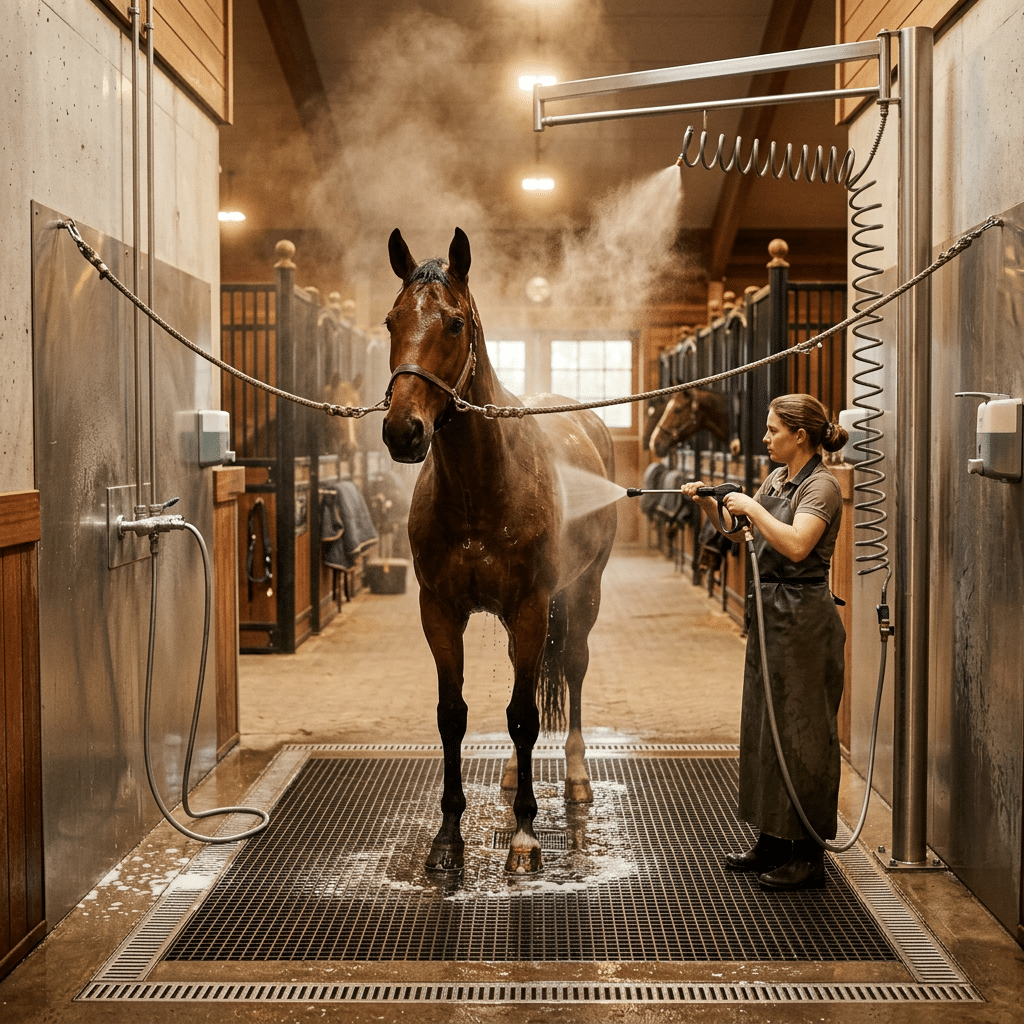
Foaling stall design is a critical control for mitigating respiratory damage and protecting the value of a newborn. Stalls that fail to manage floor-level ammonia concentrations directly contribute to chronic airway inflammation, leading to recurring veterinary expenses and compromising the foal’s long-term health and viability.
This analysis focuses on the engineering specifications that prevent these outcomes. We evaluate designs based on their capacity for ‘Stack Effect Ventilation,’ the durability of ‘Hot-Dip After Fabrication’ galvanizing in damp conditions, and the inclusion of non-negotiable safety features like a ‘Cast-Proof’ bottom gap.
The Ammonia Problem: Why Layout Dictates Lung Health
High ammonia concentrations at floor level pose a severe respiratory risk to foals. Stall design, especially open-top grills, is critical for promoting airflow and preventing this buildup.
How Ammonia Gas Puts Foals at Risk
Ammonia gas originates from the bacterial decomposition of urine in bedding. Because the gas is denser than air, its concentration is rou
ghly twice as high near the stall floor. Foals spend most of their early life lying down, putting their breathing zone directly in this high-risk area of concentrated gas.
This constant exposure is not a minor issue. Research shows that ammonia levels above 10 parts per million (ppm) can cause significant airway inflammation. The gas damages the cilia responsible for clearing debris from the lungs, which increases the foal’s susceptibility to pneumonia and chronic conditions like COPD.
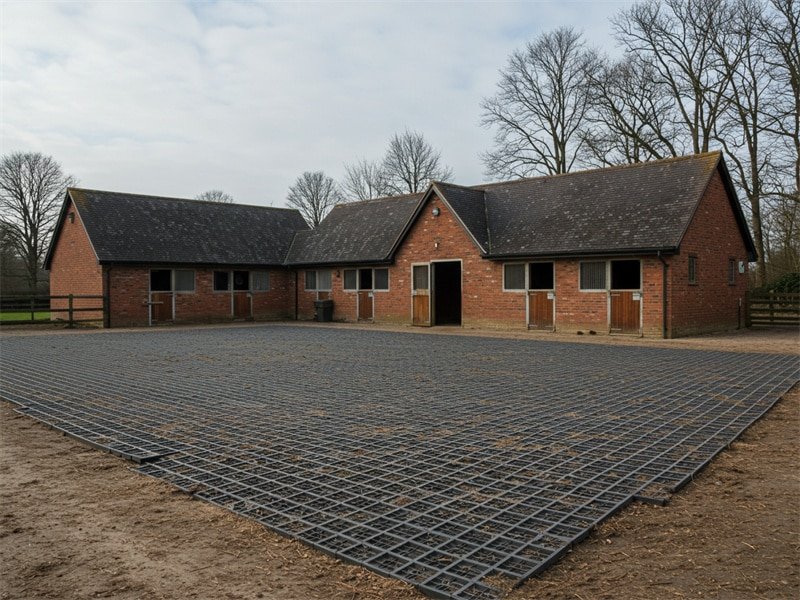
Designing for Airflow with Open Grill Partitions
We engineered the DB Stable systems to directly counter this threat. Our stall partitions feature an Open Top Grill design, which is a core safety feature, not just an aesthetic choice. This structure is built to improve air quality at the animal’s level.
This open structure promotes a principle called “Stack Effect Ventilation.” It allows the warmer, ammonia-laden air to rise and exit the stall, creating a natural convection current that pulls fresh, clean air in. Providing effective air exchange right where the horse breathes is the most direct defense against long-term respiratory damage.
Comparing Barn Layouts for Airflow
Barn layout is a direct trade-off. Open designs maximize natural airflow but sacrifice weather protection, while enclosed layouts demand well-engineered ventilation to prevent stale, toxic air.
| نوع التخطيط | Primary Airflow Mechanism | Strengths & Weaknesses |
|---|---|---|
| Inline (Shed Row) | Relies entirely on natural cross-ventilation. Each stall has an exterior wall with doors or windows, creating a direct path for fresh air. |
|
| Center Aisle | Uses a combination of cross-ventilation (end doors, windows) and the “stack effect.” Warm, moist air rises and exits through ridge vents or cupolas. |
|
| U-Shape (Courtyard) | Hybrid system that depends heavily on the building’s orientation to prevailing winds. The courtyard can either trap air or channel breezes. |
|
Why Airflow Dictates Animal Health
The entire point of comparing layouts is to combat ammonia. Ammonia gas forms from decomposing urine in bedding. It’s heavier than air, so concentrations are highest right at floor level—exactly where animals, especially young ones, spend their time lying down. Levels above 10 ppm can cause respiratory damage, and poorly ventilated stalls can easily hit 200 ppm or more.
This isn’t a minor issue. Chronic ammonia exposure damages the cilia in the airways, leading to inflammation, mucus buildup, and a higher risk of pneumonia or COPD. The barn’s physical layout is the primary tool for preventing this. A design that fails to move air at the floor level is a design that fails the animals inside it.

The Stack Effect: Your Engine in Still Weather
Wind-driven ventilation is great, but it stops working when the wind stops blowing. This is where the stack effect becomes critical, particularly in center-aisle barns. It’s a simple process driven by physics. The body heat from animals warms the air inside the barn. This warmer, less dense air rises.
A properly designed roof with a continuous ridge vent or cupolas gives this rising air a place to escape. As it leaves, it creates negative pressure inside the barn, which pulls cooler, fresh air in through lower openings like eave vents or windows. This process works 24/7, with or without wind, making it a reliable foundation for any enclosed barn’s ventilation system.
Durable, Compliant Stables Shipped Worldwide

Designing for the “Stack Effect” Ventilation
The stack effect uses natural temperature differences to ventilate stables. Warm air rises and exits through high openings, pulling fresh, cool air in from below for constant circulation.
The Science Behind Natural Air Circulation
The entire process runs on simple physics. A horse’s body heat warms the surrounding air, making it less dense. This lighter, warmer air naturally rises toward the ceiling. As it rises, it creates a pressure difference that pulls cooler, denser fresh air into the stall through lower openings.
This creates a silent, continuous cycle of air exchange. The system constantly removes excess moisture, ammonia, and stale air while replenishing oxygen. It works 24/7 without electricity, relying only on the temperature difference between the horse and the outside environment.
Open-Grill Design for Unobstructed Airflow
This natural ventilation process only works if the rising warm air has an escape route. Our stable fronts and partitions are engineered with an open top grill design for this exact purpose. This provides a clear, unobstructed exit path for the warm, moist air to leave the stall.
This isn’t just an aesthetic choice; it’s a built-in engineering feature for equine health. By facili
tating constant air movement, the design helps control humidity and dramatically reduces the buildup of airborne pathogens and ammonia that lead to respiratory issues. It’s a passive system that delivers active results.
الأسئلة المتداولة
What is the ideal layout for a horse barn?
There is no single ‘best’ layout, as it depends on your climate, herd size, and how you work. Effective layouts share key features: stalls of at least 12’x12′, wide aisles (12-14 feet), and plenty of natural ventilation to keep the air fresh.
How wide should the aisle in a horse barn be?
A 12-foot aisle is the industry minimum for safely leading horses. For busier barns where you might use equipment or have multiple people working, an aisle width of 14 to 16 feet is recommended to provide ample space and prevent congestion.
How do you properly ventilate a horse stable?
Good ventilation relies on natural airflow. A combination of ridge vents at the roof’s peak to let hot air escape and eave vents to draw in fresh air is essential. This creates a constant, gentle circulation that removes moisture without creating drafts on the horses.
What is the best stall design for an aggressive horse?
For an aggressive horse, safety is the top priority. A larger stall (such as 12’x14′ or 12’x16′) can help reduce confinement-related stress. Use solid, strong walls and partitions to prevent injuries and block the line of sight to other horses, which can help minimize agitation.
الأفكار النهائية
While pre-galvanized stalls lower the initial invoice, our ‘Hot-Dip After Fabrication’ standard is the only way to eliminate rust claims and protect your reputation. This engineering is non-negotiable for safeguarding a newborn foal in a high-moisture environment. A failed weld or a rusted panel is a liability you cannot afford.
Don’t guess on quality—verify it. We recommend a trial order to test our flat-pack efficiency and ISO 1461 galvanizing firsthand. Contact our engineering team to get a tailored quote for your first container and discuss distributor-level specifications.

 Arabic
  English
  Spanish
  French
  German
0 تعليق