


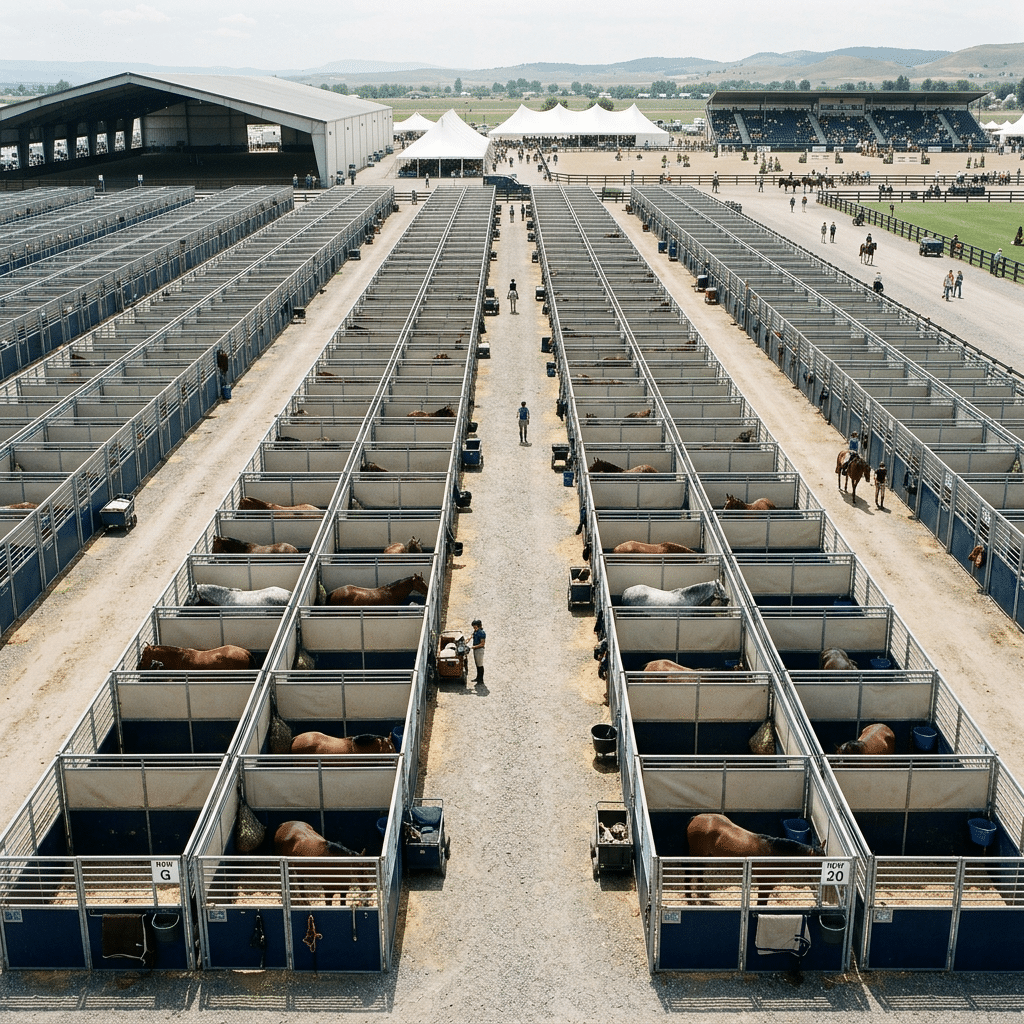
Draft Horse Rescue operations face a unique capital challenge: housing heavy breeds without exhausting donor funds on maintenance. Standard wood stalls frequently shatter under the impact of 2,000-pound animals, creating a perpetual repair loop that drains 501(c)(3) budgets. Every dollar spent fixing broken timber is a dollar lost for feed and medical care.
This analysis benchmarks sanctuary architecture against the Q235B structural steel et Hot-Dip Galvanization (ISO 1461) standards. We evaluate how High-Density Bamboo infills—rated 3x harder than oak—and flat-pack logistics solve durability and freight volume inefficiencies. Securing the right infrastructure reduces Scope 3 emissions and ensures your facility remains a permanent asset.
The Rise of ESG (Environmental, Social, Governance) in Construction
ESG has shifted from voluntary PR to mandatory compliance. For builders, the new battleground is Scope 3 emissions—tracking carbon from the factory floor to the job site.
The Shift to Scope 3 Compliance and Whole-Life Carbon Tracking
The days of “greenwashing” through vague sustainability statements are over. ESG is now a hard metric for asset value retention. Regulators and institutional investors demand verified performance data rather than simple narratives. If a project cannot quantify its environmental impact, it risks becoming a stranded asset before the concrete even cures.
The industry’s focus has aggressively pivoted to Scope 3 emissions. While Scope 1 and 2 cover a company’s direct operations, Scope 3 captures the entire supply chain—including the embodied carbon of materials and the emissions generated during logistics. Construction firms must now account for every mile their steel travels and every ton of carbon emitted to produce it. This forces procurement teams to look beyond the price tag and evaluate the “carbon cost” of their suppliers.
Reducing Supply Chain Carbon with the DB Flat-Pack System
Logistics efficiency is the fastest way to slash Scope 3 emissions. Traditional stable manufacturers often ship fully welded frames. This forces you to pay to ship “air.” A standard 40HQ container only holds about 12 to 15 fully welded sets. This inefficiency drives up the carbon footprint per unit significantly, making it harder to meet strict project emission caps.
We engineered the DB Flat-Pack System to solve this volume problem. By using a high-density steel pallet loading method, we maximize the container’s utility.
- Freight Efficiency: We load 30–45 sets per 40HQ container, compared to the industry average of 12–15 sets.
- Emission Reduction: This density reduces freight-related carbon emissions by over 60% per stable.
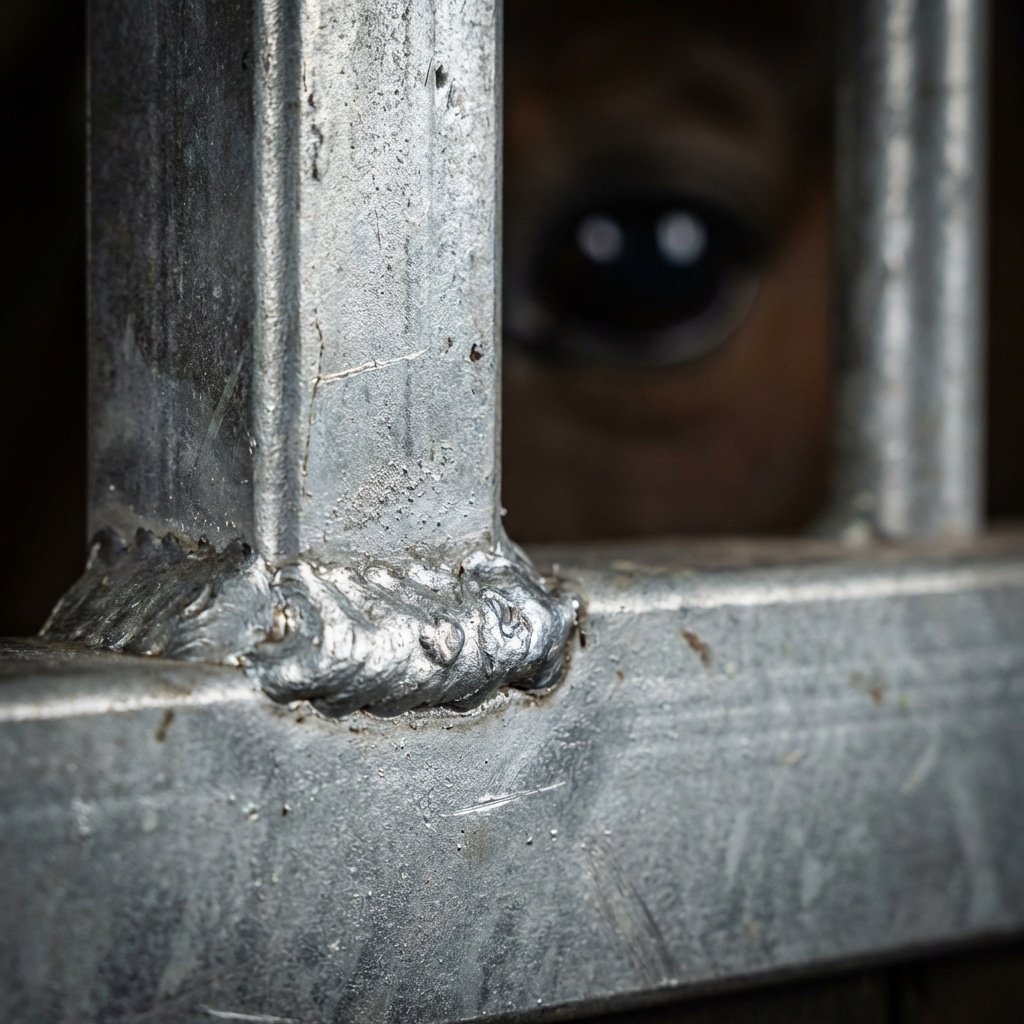
- Lifecycle Durability: Our Hot-Dip Galvanization (BS EN ISO 1461) ensures a 10+ year lifespan. This longevity improves “whole-life carbon” assessments by minimizing the need for replacements and repairs.
Moving Away from Old-Growth Timber (Oak/Pine)
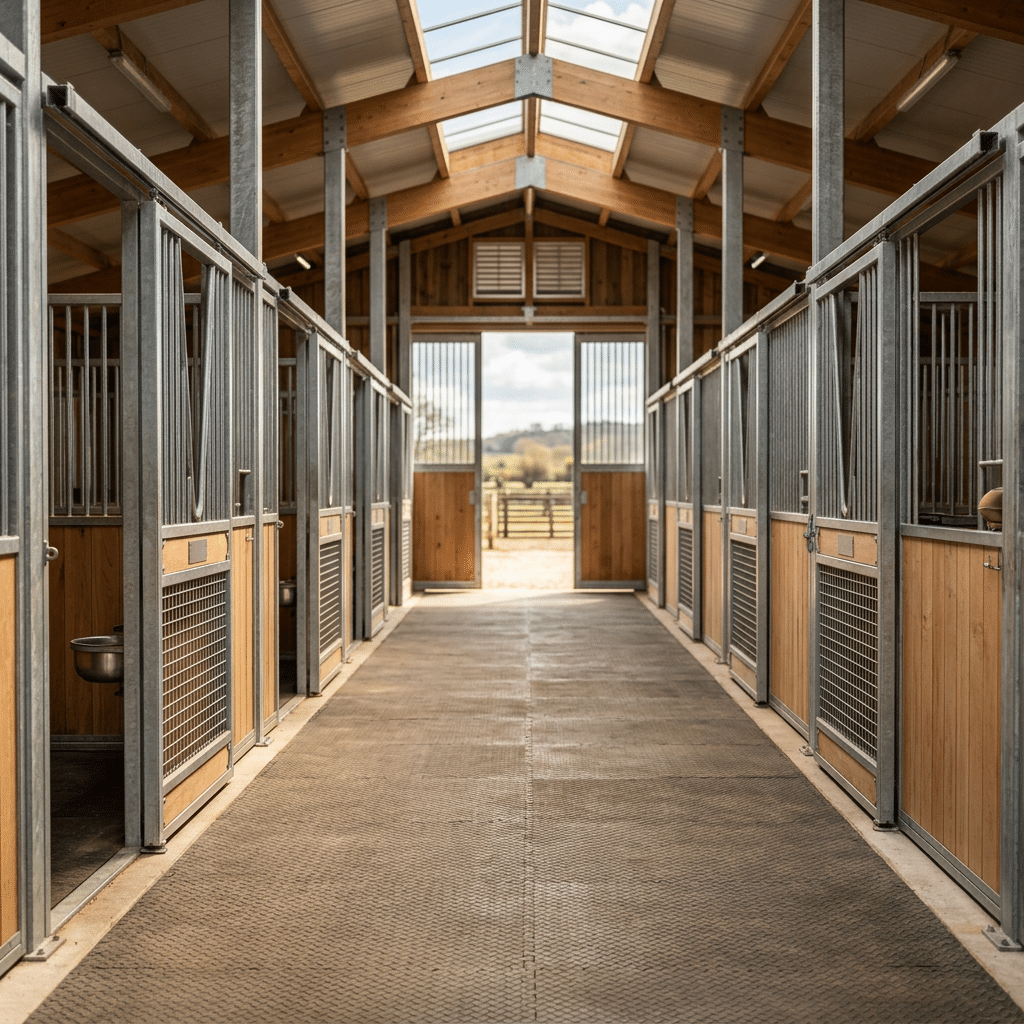
Traditional Oak and Pine are high-maintenance liabilities due to cribbing and rot. We replaced them with High-Density Bamboo (Janka > 3000 lbf) for superior durability and sustainability.
The Ecological and Maintenance Costs of Natural Lumber
For decades, Oak and Pine were the default choices for stable infill. But in a modern commercial facility, these materials often create more problems than they solve. The primary issue is biology: horses chew soft wood (“cribbing”), and organic timb
er absorbs moisture. In a wash bay or active stable environment, this leads to rapid degradation.
- Susceptibility to Cribbing: Softwoods like Pine are easily destroyed by bored horses. Once the surface is breached, splinters pose a safety risk, and the structural integrity of the partition fails.
- The Rot Cycle: Even treated timber struggles against the ammonia in urine and constant water exposure. This creates a perpetual maintenance loop where “permanent” stables require board replacements every few years.
- Ecological Strain: Harvesting old-growth hardwood places immense pressure on forests. Using 100-year-old trees for a structure that will likely be kicked and chewed is an inefficient use of natural resources.
High-Density Strand Woven Bamboo (Janka > 3000 lbf)
We moved to High-Density Strand Woven Bamboo to solve the durability gap. This is not the hollow bamboo used in garden furniture. It is a solid, engineered board created by compressing bamboo fibers under extreme heat and pressure. The result is a material that behaves more like steel than wood.
- Hardness Rating: Our bamboo carries a Janka Hardness rating exceeding 3000 lbf. For context, Red Oak sits around 1290 lbf. This material is roughly 3x harder than Oak, making it effectively impervious to horse teeth and hooves.
- Impact Resistance: Au 28mm-38mm thick, these boards absorb the full force of a kick without splintering. This density protects the horse from injury and protects the facility owner from replacement costs.
- Sustainability: Bamboo is a grass that regenerates in 3-5 years. It offers the aesthetic warmth of traditional wood without the deforestation footprint or the susceptibility to mold and rot.
Precision-Engineered Stables Built For Extreme Durability
Top Factories Embracing Sustainable Materials
Global manufacturing leaders are proving that sustainability drives operational efficiency. By integrating digital twins, circular economies, and renewable energy, these facilities set the benchmark for modern industrial responsibility.
The industrial sector is shifting from compliance-based environmental reporting to active, value-driven sustainability strategies. Major global manufacturers are redesigning their production lines to eliminate waste and reduce carbon footprints, influencing supply chains down to specialized sectors like equestrian engineering. These initiatives prioritize material longevity, energy independence, and circular economy principles—standards we mirror at DB Stable through our use of 100% recyclable Q235B steel and renewable bamboo infills.
| Manufacturer | Région | Key Initiative | Measurable Impact |
|---|---|---|---|
| Siemens | China (Chengdu) | Digital Twins & AI | 48% reduction in production waste |
| Lego | Vietnam | On-site Solar Array | Powered by 12,400 rooftop panels |
| Nestlé | Serbia / UK | Zero Waste to Landfill | 100% material recovery/recycling |
| IKEA | Pologne | Renewable Electricity | 408 factories switched to 100% renewables |
| Tesla | China (Shanghai) | Circular Economy | Advanced waste minimization processes |
Defining the New Standard
These facilities demonstrate that high-volume manufacturing does not require high-volume waste. The common thread among these leaders is a transition from linear consumption to circular resource management.
- Siemens Electronics Works (China): Recognizing that efficiency equals sustainability, Siemens deploys digital twin technology to simulate production before execution. This precision prevents material waste and optimizes energy use, achieving a 24% reduction in energy consumption per unit.
- Lego (Vietnam): As part of a $1 billion investment, Lego’s facility operates on a carbon-neutral basis using a massive on-site solar array. This move signals a shift where factories generate their own power rather than relying on grid-based fossil fuels.
- Nestlé (Europe): The zero-waste-to-landfill achievement at their Surčin and Fawdon facilities proves that aggressive recycling protocols can eliminate industrial byproducts. Every scrap of material is either recycled or recovered for energy.
- Procter & Gamble (China): P&G focuses heavily on water stewardship, utilizing rainwater harvesting and steam condensate recovery. In manufacturing, water is often a hidden waste stream; closing this loop is critical for long-term viability.
Alignment with Equestrian Manufacturing
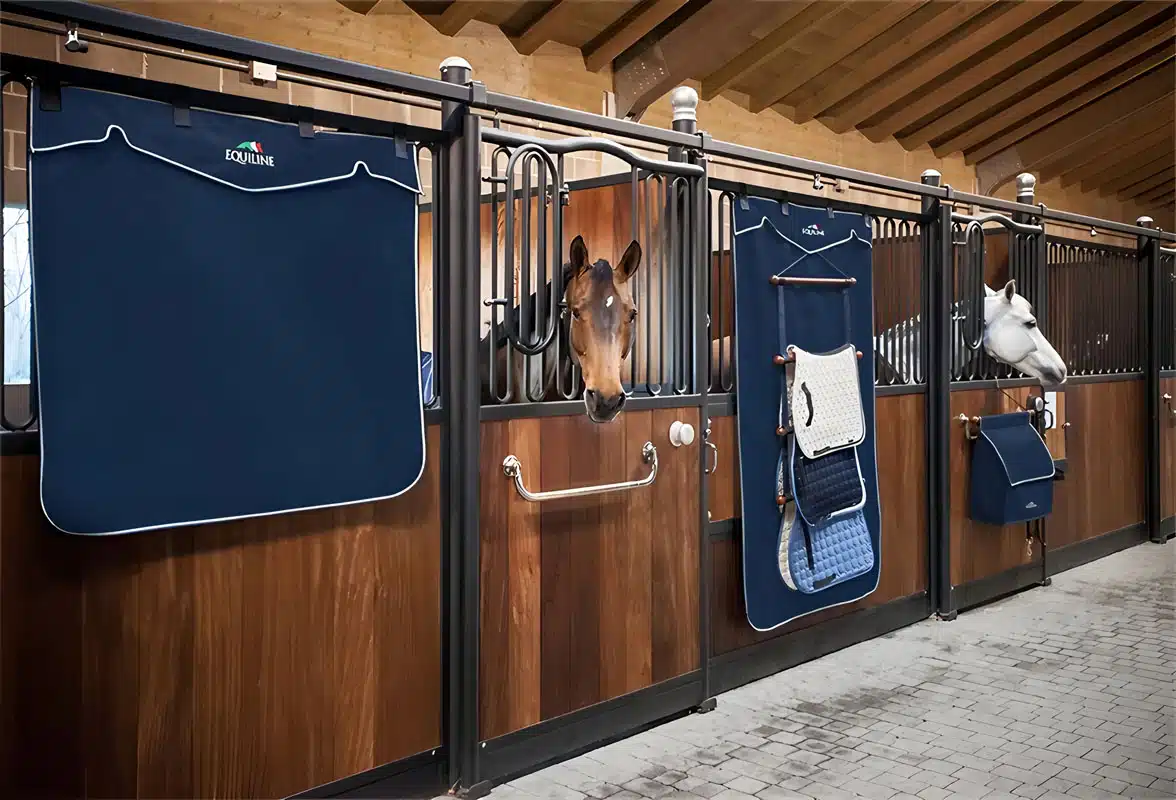
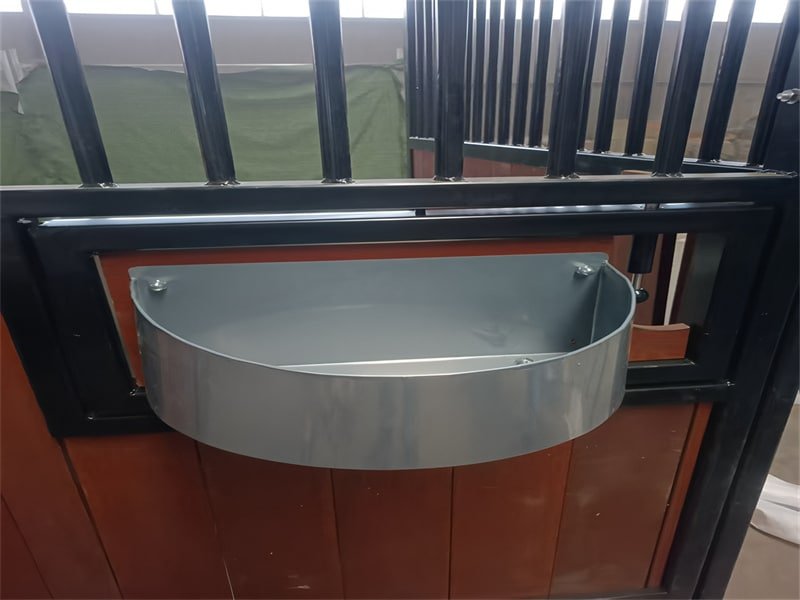
The principles driven by these giants—longevity, recyclability, and renewable sourcing—are directly applicable to high-end stable manufacturing. At DB Stable, we align with this global shift by prioritizing materials that reduce lifecycle carbon impact.
- Steel Recyclability: Just as Tesla and Siemens optimize metal usage, our Q235B and Q345B steel frameworks are 100% recyclable. Unlike concrete or treated timber, steel can be re-smelted indefinitely without losing structural integrity.
- Renewable Infill: We utilize High-Density Strand Woven Bamboo as a superior alternative to slow-growth hardwoods. Bamboo matures in 3-5 years compared to 50+ years for oak, offering a regenerative resource that aligns with the renewable strategies of companies like IKEA.
- Longevity as Sustainability: The most sustainable product is one that doesn’t need replacing. Our BS EN ISO 1461 Hot-Dip Galvanization ensures stables last decades, preventing the cycle of “manufacture, degrade, discard” that plagues cheaper, painted alternatives.
Strand-Woven Bamboo: A High-Yield Carbon Sink
Strand-woven bamboo leverages a rapid 3-5 year regeneration cycle and extreme compression to lock away carbon, effectively functioning as a durable, negative-carbon structural material.
Achieving a Negative Carbon Footprint
Most timber takes 40 to 60 years to mature. Bamboo hits maturity in just 3 to 5 years. This speed allows for frequent harvesting without depleting the forest, as the root system (rhizome) remains intact and immediately begins regenerating new shoots. This biological efficiency turns the plant into a rapid-cycle carbon vacuum.
The “strand-woven” manufacturing process is where the carbon is physically locked away. We shred the bamboo culm into fibers and compress them under immense pressure with eco-friendly resins. This transforms a hollow grass into a solid board with a density of roughly 1,100 kg/m³. Once compressed, the carbon absorbed during growth is trapped within the board for the product’s lifespan, which often exceeds 30 years in stable applications.
- Rapid Maturity: Harvestable in 3-5 years versus decades for hardwoods.
- Carbon Locking: High-densit
y compression traps sequestered carbon in the fiber matrix.
- Production Efficiency: Modern facilities use bamboo biomass waste to power the kilns, further lowering the net emissions profile.
The 3000+ Janka Hardness Standard
In the equestrian world, “sustainable” means nothing if a horse can kick through it. We utilize strand-woven bamboo specifically because it solves the durability issues common with pine and standard oak. The compression process creates a material that is technically 3x harder than Red Oak.
Our Product Bible mandates a Janka Hardness Rating exceeding 3000 lbf. For context, standard Red Oak sits around 1,290 lbf. When a 1,200 lb horse kicks a wall, softwoods splinter, creating immediate injury risks. Strand-woven bamboo absorbs that impact without shattering. This density also eliminates the microscopic air pockets where moisture typically accumulates, making the boards naturally resistant to mold, rot, and cribbing (chewing).
- Impact Resistance: >3000 lbf Janka rating ensures safety against heavy impact.
- Thickness Specs: We supply 28mm, 32mm, and 38mm boards to match specific stall frame profiles.
- Biological Resistance: Extreme density prevents moisture ingress, stopping rot and mold before it starts.
Q235B Steel: The 100% Recyclable Framework
Unlike toxic treated lumber that becomes a disposal liability, Q235B steel is a fully recyclable financial asset that retains significant scrap value at the end of its lifecycle.
Ecological Advantages Over Treated Lumber
Pressure-treated wood presents a significant, often overlooked environmental liability for sanctuaries. To prevent rot, lumber is impregnated with chemical preservatives—such as copper azole or chromated copper arsenate (CCA) in older structures—which render the wood hazardous at the end of its service life. You cannot burn this material for energy without releasing toxic ash, and it cannot be composted. It inevitably ends up in lined landfills, creating a permanent waste footprint.
Q235B steel eliminates this toxicity loop. It contains no leaching chemicals that could contaminate soil or groundwater, ensuring the land remains safe for grazing animals. More importantly, steel allows for infinite recyclability. A steel beam can be melted down and reformed into new products without any loss of structural integrity, aligning perfectly with the green building standards required by many modern donor-funded capital projects.
ASTM A36 Equivalence and Asset Recovery
We strictly utilize Q235B Structural Steel, which is the direct engineering equivalent to ASTM A36. For facility owners and non-profits, this material specification is not just about structural load; it is a long-term financial strategy. Wood degrades into a liability that costs money to haul away. Steel remains an asset on your balance sheet.
- Standard Compliance: Q235B meets the mechanical properties of ASTM A36, ensuring the material is recognized and valued by scrap recyclers globally.
- Asset Liquidity: High material purity ensures significant scrap value recovery. If a facility needs to relocate or renovate after 30 years, the steel framework generates revenue rather than incurring disposal fees.
- Core Preservation: We apply Hot-Dip Galvanization with a coating thickness exceeding 85 microns. This sacrificial zinc layer protects the steel core from corrosion, ensuring the full weight of the metal is preserved for future recycling.
Questions fréquemment posées
Do steel stables have a lower environmental impact than wood over time?
Yes, primarily due to lifecycle longevity and the circular economy. While wood claims lower initial production emissions, it is prone to rot, warping, and cribbing (chewing) by horses, leading to frequent replacement cycles that multiply its carbon footprint. Our Q235B structural steel is 100% recyclable and protected by hot-dip galvanization (BS EN ISO 1461), ensuring it lasts decades without needing replacement. For facilities housing nervous or feral rescues, steel eliminates the waste generated by destroyed timber components.
Is bamboo infill really more sustainable than traditional hardwood?
Absolutely. Bamboo is the fastest-growing plant on Earth, reaching structural maturity in just 5–7 years, compared to 30–50 years for hardwoods like oak. It absorbs significantly more CO₂ during its growth cycle and regenerates without replanting. From a durability standpoint, DB Stable’s strand-woven bamboo boasts a Janka hardness rating over 3,000 lbf—making it 3x harder than oak. This density prevents horses from damaging the material, ensuring the product lifecycle aligns with sustainable resource management goals.
How does flat-pack shipping help maximize donor funds?
Freight overhead is often the hidden killer of non-profit budgets. Traditional fully welded frames are mostly “air,” limiting a 40HQ container to just 12–15 stable sets. Our engineered flat-pack system allows us to load 30–45 sets in the same container. This logistics efficiency reduces shipping costs per unit by over 60%, allowing rescue organizations to allocate funds directly to veterinary care, feed, and rehabilitation rather than paying shipping lines for wasted space.
What maintenance is required for HDPE infill compared to wood?
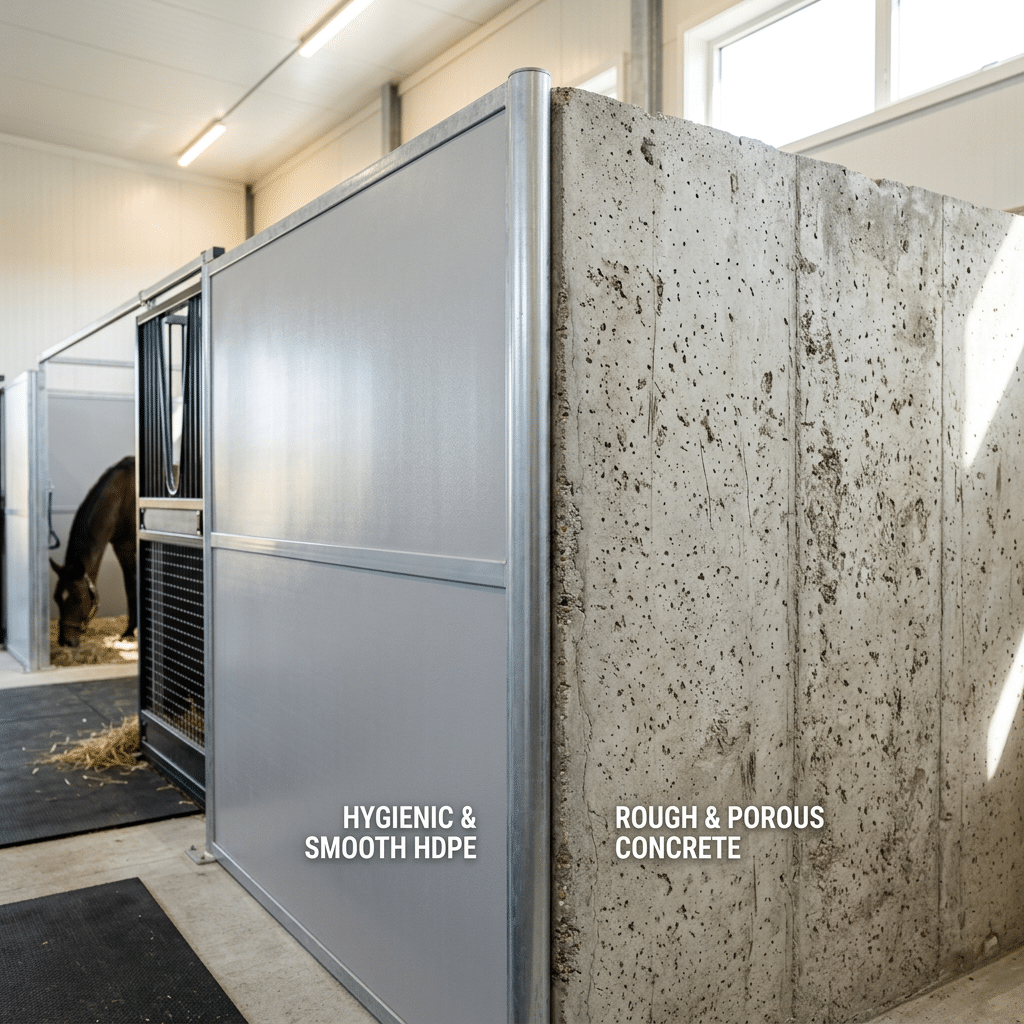
HDPE (High-Density Polyethylene) is effectively a zero-maintenance solution. Wood requires regular stripping, staining, and sealing to prevent rot, and often needs board replacement due to cribbing. Our HDPE planks are UV-stabilized, impact-absorbing, and completely resistant to moisture and bacteria. Sanitization involves a simple pressure wash, drastically reducing the labor hours and chemical cleaners required for daily stable management.
Réflexions finales
Relying on traditional timber creates a perpetual maintenance cycle that drains donor resources and risks board degradation. By choosing Q235B Hot-Dip Galvanized steel and renewable bamboo, you transform your facility from a depreciating liability into a permanent, recyclable asset. Our DB Flat-Pack System further protects your capital by slashing freight costs by 60%, ensuring funds remain focused on rehabilitation rather than shipping air.
Sustainability is now a hard metric for institutional funding, and your infrastructure must reflect that standard. We invite you to submit your site plans for a complimentary layout consultation to calculate the exact carbon and freight savings for your project. Contact our engineering team today to align your sanctuary’s expansion with the demands of the circular economy.

 French
  English
  Spanish
  Arabic
  German
0 commentaires