


Deploying portable shelters in a High Wind Paddock demands rigorous engineering to prevent costly structural failures. Relying on lightweight friction-based mounts often turns assets into projectiles, exposing operators to significant insurance claims and negligence lawsuits when storms strike.
This report examines the structural necessity of 14-gauge steel framing paired with helical earth anchors boasting 11,000 lbs holding capacity. We evaluate the shift from temporary T-posts to engineered bolted connections, ensuring your facility meets safety standards while eliminating the maintenance overhead of bent frames.
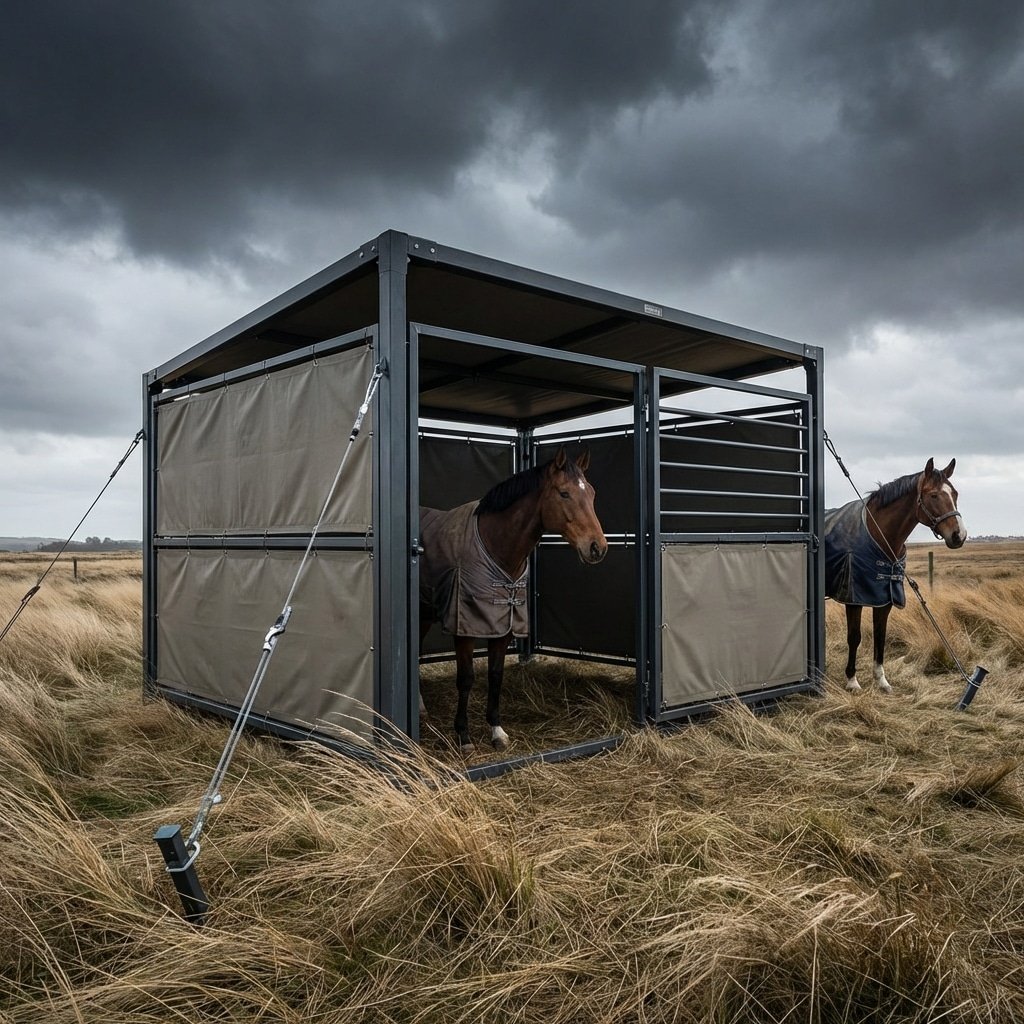
The Aerodynamics of Outdoor Run-In Sheds
Effective aerodynamics balance wind resistance with passive ventilation. Orient the open side away from prevailing winds and use a sloped roof to deflect gusts while venting heat.
Minimizing Wind Load Through Orientation and Pitch
Most structural failures in portable shelters aren’t due to weak materials; they happen because of poor aerodynamic positioning. A run-in shed acts like a giant sail if you face the opening directly into the wind. To mitigate uplift and prevent rain from driving into the shelter, you must position the open side away from prevailing winds. In the Northern Hemisphere, facing the shed South is the standard practice, as severe weather typically strikes from the North or West.
- Orientation Strategy: Face the open side South (or away from local prevailing winds) to reduce internal pressure build-up.
- Roof Pitch Dynamics: We utilize a distinct pitch—typically 10ft at the front sloping to 8ft at the rear—to encourage natural water runoff and deflect wind gusts over the structure.
- Site Selection: Avoid placing 3-sided sheds in completely exposed open fields. Without natural windbreaks, these structures create turbulence zones that stress the frame anchors.
The “Stack Effect”: Vertical Airflow via Open Grills
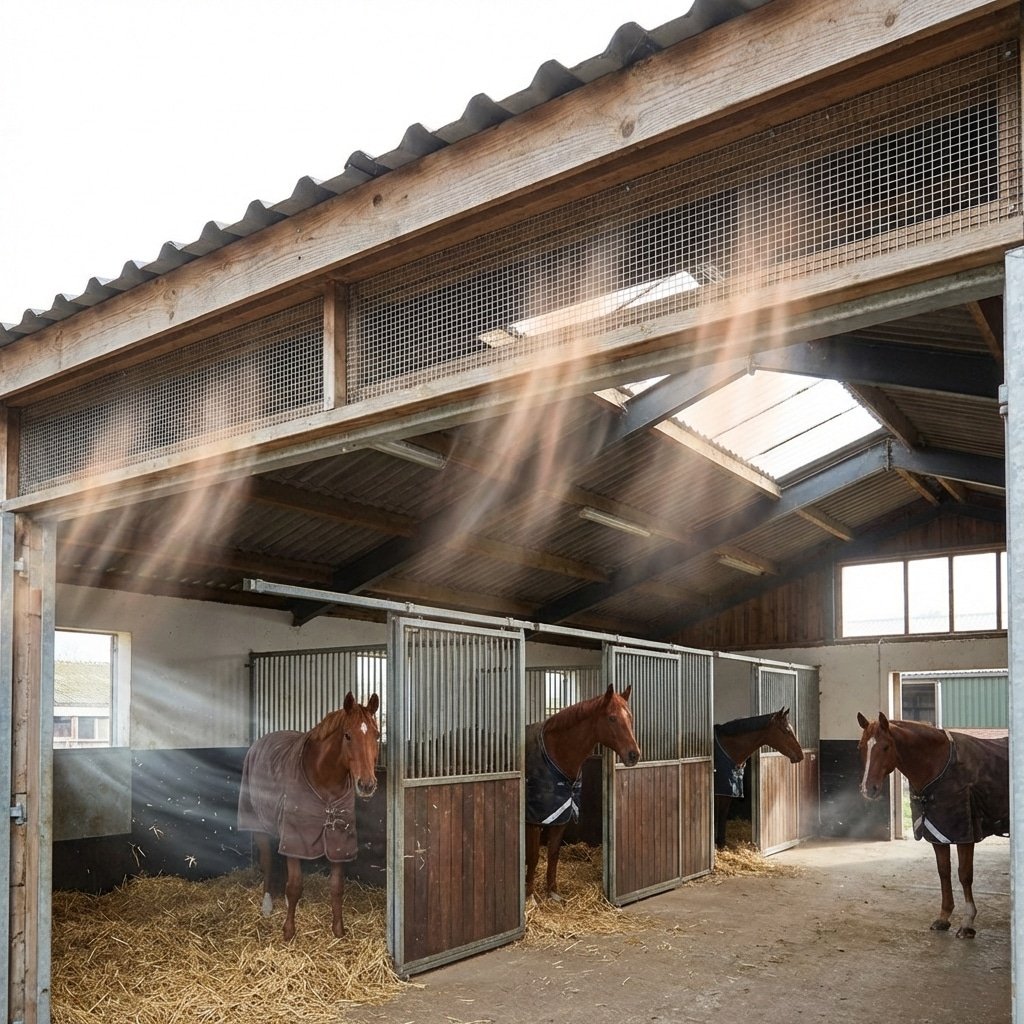
A shed that blocks wind too effectively can become a hotbox. Horses generate significant body heat, and if that heat cannot escape, the shelter becomes humid and stagnant—a breeding ground for respiratory issues. DB Stable designs solve this using “Stack Effect Ventilation.” This principle relies on thermal buoyancy: hot air rises and creates a pressure difference that naturally draws fresh air in to replace it.
Notre Professional Series incorporates open top grills specifically to facilitate this vertical movement. By venting the eaves and upper sections, we allow hot air to escape without creating a draft at the horse’s level. This ensures continuous air exchange even when the shed is fully occupied, keeping the environment dry and the ammonia levels low.
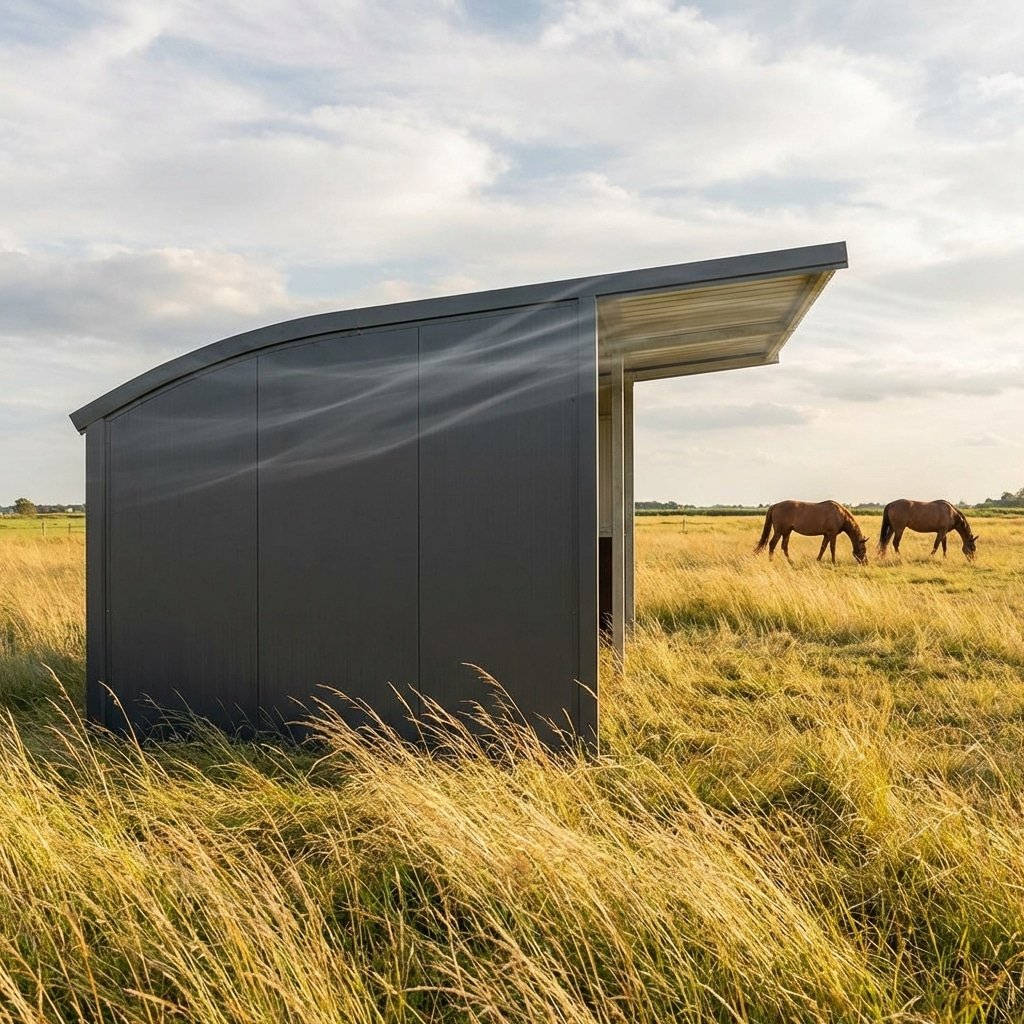
Why Weight Matters (14-Gauge vs Lightweight Tin)
In steel manufacturing, weight equals safety. We strictly use 14-gauge (2.0mm) steel because lighter alternatives buckle under impact, creating sharp, dangerous edges.
Understanding Steel Gauge: Impact and Load Resistance
Many buyers assume “steel is steel,” but the gauge system often hides dangerous cost-cutting. The relationship is inverse: a lower number means thicker steel. While the retail market often pushes 18-gauge (approx. 1.2mm) as “heavy duty,” this thickness is insufficient for large livestock. We strictly utilize 14-gauge steel, which provides a wall thickness of approximately 2.0mm.
The physics here are simple but critical. When a 1,200 lb horse kicks a wall, the steel must absorb that kinetic energy without failing. Thinner 18-gauge tubing tends to puncture or shear, creating razor-sharp metal edges that can sever tendons. 14-gauge steel has the structural mass to dent rather than tear, keeping the animal safe even during aggressive behavior.
Beyond impact, mass dictates stability in open environments. Lightweight structures rely entirely on ground anchors to stay upright. By using heavier gauge steel, the structure itself possesses inherent wind load resistance. In high-wind paddocks, this added mass prevents the frame from twisting or lifting before the anchors even engage.
The DB Standard: 2.0mm Minimum Wall Thickness
At DB Stable, our manufacturing protocol prohibits tubing thinner than 2.0mm. We fabricate exclusively with Q235B structural steel (or Q345B for climats froids), ensuring a true “Kick-Proof Guarantee.” While many competitors drop to 1.6mm to save on raw material costs and shipping weight, we maintain this safety margin to protect both the horse and the facility operator from liability.
There is also a manufacturing reason for this standard: Galvanization quality. We use Hot-Dip Galvanization After Fabrication, immersing the steel in zinc at temperatures exceeding 450°C. Thin steel (1.6mm or less) often warps or twists under this thermal stress.
- Structural Integrity: 2.0mm walls maintain straightness during the high-heat dipping process.
- Zinc Adhesion: Thicker steel supports a more robust zinc coating, consistently achieving our standard of >70 microns.
- Longevity: Heavier steel withstands corrosion longer, effectively doubling the service life compared to pre-galvanized “tin” alternatives.
Premium Modular Stables Built To Last

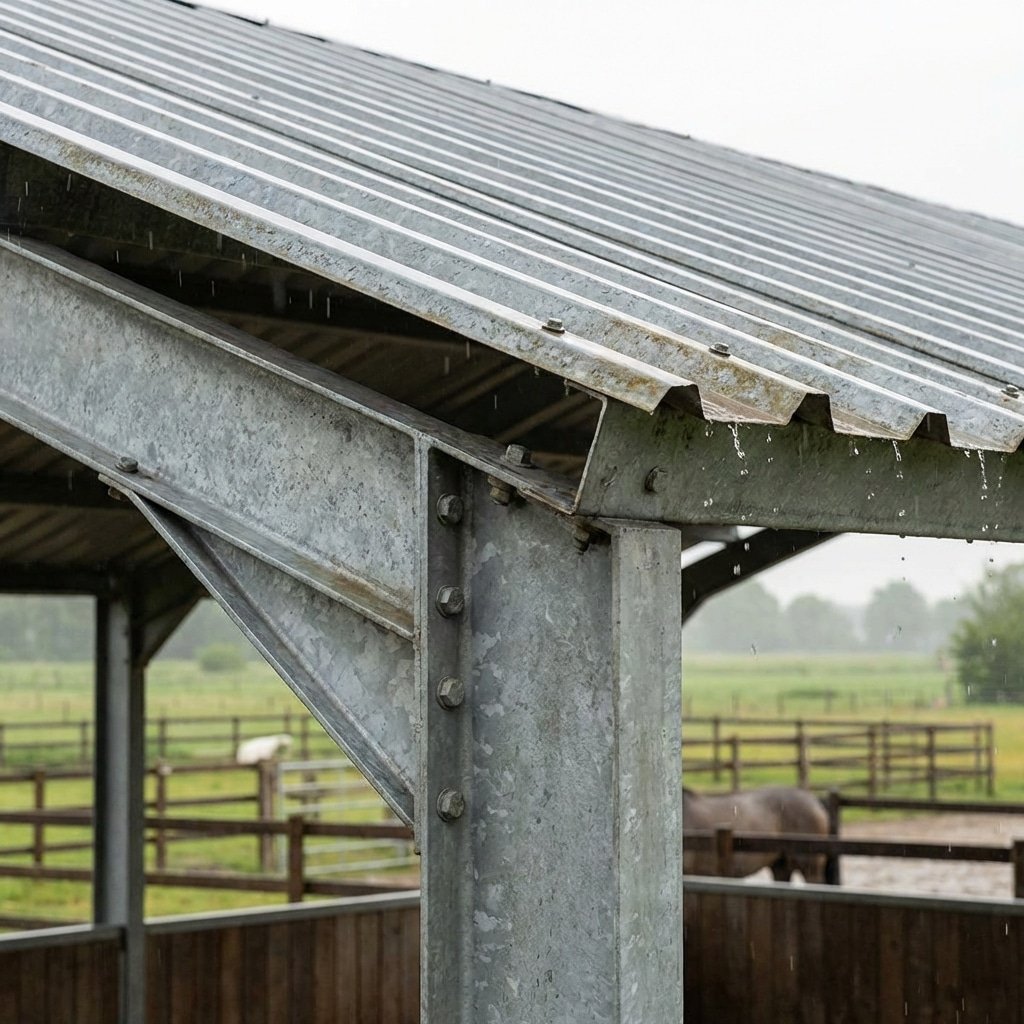
Bolted Base Plates vs Driving T-Posts
Bolted systems anchored to concrete ensure long-term structural integrity and wind resistance, whereas driven T-posts rely on unpredictable soil friction and often fail under lateral load.
Comparing Concrete Foundations Against Soil Friction
The structural difference between a permanent facility and a temporary paddock often comes down to what happens below the ground. Driven T-posts rely entirely on soil compression and friction to stay upright. This works for wire fencing, but it introduces a massive failure point for roofed run-in sheds. Under sustained wind pressure or in saturated, wet ground, soil compression fails, causing the post to loosen, lean, or lift out completely.
Bolted base plates operate on a different mechanical principle. By transferring vertical and lateral loads directly into a cured concrete footing, we eliminate soil variables. The connection effectively prevents lift-off during storms, making this method non-negotiable for any structure bearing the weight of a roof.
- Maintenance Efficiency: Replacing a bent T-post requires extraction machinery and significant ground disturbance. Replacing a bolted post only requires unbolting the flange.
- Load Transfer: Concrete footings distribute shear force, whereas driven posts concentrate stress at the soil line, leading to metal fatigue or snapping.
DB Stable’s Engineered Bolted Flange System
We prioritize permanent structural rigidity over installation speed, aligning with our “Engineering Safety” core principle. While driving a post is faster, you cannot perfectly level a driven post. Our system allows for precise vertical alignment using shim plates under the flange, ensuring gates and partitions operate smoothly for decades, not just days.
Our engineering standards for this connection point are strict:
- Structural Steel Flanges: We utilize Q235B (Standard) or Q345B (Cold Climate) steel flanges welded directly to the post base for maximum shear strength.
- Corrosion Resistance: Every Hardware Kit includes 304 Stainless Steel anchor bolts. This prevents the common issue of bolts rusting away at the concrete interface where moisture collects.
- Base Integrity: The flange distributes the post’s weight, preventing the “sinking” effect seen in driven posts over time.
Heavy-Duty Earth Auger Anchors for Dirt Paddocks
Helical anchors utilize screw mechanics to achieve up to 11,000 lbs holding capacity in dirt, requiring ISO 1461 hot-dip galvanization to survive sub-grade moisture.
| Soil Classification | Soil Description | Max Holding Capacity |
|---|---|---|
| Class 5 | Medium dense coarse sand & sandy gravel | 11,000 lbs |
| Class 6 | Loose to medium fine sand | ~8,000 – 9,000 lbs |
| Class 7 | Loose fine sand & alluvium (silt) | 6,000 lbs |
Helical Blade Mechanics & Holding Power
Standard straight spikes rely entirely on friction against the shaft to hold ground. In loose dirt paddocks, vibration from wind or animal impact loosens this friction rapidly, leading to failure. Earth auger anchors (helical anchors) solve this by using a screw-based mechanism. The helical plates thread into the soil without disturbing the surrounding earth, creating a cone of resistance that utilizes the soil’s own weight to prevent pull-out.
Installation technique dictates performance. You must install these anchors at a 45-degree angle toward the load direction (e.g., following the line of a guy wire). A deviation of just 5 degrees can significantly reduce the holding capacity. When installed correctly in Class 5 soils, a single heavy-duty anchor can withstand up to 11,000 lbs of tension, securing run-in sheds against severe wind uplift and frost heave cycles.
Sub-Grade Corrosion Protection (ISO 1461)
Soil is a hostile environment for steel. Constant moisture, acidity from animal waste, and lack of oxygen creates a perfect recipe for rapid corrosion. Many generic anchors use “pre-galvanized” steel or simple paint, which strips off during the abrasive screwing process, leading to invisible sub-surface rust and eventual structural failure.
We treat ground-contact anchors with the same rigor as our structural steel frames. Adhering to BS EN ISO 1461 standards is non-negotiable for these components. This process involves Hot-Dip Galvanization After Fabrication, ensuring the zinc bonds metallurgically to the steel.
- Zinc Thickness: We require an average coating exceeding 85 microns for structural ground anchors.
- Self-Healing: The zinc layer provides cathodic protection, sacrificing itself to save the steel if deep scratches occur during installation.
- Fabrication Sequence: Welding and forging happen before dipping, preventing weak points at the weld seams.
Questions fréquemment posées
How do I secure a portable horse shelter against high winds?
Anchoring prevents shifting or flipping. For temporary setups, use heavy-duty stakes or 3/4-inch rebar driven deep into the ground at each corner, connected to the frame with steel cables. For higher wind ratings, screw-in earth augers (like the Hellanker system) provide superior holding power in soil without requiring concrete.
What is the best foundation for a permanent outdoor run-in shed?
While portable units work on dirt, permanent installations in high-wind areas perform best on concrete pier foundations. Bolting the frame to L-brackets set in concrete footers prevents uplift better than any dirt anchor. If concrete isn’t an option, securing the frame to pressure-treated railroad ties buried in the ground is a strong alternative.
Does the orientation of the stable affect wind resistance?
Yes. Proper site selection is just as important as the anchors. Position the structure on elevated ground for drainage, but avoid exposed hilltops where wind speeds are highest. Orient the open side of the shed away from the prevailing wind direction to prevent the structure from catching gusts like a parachute.
Can lighter materials be used for wind-proof stables?
Lightweight tin or thin aluminum frames often fail under wind load. A wind-resistant structure relies on heavy-gauge steel framing—we strictly use 14-gauge (2.0mm to 2.5mm) Q235B or Q345B steel—and impact-resistant roofing materials. The added weight of the structure itself contributes to its stability, working in tandem with the anchoring system.
Réflexions finales
Retailers selling lightweight tin structures in high-wind zones invite liability and costly warranty claims. By stocking DB Stable’s 14-gauge Q235B steel kits, you deliver a “Kick-Proof” solution engineered to withstand severe weather without failure. Your dealer reputation relies on supplying equipment that stays grounded when storms hit.
Do not rely on spec sheets alone; verify our structural quality directly. We recommend scheduling a trial order to test our Hot-Dip Galvanization finish and heavy-duty anchor systems firsthand. Contact our team today to discuss flat-pack logistics that optimize your 40HQ container margins.



 French
  English
  Spanish
  Arabic
  German
0 commentaires