


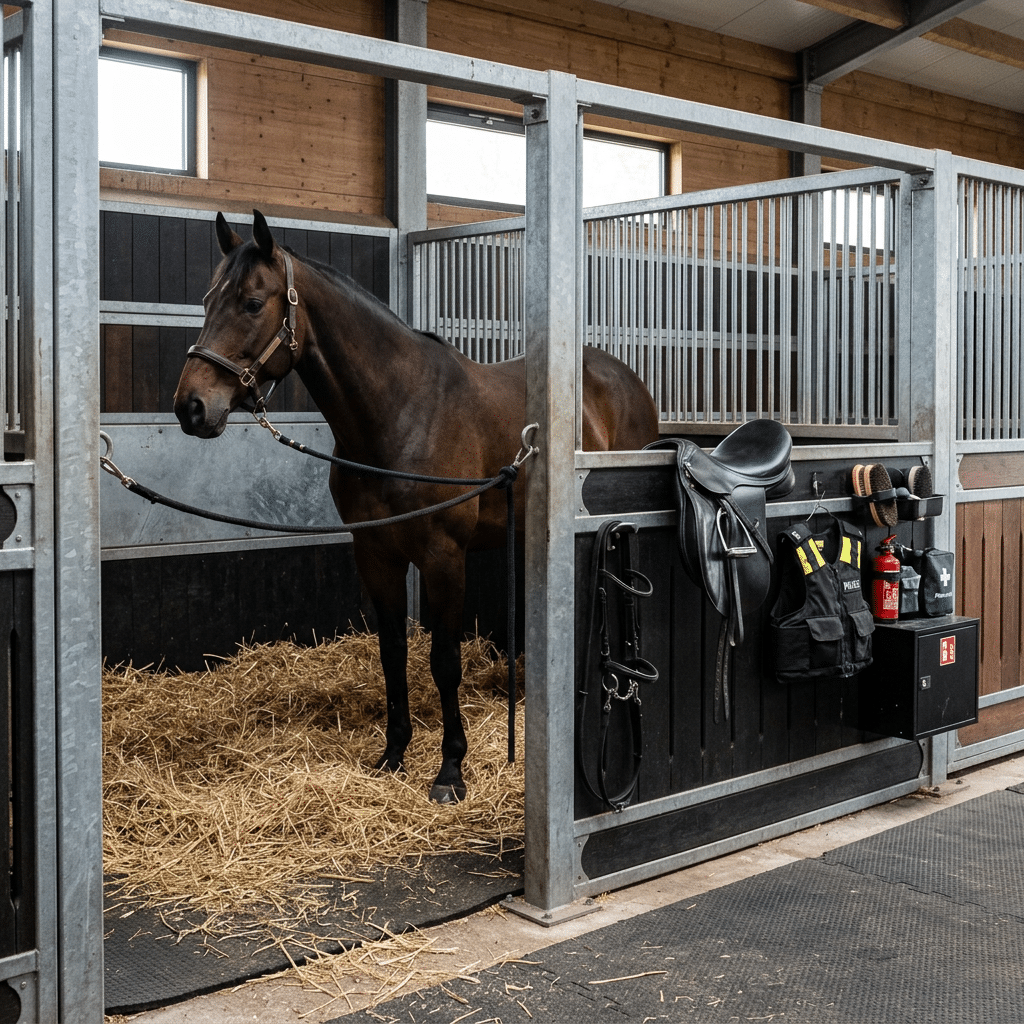
Sourcing modular horse stall kits in the USA requires strict scrutiny to avoid the flood of lightweight 16-gauge systems that compromise safety for lower shipping rates. While thinner profiles might save on upfront freight, they often buckle under the strike of a 1,200lb animal, creating catastrophic liability risks for builders and facility owners.
This guide defines the engineering baseline for professional stables, focusing on the critical 14-gauge minimum wall thickness and Q235B structural steel composition. We analyze how hot-dip galvanization after fabrication ensures longevity and why bolt-together modularity outperforms welded alternatives in both durability and installation speed.
The American Standard: 12×12 Horse Stall Kits
The 12’x12′ dimension is the North American baseline for equine safety and resale value. DB Stable supports this with modular, hot-dip galvanized kits designed for efficient B2B logistics and rapid assembly.
Defining the 12’x12′ Footprint: The Industry Benchmark
In the United States, 12’x12′ is not just a preference; it is the operational baseline for commercial and residential projects. This specific dimension provides sufficient floor area for larger breeds, such as warmbloods and quarter horses, to turn and lie down without the risk of becoming cast against a wall. Smaller 10’x10′ units, while cheaper, limit the facility to ponies or smaller breeds, significantly reducing the property’s future resale value and commercial boarding appeal.
Structurally, this footprint aligns with standard American barn engineering. Most timber-frame and clear-span metal buildings utilize 12-foot column spacing (on center). Adopting the 12’x12′ stall kit eliminates the need for expensive custom fabrication or on-site cutting. The panels mount directly to standard support columns, streamlining the construction timeline and reducing labor costs for the installer.
The Modular Kit Configuration: Panels, Infill, and Hardware
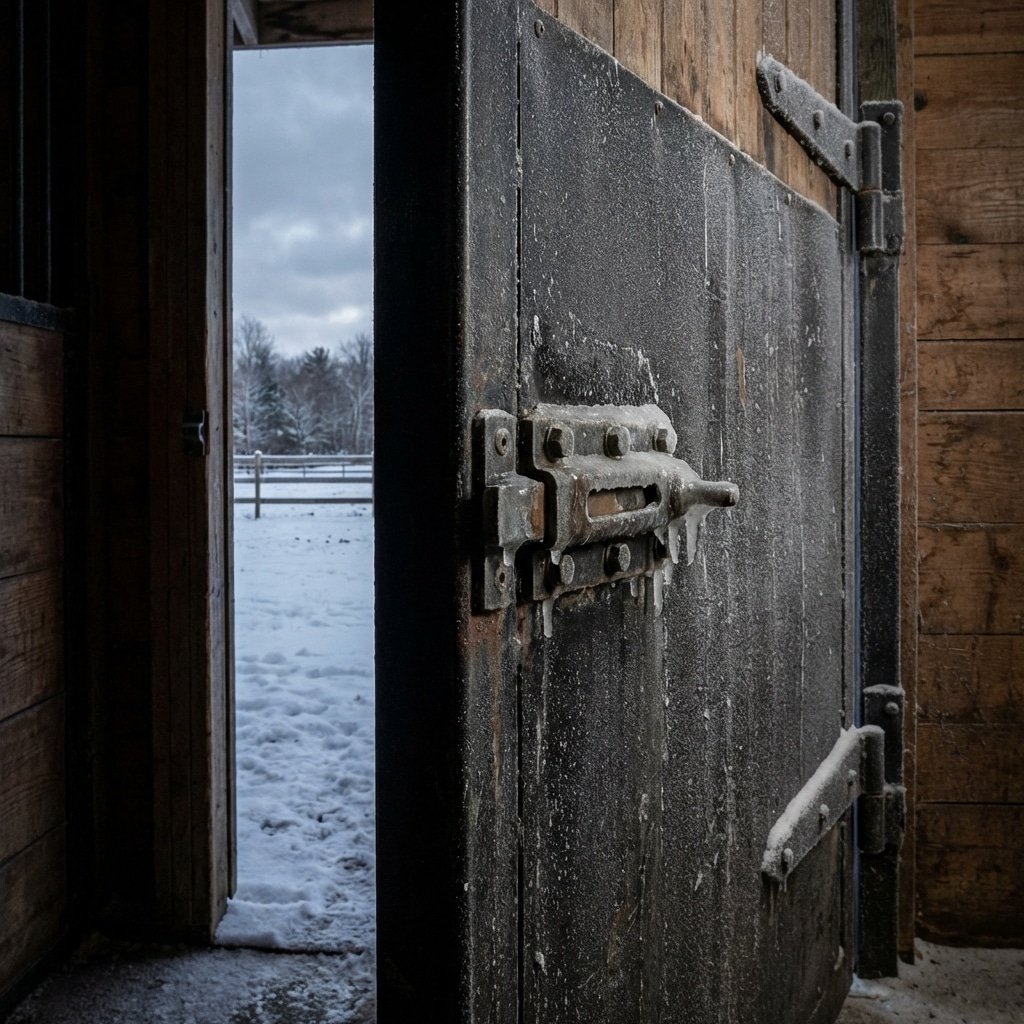
DB Stable kits are engineered for distributors who require high-volume logistics without sacrificing component quality. Unlike welded one-piece systems that ship mostly air, our modular “flat-pack” design allows for 30-45 sets per 40HQ container. A standard kit includes the following components, manufactured to strict B2B specifications:
- Stable Front Panel: Available in 3.0m to 4.0m lengths to fit 12′ bays. We use Q235B or Q345B structural steel, hot-dip galvanized après fabrication (BS EN ISO 1461) to ensure welds are fully coated and rust-proof.
- Partition Panels & Infill: Side walls come with pre-cut infill planks. Options include High-Density Bamboo (Janka Hardness > 3000 lbf) for durability or UV-stabilized HDPE for a “Zero Maintenance” finish that absorbs impact.
- Hardware Kit: We reject zinc-plated fasteners. Every kit includes 304 Stainless Steel anchors and connectors to prevent galvanic corrosion and ensure long-term l'intégrité structurelle.
- Installation Maintenance: A canister of Cold Galvanizing Spray is included with every shipment. This allows installers to immediately treat any surface abrasions caused during offloading, maintaining the protective barrier.
Unmasking “Heavy Duty”: The 14-Gauge Minimum
In the professional equestrian sector, “Heavy Duty” is a specific engineering requirement, not a marketing slogan. Any steel wall thickness below 14-gauge (approx. 2.0mm) compromises structural integrity and safety.
The Gauge System Decoded: Why 2.0mm Is the Safety Threshold
The steel industry uses an inverse scale for measurement: the lower the gauge number, the thicker the material. While a 16-gauge (1.5mm) tube might look identical to a 14-gauge (2.0mm) tube from the outside, the physical diffe
rence in performance is drastic. That missing 0.5mm of steel represents a roughly 33% reduction in mass and structural density.
We see many economy retailers pushing 16-gauge or even 18-gauge kits to cut shipping weights and manufacturing costs. At DB Stable, we strictly prohibit tubing thinner than 2.0mm across our Professional and Royal series. This adherence to the 14-gauge standard is the foundation of our Kick-Proof Guarantee. When a 1,200lb horse strikes a wall, 14-gauge steel absorbs the energy; thinner steel buckles, often shearing and creating razor-sharp edges that can catastrophically injure the animal.
| Spécifications | 14-Gauge (DB Standard) | 16-Gauge (Economy) | 18-Gauge (Light Duty) |
|---|---|---|---|
| Thickness | ~2.0mm – 2.5mm | ~1.5mm | ~1.2mm |
| Résistance aux chocs | High (Absorbs Kicks) | Moderate (Risk of Denting) | Low (Risk of Buckling) |
| Primary Use | Professional Stables | Temporary Corrals | Residential Fencing |
Material Composition: Q235B and Q345B Structural Standards
Thickness tells only half the story; the chemical composition of the steel dictates its behavior under stress. We do not use generic “mild steel.” Our manufacturing process utilizes specific structural grades to match the climate and intended use of the facility.
- Q235B (ASTM A36 Equivalent): This is our standard baseline for general applications. It offers excellent ductility, allowing the steel to flex slightly under heavy load without snapping.
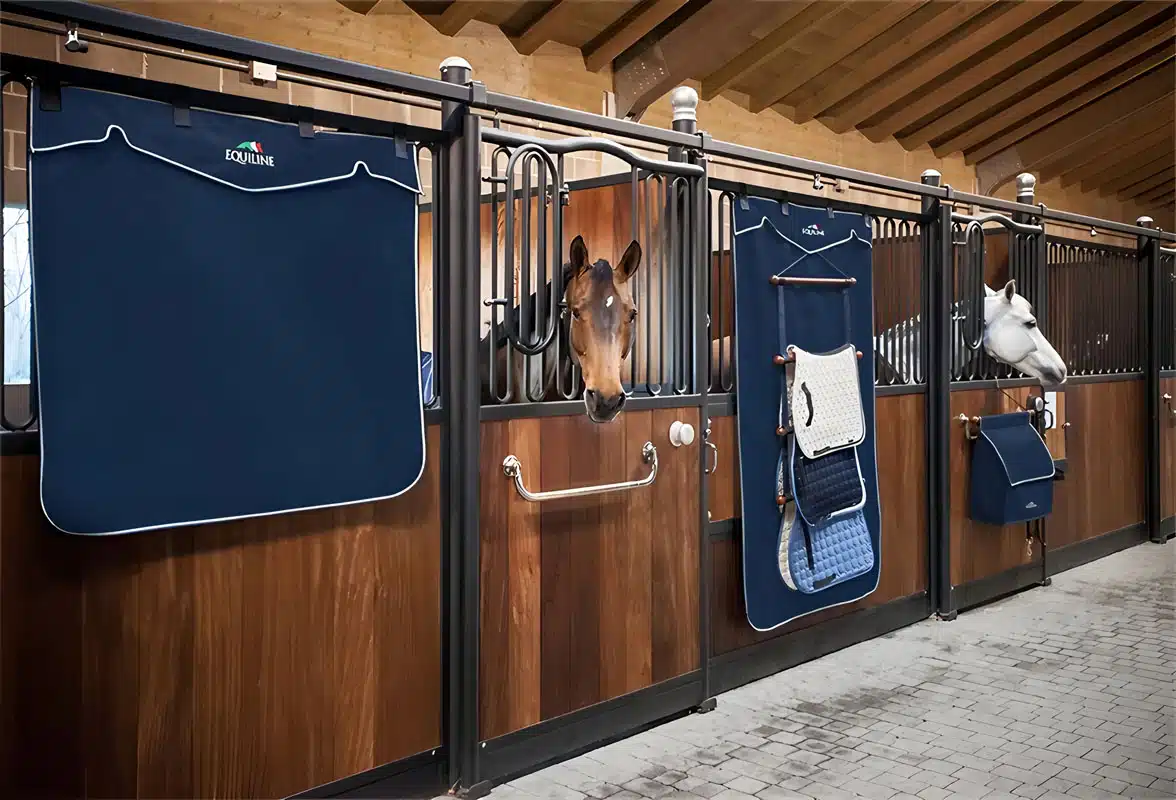
- Q345B (ASTM Grade 50 Equivalent): For clients in regions with severe winters (Northern Europe, Canada), we upgrade to Q345B Low Alloy High Strength Steel. Standard steel can become brittle in sub-zero temperatures. Q345B retains high impact toughness in freezing conditions, preventing brittle fractures if a horse kicks a frozen bar.
- Strict Tubing Protocol: Regardless of the grade (Q235B or Q345B), the 2.0mm minimum thickness rule remains absolute. We do not compromise on mass, as mass equals longevity.
Precision-Engineered Stables For Every Climate
Bolt-Together Modularity: No Welder Required
Bolt-together systems replace expensive on-site welding with pre-engineered assembly, cutting installation time by 60% and eliminating fire risks in wooden structures.
Eliminating Hot Work and On-Site Fabrication
Traditional stable construction often forces you to hire certified welders—a labor category that is increasingly expensive and difficult to schedule. By switching to a modular bolt-together system, you remove the need for specialized labor entirely. General contractors or even competent farm staff can assemble these systems using standard impact wrenches, bypassing the bottleneck of securing skilled tradesmen.
Safety protocols also become significantly simpler. welding inside an existing wooden barn introduces a massive fire risk and typically requires hot work permits, fire watches, and expensive insurance riders. A mechanical assembly process eliminates these hazards, allowing installation to proceed in active facilities without shutting down operations or risking the structure.
- Speed Advantage: Installation finishes 40-60% faster than field-fabricated systems.
- Maintenance: Damaged parts can be unbolted and swapped individually, whereas welded systems require cutting torches and grinders for repairs.
- Operational Continuity: Zero smoke or fumes means nearby livestock are not disturbed during the build.
The 304 Stainless Steel Hardware Kit
The structural integrity of a bolt-together system relies entirely on its connection points. We refuse to use standard zinc-plated hardware, which inevitably rusts when in contact with galvanized steel in humid barn environments. Instead, every connector, anchor bolt, and screw in our kits is manufactured from Acier inoxydable 304. This ensures the joints last as long as the hot-dip galvanized frames.
Precision is factory-controlled. All mounting holes are pre-drilled using CNC lasers before the galvanization process. This prevents the common issue of “field drift,” where installers have to drill new holes on-site, breaking the protective zinc seal and inviting rust.
- 304 Grade Hardware: Superior corrosion resistance for all fasteners.
- Connect Way Pins: specialized connectors designed to lock partitions firmly, preventing the “rattle” common in cheaper modular systems.
- Cold Galvanizing Spray: Included in every kit to immediately seal any minor scratches that occur during the handling process.
Sliding vs Hinged Horse Stall Doors for US Aisles
Portes coulissantes define operational efficiency for high-traffic US barns, while hinged options offer traditional aesthetics but demand wide clearance. We engineer both with hot-dip galvanized hardware to prevent rust seizure.
Evaluating Aisle Clearance and Workflow
Operational space dictates your door choice more than aesthetics. Hinged doors require a clear swing radius of at least 4 feet. In a standard aisle, this swing arc eats up valuable floor space and blocks traffic flow. If a horse is tied in the aisle or equipment is moving through, an open hinged door creates an immediate bottleneck. For facilities with aisles narrower than 12 feet, this friction slows down daily operations.
Sliding doors operate horizontally along the stall front. This zero-swing footprint makes them the safer standard for busy boarding facilities, veterinary clinics, and training centers where aisle space is at a premium. Handlers can lead horses out without backing up to clear a swinging gate.
- Wind Safety: Sliding doors remain captive on their tracks. An unlatched hinged door can swing violently in a draft, risking injury to horses or handlers.
Hardware Engineering: Hidden Tracks vs. Galvanized Hinges
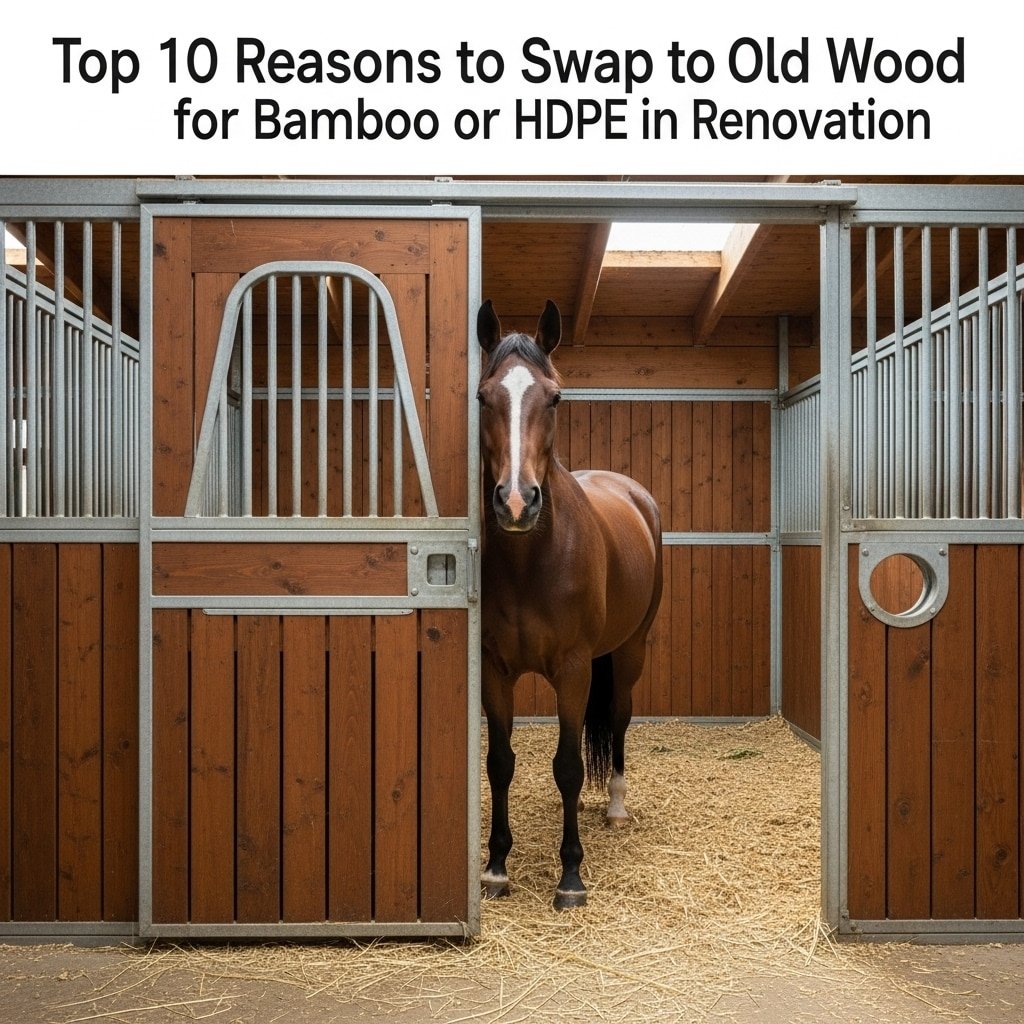
The longevity of a stall door depends entirely on the engineering of its moving parts. For sliding applications, specifically our Série professionnelle, we utilize a Hidden Track System. Exposed tracks in US barns frequently clog with dust, bedding, and hay, leading to jammed rollers. Our design shields the roller mechanism within the steel profile, preventing debris accumulation and ensuring smooth operation for decades.
Hinged variations, which are the standard for our Royal Series, present a different engineering challenge: weight. High-density bamboo infill is significantly heavier than pine or softwoods. To prevent sagging, we use heavy-duty adjustable hinges capable of supporting the full 250kg+ door weight. These allow for minor adjustments over time if the barn structure settles.
Regardless of the mechanism, rust is the enemy. Most competitors weld pre-galvanized black tubes, leaving the weld joints exposed to corrosion. We strictly adhere to Galvanisation à chaud après fabrication (BS EN ISO 1461). We weld the black steel frame first, then dip the entire unit in molten zinc. This guarantees a coating thickness above 85 microns on structural parts, sealing every joint against the ammonia and humidity typical of stable environments.
Sourcing Direct: How B2B Ordering Saves Farm Builders Money
Direct sourcing bypasses 30-50% retail markups and utilizes flat-pack logistics to triple container capacity, cutting per-unit freight costs by over 60%.
Bypassing Retail Markups for Wholesale Margins
Farm builders often bleed profit during the procurement phase by funding a middleman’s overhead. When you purchase through local dealers or domestic retailers, you pay for their storage fees, sales commissions, and inventory risk. This “retail tax” typically adds a 30% to 50% markup to the cost per stall. Sourcing directly from the manufacturer removes these intermediaries, allowing you to secure materials at true wholesale cost.
Direct factory relationships also solve the supply continuity problem. Retailers manage limited, fluctuating stock tailored to small buyers. Large-scale projects require consistency. Factory-direct ordering guarantees that material availability aligns with your construction schedule, preventing the delays associated with piecing together orders from local inventory.
Freight Economics: The Flat-Pack Loading Advantage
Logistics is often the silent killer of project budgets in the equestrian sector. The primary inefficiency is “shipping air.” Traditional fully welded stall fronts are rigid, bulky, and impossible to stack efficiently. You end up paying to ship empty space inside the frames.
We engineered the DB Flat-Pack System specifically to protect distributor margins against high freight rates. By utilizing modular designs that stack densely on steel pallets, we dramatically alter the shipping mathematics:
- Traditional Fully Welded: Loads only 12-15 sets per 40HQ container due to wasted volume.
- DB Flat-Pack System: Optimizes loading to fit 30-45 sets per 40HQ container.
- Freight Impact: Increases capacity by 3x and reduces per-unit shipping costs by approximately 60%.
For distributors and large-scale farm builders, this logistical optimization often impacts the bottom line more than raw material negotiations. You get three times the product for the same shipping slot.
Questions fréquemment posées
What is the standard size for a horse stall in the US?
The 12ft x 12ft (approx. 3.6m x 3.6m) stall is the universal standard for average horses weighing 1,000 to 1,200 lbs. This footprint allows the animal to turn, lie down, and roll safely without becoming cast. For larger breeds like Warmbloods, Drafts, or heavy Hunters, upgrading to a 12ft x 14ft or 14ft x 14ft footprint provides the necessary clearance to prevent injury.
Why is 14-gauge steel recommended over 16-gauge?
Steel gauge measures wall thickness, and in a stable environment, thickness equals safety. 14-gauge steel (approx. 2.0mm – 2.5mm thick) provides the structural integrity required to withstand heavy kicks without buckling or snapping. Thinner 16-gauge or 18-gauge steel lacks this impact resistance and is typically reserved for temporary corral panels or light-duty gates. We strictly prohibit tubing thinner than 2.0mm in our manufacturing because a bent bar is a safety hazard that can trap a hoof.
Should I choose sliding or hinged stall doors?
This decision depends entirely on your aisle width. Sliding doors are the superior choice for working barns with aisles narrower than 12ft, as they do not obstruct the walkway or risk swinging into passing horses. Hinged doors offer a traditional aesthetic and a completely open doorway, but they require wide aisles and perfectly level floors to operate safely. If your floor heaves or settles, a hinged door will drag, whereas a sliding door on an overhead track remains functional.
How do I prevent my stalls from rusting?
The only effective long-term protection is Galvanisation à chaud après fabrication (ISO 1461). This process submerges the fully welded frame into molten zinc, coating both the exterior and the interior of the tubes with a layer exceeding 70 microns. This internal coating is critical because it prevents invisible rust from eating the steel from the inside out—a common failure point in “pre-galvanized” tubing where the weld points are exposed. Paint or powder coat alone will eventually chip, but hot-dip galvanization provides a metallurgical bond that self-heals minor scratches.
Do I need professional welding equipment to install stall kits?
No. Modern modular stall systems are designed for bolt-together assembly. Our kits use standard stainless steel connectors and hardware that allow for assembly using basic tools like a drill and a socket set. This approach eliminates the need for on-site welding, hot work permits, or specialized fabrication labor, significantly reducing installation costs and fire risks in the barn.
Réflexions finales
Compromising on steel gauge invites structural failure and costly replacement cycles that erode client trust. By adhering to the 14-gauge minimum and Hot-Dip Galvanization After Fabrication, you ensure every stall withstands the physical demands of 1,200lb animals. This commitment to the 2.0mm safety threshold transforms a simple purchase into a durable infrastructure asset that protects both livestock and your reputation.
Maximizing your project margin requires smart logistics, not just low material costs. We invite you to request a flat-pack loading plan to see how our modular design triples container capacity compared to welded alternatives. Reach out to our team now to configure your trial order and secure factory-direct pricing.

 French
  English
  Spanish
  Arabic
  German
0 commentaires