


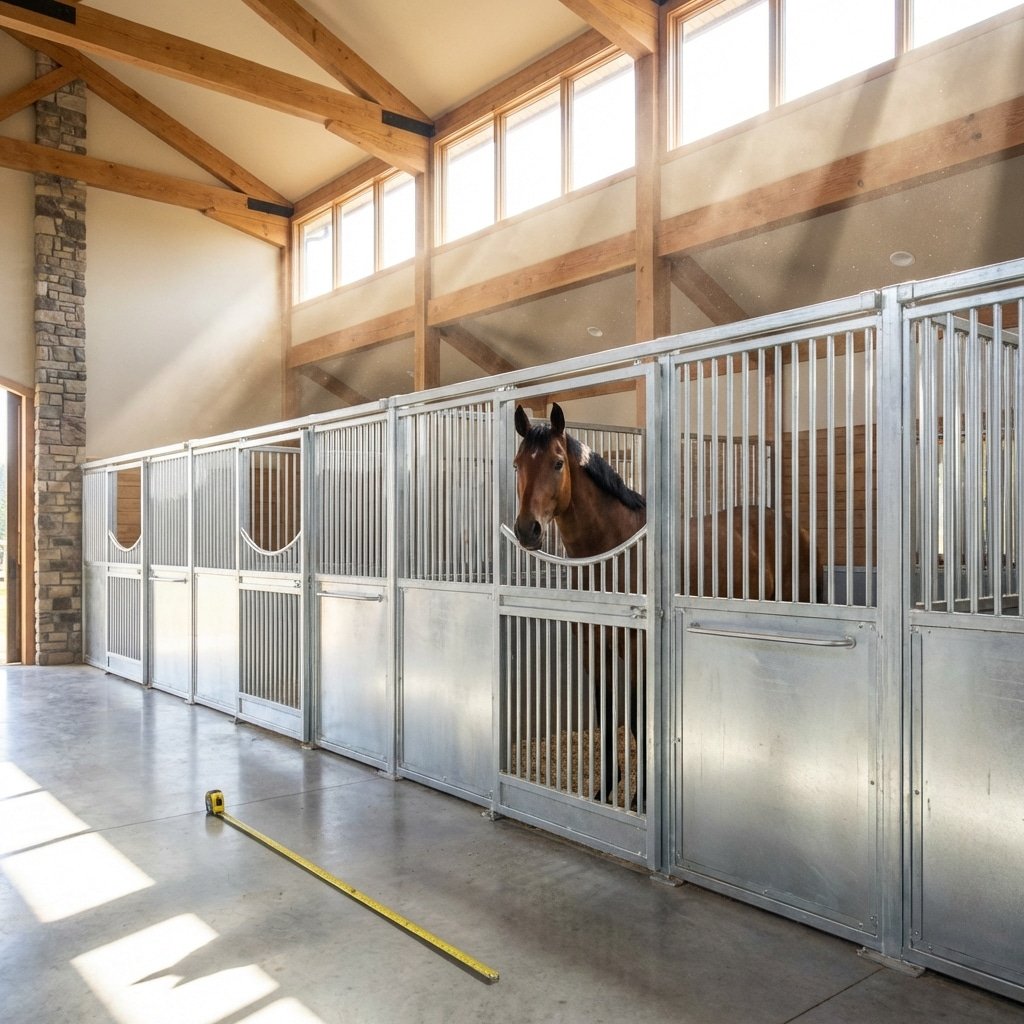
Measuring fails are the primary cause of budget overruns in DIY barn projects. Because hot-dip galvanized steel cannot be trimmed on-site without destroying its rust protection, a tight fit is actually a manufacturing error.
This protocol outlines the Center-to-Center measurement method required for rigid Q235B structural steel. You will learn to calculate specific tolerances for the 304 Stainless Steel hardware kit and account for zinc coating thickness to ensure a seamless, drill-free installation.
The $1000 Mistake: Measuring Inside Wall to Inside Wall
Ordering steel fronts to exact wall widths fails because masonry is rarely plumb. You must measure three points and deduct tolerance to prevent costly, impossible installations.
This expensive error occurs when a client measures their existing masonry opening, sees exactly 12 feet, and orders a stable front to match that
exact dimension. Because existing masonry is rarely perfectly plumb and our hot-dip galvanized steel frames cannot be trimmed on-site, a “tight” measurement often results in a frame that physically will not fit. Successful installation requires measuring the opening at three heights and deducting a specific tolerance for hardware.
The “Perfect Wall” Myth: Addressing Out-of-Plumb Field Conditions
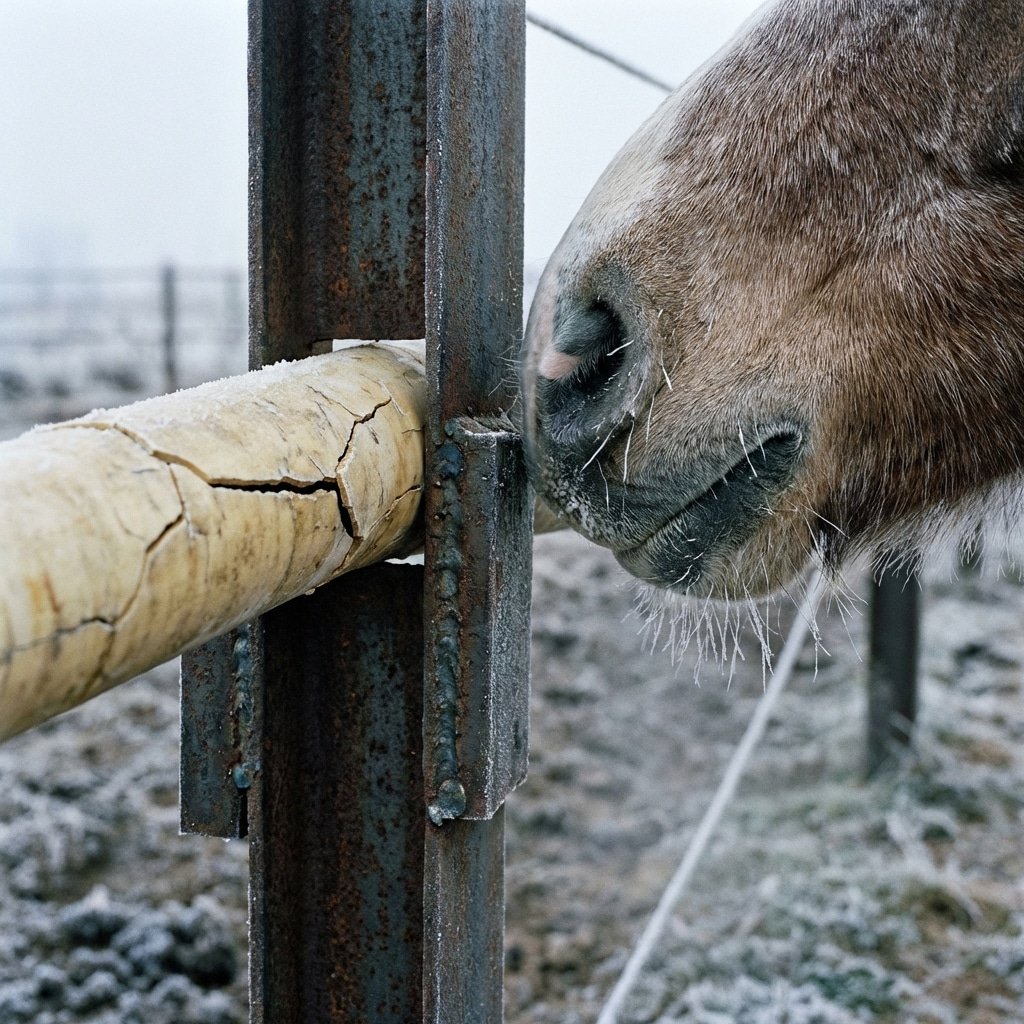
Real-world construction is rarely perfect. Most masonry or block walls lean or bow slightly; an opening might measure 12 feet at the floor but narrow to 11 feet 11 inches at the top cap. In wood framing, a builder can shave down a stud to force a fit. With DB Stable’s rigid Q235B structural steel, that is impossible.
Once a frame undergoes hot-dip galvanization (our standard ISO 1461 process), cutting or grinding the steel on-site destroys the zinc coating and voids the rust protection warranty. To avoid this, we enforce a specific measurement protocol:
- Measure three points: Check the width at the top, middle, and bottom of the opening.
- Trust the narrowest: Base your manufacturing order strictly on the smallest dimension found.
- Ignore the widest: A frame built to the widest point will jam at the narrowest section of the wall.
The Hardware Deduction: Accommodating the Installation Kit
Even if a wall is perfectly straight, a frame built to the exact opening width will still fail. You need physical space for the mounting system. The DB Stable Installation Kit utilizes heavy-duty 304 Stainless Steel connectors that require their own footprint between the steel post and your masonry wall.
Ordering without this deduction prevents the use of standard anchor bolts. You must leave a “shim gap”—typically 10-20mm on each side—to allow for proper mechanical fastening. This gap serves two critical functions:
- Hardware Clearance: It accommodates the thickness of the mounting brackets and bolt heads.
- Independent Leveling: It allows installers to level the front panel independently of the wall. If the existing structure leans, the shim gap absorbs the error, ensuring the sliding door operates smoothly regardless of the masonry’s condition.
The Modular Rule: Center-to-Center Measurements
Center-to-Center (CTC) measurement eliminates cumulative errors caused by material thickness and galvanizing buildup, ensuring modular components align perfectly with fixed anchor points.
The Mechanics of Center-to-Center Precision
Most installation failures start with the tape measure. Measuring from “edge to edge” assumes the material finish is consistent. It rarely is. In our manufacturing process, Galvanisation à chaud après fabrication adds a zinc coating averaging over 85 microns to the steel. This coating thickness varies slightly across the surface, meaning the physical “edge” of a post can shift by fractions of a millimeter.
If you measure from the edge, that variable zinc thickness throws off your math. Drilling also removes material equal to the bit width. Center-to-Center (CTC) ignores these variables. It focuses on the geometric center of the mounting point, which remains constant regardless of coating thickness or drill bit size. This method is the only way to guarantee the Installation Kit components fit without redrilling.
- Eliminates Variable Thickness: Bypasses irregularities from weld flash or zinc drips.
- Standardizes Drill Points: Accounts for material removal by the drill bit automatically.
- Prevents Hardware Conflict: Ensures pre-drilled holes align with site markings.
- Stops Cumulative Error: Prevents small variances from compounding over long stall rows.
| Méthode de mesure | The Variable Risk | Installation Outcome |
|---|---|---|
| Edge-to-Edge | Zinc thickness, weld flash, drill bit width | High risk of misalignment and “creep” |
| Center-to-Center (CTC) | None (Fixed geometric constant) | Exact modular fit |
Positioning DB Stable’s 50mm and 114mm Posts
Applying CTC is critical when laying out runs of multiple stalls. A 2mm error on the first post compounds into a 20mm error by the tenth stall. This is called “creep,” and it ruins alignment for the final door track. You must anchor your layout to the center lines.
For our standard 50mm x 50mm RHS posts, mark your floor line down the exact center of the intended partition wall. Place your anchor bolts based on the center of the post profile, not the flange. The 14-gauge (2.0mm) steel wall thickness is consistent, but the outer dimensions can fluctuate slightly due to galvanizing.
When installing the 114mm Round Posts, the principle is even stricter. You cannot accurately tape-measure the tangent (edge) of a round pipe. You must snap a chalk line representing the center axis of the row. Our 1:1 Flat-Pack templates are calibrated to these center points. Trust the template over a manual edge measurement to match the pre-drilled anchor points in the Q235B steel base plates.
Precision-Engineered Stables With 20-Year Rust Resistance

Accounting for Existing Wooden Support Pillars
Before retrofitting, verify timber columns are plumb and rot-free. Secure Q235B steel frames using our 304 Stainless Steel Hardware Kit to prevent corrosion and ensure a kick-proof bond.
Assessing Structural Integrity and Vertical Alignment
Old barns shift over time. You cannot assume existing wooden posts are straight or capable of bearing new loads just because they are still standing. Before ordering your steel stable system, you must validate the condition of the current infrastructure to prevent installation failures.
- Load Capacity Analysis: Confirm the wooden columns can support the additional static weight of heavy steel panels (Gravity Loads).
- Vertical Alignment Checks: Use a laser level to verify posts are plumb. Leaning pillars require shimming or structural correction before you attempt to mount a square frame.
- Material Inspection: Check timber for rot or termite damage, specifically at connection points near the foundation where moisture accumulates.
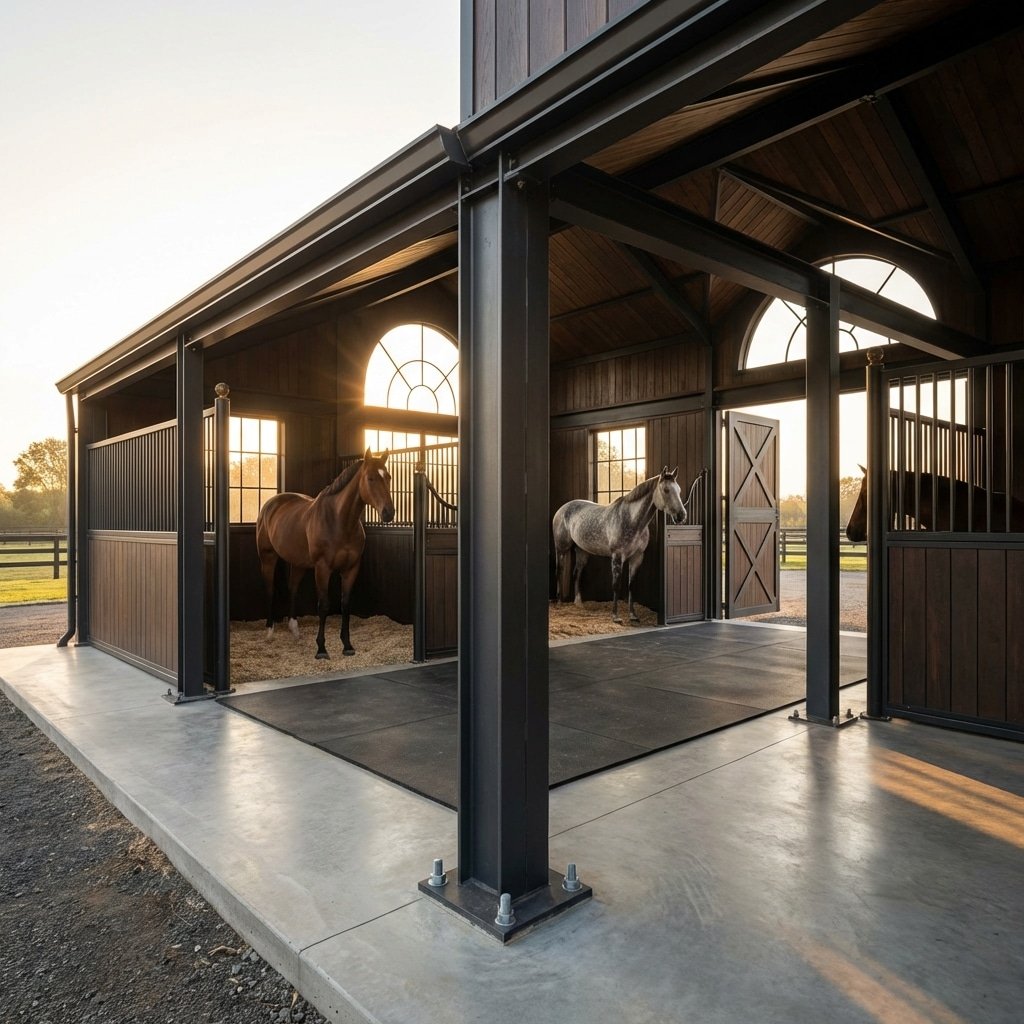
Anchoring with the 304 Stainless Steel Hardware Kit
Mixing wood and steel requires precise hardware choices to prevent corrosion transfer and ensure the connec
tion holds under impact. We provide a specialized hardware kit designed specifically for this material interface.
- Corrosion Control: We utilize included 304 Stainless Steel anchor bolts and screws. This prevents rust from transferring between the treated lumber and the galvanized steel frame.
- Direct Structural Attachment: The Q235B Structural Steel frame mounts directly to the wooden surface using heavy-duty connectors for a flush, rigid fit.
- Kick-Proof Guarantee: Reinforced connection points ensure the hardware does not shear or pull out of the wood when subjected to high-impact forces from the horse.
Ordering Custom OEM Fillers from DB
We fabricate custom hot-dip galvanized filler panels to bridge structural gaps. This ensures a perfect fit without on-site cutting, maintaining the same rust protection as our standard fronts.
Solving Irregular Barn Dimensions
Existing barn structures rarely align perfectly with modular manufacturing increments. A common issue arises when the total width of a barn aisle or stall row does not divide evenly by standard panel sizes, such as 3.0m, 3.5m, or 4.0m. Forcing standard panels into non-standard spaces often leads to structural misalignment or unsafe gaps.
To solve this, we engineer an “OEM Filler.” This is not a makeshift patch, but a narrow, custom-width panel designed specifically to close the gap between the last stable front and the structural wall. The design mimics the aesthetics of the main system to ensure visual continuity. Success relies on precise measurement: you must calculate the specific “leftover” gap only after accounting for all center-to-center post placements of the standard stalls.
The “Hot-Dip After Fabrication” Advantage
The technical superiority of a factory-made filler lies in the manufacturing sequence. Local contractors often address gaps by cutting standard panels on-site. While faster, this exposes raw steel edges that will inevitably rust when exposed to ammonia and moisture. DB Stable rejects this approach.
We weld the custom filler frame using Q235B or Q345B steel to your exact dimensions *before* it enters the galvanization plant. This ensures the filler is not just a cosmetic piece, but a structural component with the same lifespan as the rest of the facility.
- Full Galvanization: The custom frame receives the same BS EN ISO 1461 zinc coating (>70 microns) as standard products.
- Zero Raw Edges: Because we galvanize after welding, there are no cut marks or exposed steel points.
- Production Cycle: This process requires a 35-45 day lead time to accommodate the custom fabrication and dipping schedule.
Questions fréquemment posées
What is the standard size for a horse stall?
For a standard 1,000-pound horse, the global industry baseline is 12′ x 12′ (approx. 3.6m x 3.6m). This allows enough room for the animal to turn and lie down safely. But for larger breeds like Warmbloods or Drafts, we strongly recommend upgrading to 12′ x 14′ or 14′ x 16′. While Ponies fit in 10′ x 10′ stalls, sticking to the 12′ standard usually offers better resale value and versatility for facility owners.
What is the difference between ‘Center-to-Center’ and ‘Inside-to-Inside’ measurements?
“Center-to-Center” measures from the midpoint of one support post to the midpoint of the next. Architects use this for blueprints (e.g., 12′ on center). “Inside-to-Inside” (or Clear Opening) measures the actual empty space between the posts where the stable front must fit. Confusing these two is the #1 cause of installation failure. If your plans show 12′ center-to-center bays using 6″ posts, your actual clear opening is only 11′ 6″. A standard 12′ front will not fit.
Can modular stable fronts be adjusted to fit non-standard openings?
Yes. While many retail suppliers only stock fixed 10′ or 12′ sizes, DB Stable operates as an OEM manufacturer. We adjust the frame width during the fabrication process to match your specific “Inside-to-Inside” measurements (e.g., 11′ 4″). This ensures a secure fit without gaps and eliminates the need for ugly “filler panels” often used by stockists to patch up sizing errors.
How high should stall partitions be for safety?
Stall partitions should be at least 8 feet (2.4m) tall. Horses can kick as high as 7 feet, so a minimum 8-foot barrier is critical to prevent a horse from getting a leg over the wall—a scenario that often ends in severe injury. For barns with high ceilings, we often recommend 9-10 foot partitions or full-height dividers to maximize containment while our open grill upper sections maintain airflow (“stack effect ventilation”).
Réflexions finales
Relying on “tight” edge-to-edge measurements for hot-dip galvanized steel guarantees installation failure and wasted capital on site modifications. Our ISO 1461 zinc coating provides a lifetime of rust protection, but it demands the precision of Center-to-Center planning to accommodate the protective layer. Adopting this protocol ensures your modular components align perfectly with variable field conditions, protecting your project margins from costly rework.
Do not leave your facility’s layout to chance; validate your dimensions with our engineering team before production begins. We recommend submitting your floor plans for a complimentary Center-to-Center analysis to guarantee a seamless fit for your next Container Order. Contact us today to secure your production slot and leverage our flat-pack logistics for maximum shipping efficiency.

 French
  English
  Spanish
  Arabic
  German
0 commentaires