


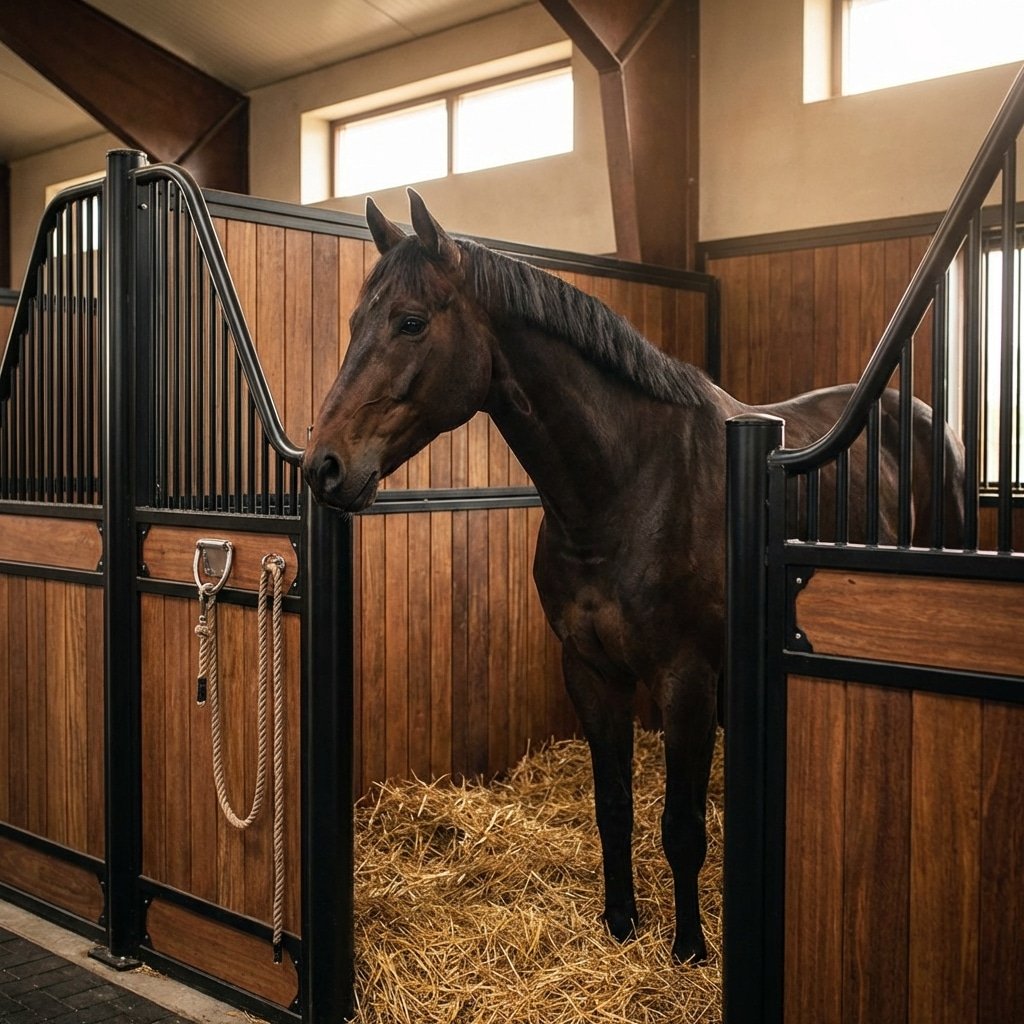
Improperly positioned Inside Tie Rings are a leading cause of avoidable mechanical injury in high-traffic equine facilities. Placing hardware below the chest line creates a slack trap that risks career-ending tendon damage and significant veterinary liability.
This analysis establishes the 1.2-meter safety standard for preventing entanglement and structural failure. We examine the engineering requirements for 14-gauge Q235B steel framing and flush-mount welded designs to ensure containment systems withstand panic loads without warping.
The Danger of Tying Low: Leg Entanglement
Tying below chest height creates a slack loop that traps pawing legs. When the horse raises its head, the rope acts as a pulley, locking the leg and triggering panic.
The Mecha
nics of the ‘Step-Over’ Incident
Most handling injuries are not accidents; they are engineering failures. Tying a horse at a low height sets a mechanical trap that exploits the animal’s natural movement. The sequence of entrapment is predictable and nearly instantaneous.
- The Slack Trap: A low tie point forces the lead rope to droop near the ground when the horse relaxes. This creates a U-shaped loop directly in the “danger zone” of the front legs.
- Pawing Behavior: Impatient or bored horses paw the ground. Because the slack hangs within the hoof’s range of motion, the horse easily steps over the rope, placing the leg inside the loop.
- The Pulley Effect: This is the critical failure point. As soon as the horse lifts its head, the rope tightens upward against the pastern or cannon bone. The horse’s own head acts as a counterweight, mechanically locking the leg in a raised, flexed position.
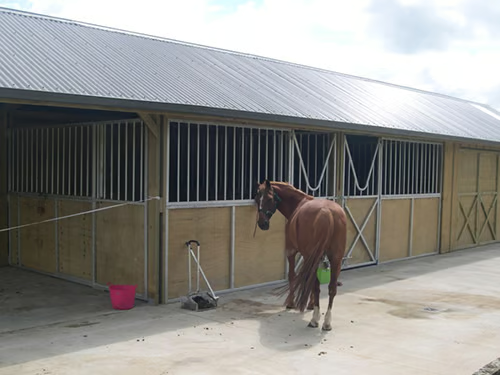
The ‘Flight’ Response and Structural Injury
The biomechanical lock is dangerous, but the horse’s psychological reaction causes the catastrophic damage. Unlike a static entrapment where an animal might wait for help, a horse defines safety through movement. A caught leg triggers an immediate, violent flight response.
- Panic Trigger: The sensation of restraint on the leg causes the horse to pull back efficiently and violently. The harder they pull, the tighter the rope binds the leg to the head, creating a feedback loop of panic.
- Soft Tissue Damage: Ropes do not stretch, but skin and tendons do. The friction burns from the rope can sever skin and fascia within seconds. Internally, the immense tension often ruptures tendons (bowed tendons), effectively ending a performance horse’s career.
- Engineering Safety Philosophy: We design our stables to eliminate this risk before a horse ever enters the stall. This specific hazard drives DB Stable’s core slogan: “Engineering Safety, Defining Standards.” We advocate for and manufacture tie-ring placements well above this danger zone to ensure the slack never drops low enough to become a snare.
The Danger of Tying High: Panic Pull-Backs
Panic pull-backs occur when a tied horse feels trapped, triggering a violent fight-or-flight response. Without 14-gauge steel framing, this force rips tie points free or warps panels.
The Cycle of Panic and Pressure
Horses operate on claustrophobia. When they feel fixed restriction on the poll (the top of the head), it often triggers a violent fight-or-flight response. This reaction is not stubbornness; it is a survival instinct. The “pull-back” becomes a self-reinforcing cycle where the horse struggles against the solid object until something breaks or they flip over.
Solid tying without release points amplifies this panic. As the horse pulls, the pressure increases, convincing the animal they are trapped. This creates a feedback loop that turns a minor spook into a dangerous incident, capable of causing severe injury to the animal or destroying light-duty stable equipment.
Withstanding the Force: The Role of 14-Gauge Steel
A 500kg horse pulling back exerts massive kinetic energy. This force easily bends or shears standard 1.6mm steel tubing found in budget stable systems. To prevent structural failure, the stable frame must possess enough tensile strength to absorb this shock without warping. DB Stable mandates specific engineering standards to handle these loads.
- Steel Grade: We use Q235B and Q345B Structural Steel for high yield strength.
- Wall Thickness: A strict 14-Gauge (2.0mm – 2.5mm) minimum thickness prevents the tube from buckling under tension.
- Weld Integrity: Full 360-degree welding (Hot-Dip After Fabrication) ensures the tie ring anchor point does not rip out of the frame.
Using thinner steel or spot-welded connections in these high-stress zones guarantees failure. Our construction ensures the frame holds together even when subjected to extreme shock loads, protecting both the infrastructure and the horse.
20-Year Rust-Free Modular Horse Stables
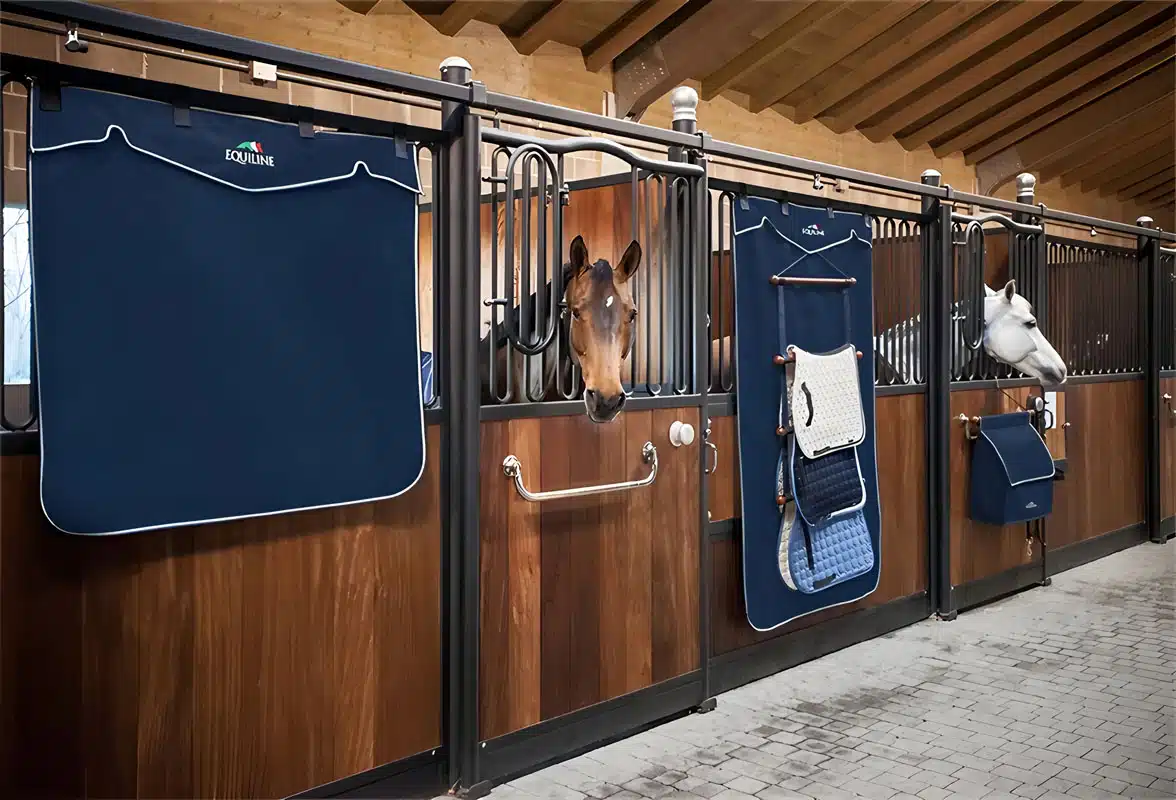
The Golden Rule: The 4-Foot Chest Height Mark
The 1.2-meter mark aligns with the horse’s chest, ensuring ropes remain taut to prevent leg entanglement while minimizing leverage forces during a panic pull-back.
| Installation Height | Risk Profile | Mechanical Consequence |
|---|---|---|
| Below 1.0m (Knee Level) | High – Entanglement | Creates a “slack loop” allowing legs to step over the rope. |
| 1.2m (Chest Height) | Optimal – Safe Zone | Aligns with center of gravity; minimizes leverage on the neck. |
| Above 1.6m (Head Level) | Restricts head movement, amplifying claustrophobia and pull-back force. |
The Anatomy of Safety: Why 1.2 Meters Matters
In professional stabling, the placement of the tie ring is a biological calculation, not an aesthetic choice. The 4-foot (approx. 1.2m) mark is the industry standard because it directly addresses the “Trapping Zone.” When a horse is tied below this level, any relaxation in the lead rope creates a loop that dips near the ground. This invites the horse to step over the rope, resulting in an immediate panic reaction and potential leg fractures.
Mechanically, this height also manages the physics of a pull-back. If the tie point is too high, the horse has no leverage to balance itself, increasing the risk of flipping backward. At chest height, the force is directed horizontally, aligning with the animal’s center of gravity. This allows the horse to brace itself without losing footing, reducing the likelihood of catastrophic injury during a panic event.
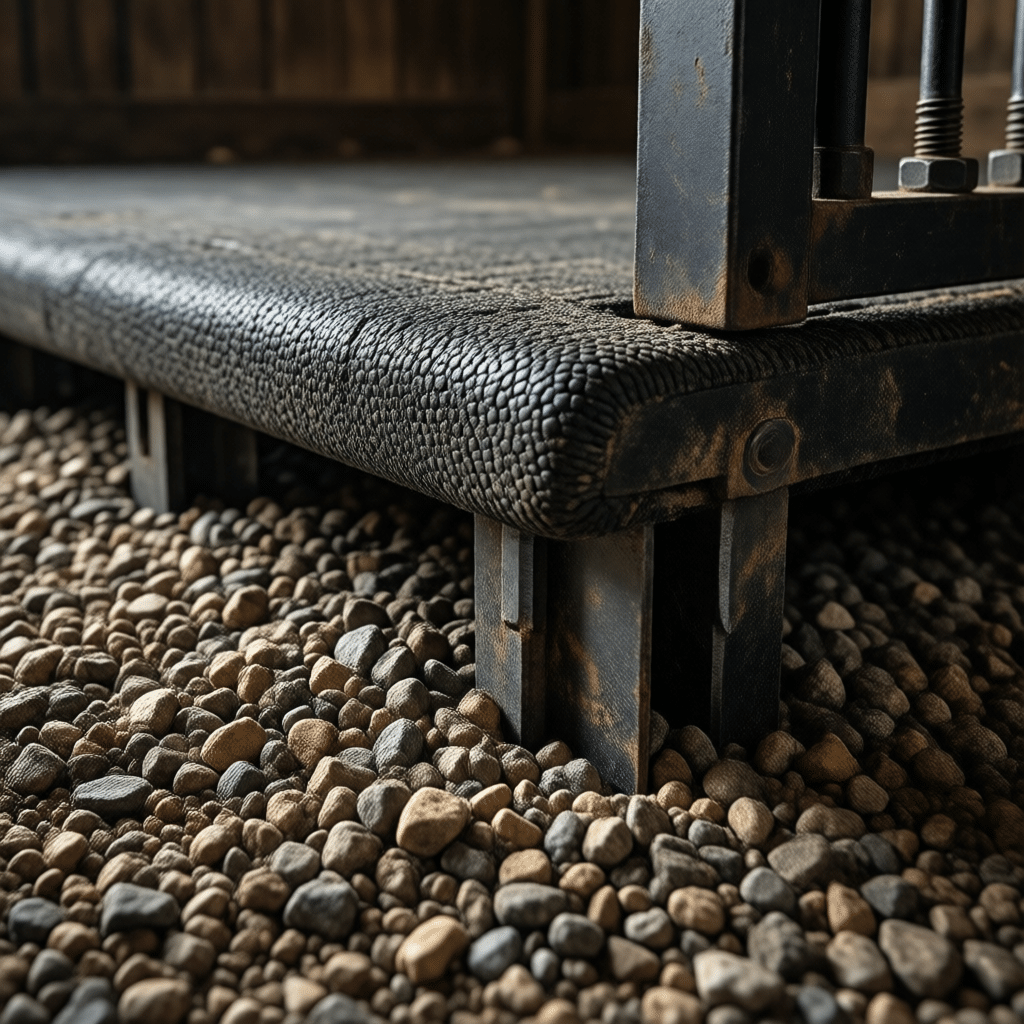
Structural Integrity: 50mm RHS Posts at the Stress Point
Adhering to the 1.2-meter rule creates a significant engineering challenge: it places the maximum point-load stress squarely in the middle of the vertical post. If the steel framework is weak, a sudden 500kg pull-back will deform the post or rip the hardware out entirely. This is where material specification defines safety.
We engineer our fronts and partitions to handle this specific load using a rigid 50mm x 50mm RHS (Square Hollow Section) framework. Unlike budget competitors who use 1.5mm wall thickness—which creates a weak point liable to tearing—we mandate a heavier gauge for all structural components.
- Material Grade: Q235B Structural Steel (Standard) or Q345B (Cold Climate/High Impact).
- Wall Thickness: Minimum 2.0mm to 2.5mm (14-Gauge).
- Mounting Surface: The 50mm flat face provides a flush, stable contact area for tie ring backplates, preventing wobble.
This combination of correct geometry and sufficient steel density ensures that when the “Golden Rule” is applied, the structure holds fast under pressure.
DB’s Flush-Mount SS Tie Rings Welded to the Frame
We replace dangerous protruding eye-bolts with flush-mounted, welded Acier inoxydable 304 rings, eliminating snag hazards and preventing hardware failure during panic pull-backs.
The Safety Advantage of Flush-Recessed Designs
Standard protruding eye-bolts are a liability in professional equine facilities. A bolt sticking out two inches from a frame is a mechanical catch point waiting for an accident. We engineered our flush-mount system to sit level with the 50x50mm RHS post, removing the physical obstruction that causes most doorway injuries.
- Eliminates Snag Points: Traditional bolts frequently catch on halters, fly masks, or blankets as horses pass, triggering panic responses that lead to unnecessary vet bills.
- Prevents Impact Injuries: Because the assembly is recessed, horses passing through doorways cannot bruise their hips or shoulders on the hardware, even in narrow spaces.
- Noise Reduction: The ring retracts flat against the frame when idle, stopping the constant metal-on-metal rattling typical of loose hardware in busy barns.
Permanent Durability: 304 Stainless Steel Welded Integration
Retail-grade stables often rely on screw-in fittings that loosen and strip threads over time. DB Stable abandons this method in favor of structural integration. We weld the tie ring housing directly to the Q235B/Q345B steel frame before galvanization, ensuring the anchor point is as strong as the stable itself.
- Structural Permanence: Unlike screwed fittings that fail under vibration or torque, our welded housings become a permanent part of the steel frame.
- 304 Stainless Steel Components: We use marine-grade stainless steel for the ring element to resist corrosion from wet lead ropes and horse saliva, preventing the rust-seizing common in galvanized rings.
- Load Resistance: The welded connection utilizes the full structural integrity of the steel post, providing maximum holding power if a horse pulls back violently.
Questions fréquemment posées
What is the main safety advantage of flush-mount tie rings?
Flush-mount rings sit inside a recessed pan when not in use, creating a flat surface flush with the stable wall. We call this a “Cast-Proof Design.” It eliminates protruding metal loops that snag horse blankets, scrape a horse’s hide, or cause injury if a horse rolls or rubs against the wall.
Can these tie rings withstand a horse pulling back?
Yes, but with a necessary warning. Our tie rings are welded directly to the heavy-duty Q235B/Q345B structural steel frame, making them significantly stronger than rings screwed into wooden planks. But for safety, we always recommend using a quick-release knot or a breakaway tether. The goal is to ensure that if a horse panics, the equipment releases before the animal injures its neck or poll.
Why do you use 304 Stainless Steel for the tie rings instead of Galvanized Steel?
We use Hot-Dip Galvanization for the structural frames to ensure maximum durability, but moving parts like tie rings require the superior smoothness of 304 Stainless Steel. Galvanizing adds thickness and texture that can cause moving parts to stick. Stainless steel ensures the ring pivots freely without rusting or seizing, even after years of exposure to stable moisture and ammonia.
Is it safe to cross-tie a horse using these rings?
Absolutely. For a cross-tie setup, install two rings on opposite walls at a consistent height (ideally matching the 4-foot chest height standard or slightly higher). Ensure the aisle width allows the horse to stand comfortably, and always use cross-ties with quick-release snaps.
Réflexions finales
Preventing injury reduces liability, making safety a non-negotiable asset for your inventory. While standard screw-in fittings loosen and rust, our Q235B frames with welded 304 Stainless Steel flush-mount rings eliminate snag hazards entirely. Stocking “Cast-Proof” engineering positions your brand as the leader in equine welfare standards.
Secure your market advantage by offering equipment that survives the panic pull-back. We invite you to request a technical specification sheet or discuss a trial LCL order to evaluate our 14-gauge steel quality firsthand. Contact our engineering team today to align our manufacturing capabilities with your project requirements.

 French
  English
  Spanish
  Arabic
  German
0 commentaires