


Calculating tube bending force is the only reliable method to predict if a stall front will survive a direct hoof strike or collapse into a liability claim. While standard 16-gauge tubing offers lower upfront costs, it lacks the mass to withstand point-impact, often crimping immediately and forcing facility owners into expensive emergency repairs.
This analysis examines the physics behind our strict 2.0mm (14-gauge) wall thickness requirement and the structural advantages of Q235B steel. We evaluate how increasing material density and utilizing a 50mm spacing profile eliminates the leverage required to bend steel, ensuring your inventory meets the Kick-Proof Guarantee standard demanded by professional equestrian centers.
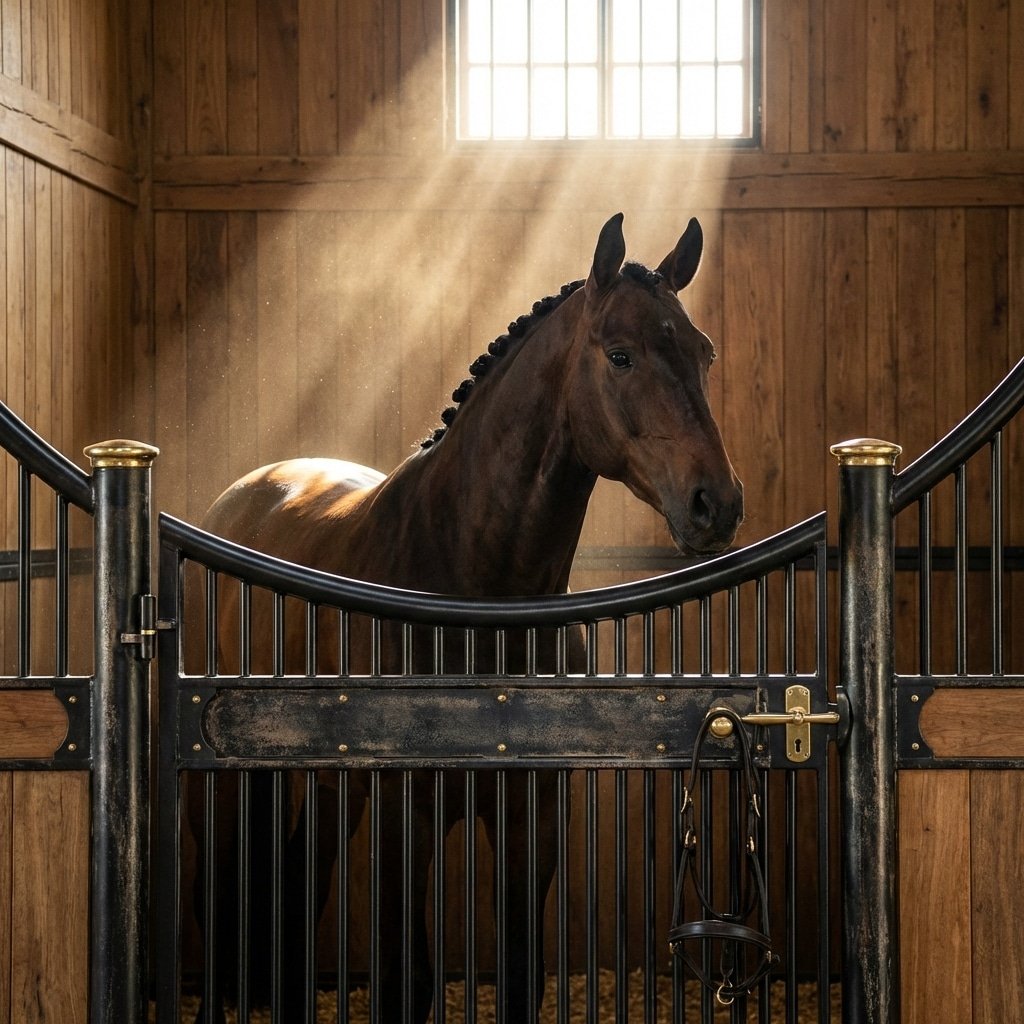
The Physics of a Direct Hoof Strike on a Round Bar
Round bars convert direct impact into tangential energy, creating a “glancing blow.” This geometric advantage, paired with Q235B structural steel, prevents the permanent deformation common in flat-surface designs.
Geometry and Energy Dissipation
When a horse kicks a flat surface, the steel absorbs 100% of the kinetic energy at the exact point of impact. This localized stress concentration forces the metal to accept the full load, often resulting in immediate dents, buckling, or shear failure. Flat surfaces have nowhere to redirect the energy.
Round bars operate on a different mechanical principle. The cylindrical shape creates a “glancing blow” effect. Unless the hoof strikes the exact geometric center with perfect perpendicularity—a statistical rarity in a dynamic stable environment—the hoof slides off the surface. This deflection converts perpendicular force into tangential energy. The steel structure avoids the peak stress load because the energy dissipates along the curve rather than driving straight through the material.
Achieving the Kick-Proof Guarantee
Geometry reduces the load, but the steel must still withstand the impact. Our “Kick-Proof Guarantee” combines this deflection physics with industrial material specifications to ensure the bar maintains its shape under extreme force.
- Structural Steel Grades: We utilize Q235B and Q345B Structural Steel to absorb the remaining impact load without yielding.
- Deflection Mechanics: The system relies on the bar’s ability to turn a direct hit into a graze, protecting the welds and anchors from shock damage.
- Gauge Prohibition: We strictly prohibit tubing thinner than 14-gauge (2.0mm). Thin-wall tubing kinks regardless of shape; our 2.0mm minimum specification ensures the wall holds firm during deflection.
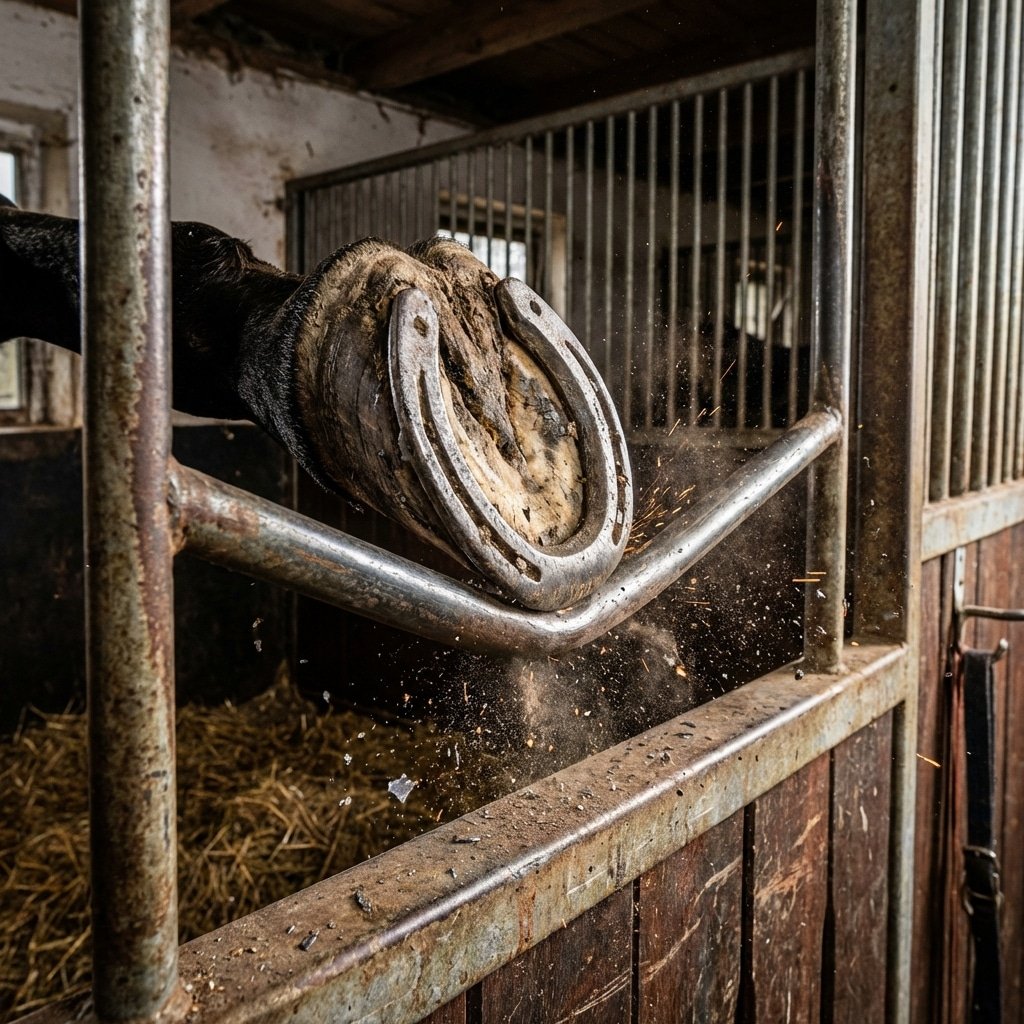
16-Gauge Tubing: The “Hollow Aluminum” Effect
16-gauge tubing lacks the mass to absorb impact, behaving like soft aluminum under stress. We strictly prohibit anything under 2.0mm (14-gauge) to prevent catastrophic crimping failures.
Structural Vulnerability: When Steel Behaves Like Aluminum
In the general fencing market, 16-gauge tubing (approximately 1.6mm or 0.065” wall thickness) is an industry standard because it is lightweight and cost-effective for static barriers. However, when applied to horse stalls, this thickness creates a structural liability we call the “Hollow Aluminum” effect. While chemically steel, 16-gauge tubing lacks the physical mass required to withstand the high-velocity point impact of a horse kick.
The failure mode of 16-gauge steel mirrors that of 6061-T6 aluminum. When struck by a hoof, the thin wall cannot distribute the energy along the length of the tube. Instead, the energy localizes at the impact point, causing the metal to buckle inward immediately. Engineers refer to this as “crimping.” Once a tube crimps, its structural integrity drops to near zero, often causing the bar to pop out of its welds or shear completely, leaving jagged edges exposed to the animal.
The 2.0mm Mandate: DB Stable’s 14-Gauge Requirement
To eliminate the risk of crimping, DB Stable enforces a strict manufacturing floor: no tubing enters our welding bays with a wall thickness below 2.0mm (14-Gauge). This additional mass fundamentally changes the physics of an impact. Instead of the wall collapsing inward, the thicker steel forces the energy to travel through the framework, allowing the material to flex and absorb the shock without permanent deformation.
- Minimum Thickness: 2.0mm – 2.5mm (14-Gauge standard).
- Standard Material: Q235B Structural Steel (equivalent to ASTM A36).
- Cold Climate Material: Q345B Low Alloy High Strength Steel (for superior low-temperature impact toughness).
- Construction Method: Fully welded Q235B/Q345B frames, hot-dip galvanized after fabrication.
Our “Kick-Proof Guarantee” relies on this specification. While 16-gauge competitors may offer a lower upfront price, their product treats a stall front like a visual barrier rather than a containment system. By utilizing Q235B and Q345B structural steel at a 2.0mm minimum, we ensure the stall front acts as a true safety device capable of withstanding direct abuse.
Wholesale Stables Built For 20-Year Durability
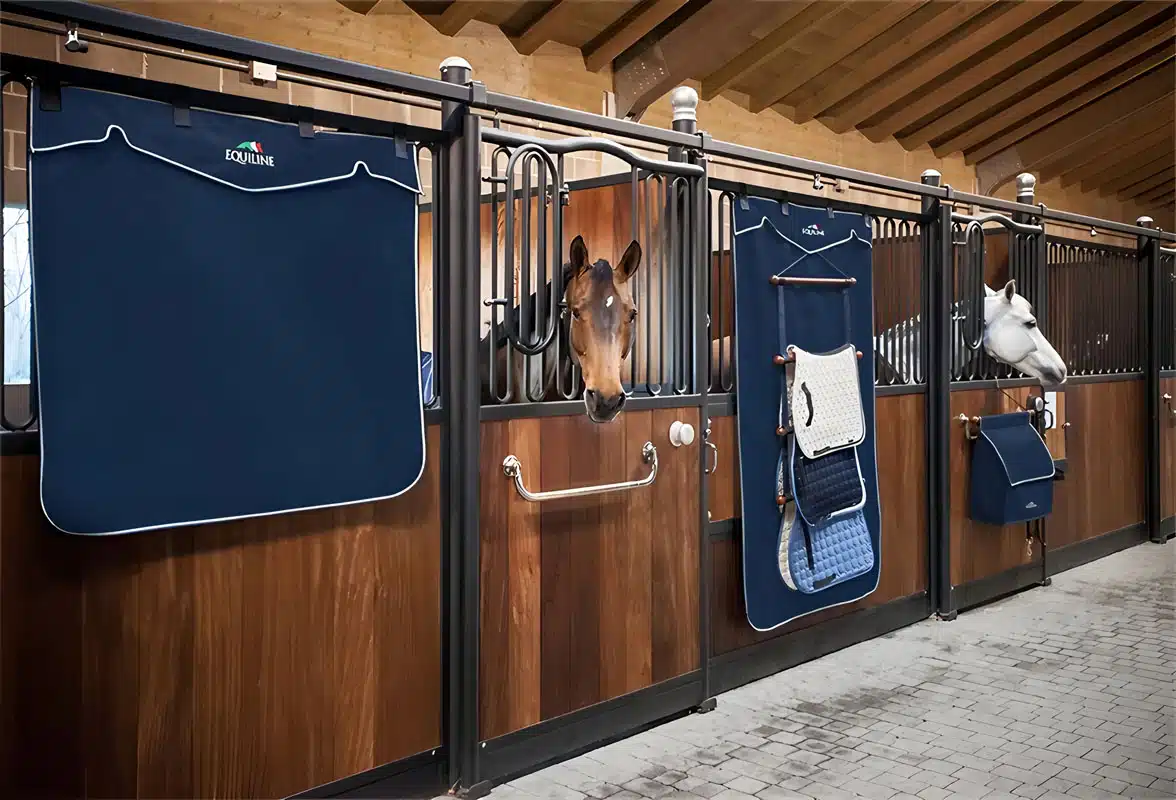

The Tensile Strength of 14-Gauge Q235B Steel
Quick Answer: Q235B steel offers a tensile strength of 370-500 MPa. This specific range allows stable bars to deform under impact rather than shattering, preventing catastrophic injury.
| Mechanical Property | Specification (Q235B) | Impact Consequence |
|---|---|---|
| Yield Strength | ≥ 235 MPa | Force required to permanently bend the bar. |
| Tensile Strength | 370 – 500 MPa | Maximum stress before the steel snaps. |
| Elongation | ≥ 26% | Absorbs kinetic energy (stretch) without fracture. |
The 370-500 MPa Tensile Standard
In structural engineering, “stronger” does not always mean “safer.” If a material is too brittle, a high-impact kick will cause it to shear or snap, creating jagged edges that can fatally injure a horse. We select Q235B specifically for its ductility.
This steel grade provides a specific deformation window. The gap between the Yield Strength (235 MPa) and Ultimate Tensile Strength (370-500 MPa) acts as a safety buffer. When a hoof strikes a bar with substantial force, the steel enters the plastic deformation phase. It bends, absorbing the kinetic energy of the kick, but stops short of the tensile limit where fracture occurs. This behavior is critical for equestrian facilities where animal safety takes precedence over aesthetic perfection.
- Yield Strength (Min 235 MPa): The threshold where elastic deformation ends and permanent bending begins.
- Ultimate Tensile Strength (370-500 MPa): The absolute limit the steel can withstand before mechanical failure.
- Elongation Rate: High ductility allows the metal to stretch rather than snap under sudden impact.
Impact Resilience of 14-Gauge (2.0mm) Profiles
Material grade means little if there isn’t enough of it. Many budget competitors reduce costs by utilizing 16-gauge (1.5mm) tubing. While this works for static loads, it lacks the wall thickness required to distribute the point-load of a direct hoof strike. A thinner wall collapses inward (crimps) immediately upon impact, compromising the structural integrity of the entire panel.
At DB Stable, we enforce a strict minimum wall thickness of 2.0mm (14-gauge) for all tubular sections. This additional 0.5mm of steel significantly increases the moment of inertia, allowing the tube to resist buckling. When combined with our hot-dip galvanization process—which metallurgically bonds zinc to the steel—the resulting composite structure offers superior resistance to both physical deformation and environmental corrosion.
- 2.0mm Minimum (14-Gauge): Our non-negotiable standard to prevent tube collapse.
- Force Distribution: Thicker walls disperse impact energy more effectively than standard 1.5mm alternatives.
- Structural Integrity: Maintains shape and safety even after years of high-traffic use.
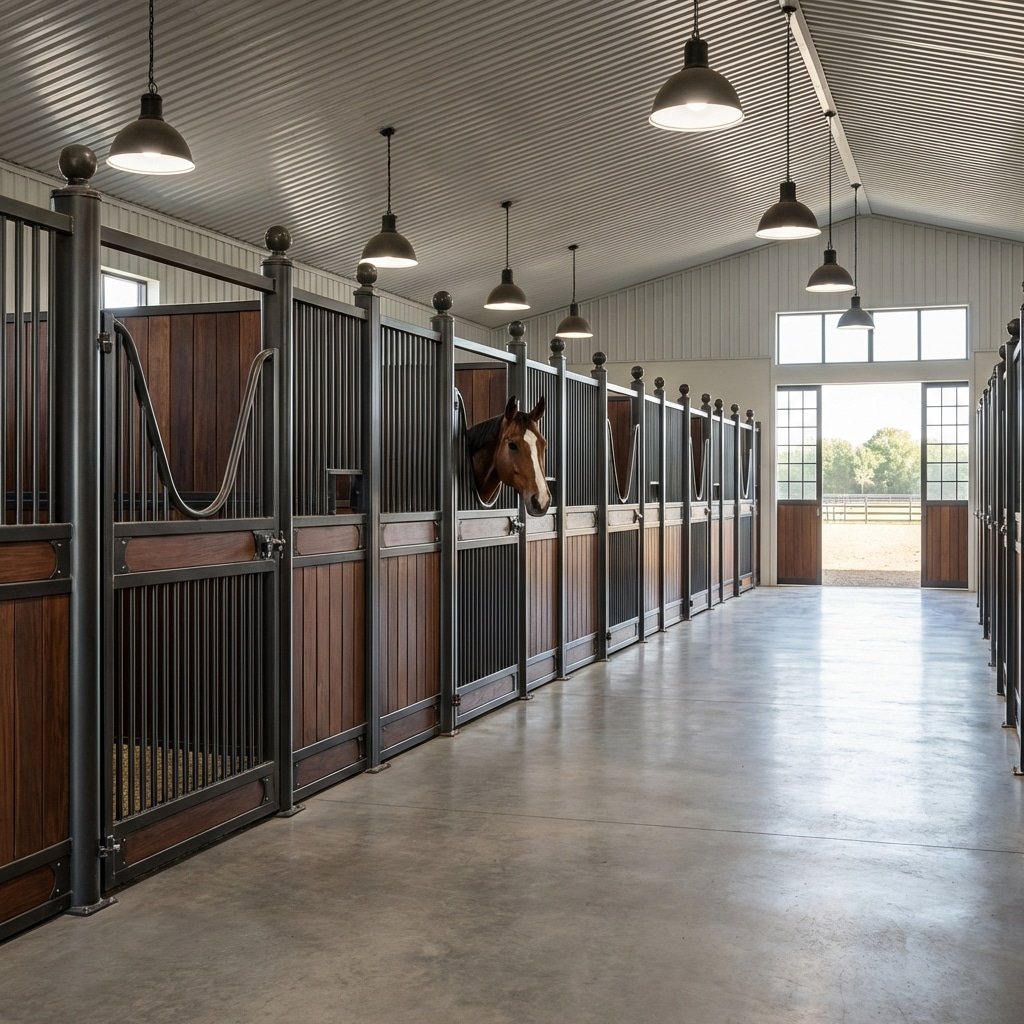
Why 2-Inch Spacing Prevents Tube Bending
Restricting gaps to 50mm blocks hoof penetration, effectively eliminating the leverage required to bend steel bars and forcing impacts to deflect off the tube face.
The Physics of Deflection: Eliminating Leverage Points
The most common cause of bent stable bars is not a direct kick, but a trapped leg. When grill spacing exceeds 3 inches (75mm), a horse’s hoof can slip between the bars. Once the leg is through, the steel tube acts as a fulcrum against the bone. As the horse panics and pulls back, this creates immense lateral torque that easily kinks standard tubing.
We engineer our systems with tight 2-inch (50mm) spacing to physically prevent this scenario. By keeping the gap narrower than the average hoof, we force every strike to hit the face of the grill. This changes the physics of the impact completely:
- Surface Deflection: The round tubular shape deflects the hoof, converting dangerous bending torque into simple compression force.
- Load Distribution: A direct kick on a 50mm grid often spans two adjacent bars, effectively doubling the structural resistance of the Q235B steel.
- Torque Elimination: Since the leg cannot penetrate the grill, the “pry bar” leverage effect is impossible to achieve.
Implementing the 50mm “Cast-Proof” Standard
In the DB Stable engineering glossary, we define this 50mm specification as our “Cast-Proof Design.” It is the critical threshold that prevents a horse from getting “cast”—stuck against the wall or fence—during a roll. While some manufacturers widen gaps to save on material costs, we maintain this density to align with Global Equestrian Engineering safety protocols.
Spacing alone is not enough. We pair this 50mm density with our mandatory 14-Gauge (2.0mm) wall thickness. Thinner 16-gauge tubing often dents even under deflection, but our 2.0mm Q235B steel provides the rigidity needed to withstand the blunt force of a kick without deforming. This synergy between narrow spacing and heavy-duty wall thickness protects both the animal’s legs and your facility’s long-term maintenance budget.
Questions fréquemment posées
What is the safety difference between 14-gauge and 16-gauge steel?
The gauge indicates wall thickness, where lower numbers mean thicker steel. We strictly use 14-gauge (approx. 2.0mm-2.5mm) because it offers significantly higher impact resistance than the industry-standard 16-gauge. Under the force of a kick, 16-gauge tubing is prone to buckling or crimping, whereas 14-gauge Q235B structural steel maintains its integrity, preventing sharp edges that could injure the horse.
Can a horse bend the steel stable bars?
It is virtually impossible with our specification. While horses can generate massive force, our use of Q235B (or Q345B) structural steel with a 50mm profile distributes impact energy effectively. Unlike hollow aluminum or thin-wall fencing which can deform, hot-dip galvanized steel bars are engineered specifically to resist the concentrated force of a direct hoof strike.
Why is ‘Hot-Dip Galvanization After Fabrication’ important?
This process is critical for longevity in corrosive stable environments (ammonia/urine). Unlike ‘pre-galvanized’ steel where welds are painted over, we dip the entire welded panel into molten zinc (BS EN ISO 1461). This seals every joint, inside and out, with a coating exceeding 70 microns, ensuring rust cannot form at the structural connection points.
Réflexions finales
Specifying 16-gauge tubing invites catastrophic crimping failures that compromise animal safety and your dealership’s liability. By mandating 2.0mm Q235B structural steel, you transform a potential lawsuit into a non-event where impact energy harmlessly deflects. We refuse to lower this standard because your reputation relies on equipment that survives real-world abuse.
Don’t rely on datasheets alone; validate the structural integrity of our “Kick-Proof Guarantee” firsthand. Request a sample profile or schedule a technical consultation to review how our Hot-Dip Galvanization after fabrication outperforms standard pre-galvanized alternatives. Contact our engineering team today to secure your region’s supply of industrial-grade stabling.


 French
  English
  Spanish
  Arabic
  German
0 commentaires