


Installing heavy-duty Barn Aisle Mats often creates an immediate mechanical conflict with standard sliding doors. Generic systems typically provide minimal ground clearance, causing the door frame to jam against the rubber surface and grind away the protective zinc layer. This friction forces builders into expensive reactive solutions, such as raising header beams, which significantly increases labor costs and compromises the stall’s structural integrity.
We eliminate this clearance issue at the engineering stage using DB Stable’s Cast-Proof Design parameters. By integrating a standard 50mm bottom gap on every Professional Series door, we ensure sufficient air remains above standard 17mm mats to prevent binding. This calculated allowance permits continuous flooring installation without on-site fabrication, preserving the Hot-Dip After Fabrication coating and maintaining critical Stack Effect Ventilation.

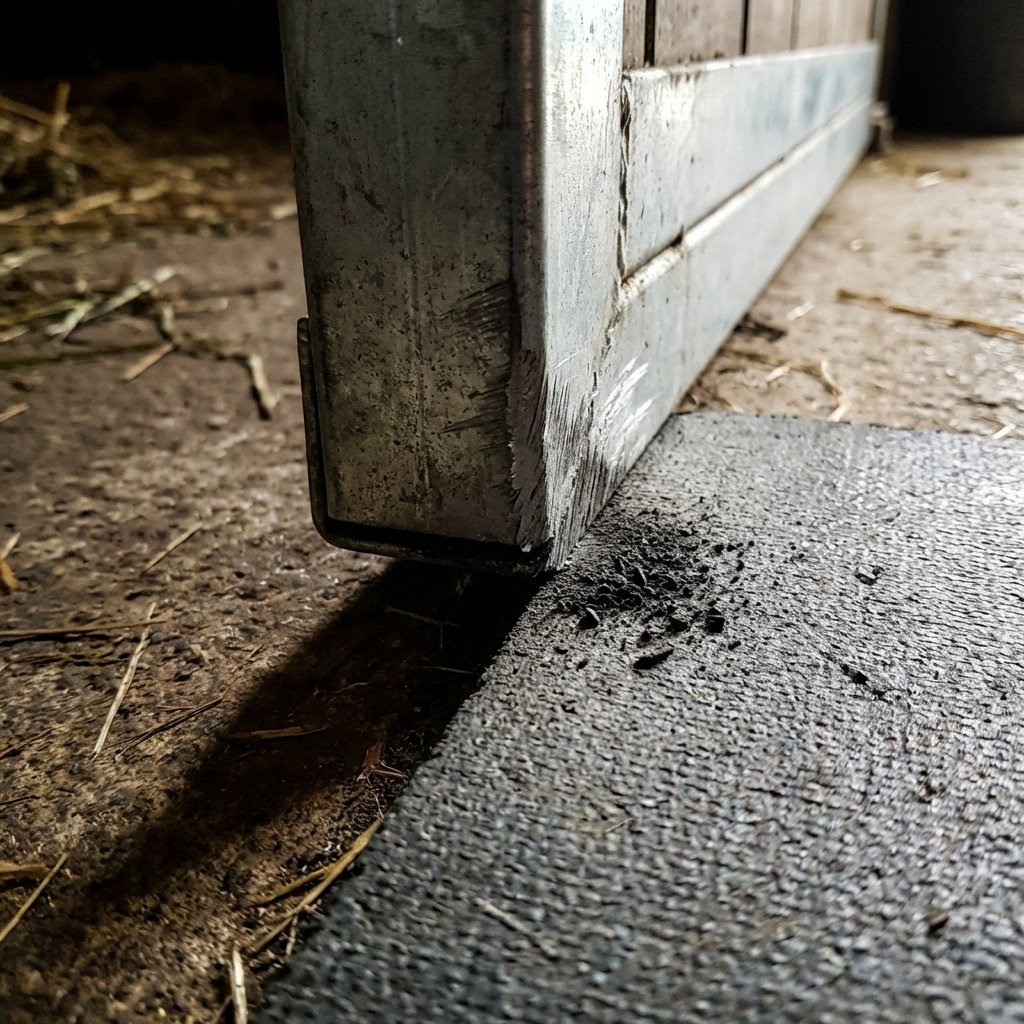
The 17mm Height Problem: Mats vs Door Clearances
Standard 17mm mats often jam generic doors with low clearance. DB Stable’s 50mm ‘Cast-Proof’ gap clears these mats automatically, eliminating the need for on-site door modifications.
Why Standard 17mm Mats Jam Conventional Doors
17mm is the global benchmark for rubber stall mats. It balances weight with the necessary shock absorption for equine joints. The conflict arises because many generic barn doors are designed with minimal ground clearance—often less than 15mm—under the assumption that they will sit over bare concrete.
Installing these mats reduces vertical headroom immediately. Sliding doors begin to drag, and hinged doors bind against the rubber surface. This forces builders into reactive solutions: either cutting mats around the door swing, which creates gaps where urine pools, or raising the entire door header, which drives up labor costs.
The 50mm Cast-Proof Gap: A Built-In Solution
We solve this mechanical conflict at the engineering stage. DB Stable incorporates a standard 50mm bottom gap on all doors as part of our “Cast-Proof Design.” While the primary function is preventing horses from trapping a leg while rolling, this specific dimension solves the flooring issue passively.
- Calculated Clearance: The 50mm gap leaves 33mm of air above a standard 17mm mat, preventing any drag or binding.
- Continuous Flooring: Installers can run mats from the aisle into the stall without breaks, eliminating threshold trip hazards.
- Zero Fabrication: There is no need for on-site grinding or header adjustments to accommodate the floor level.
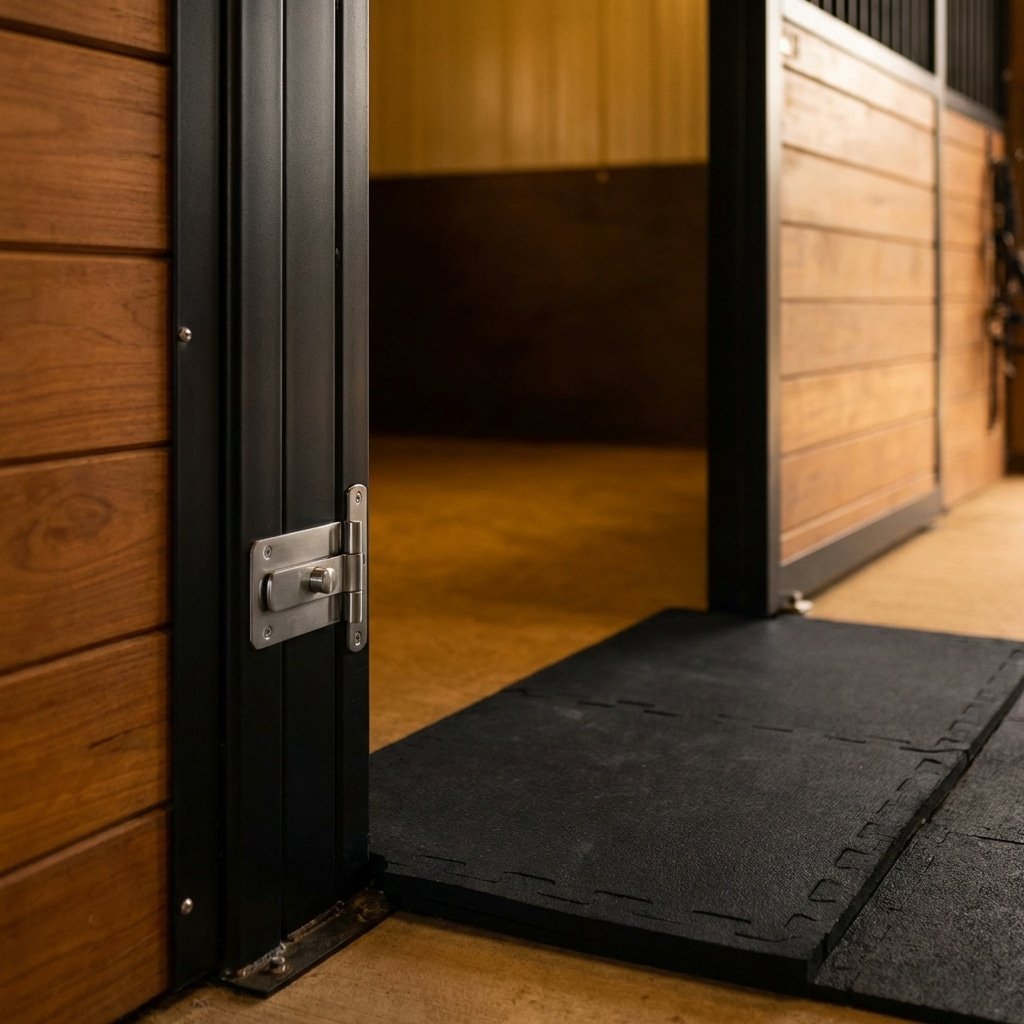
The Danger of “Lip” Hazards at the Stall Entrance
“Lip” hazards are protruding latches or bucket holders at doorways that snag horse eyelids or nostrils. We eliminate these risks using flush-mount 304 stainless hardware and recessed swivel feeders.
Identifying Protrusion Risks: Latches and Bucket Holders
In barn safety, a “lip” refers to more than just a flooring threshold. It describes any hardware projection capable of catching soft tissue as a horse passes. The stall entrance sees the highest frequency of movement in the facility, making it the statistically most probable location for injury. When a horse rushes through a doorway, even a minor protrusion creates a significant laceration risk.
- Latch Protrusion: Many sliding door latches do not retract fully flush against the frame. This leaves a metal hook exposed at eye level, which can easily tear a cheek or eyelid during entry.
- Fixed Bucket Hazards: Rigid bucket holders bolted near the entrance effectively narrow the passing width. These create a blunt force risk to hips and a snagging risk for halters or faces.
- The Traffic Factor: Unlike a stall wall, the doorway is a high-traffic choke point. The repetition of entry and exit amplifies the likelihood of contact with any exposed hardware.
DB Safety Standards: Recessed Hardware and Swivel Feeders
We do not rely on user caution to prevent injuries; we rely on engineering. DB Stable manufacturing specs explicitly eliminate these hazards by integrating hardware into the structural profile rather than bolting it onto the surface.
- Flush-Mount Design: We utilize Acier inoxydable 304 hardware designed to sit recessed within the door frame. This ensures the latch mechanism remains flush with the steel profile, removing catch points.
- Swivel Feeder Integration: Notre Professional Series replaces static protruding buckets with rotatable Aluminium Swivel Feeders. These lock safely outside the traffic zone or flush with the front, clearing the doorway completely.
- Post-Galvanization Smoothness: Le “Hot-Dip After Fabrication” process ensures every weld and edge is coated in a thick zinc layer (avg > 70 microns). This fills and smooths the sharp steel burrs common in cheaper pre-galvanized tubing.
- Rounded Profiles: All structural components use rounded edges on channel openings to protect the equine face if a horse rubs against the frame.
Engineered For 20+ Years Of Rust-Free Durability


Zero-Threshold Sliding Door Tracks
Top-hung sliding systems eliminate dangerous floor channels, allowing seamless rubber mat installation and preventing manure buildup for a safer, cleaner stable environment.
The Safety Advantage of Top-Hung Suspension
Traditional bottom channels are often the weak link in stable design. These floor-mounted tracks act as traps for bedding, urine, and manure, creating a hygiene issue that requires daily cleaning to prevent door jamming. By removing the bottom track entirely, we eliminate these maintenance headaches and significantly improve safety.
- Elimination of Trip Hazards: Raised floor tracks create a stumbling block for horses. Removing them ensures a clear, flat entry and exit path, reducing the risk of leg injuries.
- Hygiene Maintenance: Without a bottom U-channel to collect debris, the threshold remains self-cleaning. There is no place for moisture to pool, which reduces bacterial growth and ammonia buildup.
- Seamless Flooring: A zero-threshold design allows rubber mats or pavers to extend continuously from the aisle into the stall. Installers do not need to cut mats to fit around a track, ensuring structural integrity of the flooring system.
DB Stable’s “Hidden Track” Architecture
For our Professional Series, we engineer the door system to rely exclusively on overhead suspension. This approach requires higher-grade steel components to handle the dynamic load of the door without sagging or derailing over time.
- Professional Series Integration: We utilize a heavy-duty top rail system that fully conceals the roller mechanism. This protects the moving parts from stable dust and debris, extending the lifespan of the hardware.
- Floor Guide Implementation: To keep the door aligned without a full track, we install a single, low-profile guide fin. This small anchor point prevents the door from swinging outward if kicked but leaves the threshold almost entirely open.
- 304 Stainless Steel Hardware: Standard steel rollers eventually corrode in ammonia-rich stable environments. We use 304-grade stainless steel for all overhead rollers and brackets to ensure resistance against rust and moisture.
Adjusting DB’s 3D Hinges to Clear Thick Rubber Pavers
Installing aisle mats reduces door clearance. DB Stable’s 3D hinges allow you to vertically lift the door panel to restore the safety gap without moving the steel posts.
| Flooring Material | Added Thickness | Resulting Gap (Pre-Adjustment) | Required Hinge Lift |
|---|---|---|---|
| Bare Concrete | 0mm | 50mm (Standard) | Aucun |
| Standard Aisle Mat | 17mm | 33mm (Reduced) | +17mm |
| Heavy-Duty Paver | 40mm | 10mm (Critical Drag Risk) | +40mm |
Managing the ‘Cast-Proof’ Clearance Gap
We engineer every DB Stable door with a specific 50mm bottom gap. This “Cast-Proof Design” prevents a horse from getting a leg trapped if they roll near the door. But when you install 17mm, 25mm, or 40mm rubber pavers effectively raising the floor level, you eat into this safety buffer.
If you ignore this reduction, the door frame will drag across the rubber surface. This friction damages the expensive rubber mats and grinds away the hot-dip galvanization on the bottom of the door, exposing the steel to rust. Maintaining the correct gap also preserves the “Stack Effect Ventilation,” ensuring air continues to flow under the door and up through the grill.
Vertical Calibration of the Stainless Steel Hinges
To fix clearance issues without reinstalling posts, we equip our Professional and Royal Series with adjustable 3D hinges cast from 304 Stainless Steel. These are not standard static hinges; they feature an internal threaded mechanism designed for post-installation correction.
- Mechanism: A central threaded bolt controls the vertical position of the door leaf.
- Adjustment Range: Installers can lift the panel between 20mm and 50mm depending on the bolt length.
- Efficiency: You do not need to drill new holes or move the structural steel posts.
- Corrosion Resistance: The 304 Grade material ensures the threads do not seize up in wet stable environments.
Questions fréquemment posées
Do sliding horse stall doors require a bottom track?
No. Our sliding systems are suspended from a heavy-duty overhead track to keep the barn aisle free of tripping hazards and debris buildup. But a floor-level guide is non-negotiable. This small hardware piece anchors the bottom of the door to prevent sway. Without it, a horse kicking or pawing at the door can push it outward, creating a severe risk of leg entrapment.
How do I fit rubber mats under the stable door?
Installation must start at the doorway threshold. Place the first full-sized mat here to ensure a tight, seamless fit against the threshold strip, which stops horses from pawing up the exposed edge. Push the required 1/4″ to 1/2″ expansion gap to the rear walls where traffic is lower. Never use small scrap pieces in the doorway; this high-stress area demands the weight and stability of a full mat.
Can adjustable hinges help clear thick barn mats?
Yes. If you use standard 3/4″ (19mm) rubber mats, you often lose critical floor clearance. We recommend using adjustable hinges in these scenarios. They allow you to vertically raise the door (typically by +/- 1/2 inch) post-installation. This ensures the door bottom clears the bedding or mats without dragging, yet maintains a gap small enough to prevent hooves from slipping underneath.
Réflexions finales
Ignoring floor clearance metrics during procurement inevitably leads to expensive on-site retrofits and damaged inventory. By standardizing on DB Stable’s 50mm “Cast-Proof” gap and adjustable 3D hinges, you eliminate installation bottlenecks before the container even arrives. This engineering foresight protects your project margins and ensures a seamless fit for modern heavy-duty rubber flooring.
Stop gambling on generic dimensions that fail in the real world. Request our technical specification sheet today to see how the Professional Series integrates flush hardware and zero-threshold guides into your facility. Contact our team to secure a sample kit and validate our “Hot-Dip After Fabrication” quality for yourself.


 French
  English
  Spanish
  Arabic
  German
0 commentaires