


Persistent tail rubbing destroys show-quality aesthetics and accelerates stable wall degradation. While parasites often trigger the itch, the financial damage compounds when horses target abrasive, rough-cut timber that splinters under pressure. Relying on standard softwoods creates a costly cycle of injury and constant board replacement that drains operational budgets.
This analysis examines the protective benefits of replacing porous lumber with 28mm-32mm HDPE Infill or High Density Strand Woven Bamboo. By leveraging materials with a Janka Hardness exceeding 3000 lbf, facility managers eliminate the friction points that tear hair and harbor bacteria, securing a hygienic, zero-maintenance facility.

The Itchy Horse: Dealing with Tail Rubbing
Tail rubbing typically signals parasites or poor hygiene. While vets treat the horse, non-porous HDPE stable walls prevent the environment from harboring the eggs that cause reinfection.
Diagnosing the Itch: Pinworms, Insects, and Hygiene
Tail rubbing is rarely just a “bad habit.” It is almost always a physical response to intense irritation. Before assuming a horse is bored, you need to rule out the specific biological triggers that turn a horse into a scratching machine. Ignoring the root cause leads to damaged stable walls and injured horses.
- Culicoides Gnats (Sweet Itch): These midges inject saliva that triggers a hypersensitivity reaction. The itching is intense and seasonal, often affecting the mane and chest alongside the tail.
- Pinworms (Oxyuris equi): These internal parasites migrate to the anus to lay eggs, causing severe rectal irritation. The eggs appear as white plaques, but the invisible itch drives the horse to rub against anything solid.
- Hygiene Issues: Accumulated smegma in the sheath (geldings) or udder (mares) creates localized itching. Since the horse cannot scratch these areas directly, they rub their tail as a compensatory action.
Sanitary Defense: The Non-Porous Benefit of HDPE Infill
Once you treat the horse, you must treat the environment. Traditional wood stalls are porous; they absorb moisture and trap parasite eggs deep in the grain, making total disinfection nearly impossible. This creates a cycle where the horse clears the infection medically but immediately picks it up again from the stall wall.
We recommend replacing wood with our **28mm-32mm HDPE Infill** for high-traffic or quarantine stables. This material shifts the advantage from the parasite to the facility manager.
- Eliminating Harbors: Unlike rough-cut pine or OSB, HDPE is chemically non-porous. Pinworm eggs and bacteria cannot penetrate the surface, leaving them exposed for cleaning agents to kill.
- Ease of Disinfection: The smooth finish allows for effective power washing. You can scrub and sanitize the entire wall without water damage or creating splinters that could injure a rubbing horse.
- Zero Maintenance: HDPE resists rot, moisture, and urine completely. It maintains a hygienic barrier year-round without the need for sealing, painting, or treating.

The Friction Factor of Rough Cut Pine and OSB
Rough cut pine and OSB act like coarse sandpaper with friction coefficients exceeding 0.6. Moisture and irregular grain orientation amplify this abrasion, actively stripping hair during rubbing.
Surface Roughness and Moisture Impact
Many stables utilize rough cut lumber or OSB (Oriented Strand Board) to cut costs, but these materials are mechanically aggressive against equine tissue. Physics dictates that the friction coefficient of rough wood typically ranges from 0.5 to 0.8. This high resistance means that every time a horse leans back to rub, the wall effectively grabs the hair rather than letting it slide.
- Grain Orientation: Rubbing perpendicular to the grain on rough lumber generates 30% higher friction than rubbing parallel to it. Since horses rub in random patterns, they inevitably hit this high-resistance angle.
- OSB Texture: The compressed strands in OSB create microscopic peaks and valleys. These irregularities act as thousands of tiny hooks that snag and snap tail hairs.
- The Moisture Trap: Pine and OSB are hygroscopic. They absorb humidity and sweat from the horse. Wet wood has a significantly higher friction coefficient than dry wood, making the wall more abrasive exactly when the horse is sweaty and itchy.
The Smoothness Standard: HDPE vs. Traditional Timber
To eliminate the “catch and pull” effect that ruins tails, we engineer our stables with materials that maintain a consistent, low-friction surface regardless of the environment. Unlike softwood that splinters or swells, engineered infills provide a surface where hair glides rather than snags.
- Recycled Plastic (HDPE): DB Stable uses 28mm-32mm HDPE infill. This material is non-porous and uniform, meaning it has no grain direction to increase drag and cannot absorb moisture.
- High Density Bamboo: For clients demanding a wood aesthetic, we use strand woven bamboo with a Janka Hardness exceeding 3000 lbf. This density allows for a glass-smooth finish that resists the abrasion typical of soft pine.
- Impact on Hygiene: Smooth surfaces prevent the accumulation of skin oils and hair, which often attract bacteria on rougher wood walls.
Factory-Direct Stables Built for Extreme Climates

Splinter Hazards During Scratching Fits
Aggressive rubbing on soft timber forces splinters deep into muscle tissue, causing delayed abscesses. High-density materials like bamboo or HDPE eliminate this risk entirely.
The Cycle of Friction and Secondary Infection
Horses dealing with sweet itch or parasites do not scratch gently. They apply significant leverage against stable walls to relieve irritation. When they rub against standard rough-cut pine or low-grade plywood, the friction shears the wood fibers. This creates sharp debris that easily breaks the skin barrier.
The real danger is the migration of these foreign bodies. A splinter often carries bacteria from the stall environment deep into the subcutaneous tissue or muscle. The initial entry wound may heal over quickly, trapping the infection inside. This frequently results in a “cold” abscess that only becomes visible weeks later, often requiring veterinary intervention to drain and treat.
Safety Specs: Janka Hardness and HDPE
To prevent this, the material must be harder than the force applied to it. We reject standard softwoods in favor of materials that maintain a sealed surface under heavy friction.
- High Density Strand Woven Bamboo: We specify bamboo with a Janka Hardness rating > 3000 lbf. This is three times harder than Oak. The extreme density ensures the surface creates a polished effect when rubbed, rather than fraying or splintering.
- UV Stabilized HDPE: This infill is grain-free. As a solid polymer, it physically cannot splinter. It absorbs impact and provides a smooth, safe surface for itchy horses, requiring zero maintenance to keep it that way.
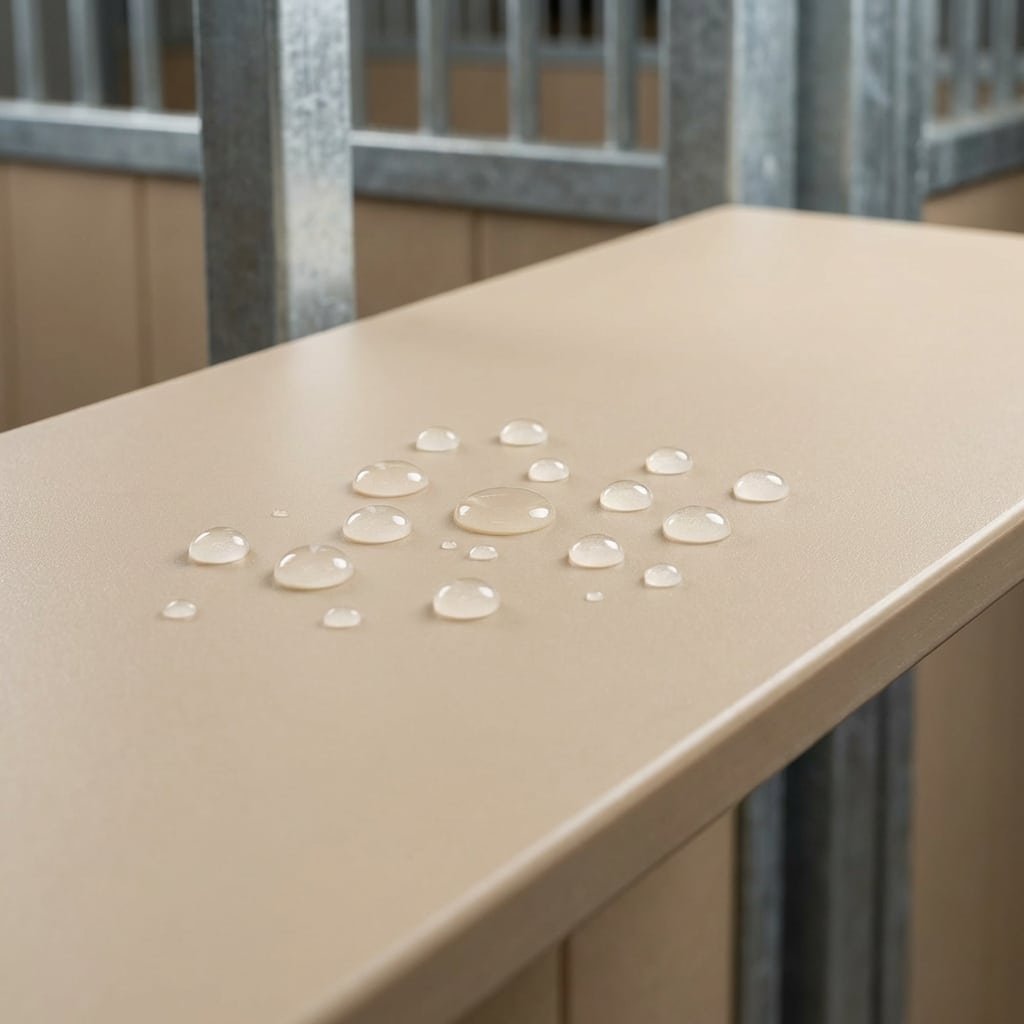
Tongue and Groove Bamboo: A Glass-Smooth Finish
Tongue and groove bamboo creates a seamless, high-density surface that eliminates the friction points and splinters common in pine, preventing tail hair damage and discouraging rubbing behaviors.
| Fonctionnalité | Standard Softwood (Pine) | DB Stable Bamboo |
|---|---|---|
| Connection Profile | Butt-Joint (Gap Prone) | Tongue & Groove (Interlocking) |
| Janka Hardness | ~600 – 900 lbf | > 3000 lbf |
| Friction Risk | High (Splinters & Warping) | Zero (Glass-Smooth) |
The Interlocking Profile: Eliminating Friction Points
Standard butt-jointed timber poses a mechanical risk to horses prone to tail rubbing. As softwoods expand and contract with humidity changes, the boards warp and separate. These movements create vertical gaps between the planks that act like tweezers, trapping tail hairs and ripping them out when the horse moves. Rough edges on warped boards also provide a texture that satisfies the itch, which encourages the horse to continue rubbing and damaging the facility.
The tongue and groove profile solves this by mechanically locking every plank together. The protruding tongue fits tightly into the receiving groove, ensuring the wall acts as a single, monolithic unit rather than individual boards. This connection prevents gaps from opening, even under environmental stress. The resulting surface is flush and seamless. Without gaps to snag hair or rough textures to scratch against, the wall offers no gratification for rubbing, often reducing the behavior naturally.
Strand Woven Durability: Janka Hardness > 3000 lbf
The material density itself plays a critical role in safety. Softwoods gouge easily; a single kick or heavy rub can create splinters and “burrs” that act like sandpaper on a horse’s dock. DB Stable strictly utilizes High Density Strand Woven Bamboo to eliminate this hazard. Unlike oak or pine, our bamboo manufacturing process compresses fibers under immense pressure to create a material that rivals the hardness of exotic hardwoods.
- Janka Hardness: > 3000 lbf (Approx. 3x harder than Oak).
- Material Composition: High Density Strand Woven Bamboo.
- Surface Finish: Factory sealed, glass-smooth texture.
This extreme density ensures the surface resists splintering even under heavy impact. While a pine board might fray into sharp slivers after a season of use, strand woven bamboo maintains its smooth integrity. This prevents the formation of rough spots that could injure the horse’s skin during rubbing, providing a safer, long-term solution for high-traffic stables.
Questions fréquemment posées
Why is my horse rubbing its tail against the stable wall?
Tail rubbing is typically triggered by irritation from pinworms, sweet itch (caused by gnats), dirty sheaths/udders, or dry skin. While treating the underlying medical issue is the first step, the condition often worsens if the horse rubs against abrasive surfaces. Rough walls turn a minor itch into significant hair loss and skin trauma.
How can I prevent tail damage if my horse won’t stop rubbing?
Eliminating rough surfaces in the stall is the best prevention method. Traditional rough-cut pine and OSB act like sandpaper, catching hair and causing splinters. We recommend upgrading to High-Density Polyethylene (HDPE) infills or high-density bamboo. These materials provide a smooth, friction-free surface that minimizes hair loss even if the horse continues to rub.
Does stable hygiene play a role in skin irritation?
Yes, porous materials like old wood can harbor fungal spores, bacteria, and parasite eggs that re-infect the horse and trigger itching. Systems built with Hot-Dip Galvanized steel and non-porous HDPE boards allow for thorough power-washing and disinfection, significantly reducing environmental allergens in the stall.
Is HDPE or wood better for an itchy horse?
HDPE is generally safer for chronic rubbers. Unlike wood, which can splinter or crack under pressure, HDPE offers a consistent, smooth surface that will not degrade from moisture or scratching. It provides the necessary barrier protection without the risk of splinter-related secondary infections.
Réflexions finales
While rough-cut timber reduces upfront costs, it creates long-term liability through splinters and recurring veterinary issues. Upgrading to our non-porous HDPE ou High-Density Bamboo safeguards your facility’s reputation by eliminating the friction points that destroy tails. Smart facility managers invest in materials that prevent injury rather than cause it.
Validate the difference before you buy. We invite you to request a Material Sample Kit to test the Janka hardness and smooth finish of our interlocking system firsthand. Reach out to our engineering team to align our OEM manufacturing with your project’s specific safety requirements.


 French
  English
  Spanish
  Arabic
  German
0 commentaires