


Therapeutic riding facility design requires strict adherence to ADA protocols where standard agricultural specifications fail. Installing inadequate aisle widths or high-threshold doors creates immediate liability risks and operational bottlenecks for wheelchair users. Architects and center directors cannot afford the financial burden of retrofitting unsafe structures after construction.
We analyze suppliers capable of delivering Q345B high-strength steel frames and zero-threshold sliding systems engineered for accessibility. This guide benchmarks manufacturers on their ability to provide ISO 1461 hot-dip galvanized longevity and modular flat-pack solutions, ensuring your project meets safety standards without the excessive costs of custom fabrication.
Designing Stables for Wheelchair Accessibility (ADA)
Quick Comparison
| Accessibility Standard | Location | Key Feature | Verdict |
|---|---|---|---|
| Accessible Routes and Pathways | Site-Wide Requirement | Stable Surfacing, Wide Pathways | Prevents wheelchairs from sinking or slipping on facility grounds. |
| Ramp Requirements | Entrances & Elevation Changes | Access Ramps, Gradient Solutions | Safe transition over elevation changes with standardized slopes. |
| Clear Floor Spaces and Maneuvering Areas | Grooming & Mounting Areas | Spacious Layouts, Maneuvering Zones | Allows users to safely participate in grooming with adequate room. |
| Assembly and Spectator Areas | Observation Areas | Accessible Seating, Companion Seats | Promotes social inclusion for observers and companions. |
Accessible Routes and Pathways
**Continuous 36-inch paths** with firm footing are the foundation of safe accessibility, preventing mobility aids from sinking into soft ground.
Accessibility begins with the ground beneath the rider. Facilities must implement continuous pathways with a minimum clear width of 36 inches to comfortably accommodate standard wheelchairs and mobility devices.
Surface integrity is equally vital for safety. Pathways require stable, firm, and slip-resistant materials to ensure reliable traction, eliminating the risks associated with mud or loose gravel in stable environments.
📊 At a Glance:
- 📍 Location: Site-Wide Requirement
- 🏭 Core Strength: Stable Surfacing, Wide Pathways
- 🌍 Key Markets: Therapeutic Riding Centers
Why We Picked Them:
| ✅ The Wins | ⚠️ Trade-offs |
|---|---|
|
|
Ramp Requirements
**Mandatory for safe access**, ensuring smooth transitions over elevation changes with a standardized 1:12 slope.
Ramps are legally required wherever elevation changes exceed ½ inch. To comply with ADA standards, they must maintain a maximum slope of 1:12, meaning every inch of vertical rise necessitates 12 inches of horizontal run.
This design rule is critical for navigating barriers between parking zones, main entrances, and riding arenas. Proper implementation ensures that wheelchair users can move independently without the risk of tipping or fatigue.
📊 At a Glance:
- 📍 Location: Entrances & Elevation Changes
- 🏭 Core Strength: Access Ramps, Gradient Solutions
- 🌍 Key Markets: ADA Compliant Facilities
Why We Picked Them:
| ✅ The Wins | ⚠️ Trade-offs |
|---|---|
|
|
Clear Floor Spaces and Maneuvering Areas
A critical design requirement that grants wheelchair users the **30×48 inch clear space** needed for safe, active participation.
A single stationary wheelchair demands a minimum footprint of 30 by 48 inches. Without this defined clearance, safe movement and positioning become impossible for the rider.
Architects must integrate these dimensions into observation decks, grooming stations, and mounting blocks. This spacing ensures riders can independently position themselves without obstruction.
📊 At a Glance:
- 📍 Location: Grooming & Mounting Areas
- 🏭 Core Strength: Spacious Layouts, Maneuvering Zones
- 🌍 Key Markets: Indoor Stable Structures
Why We Picked Them:
| ✅ The Wins | ⚠️ Trade-offs |
|---|---|
|
|
Assembly and Spectator Areas
**Integrated companion seating** ensures social inclusion while meeting strict ADA dispersion requirements.
Facilities with seating must provide wheelchair spaces following ADA dispersion requirements based on capacity. Companion seating should be provided immediately adjacent to these wheelchair spaces.
This requirement allows spectators with disabilities to sit alongside their companions rather than being isolated. Designers must calculate the specific number of accessible spots based on the venue’s total seating capacity.
📊 At a Glance:
- 📍 Location: Observation Areas
- 🏭 Core Strength: Accessible Seating, Companion Seats
- 🌍 Key Markets: Spectator Facilities
Why We Picked Them:
| ✅ The Wins | ⚠️ Trade-offs |
|---|---|
|
|
Premium Stables Engineered for 20-Year Durability
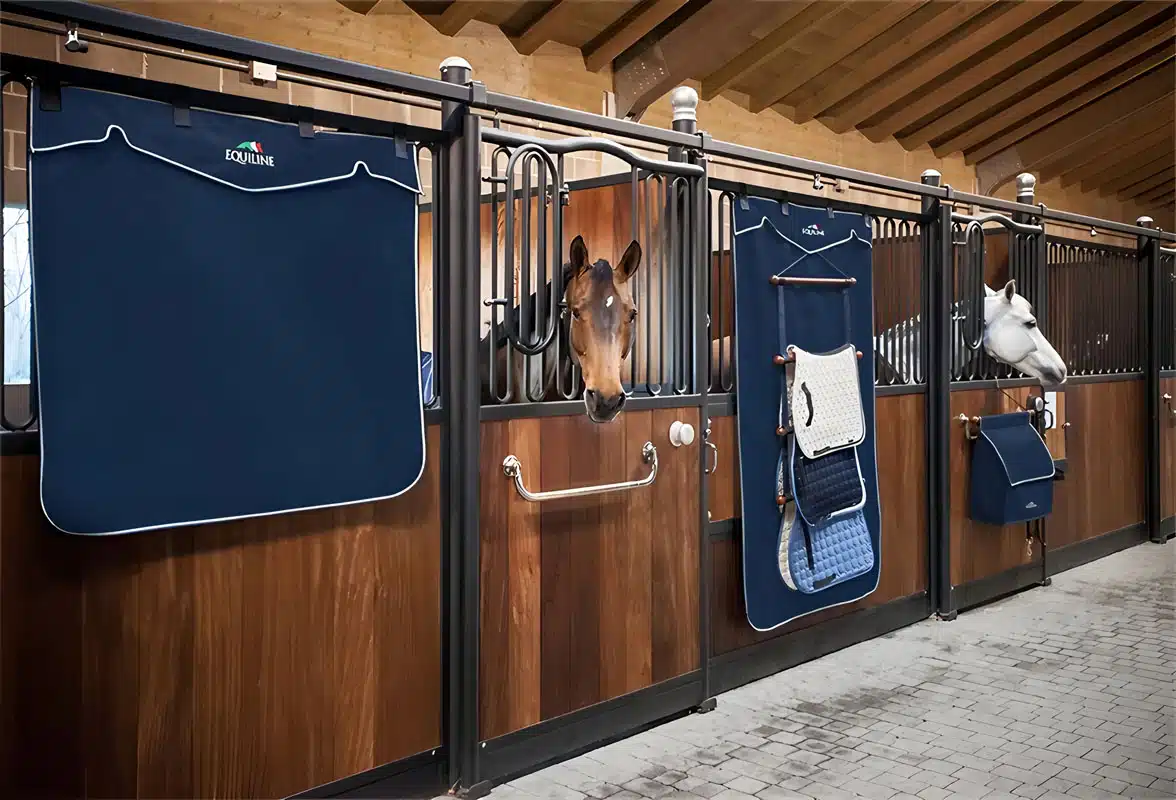

Designing Stables for Wheelchair Accessibility (ADA)
Creating an accessible equestrian facility requires integrating precise spatial dimensions with structural reinforcement to ensure safety for riders with limited mobility. We combine standard ADA clearance protocols—such as 60-inch turning radii—with our modular high-strength steel systems to create environments that are both navigable for wheelchairs and resilient against equine impact.
ADA-Compliant Clearances and Turning Radii
To accommodate standard wheelchair rotation and navigation, stable aisles and pathways must exceed typical agricultural dimensions. We recommend planning for a minimum continuous pathway width of 36 inches, expanding to at least 60 inches at key turning points. This ensures that riders using mobility devices can navigate corners without obstruction or risk of injury from protruding hardware.
For grooming bays and observation decks, specific spatial planning is required to allow stationary participation. These areas should be designed with a dedicated 30-inch by 48-inch clear floor space. This spacing allows wheelchair users to approach the horse safely for grooming or tacking up without interfering with the animal’s movement zones.
Achieving these dimensions often requires flexibility that traditional welded barns cannot offer. By utilizing our **flat-pack system**, project managers can customize partition spacing on-site. This modular approach allows installers to widen aisles or create expanded grooming areas during the assembly phase, ensuring the facility meets therapeutic access standards without the high cost of custom-fabricated steelwork.
Reinforced Wall Systems for Therapeutic Safety
Safety in therapeutic riding centers is critical, as riders with limited mobility may not be able to quickly evade a spooked horse. For these environments, we specify **Q345B low alloy high strength steel** for all structural frames. This material offers superior impact toughness compared to standard steel, providing a necessary safety margin in close-contact areas where wheelchairs and horses interact.
To further protect participants, we recommend installing **impact-absorbing HDPE infill** planks within the partitions. Unlike wood, which can splinter, or concrete, which is unforgiving, HDPE absorbs kinetic energy. This creates a **kick-proof guarantee** that protects the structural integrity of the stable while minimizing injury risks to both therapy horses and riders in the event of an accident. The **zero maintenance** nature of HDPE also ensures that the facility remains hygienic and free of rot or rust, which is essential for professional therapeutic environments.
Finally, the integration of the stable system with the facility’s flooring is vital. All ramps connecting stable levels must adhere to a maximum 1:12 slope to ensure wheelchair users can ascend and descend independently. Our frame systems are designed to accommodate these grade changes, ensuring that the transition between the ramp and the stable stall remains flush and free of trip hazards.
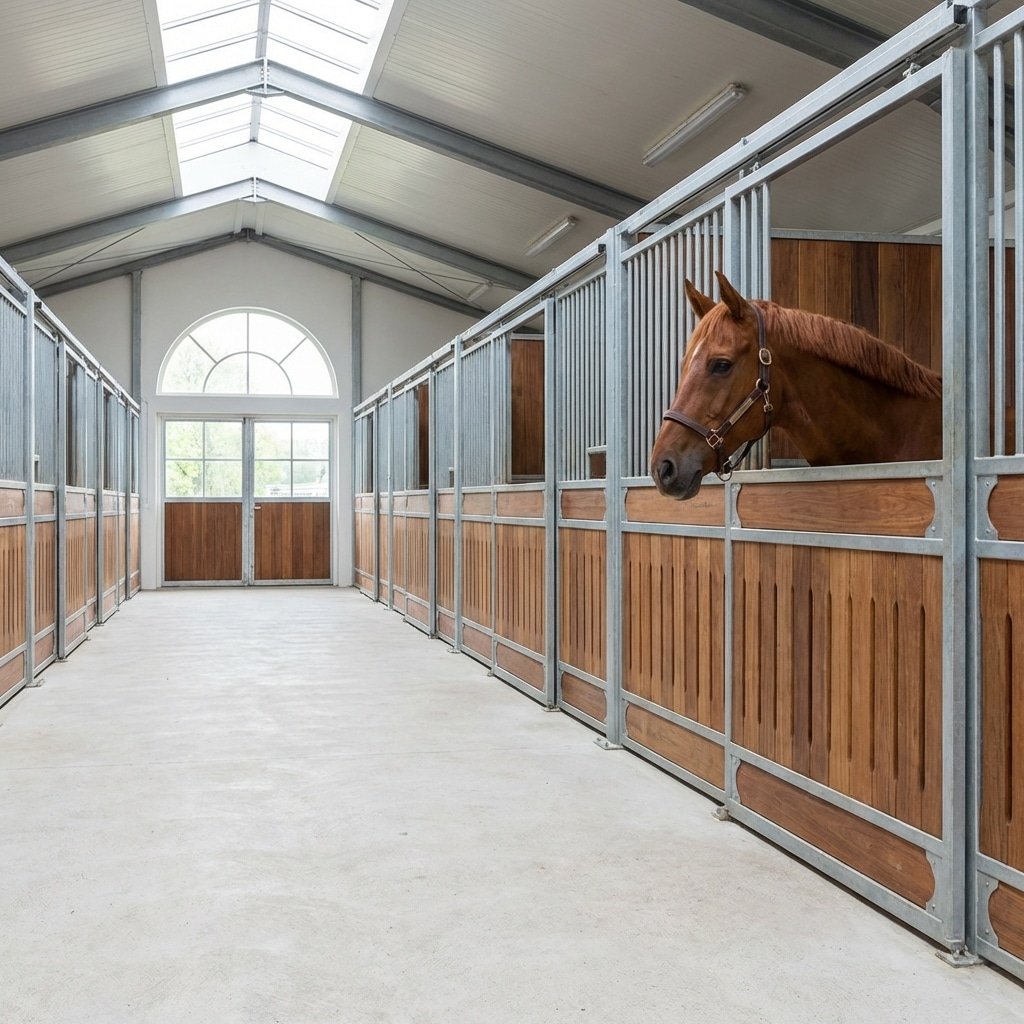
The Aisle Experience: Wide Sliding Doors vs. Swing Doors
For commercial facilities and busy riding schools, the choice of door mechanism defines daily workflow efficiency. While traditional hinged doors offer a classic aesthetic, our engineering analysis confirms that sliding systems significantly maximize aisle utility, ensure ADA compliance, and reduce liability risks associated with handling horses in high-traffic zones.
Space Optimization: Eliminating Swing Radius for Accessibility
Traditional hinged doors require substantial clearance to open, typically consuming over 1.2 meters (4 feet) of aisle width. This swing radius creates immediate obstacles for large equipment, tractors, and wheelchair users, effectively reducing the usable square footage of the facility. In busy commercial stables, this “dead space” can lead to congestion during peak activity times, forcing handlers to wait for doors to close before passing safely.
Our sliding door systems operate on a fixed linear plane, ensuring the central aisle remains completely unobstructed at all times. This design is critical for professional projects aiming for ADA compliance, as it guarantees a consistent, clear path for maneuverability. By utilizing our Professional Series hidden track systems, facility managers can maintain wider functional aisles, allowing horses and handlers to move freely without the need to dodge swinging barriers.
Operational Safety: Mitigating Wind and Handling Hazards
Hinged doors pose a calculated safety risk in breezeways or open-barn designs, where wind gusts can violently slam heavy steel frames. This creates a dangerous scenario where a door could strike a horse or pin a handler against a partition wall. Furthermore, leading a spirited horse through a hinged doorway requires the handler to manage the animal while simultaneously manipulating the door arc, increasing the complexity of the movement and the risk of the animal rushing the gap.
We prioritize sliding systems for our commercial partners because they eliminate these variables. Secured within our heavy-duty hot-dip galvanized tracks, these doors remain stable regardless of airflow. This linear operation ensures that handlers always have a clear escape route and simplifies the entry process, allowing them to focus entirely on the horse rather than the infrastructure. For high-volume stables, this reduction in handling complexity directly correlates to fewer accidents and lower liability claims.

Zero-Threshold Floors: Eliminating Trip Hazards
Therapeutic riding facilities demand absolute barrier-free access. By utilizing top-hung sliding systems and recessed anchoring, we eliminate trip hazards while maintaining the structural integrity required for heavy-duty equine safety.
Designing for Wheelchair Mobility
Therapeutic riding centers require meticulously level surfaces to accommodate participants with cerebral palsy, spinal cord injuries, or limited motor control. Standard stable designs often overlook the physical energy required for wheelchair users to transition from the barn aisle into the stall. Eliminating raised door sills allows for independent navigation and removes physical barriers that impede therapeutic goals.
To ensure consistent traction for mobility devices, we advise using smooth concrete or rubber-bricked aisleways rather than loose rugs or deep sand. A zero-threshold entryway ensures that walkers and wheelchairs can move seamlessly without the jarring impact of navigating over a door frame, creating a safer environment for both the rider and the support team.
Integrating Steel Fronts with Seamless Flooring
Notre Professional Series utilizes a heavy-duty, top-hung sliding door track system specifically designed to eliminate the need for full-length floor rails. By suspending the door weight from the overhead steel header, we remove the tripping hazards associated with traditional bottom-track systems found in cheaper alternatives.
We engineer our signature “Cast-Proof Design” with a safe bottom gap of approximately 50mm. This clearance prevents hoof entrapment if a horse rolls, yet it remains low enough to contain bedding without requiring a raised threshold bar. This engineering balance is critical for maintaining high animal welfare standards while satisfying accessibility requirements.
For installation, our kits include 304 Stainless Steel anchor bolts. When properly recessed, these anchors sit flush with the floor, ensuring the doorway remains completely barrier-free. Door guides can be integrated directly into rubber mats or concrete, creating a flush transition that supports both equine safety and ADA compliance without compromising the rust protection of the hot-dip galvanized frame.
DB’s Smooth-Glide Enclosed Track System
Our Professional Series integrates a fully concealed overhead track mechanism designed to eliminate debris buildup and mechanical failure. By shielding the 304 Stainless Steel rollers within the frame, we ensure frictionless operation and a trip-free threshold essential for accessible and commercial facilities.
Engineering the Hidden Track Mechanism
We engineer our sliding doors with a focus on longevity and safety by embedding the track system directly into the upper steel header. Unlike exposed exterior rails that accumulate hay, dust, and bedding—leading to jammed doors—our enclosed design protects the moving components from environmental contaminants. This configuration also removes sharp hardware projections from the aisle, significantly reducing the risk of injury if a horse rears or rubs against the front.
To withstand the humidity and ammonia common in active barns, we utilize exclusively 304 Stainless Steel for all rollers and bearings. This commitment to premium materials prevents the rust-induced seizing often seen in standard mild steel systems, ensuring the door glides as smoothly in year ten as it does on day one.
Operational Ease for Inclusive Facilities
For therapeutic riding centers and high-traffic commercial stables, the physical effort required to operate a stall door impacts daily efficiency. Our precision-sealed bearings significantly reduce rolling resistance, allowing staff and riders with limited mobility to open heavy steel-framed doors with minimal force. This ease of use is a critical safety feature in emergency evacuation scenarios where seconds count.
Structurally, this top-hung system supports the full weight of the door from above, eliminating the need for a continuous floor track. This creates a seamless, zero-threshold entry that accommodates wheelchairs and prevents horses from tripping on raised metal rails. By removing floor obstructions, we simplify aisle cleaning and maintain a safer, more professional environment.
Réflexions finales
Cutting corners on structural safety in a therapeutic environment creates unacceptable liability risks. Our **Q345B low alloy steel** frames and **impact-absorbing HDPE** infills provide the “Kick-Proof Guarantee” essential for protecting vulnerable riders from injury. This investment in **Hot-Dip Galvanized** durability ensures your facility passes strict safety inspections today and remains rust-free for decades.
Standard layouts rarely meet the specific flow requirements of adaptive riding centers. We recommend scheduling a consultation with our engineering team to customize door widths and verify **ADA compliance** within your specific floor plan. Request our **Professional Series** technical catalog to secure the safest specifications for your upcoming project.
Questions fréquemment posées
How to design an ADA compliant horse barn?
Designing an ADA-compliant barn requires eliminating trip hazards and ensuring ample maneuvering space. We prioritize zero-threshold entries and extra-wide aisles in our layouts. Our engineering team can customize stable fronts to accommodate lower viewing heights, ensuring inclusivity for all participants without compromising structural safety.
Minimum door width for wheelchair access in barns?
For safe equine facilities, standard residential widths are insufficient. We recommend and manufacture doors with a clear opening of at least 4 feet (1.2 meters). This width comfortably accommodates wheelchairs alongside side-walkers or handlers, ensuring safe passage without the risk of catching wheels on the frame.
Best stable doors for therapeutic riding centers?
Sliding doors are safer than swinging doors for therapeutic environments as they do not obstruct the aisle. Our Professional Series is ideal, featuring smooth-gliding hidden track systems and impact-absorbing HDPE infill options. This minimizes noise that could startle horses and eliminates trip hazards associated with swinging door footprints.
Are sliding stall doors easier to open?
Absolutely, when engineered correctly. Our systems utilize a premium enclosed track design that protects rollers from dust and debris. This ensures a consistent, low-resistance glide, allowing staff or volunteers with varying physical strengths to operate the doors smoothly and safely with one hand.
PATH Intl barn safety standards?
Safety standards focus on minimizing injury risks for both humans and horses. We adhere to these principles by using 14-gauge structural steel and ensuring bar spacing prevents entrapment. Our “cast-proof” design features a minimal 50mm bottom gap, and we use hot-dip galvanization after fabrication to ensure no rough edges develop from corrosion.


 French
  English
  Spanish
  Arabic
  German
0 commentaires