Supplying elite stables in Germany demands strict adherence to safety protocols for heavy Warmbloods. Standard Q235B steel often yields under the 1,400lb impact force of a Holsteiner, leading to catastrophic structural failure and expensive liability claims.
This analysis benchmarks heavy-duty mesh dividers against the Q345B High Strength Steel standard necessary for cold climates. We evaluate 50mm cast-proof spacing and ISO 1461 galvanization specifications to help facility managers secure long-term infrastructure without constant repair costs.
The Physical Demands of Housing Hannoverians and Holsteiners
Hannoverians and Holsteiners average over 1,300 lbs, requiring minimum 12×12 foot stalls and reinforced Q345B steel frameworks to withstand high-impact forces without structural failure.
</blockq
uote>
Accommodating the Size and Power of German Warmbloods
German Warmbloods are bred for power, not just aesthetics. Elite sport horses like Holsteiners typically weigh between 590 kg and 635 kg (1,300–1,400 lbs). This mass translates into massive kinetic energy. If a horse of this size kicks out due to stress or excitement, the impact force against a stable wall is exponentially higher than that of a lighter breed. Standard consumer-grade stalls often buckle or shear under this specific load.
Space directly correlates to soundness in these breeds. Confined spaces increase the risk of joint issues and “stocking up” (fluid accumulation in the legs). A minimum footprint of 3.6m x 3.6m (12×12 ft) is the baseline requirement to allow these large animals to lie down and stand up without injury. Tighter spaces make them prone to “casting”—getting stuck against the wall unable to rise—which is a medical emergency requiring immediate human intervention.
Beyond size, the temperament of high-performance athletes dictates the build quality. These horses often have high energy levels and can be reactive. Partitions must withstand repetitive stressors, such as cribbing, pawing, or rubbing, without warping or loosening over time.
Deploying Q345B Steel for Kick-Proof Protection
To meet the physical demands of these heavy breeds, we rely on material science rather than just adding bulk. We utilize Q345B Low Alloy High Strength Steel (equivalent to ASTM Grade 50) for our structural frameworks. Unlike standard mild steel (Q235), Q345B offers superior impact toughness, particularly in cold climates. It absorbs high-velocity kicks without suffering brittle fracture, ensuring the containment remains secure even after a significant impact.
14-Gauge Thickness: We strictly maintain a tube wall thickness of 2.0mm to 2.5mm. Many competitors drop to 1.5mm or 1.6mm to save costs, but those thinner profiles dent and buckle immediately under the weight of a warmblood.
Conception résistante aux chocs : Our fronts feature a minimal 50mm bottom gap. This prevents a rolling horse from getting a hoof trapped under the door, a common cause of career-ending tendon injuries.
Hot-Dip Galvanization After Fabrication: Warmblood stables are humid environments due to the respiration of large animals. We weld the black steel first, then dip the entire assembly in molten zinc (conforming to BS EN ISO 1461). This seals the welds against rust, which is often the first failure point in pre-galvanized alternatives.
Height Matters: Upgrading to 2.4m Tall Horse Stall Fronts
Upgrading to 2.4m fronts creates a physical barrier that prevents large breeds from rearing over doors while increasing the vertical air volume necessary for respiratory health.
Preventing Rearing and Containment Breaches
Standard 2.2m (7.2ft) stall fronts worked for decades, but modern sport horse breeding has changed the equation. Today’s elite Warmbloods—specifically Hanoverians and Holsteiners—often stand 17 hands or taller. For these athletes, a standard height barrier is more of a suggestion than a wall. When a 1,400lb animal rears, a lower door presents a tempting escape route or a pivot point for catastrophic injury.
Upgrading to the 2.4m (7.87ft) international standard eliminates this risk by raising the visual and physical ceiling of the containment area. This additional height makes it nearly impossible for a horse to get its knees or chest over the top rail. We see a direct reduction in severe neck and chest trauma in facilities that adopt this specification, as it forces the horse to remain grounded during periods of high excitement or separation anxiety.
Physical Deterrence: Visually discourages jumping attempts by large sport breeds.
Réduction des blessures : Eliminates the “pivot point” risk where horses hang their legs over lower doors.
Regulatory Compliance: Aligns with strict European welfare standards regarding stall volume and safety clearance.
Maximizing Airflow via Stack Effect Ventilation
Height is not just about containment; it is a critical component of air quality management. We engineer our 2.4m fronts to facilitate “Stack Effect Ventilation.” This principle relies on thermal buoyancy—heat generated by the horse’s body rises, carrying dust, ammonia, and moisture with it. If the stall front is too low or too solid near the top, this stale air gets trapped at the horse’s respiratory level.
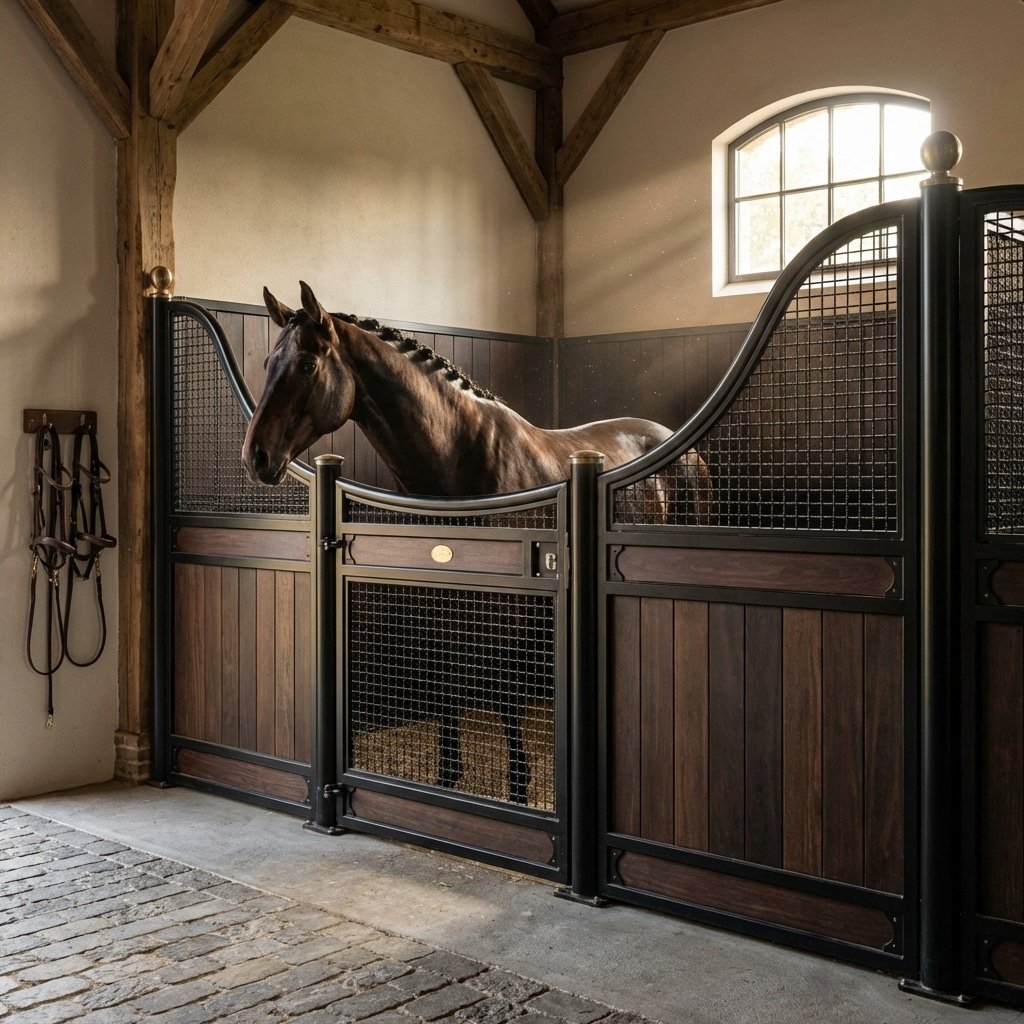
By extending the front to 2.4m, we create a larger vertical air column. This extra volume allows pollutants to rise above the horse’s breathing zone before being exhausted through the barn’s ridge vents or cupolas. Our design combines high-security solid bottom panels with open upper grills, ensuring that while the horse is contained, the airflow is never constricted.
Vertical Volume: Increases the air column size, allowing heat to draw fresh air in from the aisle.
Ammonia Mitigation: Allows lighter-than-air gases to rise above the respiratory zone.
Balanced Design: Merges kick-proof bottom security with open upper visibility for social contact.
Custom Modular Stables With 20-Year Rust Resistance
Reduce maintenance costs with hot-dipped galvanized steel frames designed to withstand 120km/h winds. Our modular bolt-on panels allow for 30% faster installation and meet global BHS and ISO standards.
Q345B offers 345 MPa yield strength and superior low-temperature ductility, preventing structural failure when heavy Warmbloods kick stable walls in freezing conditions.
Yield Strength Advantages Over Standard Q235B
Most stable manufacturers default to Q235B (equivalent to ASTM A36) because it is cheap and easy to weld. For general boarding facilities housing lighter breeds, this material is sufficient. But when housing elite German Warmbloods—breeds like Holsteiners and Hanoverians that frequently exceed 600kg (1,300 lbs)—standard steel becomes a liability. The kinetic energy generated by a Warmblood kick can deform standard frames instantly.
We use Q345B (equivalent to ASTM Grade 50) as the baseline for our Professional Series to address this mass-force equation. This low-alloy structural steel provides a yield strength of 345 MPa, significantly higher than the 235 MPa found in standard market tubing. The difference lies in energy absorption. When a horse kicks a Q345B frame, the steel absorbs the impact energy and rebounds rather than yielding (bending) permanently. This structural integrity is critical for facilities that cannot afford frequent downtime for repairs.
Preventing Brittle Fracture in Cold Climates
Structural failure in Northern markets often stems from temperature, not just force. Standard carbon steel loses ductility as temperatures drop, leading to “brittle fracture.” In this state, a steel tube does not bend when kicked; it snaps, creating jagged, sharp edges that can cause catastrophic injury to a horse’s leg.
Low-Temperature Toughness: Q345B is engineered to pass Charpy V-Notch impact testing at low temperatures, retaining its ability to deform plastically rather than shatter in freezing conditions.
Garantie « anti-coups de pied » : This metallurgical resilience allows us to offer our “Kick-Proof Guarantee.” Even if the impact is severe enough to damage the cosmetic finish, the tube itself will not shear or expose the horse to laceration risks.
Safety Over Cost: While Q345B increases raw material costs, it eliminates the risk of shattered tubing, which is the primary cause of career-ending injuries in stable accidents during winter months.
Mesh dividers utilize “Stack Effect” ventilation and 50mm “Cast-Proof” spacing to balance respiratory health with heavy-duty containment for high-value sport horses.
Fonctionnalité
DB Stable Specification
Operational Advantage
Steel Profile
14-Gauge (2.0mm – 2.5mm)
Resists high-impact kicks without structural failure.
Safety Spacing
50mm (Approx. 2 inches)
“Cast-Proof” design prevents hoof entrapment.
Qualité de l'acier
Q235B (Standard) or Q345B (Cold)
Superior tensile strength for heavy-duty containment.
Rust Protection
Hot-Dip Galv (ISO 1461)
Applied après fabrication to seal weld points.
Enhancing Equine Welfare Through Ventilation and Visibility
Solid walls create dead air pockets where ammonia and dust accumulate. Mesh dividers solve this by facilitating “Stack Effect Ventilation.” As body heat rises from the horse, it pulls fresh, cooler air in from the aisle, forcing stale air up and out through the mesh. This constant passive airflow significantly lowers the risk of respiratory issues like COPD (heaves) compared to fully enclosed stalls.
Beyond physical health, open designs address behavioral stability. Horses are herd animals; isolation is a primary driver of vices like weaving, cribbing, and stall walking. Visual contact with neighbors reduces stress levels and keeps high-performance animals calmer. For facility staff, mesh dividers improve operational efficiency by providing clear sightlines. You can monitor a horse’s position, check for cast situations, or verify feed intake without opening the door.
Structural Integrity: 50mm Safety Spacing and 14-Gauge Steel
Many manufacturers compromise on steel thickness to cut shipping weight. We do not. Our dividers are engineered with 14-Gauge (2.0mm – 2.5mm) steel as the absolute minimum. For colder climates or facilities housing large warmbloods, we upgrade to Acier Q345B faiblement allié à haute résistance mécanique. This material offers superior impact toughness, ensuring the partition absorbs the energy of a direct kick without snapping or deforming.
The layout of the mesh is just as critical as the material. We utilize a “Cast-Proof Design” with strict 50mm spacing between vertical bars. This specific gap is narrow enough to prevent even a foal’s hoof from slipping through and getting trapped, yet wide enough to maintain visibility. To ensure longevity, every panel undergoes Galvanisation à chaud (ISO 1461)après fabrication. This seals every weld point against moisture, preventing the rust bleed-out common in cheaper, pre-galvanized alternatives.
Integrated Impact Absorption: Upper mesh sections seamlessly join with lower sections of 28mm-32mm HDPE or High-Density Bamboo.
Résistance à la corrosion : Zinc coating averages >70 microns on tubing, ensuring 20+ years of rust protection.
Garantie « anti-coups de pied » : The combination of Q345B steel and heavy-duty infill creates a barrier capable of withstanding aggressive stable behavior.
Precision CNC machining eliminates tolerance gaps in fasteners, preventing vibration-induced loosening and ensuring structural integrity against heavy impact.
The Engineering of Vibration Resistance
Standard stable hardware often fails because mass-produced bolts possess inconsistent tolerance levels. When a fastener does not fit its housing perfectly, a microscopic gap remains. In an equestrian environment, this gap is the failure point. Every time a horse kicks a wall or leans against a door, that kinetic energy seeks the path of least resistance. In loose connections, this energy manifests as vibration, physically shaking the nut loose from the bolt over time.
We utilize CNC (Computer Numerical Control) machining to manufacture bolting systems with near-zero tolerance. By removing the physical space where vibration begins, we force kinetic energy to dissipate through the heavy steel frame rather than the joint itself. This engineering approach eliminates the “rattle” effect that spooks sensitive horses and prevents the structural fatigue that eventually causes stall fronts to sag or detach.
304 Stainless Steel Hardware Integration
A rigid connection is useless if the fastener corrodes and snaps. While many manufacturers pair galvanized frames with cheap galvanized screws to cut costs, we recognize that threaded areas are the first to rust. Once rust sets into a thread, the bolt seizes, making maintenance impossible and weakening the grip strength of the assembly. To counter this, we integrate a complete **304 Stainless Steel** hardware kit into every system.
Résistance à la corrosion : 304 Stainless Steel naturally resists the ammonia and moisture inherent in stables, unlike galvanized alternatives that degrade when the zinc coating is scratched during installation.
Thread Integrity: Stainless steel threads maintain their tensile strength and grip over decades, preventing the “loosening creep” seen in softer metals.
Structural Compatibility: This hardware ensures the longevity of our **Q235B and Q345B** steel frameworks, ensuring that the connection points last as long as the hot-dip galvanized steel itself.
Questions fréquemment posées
What is the recommended stall size for Warmbloods?
Warmbloods typically stand 16 to 18 hands and physically require more space than average breeds. While 3.6m x 3.6m (12′ x 12′) is the standard minimum, we strongly recommend upgrading to 3.6m x 4.0m (12′ x 14′) or 4.2m x 4.2m (14′ x 14′). This additional space allows larger horses to lie down and roll safely without the risk of getting cast against the walls.
How tall should a horse stall front be for safety?
Stall fronts should stand at least 2.2m (7.2ft) for general safety. For Warmbloods and athletic jumpers, we recommend a height of 2.4m (approx. 8ft) to prevent horses from rearing and catching their hooves over the top rail. Our Professional and Royal Series can be fabricated to these higher European standards to match your herd’s needs.
Why use Q345B steel instead of standard structural steel?
We offer Q345B Low Alloy High Strength Steel (equivalent to ASTM Grade 50) for clients in cold climates. This material possesses superior low-temperature impact toughness compared to standard Q235B. It resists brittle fractures even if a horse kicks the frame during freezing winter conditions, providing a critical safety margin.
Do mesh dividers improve stable ventilation?
Yes. Mesh partitions facilitate ‘Stack Effect Ventilation’ by allowing air to flow freely through the stall rather than getting trapped by solid walls. This prevents ammonia buildup at the horse’s nose level. Additionally, mesh allows horses to see and smell their neighbors, reducing isolation stress and associated stable vices.
Can I order custom sizes to fit my existing barn columns?
Yes. As a B2B OEM manufacturer, we specialize in custom fabrication. We can adjust panel widths, door locations, and heights to match your specific facility layout. We utilize a flat-pack system for logistics, which allows us to ship non-standard dimensions efficiently without the exorbitant freight costs associated with fully welded custom frames.
Réflexions finales
Housing elite Warmbloods requires infrastructure that withstands 1,400 lbs of kinetic energy, not just a visual barrier. While standard Q235B steel reduces initial manufacturing costs, the liability of structural failure during a kick far outweighs those savings. Investing in Q345B High Strength Steel and ISO 1461 hot-dip galvanization protects your facility against catastrophic injury claims and costly downtime.
Do not rely on spec sheets alone when the safety of valuable livestock is at risk. We invite you to request a physical sample section to test our 14-gauge tubing and precision CNC joinery firsthand. Contact our engineering team today to configure a Professional Series solution tailored to your specific operational demands.
Bonjour, je suis Frank Zhang, fondateur de DB Stable, entreprise familiale, spécialiste des écuries. Au cours des 15 dernières années, nous avons aidé 55 pays et plus de 120 clients, comme le ranch, à protéger leurs chevaux. L'objectif de cet article est de partager les connaissances relatives à l'écurie pour assurer la sécurité de votre cheval.
Les erreurs de conception et les non-conformités au code constituent le premier point à vérifier pour les acheteurs avant d'approuver un fournisseur,...
La conception du système de ventilation d'une écurie est le premier point que les acheteurs doivent vérifier avant de choisir un fournisseur, de fixer un budget ou...
La conception d'une grange résistante aux intempéries est le premier critère que les acheteurs doivent vérifier avant de valider un fournisseur, un budget ou...






 French
  English
  Spanish
  Arabic
  German
0 commentaires