


Implementing a Multi-Species Modular infrastructure is the only viable engineering strategy to mitigate the liability of housing diverse livestock under one roof. Standard equine layouts with 3-inch bar spacing create fatal entrapment zones for alpacas and foals, turning a versatile barn into a legal and veterinary nightmare for operators.
This analysis evaluates suppliers based on the Q235B structural steel standard and adjustable OEM grill spacing requirements essential for mixed herds. We prioritize manufacturers offering flat-pack logistics and ISO 1461 hot-dip galvanization to ensure your facility maintains operational flexibility and structural longevity without inflating capital expenditure.
The Challenge of Housing Mixed Livestock in One Barn
Comparaison rapide
| Manufacturer | Meilleure application | Caractéristiques principales | Verdict |
|---|---|---|---|
| Lab Products | Multi-species barn environments | Durable stainless steel, Ergonomic elevated bases | A robust choice for ergonomic handling and durability in modular setups. |
| Alternative Design Manufacturing | Space optimization & flexible layouts | Customizable housing configurations, Adaptive capacity | Excellent for facilities needing to adapt space for multiple species. |
| Britz & Company | Meeting international housing guidelines | Interchangeable modular components (floors, dividers) | Ideal for labs navigating complex or conflicting regulatory requirements. |
| Midmark | Labor reduction & integrated hygiene | Integrated ventilation, waste, and hydration systems | Best for high-efficiency management and automated hygiene control. |
| Tecniplast | Social housing & density management | Flexible dividers for single/pair/group configurations | Top choice for prioritizing animal socialization and flexible housing density. |
| LenderKing | Odor control & cross-contamination prevention | Slatted housing designs, Enhanced airflow | Essential for maintaining high hygiene standards in mixed-species facilities. |
Lab Products
This provider stands out for **industrial-grade durability**, offering stainless steel modular systems designed explicitly for high-demand multi-species barns.
Lab Products delivers purpose-built modular kennel and cage systems tailored for the unique challenges of mixed-livestock environments. They focus on structural integrity to support diverse animal housing needs within a single facility.
Their equipment features high-quality stainless steel construction to withstand rigorous daily use and cleaning protocols. Additionally, the inclusion of elevated bases enhances ergonomic handling, significantly reducing physical strain on facility staff.
📊 En bref :
- 📍 Lieu : Not Listed
- 🏭 Renforcement musculaire : Modular Kennel Systems, Multi-Species Cages
- 🌍 Principaux marchés : Mondial
Pourquoi nous les avons choisis :
| ✅ Les victoires | ⚠️ Compromis |
|---|---|
|
|
Alternative Design Manufacturing
They excel in **customizable housing configurations**, enabling facilities to adapt a single space for multiple species instead of relying on fixed, rigid layouts.
Alternative Design Manufacturing focuses on flexible infrastructure that solves the spatial challenges typical of mixed-species environments. By avoiding fixed layouts, their systems allow operators to reconfigure housing areas rapidly based on current livestock needs.
Their customizable modular units are engineered to maximize facility capacity without compromising animal welfare. This adaptive approach significantly reduces the need for specialized, single-purpose construction, making them ideal for dynamic agricultural or research settings.
📊 En bref :
- 📍 Lieu : Not Listed
- 🏭 Renforcement musculaire : Customizable Modular Housing, Adaptive Cages
- 🌍 Principaux marchés : Mondial
Pourquoi nous les avons choisis :
| ✅ Les victoires | ⚠️ Compromis |
|---|---|
|
|
Britz & Company
They excel at providing **regulatory-compliant modular systems** that help facilities navigate conflicting international housing guidelines.
Britz & Company specializes in manufacturing versatile housing infrastructure designed to bridge the gap between diverse animal needs and regulatory requirements. Their primary focus is assisting facilities that must strictly adhere to varying international guidelines for livestock care within a single environment.
The core utility of their systems lies in total interchangeability. By offering swappable components like floors, dividers, and feeders, they allow operators to reconfigure barn spaces rapidly to accommodate different species without permanent structural changes.
📊 En bref :
- 📍 Lieu : Not Listed
- 🏭 Renforcement musculaire : Interchangeable Housing Components, Modular Barn Systems
- 🌍 Principaux marchés : Mondial
Pourquoi nous les avons choisis :
| ✅ Les victoires | ⚠️ Compromis |
|---|---|
|
|
Midmark
Midmark delivers **integrated hygiene and ventilation solutions**, significantly reducing labor costs through all-in-one modular housing designs.
Midmark specializes in advanced modular units that embed critical life-support systems, including feeding, hydration, and ventilation controls. By integrating these features directly into the housing structure, they streamline facility workflows and optimize space usage.
Their engineering focuses heavily on operational efficiency and sanitation, supporting rigorous cleaning protocols like rack washers and autoclaving. These systems are designed to minimize manual labor while ensuring high standards of hygiene management.
📊 En bref :
- 📍 Lieu : Not Listed
- 🏭 Renforcement musculaire : Integrated Housing Units, Ventilation Systems
- 🌍 Principaux marchés : Mondial
Pourquoi nous les avons choisis :
| ✅ Les victoires | ⚠️ Compromis |
|---|---|
|
|
Tecniplast
Tecniplast excels in **flexible social housing systems**, allowing facilities to instantly toggle between single, pair, or group configurations.
Tecniplast specializes in versatile containment architectures that utilize removable dividers to support various housing states. Their modular design philosophy allows research facilities to modify layouts dynamically without the need for extensive infrastructure replacement.
The core advantage of their technology is the ability to promote animal welfare through social interaction while maintaining high housing density. This flexibility assists facilities in balancing operational efficiency with evolving ethical housing standards.
📊 En bref :
- 📍 Lieu : Not Listed
- 🏭 Renforcement musculaire : Social Housing Systems, Modular Dividers
- 🌍 Principaux marchés : Mondial
Pourquoi nous les avons choisis :
| ✅ Les victoires | ⚠️ Compromis |
|---|---|
|
|
LenderKing
LenderKing specializes in **slatted housing designs** that optimize airflow and significantly reduce odor and cross-contamination risks in mixed-species environments.
LenderKing focuses on manufacturing housing solutions designed to maintain high hygiene standards in complex agricultural or laboratory settings. Their slatted design architecture facilitates better environmental control compared to traditional solid-floor systems.
These airflow-optimized cages are essential for facilities struggling with odor management and pathogen control across different animal populations. While highly effective at reducing contamination risks, the specialized design necessitates adherence to specific cleaning protocols.
📊 En bref :
- 📍 Lieu : Not Listed
- 🏭 Renforcement musculaire : Slatted Housing Designs, Airflow-Optimized Cages
- 🌍 Principaux marchés : Mondial
Pourquoi nous les avons choisis :
| ✅ Les victoires | ⚠️ Compromis |
|---|---|
|
|
Premium Modular Stables With 20-Year Durability
The Challenge of Housing Mixed Livestock in One Barn
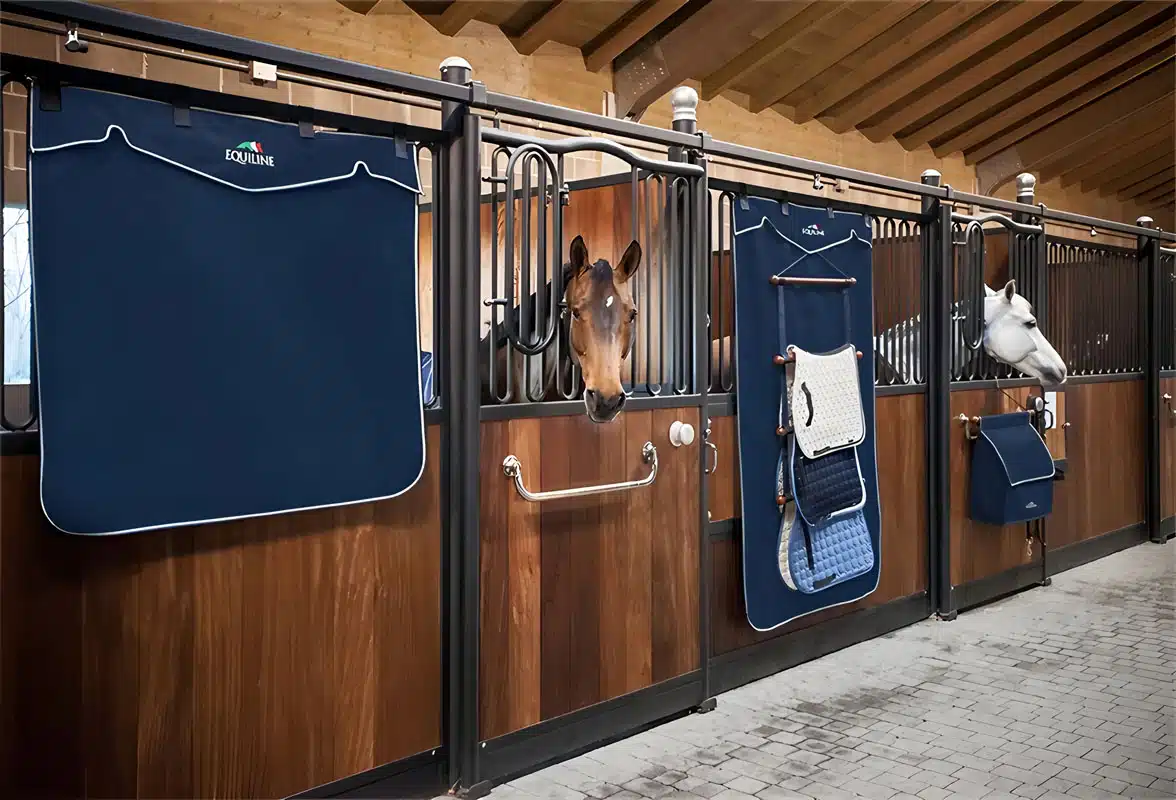
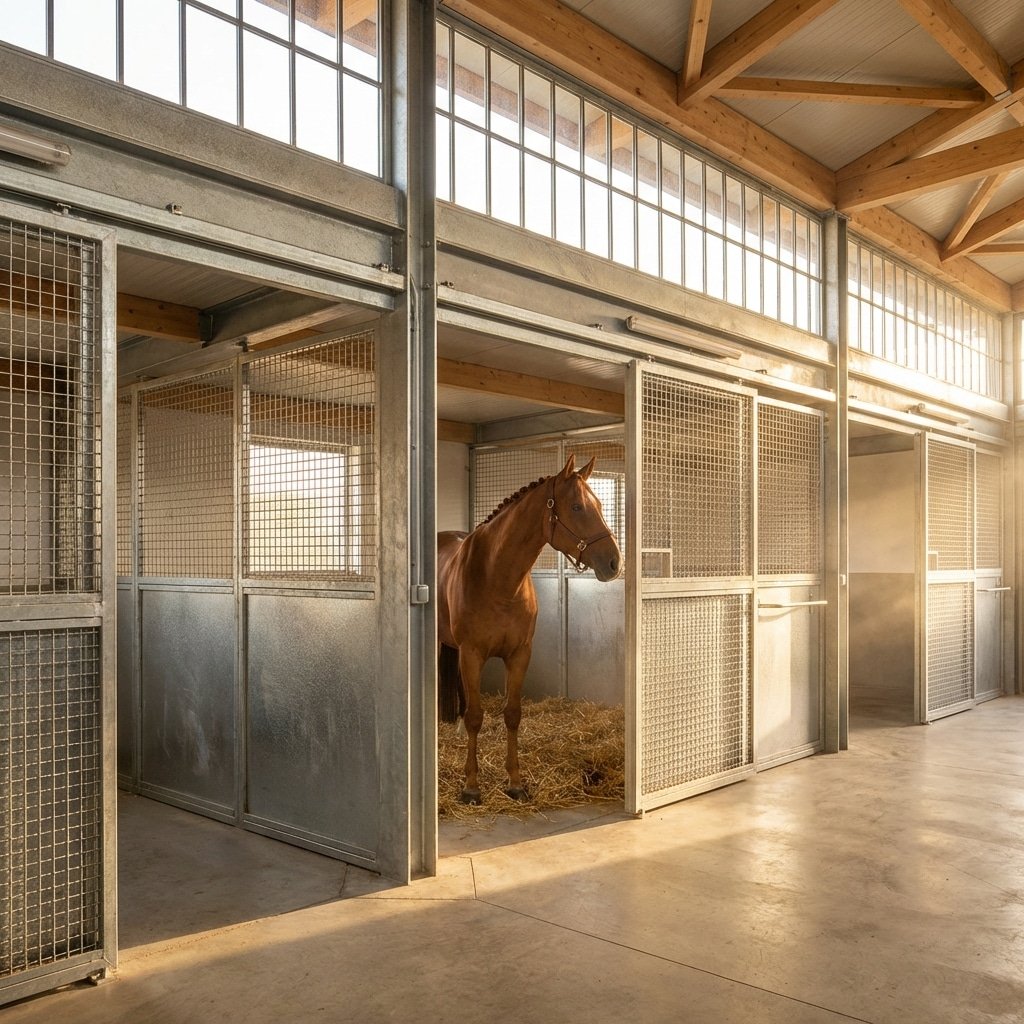
Housing diverse species under one roof creates a direct engineering conflict between the heavy-duty impact resistance required for equines and the containment nuances needed for smaller livestock. Without modular infrastructure, facility managers face operational bottlenecks where static masonry or welded layouts fail to adapt to shifting herd demographics.
The Operational Constraints of Static Infrastructure
Traditional barns frequently rely on fixed masonry or permanently welded stall fronts, which rigidly dictate the facility’s usage and capacity. In a commercial context, this lack of adaptability creates significant operational bottlenecks. A standard 3.5m x 3.5m box designed for a large Warmblood cannot be easily subdivided to house smaller stock like sheep or goats without major construction efforts. This rigidity locks capital into a single layout that may not serve future business needs.
Static layouts lead to wasted resources and underutilized square footage when herd demographics shift. If a facility manager needs to transition a wing from equestrian boarding to quarantine isolation for smaller animals, fixed concrete walls prevent optimized space utilization. Our engineering philosophy emphasizes modularity through our flat-pack systems, allowing the physical infrastructure to evolve alongside the business model and ensuring that every square meter contributes to the bottom line.
Divergent Welfare and Behavioral Requirements
Housing mixed livestock presents a complex engineering conflict: the infrastructure must provide “Kick-Proof” resilience against a 600kg horse while preventing entrapment for smaller breeds. Different species have unique social and environmental needs that static designs often ignore. For example, the open grillwork we design to promote “Stack Effect Ventilation” for horses is excellent for reducing ammonia buildup but may not offer sufficient draft protection for smaller, more sensitive animals if not properly configured.
Balancing these conflicting welfare standards requires a modular approach rather than a universal compromise. Utilizing a single design often compromises safety or comfort for specific animals within the shared space. A partition gap safe for a horse (our standard Cast-Proof Design at approx. 50mm) might still pose risks for smaller hooves or heads. We address this by offering interchangeable infill options, such as impact-absorbing HDPE or high-density Bamboo, which can be tailored to meet specific containment requirements without sacrificing the structural integrity needed for large animals.
Safety Grills: Why Standard 3-Inch Gaps Trap Foals and Alpacas
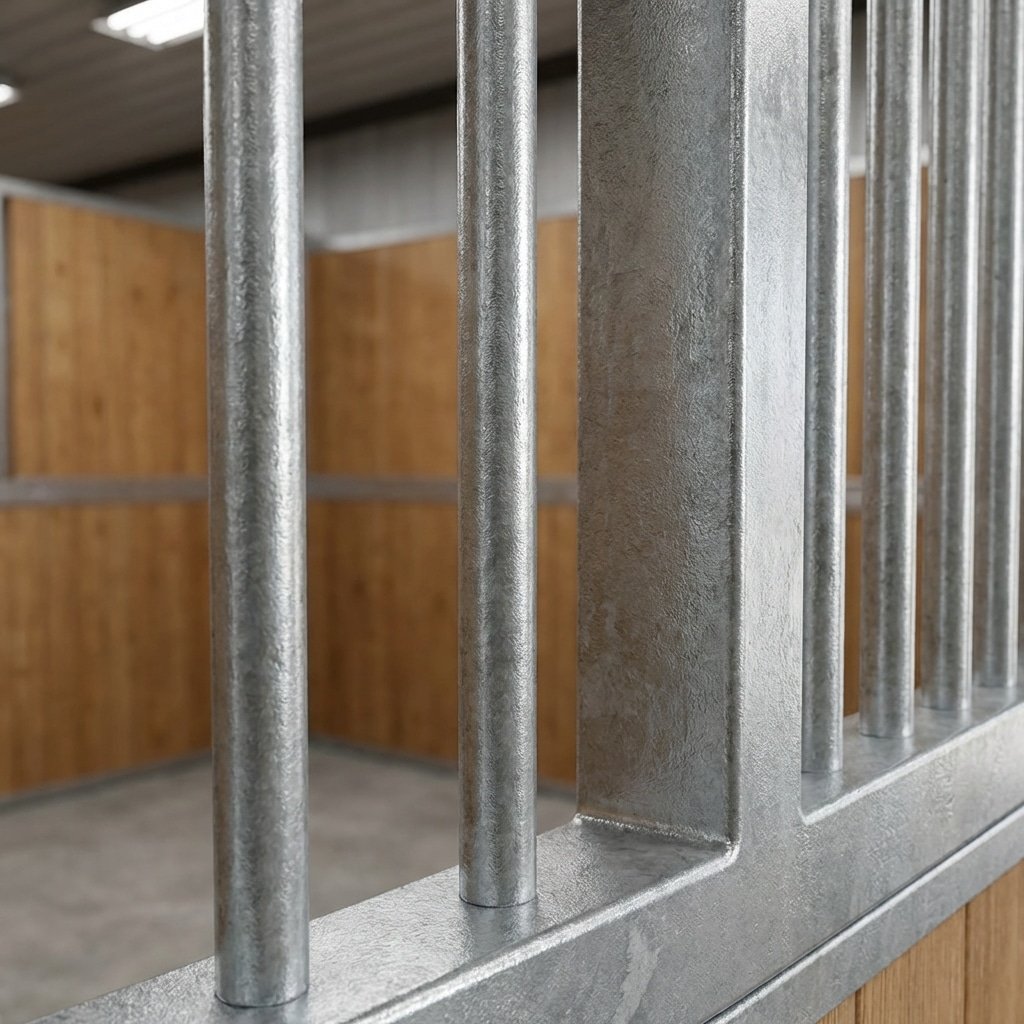
Standard 3-inch (approx. 76mm) bar spacing is engineered specifically for the cranial width of adult horses. For foals and alpacas, this dimension creates a mechanical trap: the narrower head fits through easily to reach feed, but the jawline or ears catch on the bars during the return motion, triggering a panic response that often leads to fatal neck or skeletal injuries.
The Anatomy Mismatch: How Standard Spacing Fails Smaller Breeds
Most equestrian manufacturing defaults to a 3-inch bar spacing because it aligns with the skull structure of adult Warmbloods and Quarter Horses. While this creates a safe visual barrier for a 500kg animal, it represents a critical design flaw for mixed-livestock operations. Alpacas and nursing foals possess significantly narrower skull structures that slip through these standard openings with little resistance, usually to investigate distractions or reach hay in the aisle.
The entrapment mechanism is rarely the entry; it is the withdrawal. As the animal attempts to pull its head back, the wider jawline, ears, or halter hardware catches on the rigid steel bars. This effectively locks the animal in place. We see this frequently in facilities that utilize generic “one-size-fits-all” partitions rather than species-specific engineering. For our OEM partners distributing to breeders, specifying tighter bar spacing or mesh infills is not just an aesthetic choice—it is a necessary liability shield.
The Panic Response and Impact on Skeletal Integrity
The danger of entrapment is compounded by the instinctive flight response of prey animals. Unlike a predator that might manipulate its way out of a snare, a trapped foal or alpaca will thrash and pull backward violently. In this scenario, the steel bar acts as a fulcrum point against the neck or limb, creating immense leverage.
Our structural analysis of Q235B and Q345B steel frameworks confirms that the material tensile strength far exceeds the density of juvenile bone. When a terrified 100kg foal fights against a 14-gauge steel tube, the steel will not yield—resulting in catastrophic fractures or tendon damage. Furthermore, standard vertical bars often lack the density to deflect small hooves, making “cast” situations highly dangerous if a foal rolls near the front panel. We recommend adjusting grill spacing or integrating mesh bottoms for any stall intended for weaning or mixed species use.

Custom OEM Spacing: Specifying 2-Inch Grills for Small Heads
Standard equestrian spacing often fails to protect smaller livestock. We offer a specialized OEM modification that reduces grill gaps to a strict 2-inch (50mm) clearance, utilizing heavy-duty Q235B steel to prevent head entrapment for miniature horses, alpacas, and foals while maintaining necessary airflow.
Preventing Entrapment with Precision Gaps
Standard horse stalls are typically manufactured with 3-inch (76mm) gaps between bars. While safe for full-sized equines, this spacing poses significant risks for mixed-use barns housing miniature horses, alpacas, or weanlings. Small livestock can easily push their heads through standard bars but often panic when trying to pull back, leading to entrapment and severe injury. We address this by engineering a strict 2-inch (50mm) clearance for safety-critical zones.
This specific modification is not merely a cosmetic adjustment but a physical barrier design. By reducing the gap, we physically block head entry completely while maintaining high visibility and ventilation. This approach aligns with our “Engineering Safety” principle, ensuring that distributors can supply facilities capable of housing diverse breeds safely from day one without requiring aftermarket retrofits or dangerous mesh overlays.
Production Specs for High-Density Grills
Reducing bar spacing significantly increases the steel volume per panel, which changes the structural requirements of the stable front. We utilize robust Q235B structural steel to support this added weight, ensuring the frame remains rigid. We maintain a strict 14-Gauge (2.0mm) minimum wall thickness for all vertical tubes in these high-density arrays, preventing the bars from bending even under pressure from livestock.
Manufacturing these tighter grills requires precision in our rust protection process. Every custom grill undergoes Hot-Dip Galvanization (ISO 1461) after fabrication. This step is critical because the tighter spacing creates more complex weld joints that are prone to rust if not fully sealed. Our process ensures molten zinc penetrates every crevice. Distributors must also account for logistics; these high-density safety panels will exceed the standard 250kg average weight, requiring appropriate handling equipment for offloading.
DB’s V-Drop Doors: Adjustable Heights for Different Breeds
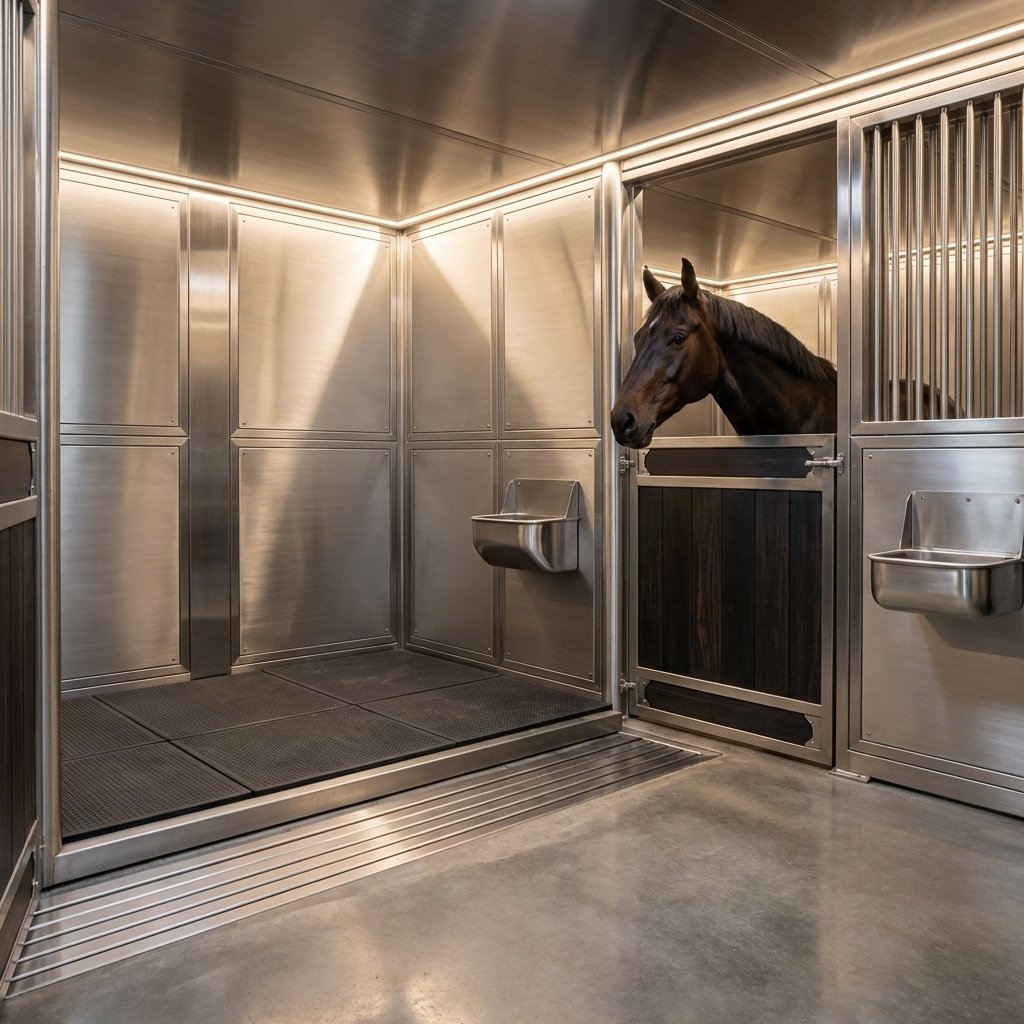
Our V-Drop door system leverages OEM customization to tailor yoke dimensions for specific breeds, ensuring safety and comfort for everything from miniature horses to large warmbloods. By combining adjustable V-opening depths with heavy-duty, hot-dip galvanized steel, we provide a versatile solution for veterinary clinics and professional stables that require flexibility without compromising structural integrity.
Tailoring Yoke Dimensions for Varied Animal Sizes
At DB Stable, we utilize our OEM manufacturing capabilities to strictly customize the bottom height of the V-drop opening based on specific project requirements. Standard fixed yokes often fail to accommodate the diverse size range found in veterinary clinics or quarantine units. By adjusting the depth and width of the V-opening during the design phase, we prevent smaller animals from attempting to jump through the gap while ensuring larger breeds have adequate neck clearance to rest their heads comfortably outside the stall.
This customization significantly improves animal welfare by allowing social interaction and reducing boredom-induced behaviors like weaving, which are common in fully enclosed boxes. For facilities housing mixed livestock or varying breeds, our ability to tailor these dimensions ensures that the stable front remains functional and safe regardless of the occupant’s size. We work directly with distributors to define these parameters early in the production cycle, ensuring the final product meets the exact operational needs of the facility.
Ensuring Safety with Heavy-Duty Steel Construction
The V-drop design introduces exposed edges that must withstand significant contact and pressure from the animal. To prevent bending or structural failure, we exclusively use 14-gauge (2.0mm – 2.5mm) Q235B structural steel for standard climates, with an option for Q345B low alloy high-strength steel for regions requiring superior impact toughness. This heavy-duty frame design integrates seamlessly with our Professional Series hidden track system, maintaining rigidity even with the open yoke feature.
Crucially, we apply our “Lifetime” standard of Hot-Dip Galvanization (BS EN ISO 1461) after fabrication. Because the V-shape involves complex welding angles, pre-galvanized tubing would leave raw steel exposed at the joints, leading to rapid corrosion. Our process involves dipping the entire door after welding, ensuring the complex geometry of the V-drop is fully coated with an average zinc thickness of over 70 microns. This eliminates sharp, raw steel edges often found in inferior alternatives, protecting the animal’s neck and chest from injury while guaranteeing resistance against rust.
Réflexions finales
Standard equestrian framing creates lethal trap zones for smaller livestock, turning minor curiosity into major veterinary liabilities. Our OEM precision—specifically the Hot-Dip Galvanized 50mm safety grill—eliminates these risks while retaining the Q235B structural rigidity required for large animals. Investing in adaptable, flat-pack infrastructure safeguards your operation against demographic shifts, ensuring your facility evolves without costly demolition.
Do not gamble on generic imports that ignore species-specific anatomy. We recommend initiating a consultation with our engineering team to define your specific bar spacing and V-drop dimensions before fabrication begins. Contact us to request a Professional Series specification sheet and secure a production slot that meets your exact safety requirements.
Questions fréquemment posées
Can you keep alpacas in a horse stall?
Yes, but standard equine stalls often pose risks due to wide bar spacing. We recommend modifying the design to include lower mesh panels or tighter vertical bars. Our OEM team adjusts the fabrication specs to prevent alpacas from sticking their heads through the standard gaps typically used for large horses, ensuring safe containment through precise custom engineering.
Safe bar spacing for miniature horses and goats?
For miniatures and goats, we engineer custom grills with reduced 50mm (2-inch) spacing rather than the standard equine gap. This prevents head entrapment while maintaining essential airflow. We utilize Acier de construction Q345B for these tighter profiles to ensure the bars remain rigid against impact from active smaller stock, providing superior durability compared to standard mild steel.
Best modular barns for multi-species farms?
Notre Série professionnelle offers the necessary versatility for mixed livestock operations. We design these modular systems with removable partitions and adjustable door heights, allowing facility managers to quickly reconfigure a large horse stall into two smaller pens for sheep or calves. This utilizes our flat-pack system for easy layout changes, protecting your operational flexibility.
How to customize stable grills?
As a direct manufacturer, we fabricate grills to your exact specifications before galvanization. You define the tube diameter and spacing during the CAD design phase. We weld the black steel to these custom dimensions first, then hot-dip galvanize the entire unit to BS EN ISO 1461 standards. This “Hot-Dip After Fabrication” process ensures no rust points form at the custom joints, unlike pre-galvanized alternatives.
Multi-purpose livestock stabling?
We recommend our HDPE infill options for facilities housing diverse species. The high-density polyethylene planks are completely non-absorbent and resist bacteria, making them easy to sanitize when rotating between different animals. This “Zero Maintenance” material withstands the high-moisture cleaning protocols required for biosecurity in multi-purpose barns.

 French
  English
  Spanish
  Arabic
  German
0 commentaires