


Sourcing equestrian infrastructure for France demands a rigorous balance between Renaissance aesthetics and structural longevity. Relying on traditional oak in damp climates often results in warped joinery and costly maintenance cycles that undermine the value of a luxury estate.
We resolve this architectural challenge by benchmarking 40mm High-Density Bamboo against second-growth timber. This report details how our Royal Series engineering achieves a Janka hardness of 3000 lbf to replicate the acoustic weight of heritage wood while eliminating rot risks through ISO 1461 hot-dip galvanization.
The Aesthetic of the French Equestrian Estate
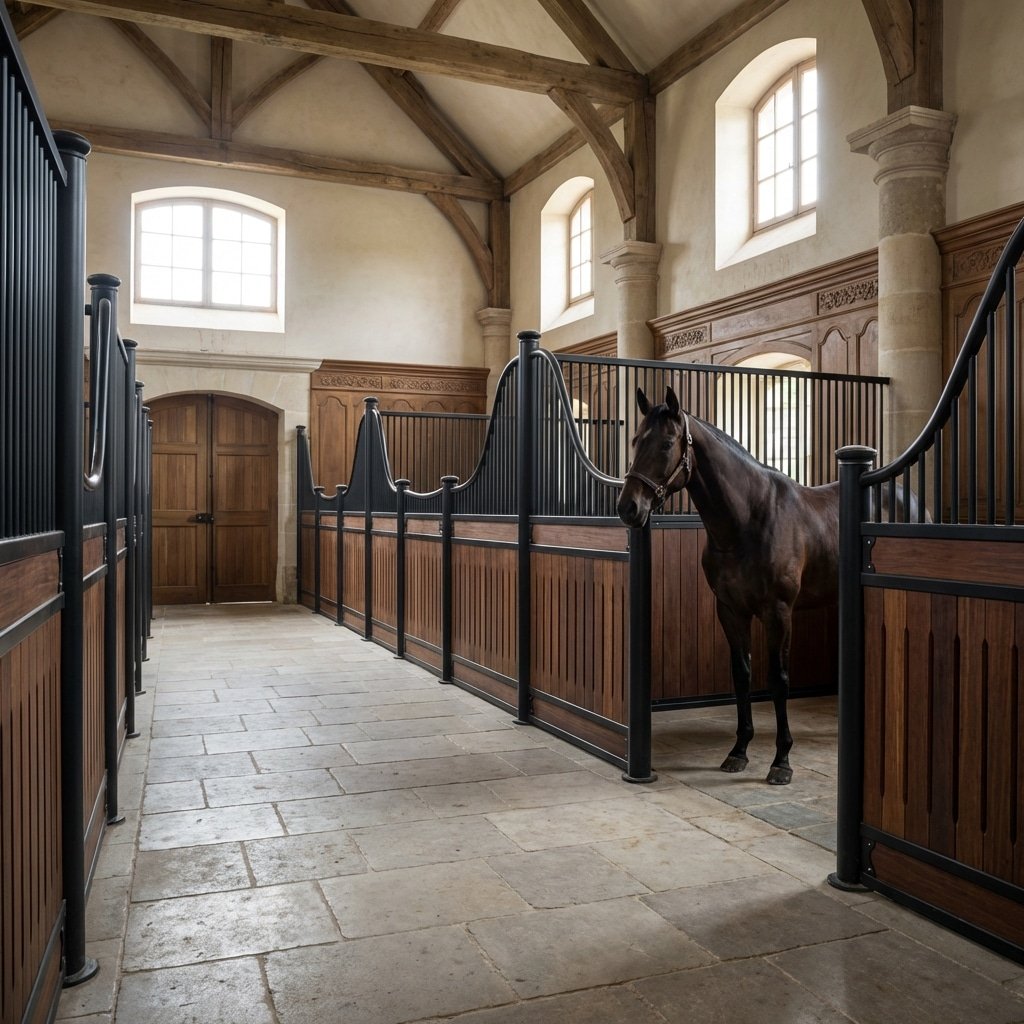
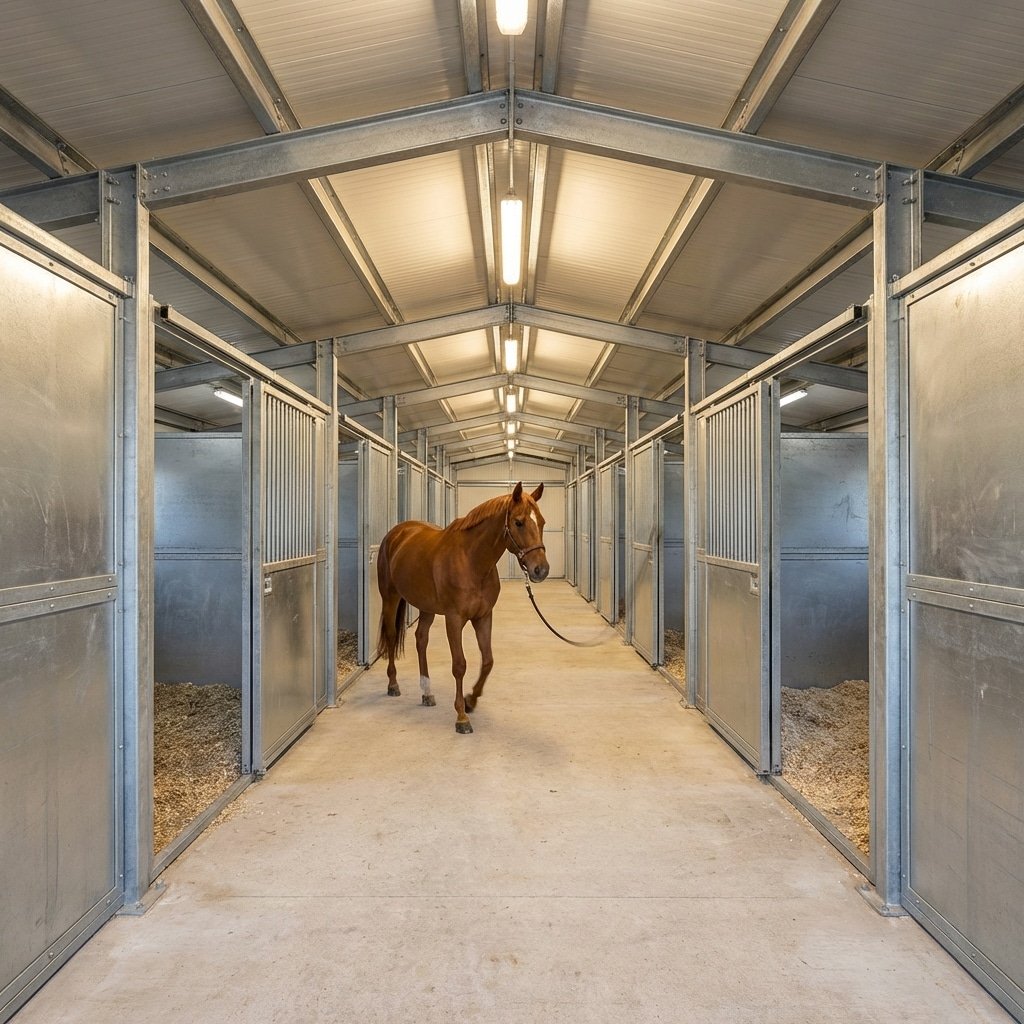
French equestrian design demands symmetry and monumental scale, transforming functional stables into “palaces for horses.” We replicate this historic grandeur using heavy-gauge steel and 40mm infills.
Architectural Symmetry and the ‘Palace for Horses’ Concept
The modern luxury stable draws its primary inspiration from the French Renaissance, a period that fundamentally shifted stable design from medieval utility to architectural dominance. Before this era, stables were dark, purely functional sheds. The shift began at Château du Rivau in the 1550s, where architects first treated the stable as a structure equal in beauty to the residence itself. This evolution reached its peak with the Great Stables at Versailles and Chantilly, establishing the “Palace for Horses” concept.
High-end projects today emulate this specific historical standard through three core principles:
- Monumental Scale: Just as the Great Stables at Chantilly housed 240 horses in a structure dwarfing many castles, modern French-style frontages prioritize height and imposing grille work over minimalism.
- Ornamental Functionality: Ventilation elements in French design are never hidden. They are highlighted through decorative arches and finials, turning airflow requirements into visual features.
- Strict Symmetry: The layout demands a mirror-image consistency along the central aisle, creating a tunnel of uniform grandeur that reflects authority and order.
Achieving the Look: The Royal Series Specification
To capture the visual weight of French limestone and timber architecture while delivering modern durability, we engineered the Royal Series. This line is specifically positioned for private estates and premier stud farms where the “Economy” aesthetic is insufficient. We translate the historical requirements of the French aesthetic into specific manufacturing protocols found in our product bible.
The Royal Series distinguishes itself through specific technical upgrades designed to mimic the solidity of the Ancien Régime structures:
- Dual-Finish Protection: We apply a Powder Coat finish over the standard Hot-Dip Galvanized base (BS EN ISO 1461). This provides the matte black or deep green aesthetic common in French ironwork without sacrificing the rust protection of zinc.
- 40mm Board Thickness: While standard stalls use 28mm or 32mm infills, the Royal Series accommodates 40mm High-Density Bamboo or HDPE. This extra thickness provides the acoustic dampening and physical “thud” associated with heavy timber construction.
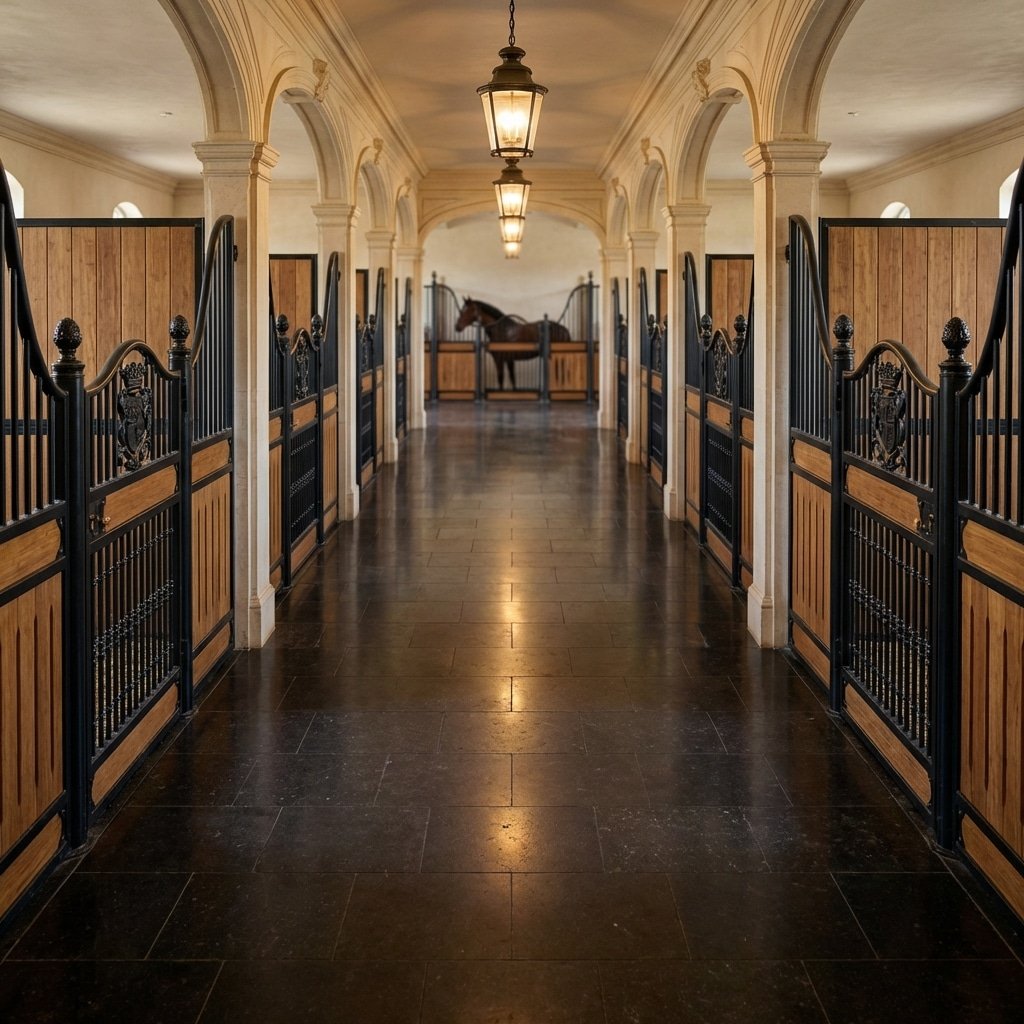
- European Arches & Brass Finials: We integrate swooping “High Euro” or “Low Euro” curves and cap posts with brass finials. These are not merely decorative; they break the industrial lines of the steel, returning the design to the ornamental functionality of the 18th century.

European Arches and Brass Finials on Horse Stall Fronts
European-style fronts blend high-swoop arches and brass finials with industrial Q345B steel. We apply powder coating over a hot-dip galvanized base to ensure these luxury aesthetics never rust.
Architectural Impact of Swooped Designs
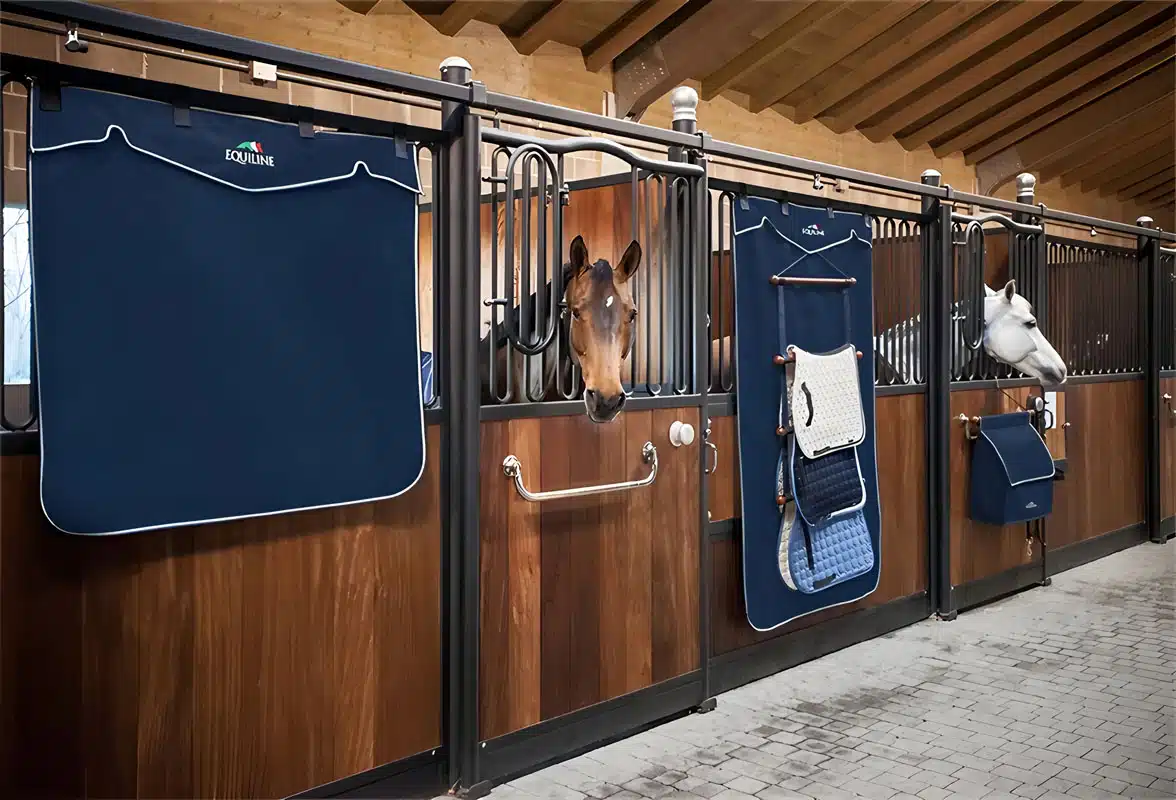
The “European” aesthetic isn’t just about looking expensive; it serves a distinct behavioral function for high-performance horses. Standard straight-line fronts often isolate the animal, but the signature low-swoop or V-shaped yokes found in our Royal Series allow horses to socialize and observe their surroundings. This visual openness significantly reduces stable vices like weaving or cribbing that stem from boredom and isolation.
- Social Connectivity: The deep V-yoke design permits head-out interaction while maintaining secure containment, vital for the mental health of stabled thoroughbreds.
- Ornamental Capstones: We utilize brass or gold finials not merely as decoration, but as sealed capstones for the posts, preventing moisture ingress while defining the vertical grandeur of the stable.
- Stack Effect Ventilation: The open grill structure promotes vertical airflow, allowing heat to rise and escape, which is critical for maintaining respiratory health in professional training barns.
Engineering the Royal Series: Dual-Finish Protection
Luxury designs often fail in commercial environments because manufacturers prioritize style over steel composition. A common failure point in European-style fronts is the rusting of decorative curves where water pools. To solve this, the Royal Series adheres to a strict “Dual Protection” protocol. We do not paint on bare steel. Every component is hot-dip galvanized first to ISO 1461 standards, ensuring a metallurgical bond with the zinc, before receiving a high-grade powder coat finish.
- Dual Protection System: The powder coat provides the requested color (e.g., Black, Green, Navy), while the underlying galvanized layer serves as a fail-safe against rust if the paint is scratched.
- Q345B Structural Steel: Creating the deep swoops requires bending heavy-gauge steel. We use Q345B (equivalent to ASTM Grade 50) because it maintains structural rigidity and impact toughness even after being curved, unlike standard Q235B which can warp under stress.
- Heavy Infill Integration: To match the visual weight of the steel arches, these frames are engineered to hold 40mm thick bamboo boards—significantly thicker than the standard 28mm or 32mm options—providing maximum kick resistance.
Engineered For 20 Years of Rust-Free Durability
The Wood Debate: Why Oak Warps in Damp Regions
Timber is hygroscopic. Uneven moisture absorption below the 30% saturation point creates differential stress, causing even high-grade oak to bow and cup in humid climates.
The Science of Differential Shrinkage
Wood functions as a hygroscopic material, meaning it never stops exchanging moisture with the surrounding air. It constantly seeks equilibrium with the environment. Warping occurs when one side of a board absorbs or releases moisture faster than the other, creating immediate internal tension. The board effectively fights itself, pulling the grain in opposing directions.
Seasonal humidity cycles in regions like France cause repeated expansion and contraction, which stresses the timber grain over time. When environmental humidity changes rapidly, the wood cannot acclimatize evenly. This acceleration often leads to permanent deformation, manifesting as bowing or cupping that no amount of fasteners can correct.
Vulnerability of Second-Growth Oak
Modern sourcing often relies on second-growth oak, which presents a distinct structural disadvantage compared to historical timber. These younger trees have significantly wider grain spacing than old-growth varieties. This wider grain structure absorbs and loses moisture more rapidly, acting like a sponge in damp stable conditions.
Physical movement typically begins when the wood moisture content drops below the fiber saturation point, which sits between 25% and 30%. Once the moisture dips below this threshold, the cells physically shrink. Even high-quality oak cannot fully resist warping if air circulation is poor or humidity remains consistently high, making it a maintenance liability for large-scale professional facilities.

Strand-Woven Bamboo: Janka 3000 Hardness
Strand-woven bamboo delivers a Janka rating over 3000 lbf, creating a kick-proof, high-density barrier that resists impact and moisture far better than traditional oak.
| Material Material | Janka Hardness (lbf) | Impact Behavior |
|---|---|---|
| Bambou tressé | 3,000+ | High Density (No Splintering) |
| Red Oak | ~1,290 | Moderate (Prone to Denting) |
| Pine (Softwood) | ~600 – 900 | Low (High Fracture Risk) |
The Science Behind Janka 3000 Density
Standard timber relies on natural growth rings, which create inconsistencies and air pockets within the grain. Strand-woven bamboo eliminates these structural weaknesses through extreme hydraulic compression. Manufacturers strip bamboo into fibers, coat them in adhesive, and fuse them under immense pressure. This process creates a material density exceeding 1,100 kg/m³, far surpassing natural wood.
The resulting board achieves a Janka hardness rating of over 3000 lbf. For comparison, Red Oak—often considered a benchmark for stable hardwood—rates at approximately 1290 lbf. This density gap is critical for safety. When a horse kicks a strand-woven bamboo board, the lack of internal air pockets ensures the energy disperses without causing the material to shatter or splinter. This protects the animal from leg injuries common with lesser softwoods.
28mm High-Density Bamboo for Professional Stables
We integrate this material directly into the DB Professional Series to meet the demands of commercial riding schools and heavy-use facilities. While budget options often rely on hollow plastics or thin pine, we mandate specific thickness standards to ensure longevity and impact resistance.
- Heavy-Duty Thickness: We strictly supply 28mm to 38mm boards, providing maximum resistance against repeated hoof impact.
- Résistance à l'humidité : Unlike oak, which warps in damp conditions, high-density bamboo resists rot and mold, making it the superior choice for humid wash bays.
- Commercial Durability: This specification is the core of our Professional Series, designed to reduce maintenance costs for facilities managing large numbers of horses.
Dual-Finish Powder Coating over Hot-Dip Galvanizing
A duplex system applies powder coating over a hot-dip galvanized base, preventing zinc weathering and extending the structure’s lifespan significantly beyond either finish alone.
The Synergistic Benefits of Duplex Coating
Most manufacturers treat powder coating and galvanizing as separate, mutually exclusive options. A “Duplex System” combines them to solve the inherent weaknesses of each. While zinc provides cathodic protection to the steel, it naturally weathers and consumes itself over time. By applying a fused powder topcoat, we create a barrier that slows this zinc consumption rate drastically.
- Synergistic Protection: The barrier layer protects the zinc, while the zinc prevents under-film creep if the paint is scratched. This results in a service life 1.5 to 2.5 times longer than the sum of the individual coatings.
- C4 Corrosion Resistance: This combination achieves resistance ratings suitable for Category C4 coastal environments, where high salinity usually strips standard finishes rapidly.
- Close-Pored Surface: We apply the coating to a thickness of 120–160 µm. This creates a dense, non-porous shell that resists chipping, fading, and chemical attacks found in stable environments (like ammonia from urine).
Royal Series Specification: Galvanization Beneath the Finish
In the luxury stable market, aesthetics often compromise durability. Many “premium” black stalls are simply powder coated over bare steel or pre-galvanized tubing with exposed weld seams. These rust from the inside out within a few years. For our Royal Series, we refuse to compromise the substrate integrity for the sake of color.
- Hot-Dip After Fabrication: We adhere strictly to the BS EN ISO 1461 standard. We weld the black steel frames first, then dip the entire structure in molten zinc. Only after this metallurgical bond is formed do we apply the cosmetic powder coat.
- Eliminating Hidden Rust: This process ensures that weld seams and internal surfaces are fully galvanized before they are painted. There is no risk of the “rot from within” common in cheaper pre-galv alternatives.
- Custom Styling with Warranty: This method allows clients to specify high-end European styles—such as Deep Green or Matte Black—without forfeiting our 10+ year structural rust warranty.
Questions fréquemment posées
What defines the ‘European Style’ in horse stall architecture?
European stall fronts trade the enclosed feel of standard American sliding doors for open, sweeping lines and social interaction. These designs typically feature hinged doors rather than sliders, often paired with swooping ‘wings’ (curved side panels) and decorative brass finials. The architecture serves a dual purpose: it creates a refined aesthetic for the barn aisle while maximizing ventilation and allowing horses to socialize freely over low-profile fronts.
Why is strand-woven bamboo recommended over oak for damp regions?
Oak is traditional, but it acts like a sponge in damp climates like France or the UK, leading to warping and rot. Strand-woven bamboo resolves this through density. We compress bamboo fibers under extreme pressure to achieve a Janka Hardness rating over 3,000 lbf—making it three times harder than oak. This density makes the board naturally resistant to moisture absorption, mold, and hoof impacts, offering the warmth of wood without the maintenance liability.
Is powder coating sufficient for rust protection on its own?
No. On its own, powder coating is just a cosmetic skin. If a horse kicks it or a latch scratches it, moisture reaches the raw steel, and rust spreads underneath the paint. For true longevity, we strictly use a ‘Duplex System.’ We Hot-Dip Galvanize the steel first (dipping it in molten zinc per ISO 1461) to chemically bond a rust-proof layer to the metal. We apply the powder coat only after this step. If the paint chips, the zinc underneath ensures the steel remains rust-free.
What is the difference between ‘Pre-Galvanized’ and ‘Hot-Dip After Fabrication’?
‘Pre-galvanized’ is a manufacturing shortcut where tubes are zinc-coated before they are cut and welded. The welding process burns the zinc off, leaving the seams—the weakest points—exposed to rust immediately (manufacturers often hide this with silver spray paint). ‘Hot-Dip After Fabrication’ means we weld the raw black steel first, and then submerge the entire door into the zinc bath. This seals every weld, joint, and interior surface, providing superior protection against ammonia and moisture.
Are these stalls compatible with standard barn flooring?
Yes. We engineer the systems with heavy-duty base plates that anchor securely into concrete, pavers, or curbed foundations. The design accounts for uneven surfaces using adjustable heavy-duty hinges. Crucially, we maintain a specific 50mm bottom gap—our ‘Cast-Proof Design’—which allows for drainage and bedding clearance while preventing a cast horse from getting a leg trapped under the door.
Réflexions finales
Relying on traditional oak in damp French climates guarantees warping and costly repairs, regardless of the initial aesthetic appeal. The Royal Series eliminates this risk by combining Janka 3000 strand-woven bamboo with our ISO 1461 duplex coating system, delivering the “Palace” look without the maintenance liability. This engineering secures your reputation against rust claims while providing the monumental scale high-end estates demand.
Do not risk your project’s longevity on unverified materials or “pre-galvanized” shortcuts. We invite you to request a physical sample of our 40mm bamboo and Q345B steel sections to personally validate the density and finish quality. Contact our engineering team today to configure a trial specification that meets your client’s architectural standards.

 French
  English
  Spanish
  Arabic
  German
0 commentaires