


Deploying engineered Stallion Walls is the only defense against the kinetic energy of a rearing 600kg animal. Standard 7-foot partitions create a dangerous fulcrum point, often leading to catastrophic leg fractures and six-figure thoroughbred losses.
We engineer containment systems using Q345B Low Alloy High Strength Steel to absorb vertical shock loads without brittle fracture. By integrating 38mm High Density Bamboo and dual-point anchoring, we eliminate the structural flex that causes conventional frames to fail under aggression.
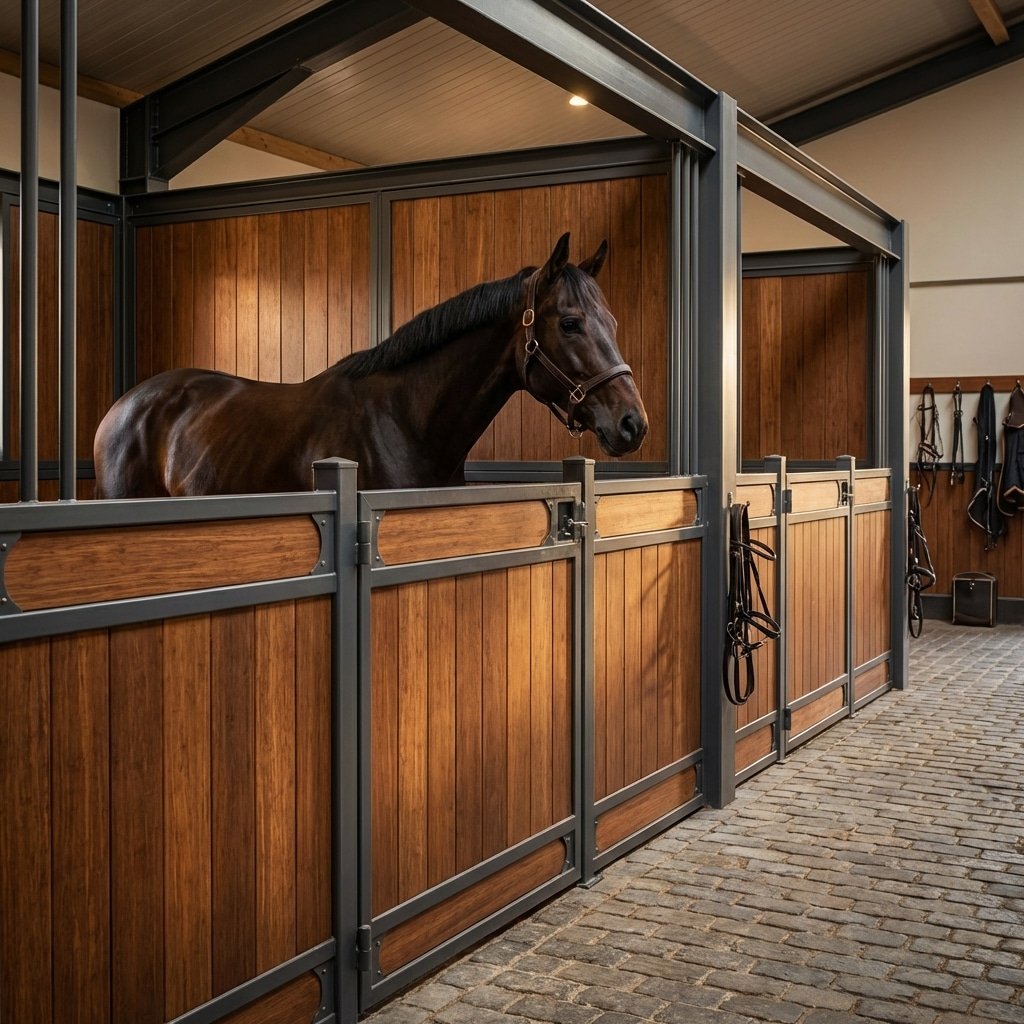
The Biomechanics of a Rearing Stallion
Rearing shifts a stallion’s center of mass entirely to the hindquarters, utilizing the posterior chain to create a dangerous pivot point. This generates immense downward kinetic energy, requiring wall structures capable of absorbing high-velocity vertical impacts without deformation.
The Mechanics of Bipedal Posture and Balance
When a stallion rears, he rapidly redistributes his entire body mass onto the hind limbs and posterior chain. This action recruits the “sling muscles”—specifically the serratus ventralis and pectorals—to catapult the forehand upward. This isn’t just a static pose; it is a kinetic loading phase that creates significant potential energy.
Standard partition heights often fail here. A mature stallion can achieve vertical extensions exceeding 2.5 meters, easily clearing or hooking legs over standard 2.2-meter walls. The real danger arises when gravity takes over. The animal brings that elevated mass down with considerable velocity, turning the forelegs into high-impact hammers against the stall front or partition wall.
Countering Impact Forces with Q345B Structural Steel
Standard architectural steel (Q235B/ASTM A36) handles static loads well, but it often lacks the toughness to withstand the sudden, concentrated shock load of a rearing stallion striking a wall. When a 600kg animal lands a direct strike, standard steel frames can suffer brittle fractures, especially near weld points or in colder climates.
To mitigate this risk, we engineer stallion-specific housing using Acier Q345B faiblement allié à haute résistance mécanique (equivalent to ASTM Grade 50). This material specification is non-negotiable for high-risk livestock housing for several reasons:
- Impact Toughness: Q345B absorbs kinetic energy without cracking, unlike standard carbon steel which may snap under sudden, high-velocity impact.
- Cold Weather Resilience: Standard steel becomes brittle at low temperatures. Q345B maintains ductility, preventing catastrophic frame failure during winter.
- Deformation Resistance: The higher yield strength prevents the frame from bowing or warping after repeated strikes, keeping the sliding door mechanisms operational.

Why 7-Foot Standard Panels are a Jumping Hazard
Standard 7-foot panels sit below a stallion’s maximum rearing height, creating a dangerous fulcrum point. This triggers “high-point” entrapment where animals hang up or vault over, risking fatal leg injuries.
The Fulcrum Effect: Biomechanics of Entrapment
A standard 2.1m (7-foot) panel provides false security for housing stallions. High-testosterone animals often exceed 2.4 meters in vertical reach when rearing. This height discrepancy places the top rail of a standard panel directly at the mid-chest level of a rearing horse, rather than above the head where it would act as a visual and physical deterrent.
This creates a mechanical fulcrum. Once the horse’s chest or forelegs make contact with the top rail, the barrier acts as a pivot point. The horse’s upward momentum shifts forward, creating a “see-saw” effect. The hind legs remain grounded while the center of gravity tips over the wall. This leads to unintentional vaulting or, more frequently, the horse becoming “hung up”—straddling the wall with forelegs trapped on the outside and hind legs inside. The panic response in this position typically results in severed arteries or catastrophic tendon rupture.
Structural Deformation in Standard 50mm RHS Frames
Material failure exacerbates the danger of a hang-up. Most standard stable fronts utilize Q235B structural steel (ASTM A36 equivalent) in a 50mm x 50mm profile. While we engineer these frames to withstand massive lateral impact from kicks, standard tubing is not designed for vertical crush loads concentrated on a single point.
- Vertical Yield Failure: When a 600kg stallion drops its weight onto the top rail, the force exceeds the steel’s yield strength, causing immediate buckling.
- The Pinch Point: The tube does not bend smoothly; it kinks, creating a sharp “V” depression.
- Mechanical Lock: The horse’s leg slides into this deformation, and the steel effectively crimps around the limb. This traps the animal permanently, often requiring angle grinders to cut the steel frame to free the leg.
Premium Horse Stables Engineered For Extreme Durability

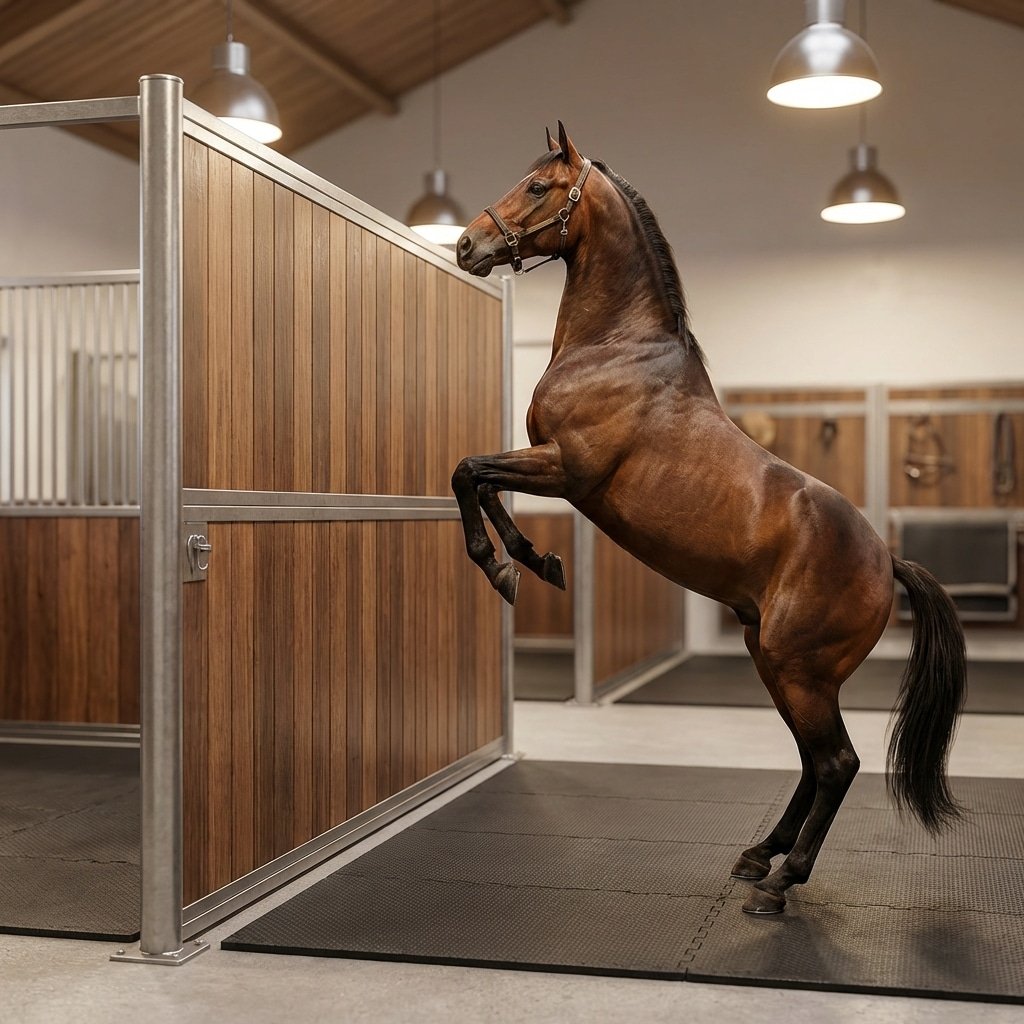
Engineering 10-Foot Floor-to-Ceiling Stall Panels
Résumé : 10-foot stallion panels require dual-point anchoring (floor and ceiling) and Q345B structural steel to neutralize the leverage exerted by rearing horses. Standard free-standing designs fail under these kinetic loads.
| Spécifications | Standard Partition (7ft) | Stallion Containment (10ft+) |
|---|---|---|
| Anchoring Method | Floor Only (Single Point) | Floor + Overhead Beam (Dual Point) |
| Qualité de l'acier | Q235B (ASTM A36) | Q345B (ASTM Grade 50) |
| Flex Tolerance | Moderate Flex Allowed | Zero-Flex Rigid Frame |
| Impact Rating | General Housing | High-Kinetic Impact (Rearing) |
Structural Reinforcement for Full-Height Containment
Constructing a 10-foot or 12-foot partition is not simply about stacking more boards. As the height increases, the leverage a horse can exert on the top of the panel grows exponentially. A standard floor-mounted post acts like a lever; if you extend it from 7 feet to 12 feet without additional support, a single impact from a rearing stallion can bend the steel at the base plate or rip the anchors from the concrete.
- Dual-Anchoring Systems: We secure panels to both the concrete footer and the overhead structural beams. This creates a rigid column that transfers kinetic energy into the building’s frame rather than the panel’s welds.
- Anti-Flex Design: Taller panels have a natural tendency to bow under pressure. We counter this by using reinforced vertical posts, ensuring the partition remains static even when a 1,200lb animal impacts the mid-section.
- Stack Effect Ventilation: Full-height walls often suffocate airflow. To solve this, we integrate open upper grills starting at the 7-foot mark. This facilitates vertical air movement (Stack Effect) while maintaining a secure physical barrier against climbing.
Implementing Q345B Structural Steel Frameworks
Material selection defines the safety margin of a high-containment stall. Standard mild steel (Q235B) is sufficient for general riding school ponies, but it lacks the tensile strength required for breeding stallions or quarantine isolation units where aggression and stress levels are higher.
- Material Grade: Nous utilisons Acier Q345B faiblement allié à haute résistance mécanique (equivalent to ASTM Grade 50). This grade offers superior impact toughness, particularly in cold climates where standard steel becomes brittle and prone to fracture.
- Tube Thickness: We mandate a 14-Gauge (2.5mm) wall thickness for all main structural posts. This is the baseline for our “Kick-Proof Guarantee,” ensuring the frame absorbs heavy blows without deforming.
- Galvanization Standard: All 10-foot panels undergo Galvanisation à chaud après fabrication (ISO 1461). We weld the black steel first, then dip the entire massive structure. This seals every weld joint against the corrosive ammonia found in high-traffic stallion barns.

Heavy Gauge Steel and 38mm Bamboo for Extreme Impact
Standard stables fail under stallion-level aggression. We combine Q345B Low Alloy Steel with 38mm ultra-dense bamboo to prevent catastrophic brittle fractures.
Structural Requirements for High-Impact Zones
Stallions generate kinetic energy that exceeds the yield strength of typical consumer-grade materials. A kick from an agitated stallion does not just dent cheap steel; it shears it. Standard pine boards shatter on impact, creating shrapnel that causes secondary injuries. The structure must be capable of absorbing this sudden shock load without catastrophic failure.
The hidden danger in many regions is brittle fracture. In cold climates, standard carbon steel loses ductility and becomes glass-like. If a horse kicks a frozen, lower-grade steel frame, it snaps rather than bends. This creates jagged metal edges that can sever tendons instantly. “Kick-Proof” design is not a marketing term; it is an engineering necessity to prevent euthanasia-level injuries.
Q345B Steel and 38mm Bamboo Specifications
DB Stable meets these physical demands by upgrading the metallurgy and infill density beyond standard specifications. We reject the industry trend of thinning materials to save on shipping weight.
- Steel Specification: We use Q345B (ASTM Grade 50 equivalent). This Low Alloy High Strength Steel offers superior toughness and resists brittle fracture even in sub-zero temperatures.
- Épaisseur de la paroi : Nous respectons scrupuleusement une 14-Gauge standard (2.0mm – 2.5mm). We strictly prohibit the use of 1.5mm tubing often found in “economy” alternatives.
- Infill Material: 38mm High Density Strand Woven Bamboo. With a Janka Hardness > 3000 lbf, it is 3x harder than Oak and virtually impossible for a horse to kick through.
Questions fréquemment posées
What is the recommended partition height for stallion stalls?
Industry standards recommend a partition height of at least 2.4 meters (approx. 8 feet). This specific height prevents rearing horses from hooking their front legs over the wall, which is a common cause of severe tendon injury. While the barn ceiling itself should be 3.0–3.6 meters (10–12 feet) high to allow for rearing clearance, the stall fronts and partitions are best kept at 2.4 meters. This height balances secure containment with the necessary airflow required for respiratory health.
Are floor-to-ceiling solid walls better for aggressive horses?
No. While they offer total isolation, full floor-to-ceiling solid walls block “Stack Effect Ventilation” and prevent social visibility. Total isolation often increases boredom and leads to aggressive vices like weaving or cribbing. The superior design uses a solid bottom (approx. 1.2m) to prevent casting, topped with heavy-duty open grills. This maximizes airflow and allows safe socialization, keeping the stallion calmer and easier to manage.
How do DB Stable materials withstand impact from heavy kickers?
We back our “Kick-Proof Guarantee” with specific metallurgy. For our Professional Series, we use Q345B Low Alloy High Strength Steel (equivalent to ASTM Grade 50) rather than standard structural steel. This grade maintains toughness even in freezing temperatures, preventing brittle fractures when kicked. For infills, we use High-Density Bamboo (Janka Hardness > 3000 lbf, which is 3x harder than oak) or impact-absorbing HDPE. These panels do not splinter or shatter under force, protecting the horse from leg injuries.
Why is ‘Hot-Dip After Fabrication’ critical for stable longevity?
Many competitors cut costs by using pre-galvanized tubes. When they weld these tubes, the zinc coating burns off at the joint, leading to rapid rust where the structure is weakest. DB Stable utilizes “Hot-Dip Galvanization After Fabrication” (ISO 1461 standard). We weld the black steel frame first, then dip the entire door into molten zinc. This creates a sealed, rust-proof coating over 70 microns thick that covers every weld and seam, ensuring the stable lasts for decades rather than years.
Réflexions finales
Housing high-value bloodstock in standard 7-foot panels creates an unacceptable liability risk for any professional stud farm. Upgrading to our floor-to-ceiling Professional Series with Q345B steel provides the necessary structural insurance against catastrophic rearing injuries. This investment protects your assets and validates your facility’s reputation for elite safety standards.
Don’t compromise on containment; send us your barn floor plan today for a complimentary structural assessment. We will engineer a custom dual-anchored solution that aligns with your specific climate and handling requirements. Contact our team now to secure the heavy-duty infrastructure your stallions demand.

 French
  English
  Spanish
  Arabic
  German
0 commentaires