


Integrating horse stalls into Red Iron Barns demands specific attachment protocols to prevent structural fatigue. While clear-span steel offers superior floor plan flexibility, standard lag bolts fail against the density of I-beam columns. This incompatibility often results in loose partitions and costly safety liabilities for facility managers.
This guide defines the engineering protocols for securing Q235B stall systems to structural steel frames. We examine moment-resisting flange connections and fillet weld techniques that preserve ISO 1461 galvanization standards. These methods ensure your interior fit-out matches the 40-year service life of the building shell.
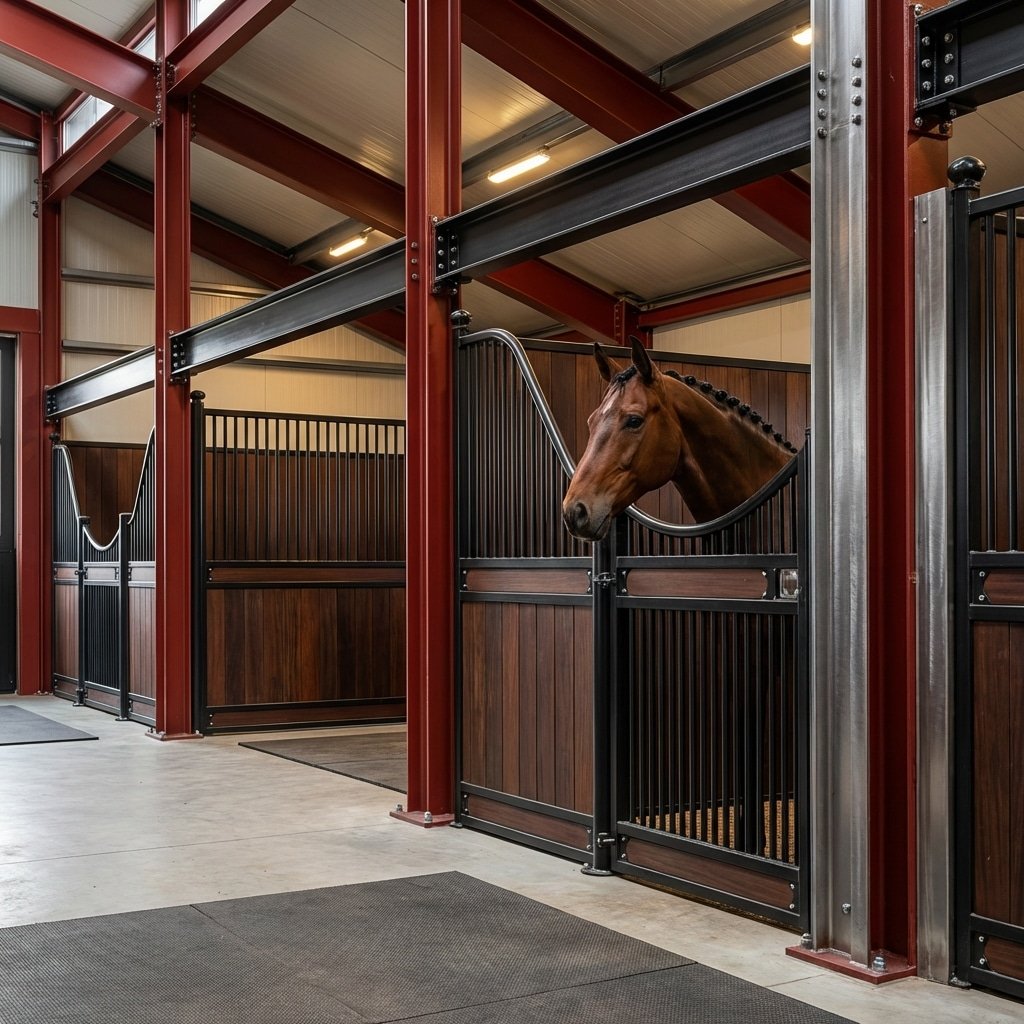
The Popularity of Clear-Span Metal Barns
Clear-span designs utilizing Q235B/Q345B structural steel have replaced timber as the agricultural standard, offering 100% usable interior space and superior resistance to corrosive stable environments.
Maximizing Floor Plans with Column-Free Design
The primary architectural advantage driving the shift to clear-span trusses is the total elimination of internal support columns. Traditional timber post-and-beam construction dictates the floor plan based on where the structural posts must sit. In contrast, clear-span steel trusses transfer the entire roof load to the perimeter walls. This creates a facility with 100% usable interior space, allowing facility managers to configure stall layouts, aisles, and riding arenas based on operational workflow rather than structural limitations.
- Operational Flexibility: Without internal posts, you can reconfigure internal partitions or expand stall sizes as business needs change without altering the building shell.
- Enhanced Safety: Removing support columns eliminates potential collision points for heavy machinery (tractors, spreaders) and high-value livestock.
- Superior Ventilation: The open ceiling structure facilitates the “Stack Effect,” allowing hot, ammonia-filled air to rise and exhaust through ridge vents without obstruction from low-hanging rafters or lofts.
Ensuring Longevity with Galvanized Steel Structures
While wood framing is susceptible to rot, warping, and termite damage, modern agricultural facilities demand materials that withstand high humidity and acidic environments. Clear-span barns constructed from structural steel grades like Q235B (standard) and Q345B (cold climate resilient) provide the necessary yield strength to handle heavy snow and wind loads that would compromise timber. This shift toward steel is not just about strength; it is about reducing the total cost of ownership through durability.
For equestrian and agricultural applications, the protection method is as critical as the steel grade. The high ammonia levels in animal housing will corrode standard painted steel or “pre-galvanized” (black tube welded) structures rapidly. The industry standard for longevity is Galvanisation à chaud après fabrication, adhering to ISO 1461 protocols. This process ensures a zinc coating average of >85 microns on structural parts, creating a metallurgical bond that resists rust for decades. Prefabricated steel kits also streamline the construction timeline, allowing for rapid on-site assembly that significantly cuts labor costs compared to traditional stick-built methods.

Wood Posts vs Red Iron I-Beams
Red iron structures deliver 40+ year durability and massive clear spans for professional facilities. Wood posts save upfront costs but sacrifice longevity and structural integrity against rot and load.
Load-Bearing Capacity and Clear Spans
The structural difference between these two methods comes down to the physics of the frame. Red iron buildings utilize heavy I-beams, typically crafted from A36 or A992 structural steel. This rigid frame carries the entire weight of the roof and environmental loads, allowing for clear spans that easily exceed 100 feet. You get a completely open interior without internal columns obstructing your aisleways or arena footing.
Wood post construction (pole barns) operates on a different principle. It relies on posts buried in the ground and the shear strength of the wall panels to maintain rigidity. This dependence limits the width of the span significantly. If you push a wood truss too wide, you risk sagging or structural failure under heavy loads. For regions dealing with significant snow accumulation or high wind shear, the steel frame of a red iron building offers a load-handling capacity that standard wood posts cannot replicate.
Material Longevity and Foundation Standards
Durability dictates the true cost of ownership. A red iron structure typically offers a service life of 40+ years because the primary material is immune to biological decay. Steel does not rot, warp, or attract termites. In contrast, wood pole barns generally last between 15 and 30 years before ground-contact moisture rots the posts or pests compromise the structural integrity. Wood requires constant vigilance and maintenance to reach its maximum lifespan.
The foundation requirement is the other critical differentiator for B2B facility planning:
- Red Iron: Requires a engineered concrete slab with heavy-duty anchor bolts. This provides the necessary base for installing professional equipment, such as DB Stable’s hot-dip galvanized stall fronts, which rely on secure concrete anchoring for stability.
- Wood Posts: Often utilize dirt or gravel floors to reduce upfront capital. While cheaper initially, dirt floors make it nearly impossible to install high-end stable systems correctly and create long-term sanitation issues.
Heavy-Duty Galvanized Stables Built to Last


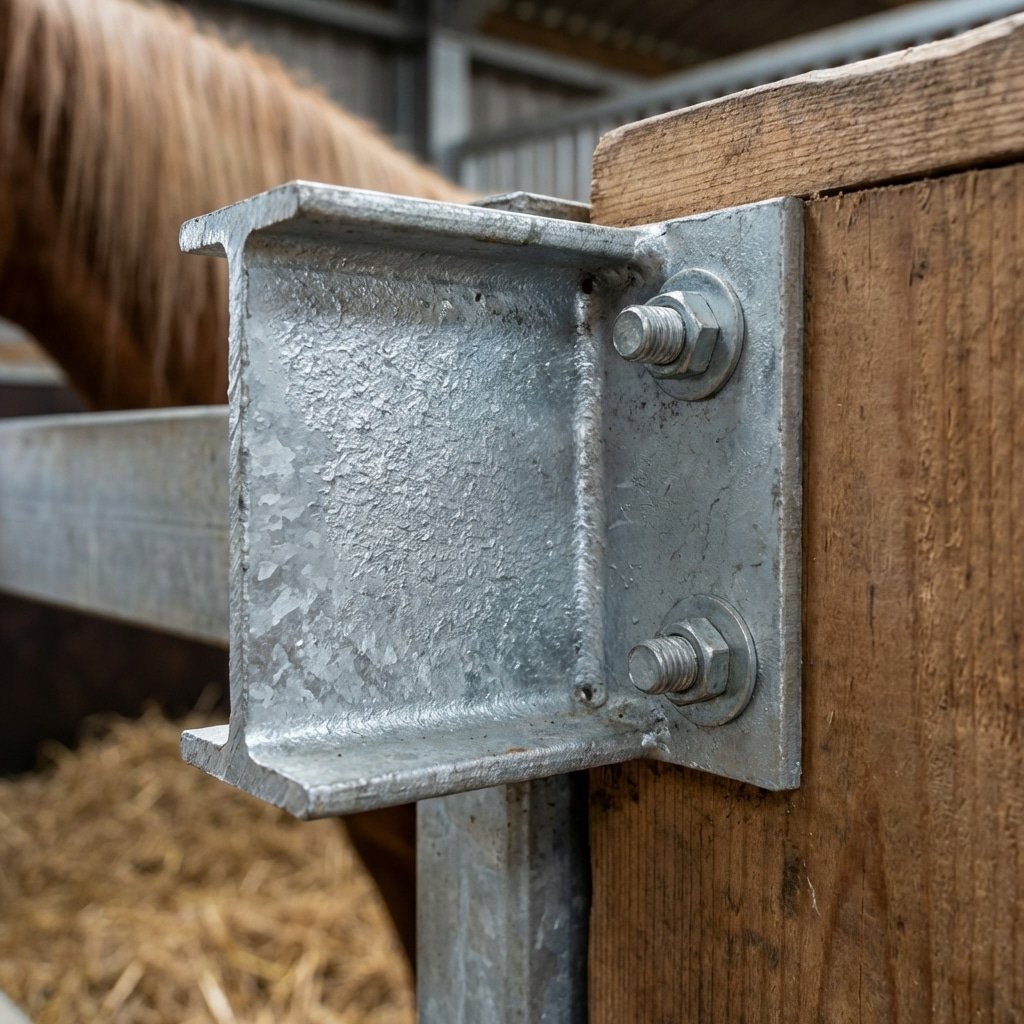
Using Heavy Steel Flanges to Bolt to I-Beams
Heavy steel flange connections utilize bolted plates to transfer bending loads and moment forces between I-beams, offering a modular alternative to direct welding while maintaining structural integrity in clear-span barns.
| Structural Component | DB Stable Specification | Engineering Function |
|---|---|---|
| Qualité de l'acier | Q235B / Q345B | Matches I-beam yield strength to prevent connection failure. |
| Traitement de surface | ISO 1461 Hot-Dip Galv (>85μm) | Prevents rust in high-ammonia stable environments. |
| Plate Thickness | > 6mm Minimum | Resists plate bending under high-tension loads. |
| Fixations | Acier inoxydable 304 | Ensures long-term disassembly capability. |
The Mechanics of Moment-Resisting Flange Connections
Structural integrity in red iron barns relies on the connection’s ability to handle moment forces—specifically the bending loads caused by wind or snow on clear-span frames. Unlike simple shear connections that only support vertical weight, moment-resisting flange connections create a rigid frame. This method splits the bending moment into a force couple: tension pulls at the top flange while compression pushes at the bottom flange.
- Force Distribution: Bolt groups on the flange plates distribute shear stress evenly, preventing localized failure points common in poor field welds.
- Web Integrity: The design creates rigid load paths that bypass the I-beam web, protecting the thinner vertical section from buckling under rotation.
- Field Flexibility: Bolted connections allow for on-site assembly and adjustment, eliminating the need for certified welders to perform vertical or overhead welds in the field.
Material Standards for Heavy-Duty Connection Plates
A structural design is only as good as the steel used to execute it. At DB Stable, we align our connection plate specifications directly with the primary structural framing of the barn. Connecting a high-strength I-beam with a low-grade steel plate creates a weak link that compromises the entire load path. We strictly enforce material compatibility and corrosion resistance standards found in our Product Bible.
- Structural Steel Match: We specify Q235B (standard) or Q345B (cold climate) steel for all connection plates to match the yield strength of the I-beams they secure.
- Hot-Dip Galvanization: All plates undergo ISO 1461 galvanization after fabrication, ensuring a zinc coating exceeding 85 microns to withstand corrosive ammonia in stables.
- Plate Thickness: We enforce a minimum thickness of 6mm for connection plates to handle high-stress loads without warping.
- Hardware Specification: Nous utilisons exclusivement Acier inoxydable 304 bolts and nuts to prevent the “frozen bolt” issue caused by rust, ensuring future maintenance is possible.
Welding DB Stall Brackets Directly to the Barn Frame
Welding stall brackets to red iron I-beams creates a permanent, vibration-resistant bond superior to self-tapping screws. This method requires grinding away the beam’s primer and the bracket’s galvanization at the weld site, followed by immediate cold galvanization treatment.
Achieving Maximum Rigidity on Red Iron Frames
For commercial equestrian facilities utilizing heavy steel (Red Iron) architecture, welding stall connectors provides structural rigidity that bolted connections cannot match. Horse kicks transfer significant kinetic energy into the stall front. Over time, repeated impact loosens self-tapping screws and bolted clamps, leading to rattling partitions and compromised safety.
A fillet-welded angle iron bracket integrates the stall system directly into the building’s skeleton. This effectively makes the stall front an extension of the I-beam column, preventing any movement regardless of the animal’s size or temperament. However, you cannot weld directly over coated surfaces. To ensure a structural weld that will not crack under stress, the preparation phase is non-negotiable.
- Grind the Red Oxide Primer: The I-beam’s factory primer must be ground down to bare, bright metal at the contact point.
- Remove Bracket Galvanization: Our brackets feature a heavy hot-dip zinc coating (>70 microns). You must grind this off at the weld tab to prevent zinc inclusion in the weld puddle.
- Fillet Weld Technique: Apply a heavy fillet weld along the edges of the bracket to handle the shear and tension loads from horse impact.
Restoring Zinc Protection with Cold Galvanizing Spray
The heat from welding exceeds 2,500°F (1,370°C), which vaporizes the protective zinc coating on our galvanized steel and burns the paint off the red iron beam. If you skip post-weld treatment, the bracket area will rust within days due to atmospheric moisture, compromising the BS EN ISO 1461 standard we manufacture to.
Every DB Stable installation kit includes specific high-zinc cold galvanizing spray for this exact purpose. This is not standard silver paint; it contains a high percentage of zinc dust that provides cathodic protection similar to the original hot-dip process.
Once the weld cools and you have chipped away the slag, clean the area with a wire brush. Apply multiple light coats of the touch-up spray to the weld bead and the surrounding heat-affected zone. This restores the corrosion barrier and ensures the installation points last as long as the 85-micron coating on the rest of the stall system.
Questions fréquemment posées
Can I install horse stalls in a clear-span metal building?
Yes, but you cannot anchor directly to the exterior wall sheeting. Clear-span columns are often spaced 20+ feet apart, which exceeds the width of standard stall fronts. You must install intermediate steel posts or heavy-gauge horizontal girts to create a rigid sub-frame. This ensures our 3.0m or 4.0m panels have a structural connection point capable of withstanding heavy kick loads without relying on the building’s outer shell.
How do I attach stall fronts to steel I-beams without welding?
Stop drilling holes in your primary columns. It compromises the protective coating and can void structural warranties. Instead, use heavy-duty beam clamps (typically 1-5/8″ strut channel style) that grip the I-beam flange securely. This method creates a rigid anchor point for the stall channels without welding or drilling. It also preserves the galvanization on the building frame and allows you to adjust the stall layout in the future.
Are Red Iron barns suitable for heavy-duty horse stalls?
Yes, they are the gold standard for commercial equestrian facilities due to their immense load-bearing capacity. Unlike wood pole barns, red iron does not warp or rot. However, the steel frame is unforgiving on impact. We recommend pairing red iron structures with our Professional Series stalls (Q345B steel) to ensure the internal components match the building’s lifespan. This combination creates a facility engineered to withstand heavy use and harsh weather.
Réflexions finales
Installing lightweight pre-galvanized stalls inside a heavy red iron structure creates a durability mismatch that inevitably leads to expensive retrofits. You must align your interior specifications with the building’s lifespan by utilizing our Q345B structural steel and ISO 1461 hot-dip galvanization standards. This ensures your capital equipment resists ammonia corrosion and impact just as effectively as the primary I-beams supporting the roof.
Do not leave critical structural connections to field improvisation or generic hardware. We invite you to submit your building’s column schedule so our engineers can specify the exact heavy-duty flange clamps or weld tabs required for a rigid fit. Contact DB Stable today to secure a manufacturing partner who understands the engineering demands of commercial steel facilities.

 French
  English
  Spanish
  Arabic
  German
0 commentaires