


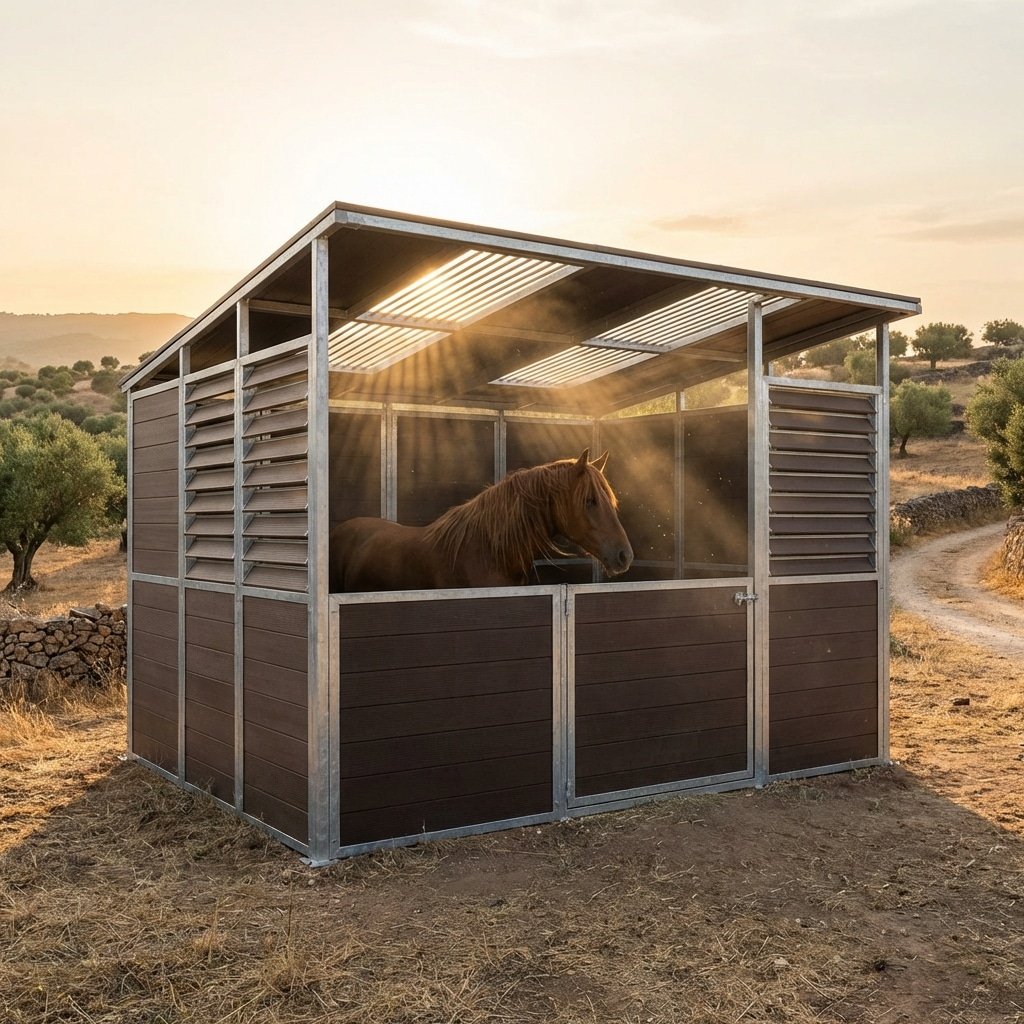
Constructing safe equine facilities in Spain demands infrastructure capable of neutralizing 40°C heat loads. Standard timber stables often turn into heat traps, leading to severe veterinary liabilities and rapid material degradation under intense UV exposure.
We engineer our free-standing kits specifically for arid climates using the Stack Effect Ventilation principle. By combining ISO 1461 Hot-Dip Galvanized Q235B frames with UV-stabilized HDPE, we eliminate thermal soaking and ensure structural integrity without permanent foundations.
Gérer le stress thermique des équidés pendant l'été espagnol
Managing equine heat stress in Spain requires strict physiological monitoring and passive cooling infrastructure like stack effect ventilation to keep horses safe when temperatures exceed 30°C.
Horses begin to experience significant physiological discomfort once ambient temperatures cross 25°C. In the Spanish summer, daily highs frequently exceed this threshold, making thermal regulation a primary concern for facility managers. You cannot rely on visual cues alone; monitoring specific biomarkers is non-negotiable.
Key indicators of thermal distress include elevated respiratory rates that do not recover quickly after exercise and rectal temperatures rising above normal limits. If a horse exhibits these signs, immediate intervention is required. Cease all work, move the animal to a shaded area, and apply cool water to the legs and body to facilitate rapid heat exchange.
Mitigating Heat with Stack Effect Ventilation
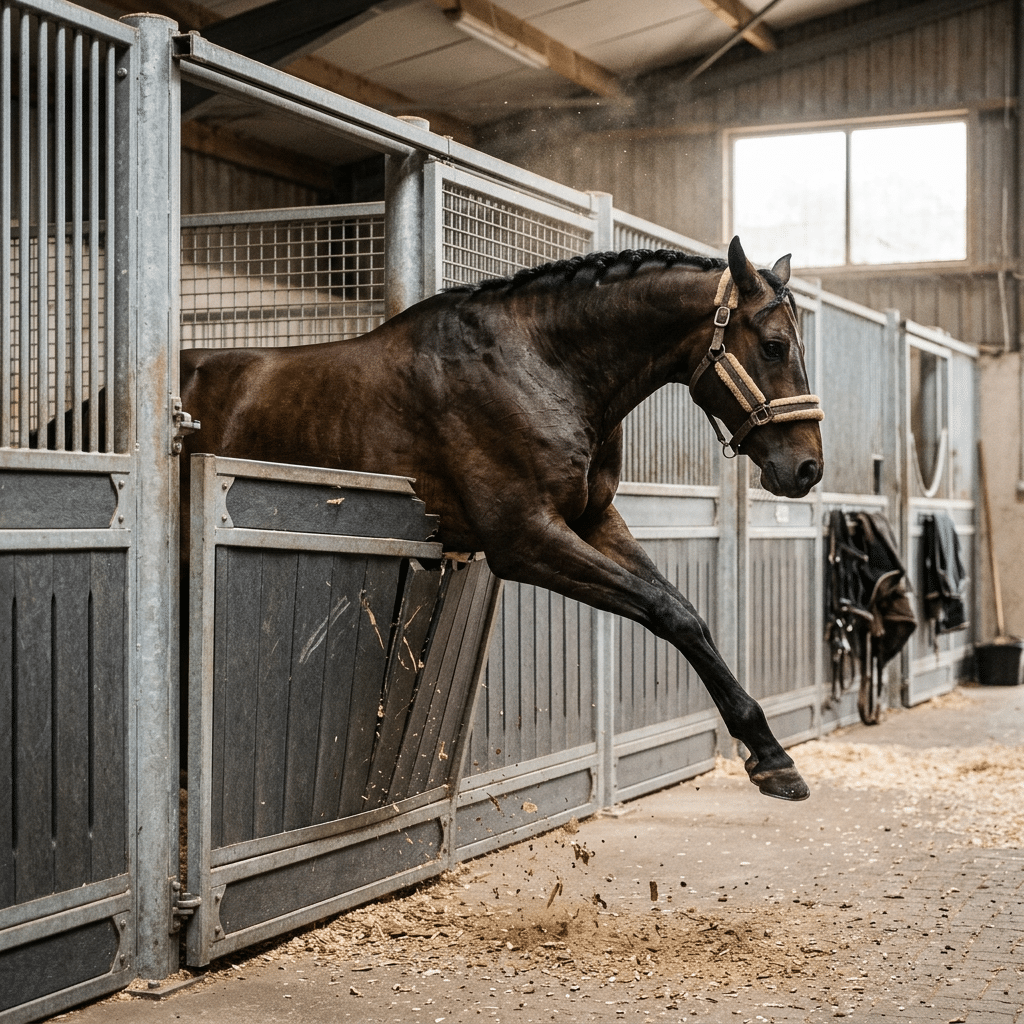
Active cooling helps a stressed horse, but passive stable design prevents the stress from occurring in the first place. At DB Stable, we engineer our systems to work with the climate rather than against it. We utilize “Stack Effect Ventilation” and specialized materials to lower the internal ambient temperature of the stable.
- Stack Effect Design: We utilize open top grills to allow hot, buoyant air to rise and escape vertically, creating a natural vacuum that pulls cooler air in from the bottom.
- HDPE stabilisé aux UV : Unlike cheap PVC that warps or wood that retains heat, our 28mm-32mm HDPE infills are UV-stabilized to maintain structural integrity and resist thermal soaking.
- Steel Board Roofs: These provide essential shade, significantly reducing the direct solar radiation exposure that drives up internal stable temperatures.
Écuries autoportantes : L'ombre instantanée n'importe où
Free-standing stables allow immediate deployment on pastures without concrete foundations, utilizing heavy-duty steel frames for mobility and rotational grazing support.
| Caractéristiques techniques | DB Stable Specification | Operational Advantage |
|---|---|---|
| Structural Steel | Q235B (ASTM A36 Equiv) | High tensile strength against wind loads |
| Tube Profile | 50mm x 50mm RHS (14-Gauge) | Resists deformation from horse impact |
| Rust Protection | Hot-Dip Galv >85 microns (ISO 1461) | Prevents corrosion in exposed pastures |
| Assembly Method | Palette en acier à monter soi-même | Rapid setup; high shipping density |
Portable Protection: Advantages of Foundation-Free Designs
Speed is the primary currency when managing heat stress in open pastures. Traditional construction requires weeks of ground preparation, concrete curing, and permitting delays. Free-standing stables bypass the need for permanent groundworks entirely. In many agricultural zones, structures that do not require a concrete slab fall under different classification codes, often eliminating the need for expensive planning permits or increasing property taxes.
Operational flexibility drives the adoption of these units in large-scale facilities. Fixed shelters inevitably lead to “sacrifice areas”—patches of mud and manure buildup where horses congregate. Portable units support true rotational grazing. When a paddock requires rest, you move the shelter to fresh grass along with the herd. This simple adjustment breaks parasite cycles and maintains better hoof health by reducing exposure to mud.
Solar orientation changes significantly between winter and summer solstice. A fixed barn cannot adjust to these angles. Free-standing units allow site managers to rotate the opening of the stable to block prevailing cold winds in winter or catch cooling breezes in summer, optimizing airflow and shade based on the specific season.
Engineering Durability: Hot-Dip Galvanized Q235B Framework
“Portable” often implies “temporary” or “flimsy” in the consumer market. For B2B industrial applications, structural integrity is non-negotiable. We engineer our frames using Acier de construction Q235B (equivalent to ASTM A36). We do not use lightweight tent poles; we utilize 50mm x 50mm RHS profiles with a strict 14-gauge (2.0mm minimum) wall thickness. This ensures the structure withstands high wind loads and physical impact from horses without buckling.
Corrosion is the primary failure point for outdoor equipment. Many competitors cut costs by using pre-galvanized tubing, which leaves the weld seams exposed to rust immediately after fabrication. We adhere to a “Hot-Dip After Fabrication” process. The entire steel frame is welded first, then submerged in molten zinc to meet Normes ISO 1461. This results in a protective coating averaging >85 microns on structural parts, providing decades of resistance against rain, UV exposure, and ammonia.
- Spécifications des matériaux : Q235B Steel, 50x50mm RHS.
- Épaisseur du revêtement : >85 microns (Structural), >70 microns (Tubing).
- Salt Spray Test: Passes ASTM B117 > 96 hours with no red rust.
- Efficacité logistique : Modular ‘Steel Pallet Flat-Pack’ design allows 30-45 sets per 40HQ container, significantly reducing freight costs per unit.
Engineered 20-Year Rust-Proof Horse Stables
Maximiser la circulation de l'air : Panneaux de box entièrement grillés
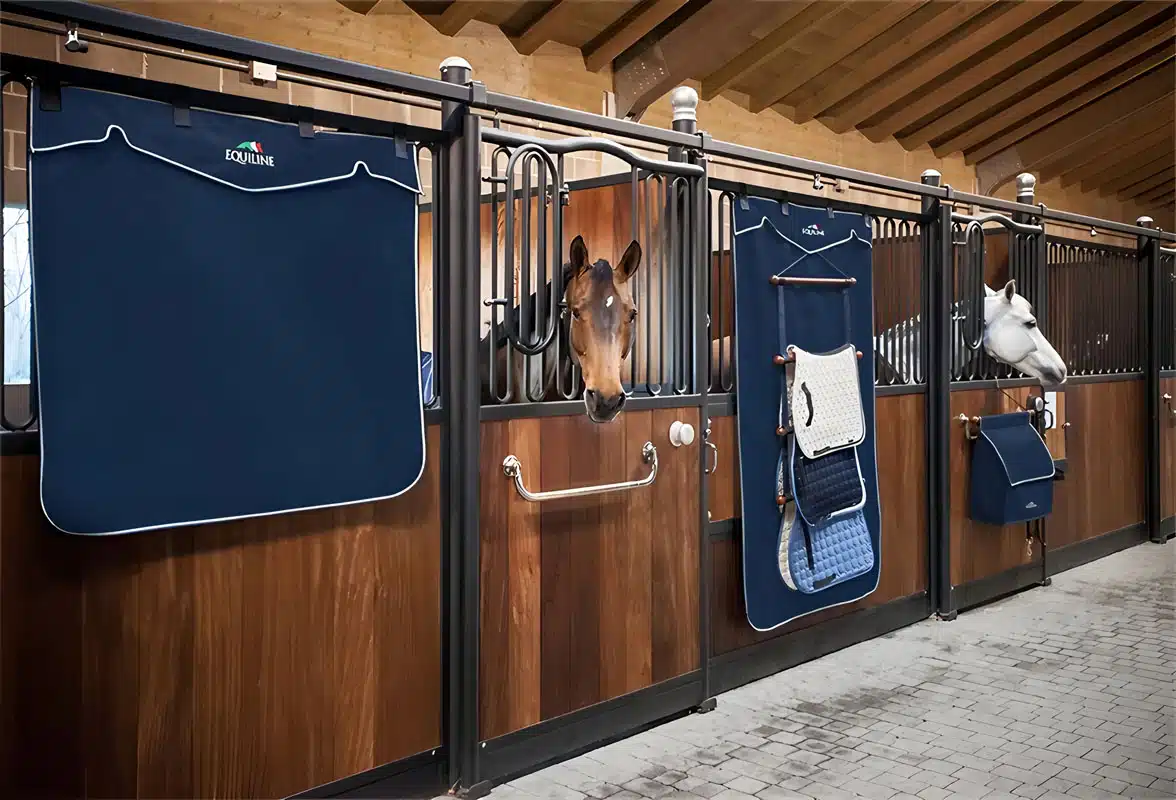
Fully grilled European fronts maximize airflow via the “Stack Effect.” We strictly use 14-gauge steel and post-fabrication hot-dip galvanization to ensure structural safety and rust immunity.
Enhancing Air Circulation with “Stack Effect” Ventilation
Standard stall fronts often trap heat and ammonia near the floor, exactly where the horse eats and sleeps. Fully grilled panels—often called European fronts—replace these solid lower partitions with vertical bars to solve this thermal problem. This design activates the “Stack Effect,” a physical mechanic where hot air naturally rises and pulls cooler air in from the bottom. By removing the solid barrier, you allow this cycle to function continuously rather than creating a stagnant heat pocket.
For facilities in high-temperature regions, such as the Spanish summer, this passive ventilation is critical. It reduces the ambient temperature inside the stall without mechanical fans. More importantly, it clears ammonia buildup from the bedding area, significantly lowering the respiratory risks associated with horses breathing stagnant, polluted air for long periods.

Replacing solid infill with open bars introduces a structural challenge: the bars become the primary barrier against impact. A kicking horse can easily bend or snap standard light-duty tubing. To mitigate this risk, we enforce a strict material standard of **14-Gauge (2.0mm – 2.5mm)** wall thickness for all grill work. This is significantly stronger than the 1.5mm or 1.6mm tubing often found in budget alternatives, ensuring the bars absorb impact without failure.
- Hot-Dip Galvanization After Fabrication: We reject pre-galvanized tubing (black tube welded then painted). Instead, we dip the entire welded panel into molten zinc (ISO 1461), sealing every weld against humidity.
- Épaisseur du revêtement de zinc : Our process ensures a zinc layer greater than 70 microns, providing a “lifetime” shield against rust even in moisture-rich stable environments.
- Safety Spacing: Vertical bars are set with standard 50mm spacing to prevent hoof entrapment, or we utilize heavy-duty 114mm round posts for structural columns.
This combination of heavy-gauge steel and full immersion galvanization prevents the “inside-out” rust that typically destroys grilled panels within a few years of installation.
Matériaux de toiture réfléchissant la chaleur pour les stalles extérieures
High-SRI roofing, particularly light-colored powder-coated steel, reflects solar radiation rather than absorbing it, significantly lowering internal stall temperatures in hot climates without mechanical cooling.
The Role of High-SRI Materials in Passive Cooling
In regions like Southern Spain or Australia, the roof is the primary defense against solar gain. Managing internal stall temperatures relies heavily on the Solar Reflectance Index (SRI) of your roofing material. SRI measures a surface’s ability to reject solar heat, combining both reflectance and emittance. A higher SRI value means the material rejects more heat, keeping the surface—and the horse beneath it—cooler.
Traditional dark ceramic or terra-cotta tiles often have high thermal mass. They absorb heat throughout the day and radiate it down into the stall long after sunset. In contrast, high-SRI surfaces, such as white or light-grey metal, reflect a significant portion of that energy away from the structure immediately. Research confirms that reflective roofing reduces the ambient heat load on the animal, a critical factor for outdoor stalls where mechanical air conditioning is not an option.
Powder-Coated Steel Board Roofing
For professional equine facilities, we utilize a specialized steel roofing system designed to maximize this passive cooling effect while maintaining structural rigidity. Unlike generic corrugated iron that rusts quickly, our solution integrates directly with our hot-dip galvanized steel frames for a complete, weather-resistant shelter.
- Intégrité structurelle : We use steel boards ranging from 0.4mm to 0.8mm in thickness. This gauge provides the necessary strength to withstand wind loads without adding excessive weight to the structure.
- Reflective Finish: The steel features a powder-coated finish, typically in light grey or white. This coating serves a dual purpose: it drastically increases the SRI to reflect sunlight and provides a secondary layer of protection against corrosion.
- Low Thermal Mass: Metal roofing cools down rapidly once the sun sets. Unlike concrete or heavy tiles that act as heat batteries, our steel boards dissipate heat quickly, allowing the stall temperature to drop faster in the evening.
- Intégration système : The roof connects seamlessly to our ISO 1461 Hot-Dip Galvanized frame, ensuring the entire structure—from ground to roof—is engineered to resist the elements.
Mangeoires pivotantes pour un arrosage et un nourrissage en toute sécurité
Swivel feeders allow staff to feed from the aisle, eliminating stall entry risks, while DB Stable’s cast aluminum design ensures zero rust and maximum hygiene for professional facilities.
The Safety Mechanics of Aisle-Side Feeding
Feeding time often triggers high excitement in horses, turning a routine task into a potential liability. Entering a stall with grain creates a “danger zone” where staff can be crowded, stepped on, or bolted past. Swivel feeders eliminate this interaction entirely by allowing handlers to dispense hay and grain directly from the barn aisle.
- Total Containment: There is no need to open stall doors, keeping horses contained and calm during the feeding rush.
- Prévention des blessures : Handlers remain outside the stall, removing the necessity to enter the space when horses are most reactive.
- Operational Speed: Staff can move rapidly down the aisle without the repetitive latching and unlatching of doors, significantly speeding up morning and evening routines.
Cast Aluminum Construction for Hygiene and Longevity
In high-traffic professional facilities, equipment failure is not an option. While plastic feeders crack under impact and galvanized steel eventually succumbs to corrosion from wet feeds, DB Stable utilizes heavy-duty Cast Aluminum for our Professional Series swivel feeders. This material choice ensures a completely rust-proof surface that withstands daily abuse.
- Material Superiority: Uses heavy-duty Cast Aluminum instead of plastic or galvanized steel to ensure zero rust and easy cleaning.
- Secure Mechanism: Features a robust 360-degree rotating mechanism with a locking pin, preventing horses from pushing the bowl out or tampering with the feeder.
- Professional Series Standard: Designed as a key component of the “Professional Series” to meet high-traffic facility standards where durability is paramount.
Questions fréquemment posées
How do fully grilled horse stall panels help in hot climates?
Fully grilled panels maximize cross-ventilation, which is critical for mitigating heat stress. Unlike solid lower partitions that trap stagnant air, full grills utilize the "stack effect" to facilitate vertical and horizontal airflow throughout the entire stall. This continuous air exchange lowers internal barn temperatures and improves air quality by removing ammonia and dust more efficiently than solid-bottom designs.
What materials are best for outdoor horse shelters in varying weather conditions?
For structural longevity, hot-dip galvanized steel (ISO 1461) is the only viable option to prevent rust in wet or coastal environments. Regarding infills, we recommend UV-stabilized HDPE or High-Density Bamboo over standard softwood. HDPE requires zero maintenance and resists rot, while our bamboo is treated to be three times harder than oak, preventing warping and animal damage even under intense sun or heavy rain.
Do free-standing stable kits require a permanent foundation?
Free-standing kits offer modularity and do not strictly require a poured concrete footing, making them ideal for temporary or leased land. You can install them on compacted ground, pavers, or existing concrete pads. However, stability is non-negotiable; you must secure the structure against wind loads and animal impact using heavy-duty anchoring systems, such as the 304 Stainless Steel anchor bolts included in our hardware kits.
What is the difference between hot-dip galvanized and pre-galvanized steel?
The difference lies in the process and the protection level. Pre-galvanized steel uses tubes coated avant welding, leaving the weld seams exposed to rust immediately. We strictly use Galvanisation à chaud après fabrication (ISO 1461), dipping the entire welded frame into molten zinc. This seals all joints and ensures a zinc coating thickness of over 70 microns on tubing, providing true lifetime protection compared to the thin, vulnerable finish of pre-galvanized alternatives.
How does the flat-pack system benefit international shipping?
Traditional fully welded stalls are bulky, limiting a 40HQ container to just 12-15 sets, which drives up the landed cost per unit. Our steel pallet flat-pack system optimizes space, allowing us to load 30-45 sets in the same container. This logistics strategy reduces freight costs by over 60%, significantly protecting the profit margins for distributors and large-scale project developers.
Réflexions finales
Mitigating heat stress is not just about animal welfare; it is about protecting the asset value of high-performance horses in the Spanish climate. While budget shelters cut costs using pre-galvanized tubing, our ISO 1461 Hot-Dip Galvanized frames and UV-stabilized HDPE provide decades of resilience against the harsh sun. Investing in proper “Stack Effect” ventilation eliminates the respiratory risks and rust claims that plague cheaper, solid-wall alternatives.
Do not rely on spec sheets alone; verify the structural integrity of our 50mm x 50mm RHS profiles with a trial order. Our modular flat-pack system optimizes logistics, allowing us to ship 30-45 sets per container to maximize your distribution margins. Contact our engineering team today to configure a heat-resistant solution tailored to your facility’s specific layout.

 French
  English
  Spanish
  Arabic
  German
0 commentaires