


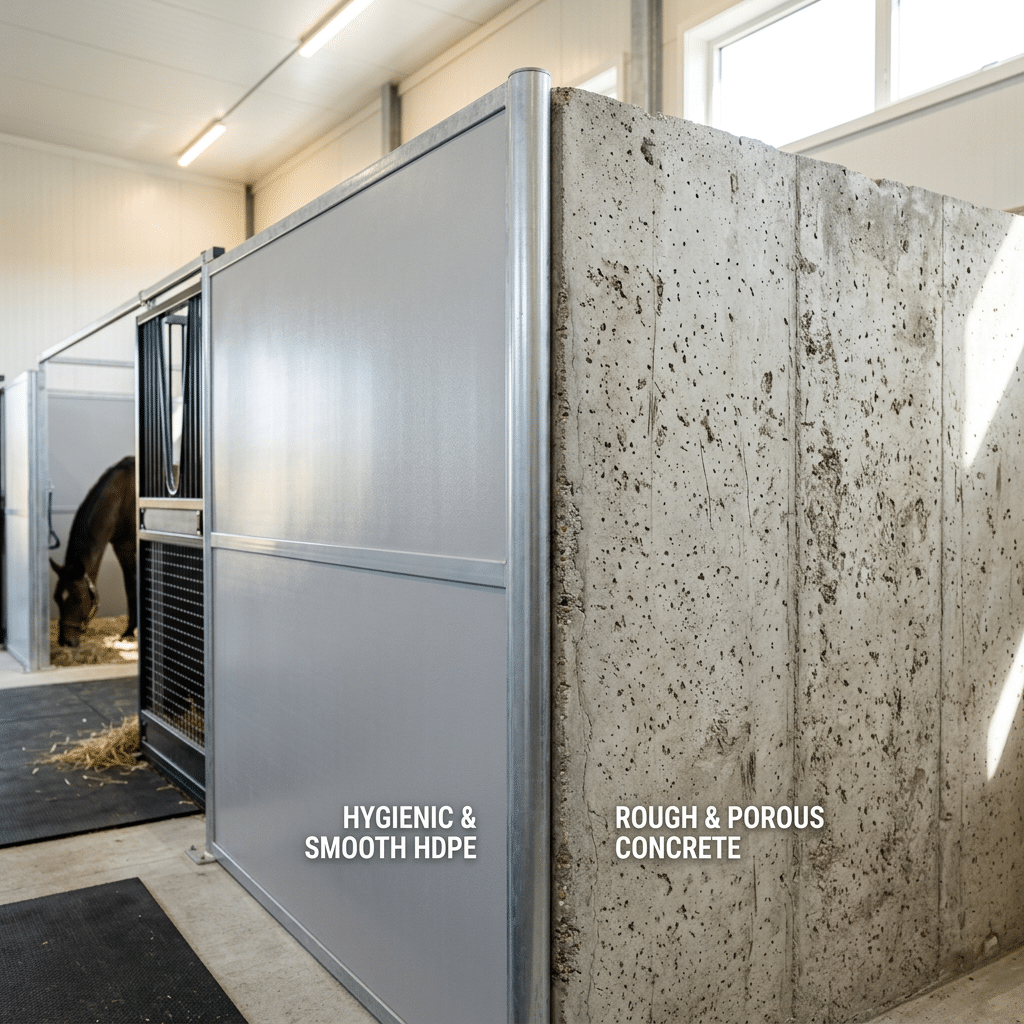
Show biosecurity protocols often fail at the material level, exposing managers to significant liability. Common wood stalls absorb pathogens, making complete sterilization between uses impossible. This hidden risk can turn one sick animal into an outbreak, threatening the event’s reputation and financial viability.
This analysis benchmarks stall materials based on a single metric: surface porosity. We evaluate how non-porous, UV-stabilized HDPE infill provides verifiable disinfection compared to high-risk porous options. The data clarifies how material choice directly impacts the speed and reliability of stall turnover at large events.
The Rot Cycle in High-Humidity Environments
Fungal rot thrives in mild temperatures with poor air circulation, causing condensation. Using non-porous, rot-resistant materials like bamboo or HDPE for stable walls breaks this cycle.
The Environmental Triggers for Fungal Growth
Fungal growth isn’t random; it requires a specific recipe of conditions. The cycle accelerates aggressively when relative
humidity climbs above 85% and temperatures sit in the 15–25°C range. These are common conditions inside a poorly ventilated stable, especially during transitional seasons.
The real trigger for rot is surface wetness. When warm, humid air hits cooler surfaces, it forms condensation. This moisture allows dormant fungal spores to germinate and attack porous materials like wood, starting a destructive cycle that compromises both structural integrity and animal health.
Interrupting the Cycle with Rot-Resistant Infill
The most effective way to prevent rot is to choose infill materials that don’t support fungal growth. High-density strand woven bamboo offers a powerful natural defense. Its manufacturing process creates a material so dense that it inherently resists mold and fungal penetration, even in consistently damp stable conditions.
HDPE infill provides an even more direct solution. As a non-porous plastic, it cannot absorb moisture. This simple fact completely denies fungus the damp, organic surface it needs to grow. By removing a key element of the rot cycle, HDPE effectively starves the problem before it can begin.
Material Comparison for Tropical Climates
In tropical climates, mold resistance is a direct result of water absorption. Non-porous materials provide passive, reliable protection while porous ones create a constant maintenance battle.
High humidity is the primary driver of rot and material degradation in the tropics. When humidity consistently stays above 60%, mold can start growing in as little as 24 hours. Choosing the right material isn’t just about aesthetics; it’s about structural integrity and long-term maintenance costs. The core difference comes down to how a material handles constant moisture.
| Matériau | Water Absorption Rate | Mold & Rot Resistance | Verdict |
|---|---|---|---|
| HDPE (High-Density Polyethylene) | < 0.01% (Waterproof) | Excellent. Non-porous and inorganic; offers no food source for mold. | Top choice. Provides a zero-maintenance solution that doesn’t swell, rot, or degrade. |
| High-Density Strand-Woven Bamboo | ~0.4% (in 24 hours) | Excellent. Thermal treatment removes sugars, and high density prevents water ingress. | Excellent performer. Far superior to any traditional wood due to its engineered properties. |
| WPC (Wood-Plastic Composite) | < 1.5% | Good. Low water absorption and added fungicides help prevent mold growth. | A viable, low-maintenance alternative to traditional wood, but not as impervious as pure HDPE. |
| Pin traité | 18-22% | Poor. High moisture retention creates ideal conditions for mold, requiring constant ventilation. | Suboptimal. A high-maintenance material that fights a losing battle against humidity. |
The data is clear. Materials that are inherently non-porous or have been engineered to resist water absorption, like HDPE and strand-woven bamboo, provide a “set it and forget it” solution. They don’t give moisture a place to settle or mold a food source to consume. On the other hand, treated pine, despite its chemical protections, still behaves like a sponge. It absorbs ambient moisture, making it a high-risk choice that depends entirely on perfect ventilation to survive—a risky bet in a tropical climate.
Engineered Stables for Maximum Durability & ROI

Airflow Design to Prevent Tropical Fungal Infections
Open-grill stables create a ‘stack effect’ that pulls moist, spore-laden air up and out. This constant air exchange prevents the stagnant, damp conditions where fungi thrive in the tropics.
Core Mechanisms for Fungal Spore Control
To reduce airborne fungal pathogens in stables, the engineering focus is on three key environmental controls. These principles work together to create an environment hostile to fungal growth and spread.
- Directional Airflow: The system moves air in a single, unidirectional path. This minimizes the air turbulence that allows spores to settle on surfaces.
- Room Pressurization: Controlled pressure prevents contaminated air from adjacent areas, like feed rooms, from infiltrating clean stable zones.
- Humidity Management: Maintaining low humidity denies fungi the moisture needed to colonize and grow. High humidity is the primary trigger for mold outbreaks.

The Role of Stack Effect Ventilation
DB Stable systems apply these principles through passive design features engineered for tropical climates. The goal is to achieve constant air exchange without relying entirely on mechanical systems.
- Stable fronts and partitions feature an open top grill structure. This design is not just for visibility; it’s a core part of the ventilation engine.
- This structure creates a natural “Stack Effect.” Warmer, moisture-heavy air from the horse’s breath and manure rises and exits through the top grills.
- As warm air escapes, cooler, drier air is pulled in from lower levels. This creates constant, passive air exchange that dilutes pathogens and prevents moisture buildup.
Questions fréquemment posées
What is the best stall material for high-humidity and coastal regions?
Non-porous materials are the only reliable choice. High-Density Polyethylene (HDPE) and our high-density strand woven bamboo are the best options. They don’t absorb moisture, which stops mold, mildew, and bacteria from growing. This is critical for biosecurity and structural life in damp environments where timber would fail.
No. Our high-density strand woven bamboo is engineered to resist rot. The process removes all sugars and starches—the food source for mold—then compresses the fibers to a density that’s three times harder than oak. This stops moisture from getting in and prevents decay, giving it a lifespan that rivals tropical hardwoods.
How does the stall design help with ventilation?
The open-grill top sections on the fronts and partitions are designed to create natural air circulation through the ‘stack effect.’ This process lets warm, damp air rise and exit while pulling in cooler, fresh air from below. It’s essential for cutting down humidity, ammonia levels, and airborne germs inside the stable.
Is the HDPE infill truly waterproof and maintenance-free?
Yes. HDPE’s water absorption is less than 0.05%, so it’s completely waterproof. It won’t swell, delaminate, or rot, even with constant exposure to water or disinfectants. The non-porous surface is easy to clean and never needs painting or sealing. It is a genuine zero-maintenance solution.
How do you prevent rust on the steel frames?
Every steel part is hot-dip galvanized after all welding and fabrication is finished. This isn’t pre-galvanized tubing that gets welded later. The entire finished piece is dipped, creating a thick zinc coating of over 70-85 microns that bonds to the steel. This process meets the ISO 1461 standard and gives long-term protection against rust, even in salty coastal air.
Réflexions finales
Choosing porous wood stalls saves money upfront but exposes you to the long-term costs of rot, maintenance, and biosecurity failures. Our system, with its non-porous HDPE infill and hot-dip galvanized frame, is not a premium option; it is the baseline for professional operations. This engineering protects your animals, your reputation, and your investment.
The next step is to match these specifications to your project requirements. Contact our team with your layout or event size to receive a detailed quote and material samples. Verify the engineering firsthand before committing to your next build.

 French
  English
  Spanish
  Arabic
  German
0 commentaires