
Trade Show Sourcing demands exact strategic focus to protect your procurement budget from escalating travel costs and dead-end supplier meetings. Sending buyers across continents to evaluate inferior pre-galvanized setups drains capital and exposes your supply chain to devastating rust claims.
This analysis benchmarks exhibition suppliers against the BS EN ISO 1461 hot-dip galvanization after fabrication standard. We evaluate factory capabilities on Q345B steel integration and steel pallet flat-pack container loading efficiency to help you secure a scalable B2B partnership without inflating freight overhead.
Conception d'écuries adaptées aux fauteuils roulants (ADA)
Commercial stables require 36-inch continuous pathways, 32-inch clear doorways, and slip-resistant flooring to ensure safe, barrier-free access for wheelchair users and facility support staff.
Core ADA Clearances and Route Standards
Commercial equestrian facilities serving the public must adapt foundational accessibility guidelines to agricultural environments. Navigating a wheelchair through a working barn demands specific spatial planning to keep riders, staff, and horses safe. You need to establish dedicated, barrier-free routes throughout the entire stable area.
- Continuous Pathways: Plan accessible routes with a minimum width of 36 inches and running slopes no steeper than 1:20.
- Clear Floor Space: Allocate an unobstructed footprint of at least 30 by 48 inches where users interact with stable components, like tack rooms or grooming bays.
- Flooring Materials: Construct aisles using stable, firm, and slip-resistant materials to prevent wheelchair casters from sinking or sliding.
- Vertical Clearance: Verify all accessible overhead routes provide a minimum of 80 inches of vertical headroom to prevent collision hazards.

Configuring Stable Fronts for Wheelchair Access
Traditional hinged doors create massive obstructions in barn aisles. A standard 48-inch swing door blocks the walkway and requires significant upper body mobility to operate safely. DB Stable engineers flat-pack sliding door systems specifically to solve this logistical challenge for commercial projects. Our sliding configurations easily meet the ADA requirement for a 32-inch minimum clear opening without pushing heavy steel into the main traffic route.
- Sliding Door Operation: DB Stable sliding doors open flush against the stall front, allowing a handler to navigate a wheelchair smoothly without maneuvering around a swinging obstacle.
- 304 Stainless Steel Hardware: We equip every installation kit with standard 304 stainless steel track rollers and guides. This ensures low-friction, rust-free operation so users with limited mobility can open doors with minimal physical effort.
- Zero-Maintenance HDPE Infill: We utilize 28mm to 32mm UV-stabilized HDPE instead of traditional wood. This prevents splintering, resists kick impacts, and keeps the accessible route structurally intact and safe.
Equipping your project with these engineered stall fronts protects your facility’s long-term operational efficiency. The hot-dip galvanized steel framing and heavy-duty hardware keep maintenance costs at zero while ensuring strict accessibility compliance.
L'expérience en rayon : portes coulissantes larges ou portes battantes
Sliding doors maximize aisle space and handle high traffic seamlessly. Swing doors provide tighter seals and structural integrity. DB Stable integrates both into heavy-duty galvanized frames.
Space Efficiency and Traffic Flow Dynamics
Choosing the right door type directly impacts daily barn operations. Sliding doors optimize ais
le floor space because they eliminate the need for lateral clearance. Handlers can move horses and equipment simultaneously without risking collisions in high-traffic environments.
Swing doors operate differently. They create a tight frame contact that improves thermal and acoustic insulation inside the stall. To function safely, they require a clear opening arc. This swing radius can obstruct workflow and create bottlenecks in narrow aisles if multiple horses are moving at once.
Front Panel Integration and Hardware Specifications
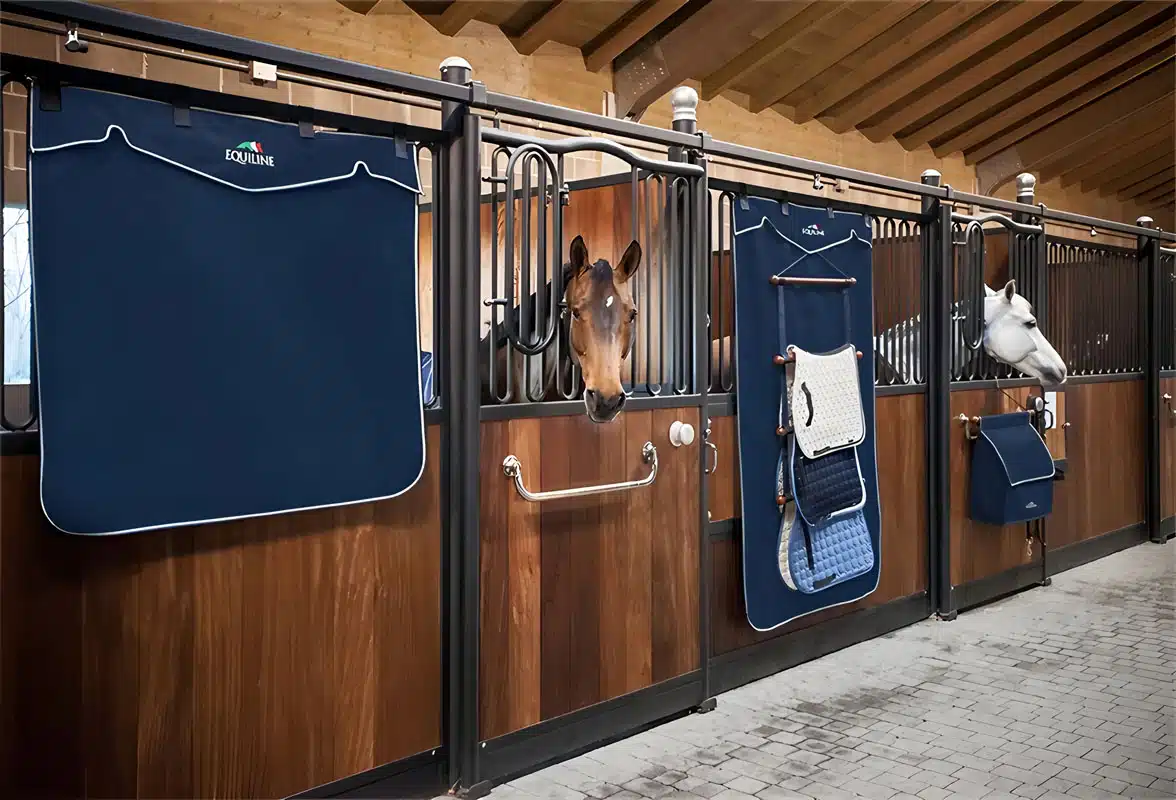
The standard DB Stable installation kit features customizable front panels engineered for B2B project layouts. Facilities can specify either a sliding door or a hinged swing door depending on their specific aisle dimensions and operational needs.
We manufacture all door mechanisms and attach them to heavy-duty 14-gauge (2.0mm – 2.5mm) steel frames. Buyers choose between standard Q235B structural steel or Q345B low-alloy high-strength steel for extreme cold-climate impact resistance. We strictly apply a hot-dip galvanization process after fabrication to ensure a lifetime rust seal. This process avoids the weak points of pre-galvanized black tube welding. Zinc coatings average over 85 microns on structural parts and 70 microns on tubing to meet BS EN ISO 1461 standards.
To secure the doors, the kits include industrial-grade components:
- Hardware: 304 stainless steel anchor bolts, connectors, and screws
- Sliding Variants: Enclosed tracks with precision rollers for smooth track alignment
- Swing Designs: Heavy-duty hinges built to prevent sagging and maintain durability
These fully integrated panels ship via our steel pallet flat-pack system, allowing distributors to load 30 to 45 sets per 40HQ container and drastically reduce freight costs compared to fully welded traditional setups.
Custom Horse Stables Engineered for Durability
Sols sans seuil : éliminer les risques de trébuchement
Zero-threshold flooring replaces raised barriers with level transitions, using magnetic and drop-seal technologies to block water and sound while meeting strict ADA and European accessibility standards.
The Mechanics of Barrier-Free Floor Transitions
Strict building regulations and demographic shifts force facility engineers and builders to adopt continuous floor transitions. You can no longer rely on traditional raised thresholds without risking accessibility violations or creating safety liabilities. Modern zero-threshold systems solve this by engineering a completely flat surface that removes tripping risks and accommodates heavy foot traffic.
A flat floor presents a major structural challenge: protecting the building envelope. To achieve this, modern systems abandon basic weatherstripping. They actively resist water infiltration and maintain high air-tightness, ensuring that barrier-free access does not compromise internal environmental control.
Integrating Magnetic Seals and Pivot Door Plates
Engineers rely on active sealing mechanisms to make barrier-free floor transitions viable in high-exposure environments. Standard friction seals drag across the floor and degrade quickly. To fix this, the industry utilizes dynamic components that engage specifically when the door operates to seal the gap.
- Movable magnetic seals: These components actively engage to deliver driving rain-tightness and acoustic isolation in demanding environments.
- Advanced flush floor plates: Precision engineering reduces installation gaps to just 7mm, providing rigid structural support for heavy-traffic pivot doors.
- Aluminum construction: High-grade aluminum guarantees long-term durability and prevents structural warping across extreme temperature differentials.
Principaux fournisseurs de services d'ingénierie pour la communauté PATH/RDA
The therapeutic riding industry relies on PATH and RDA for standards, yet faces a massive gap in dedicated B2B engineering suppliers for specialized facility equipment.
| Entity Category | Key Organizations | Supply Chain Role | ||
|---|---|---|---|---|
| Certification & Standards | PATH Intl, RDA (UK) | Establish facility safety, instructor certification, and equine welfare protocols. | ||
| Direct Service Delivery | Therapeutic Riding Centers | Ancillary Products | Freedom Rider, AHA | Distribute consumer-level therapeutic tack and clinical frameworks. |
| B2B Facility Engineering | Market Gap Identified | Manufacture ADA-compliant stable fronts, flat-pack systems, and heavy-duty partitions. |
The Information Gap in Therapeutic B2B Engineering
Currently, the market segment for engineered equipment specific to the Professional Association of Therapeutic Horsemanship (PATH) and the Riding for the Disabled Association (RDA) remains undefined. Industry databases reveal a stark absence of consolidated B2B vendors focusing purely on facility engineering or custom stable manufacturing for therapeutic operations.
Facilities often string together solutions from general agricultural suppliers or local contractors. This creates compliance and safety risks. Therapeutic centers require exact specifications for wheelchair clearances, heavy-duty impact resistance, and smooth mechanical operations that standard agricultural suppliers overlook.
Defining the PATH/RDA Organizational Structure
Before sourcing equipment, facility directors must understand the organizational framework governing therapeutic riding. The active entities fall into specific operational categories rather than manufacturing.
- Accrediting Bodies: PATH International operates as a 501(c)(3) to certify instructors and accredit riding centers.
- International Associations: The UK-based RDA supports over 500 member groups managing riding, driving, and vaulting programs.
- Program Operators: Nonprofit therapeutic riding centers execute the daily equine-assisted activities and therapies (EAAT).
- Ancillary Providers: Companies like Freedom Rider supply specialized tack, while organizations like the American Hippotherapy Association provide clinical frameworks.
Meeting Therapeutic Standards with DB Stable Engineering
Since the market lacks dedicated therapeutic engineering suppliers, facilities must partner with B2B OEM manufacturers capable of adapting to rigorous safety standards. DB Stable engineers flat-pack stable systems that align with the high-traffic, strict-compliance demands of accredited riding centers.
- Intégrité structurelle : We use Q345B Low Alloy High Strength Steel to provide a kick-proof guarantee, preventing brittle fractures from horse impacts in cold climates.
- Hazard-Free Surfaces: We apply hot-dip galvanization after fabrication to exceed 85 microns of zinc coating on structural parts. This ensures no sharp rusted edges threaten participant safety.
- Zero Maintenance Infill: We integrate 28mm-32mm UV-stabilized HDPE planks that absorb impact without splintering, eliminating the maintenance hazards of traditional wood.
- Logistics Protection: Our flat-pack technology fits 30-45 sets in a single 40HQ container, protecting project budgets for nonprofit therapeutic centers compared to fully welded systems that only fit 12-15 sets.
Système de rails encastrés Smooth-Glide de DB
Enclosed tracks protect rollers from debris. DB Stable integrates this hidden system into the Professional Series using heavy-duty steel and stainless hardware for low-friction operation.
Mechanics of Enclosed Track Designs
Exposed tracks eventually jam when bedding shavings, dirt, and moisture accumulate. Enclosed rails physically shield the moving roller components from the daily environmental debris found in active equestrian facilities. This continuous protection enables the precision-engineered rollers to operate with low friction, ensuring heavy stable doors slide open smoothly over thousands of cycles.
Beyond smooth operation, the track housing functions as a primary safety constraint. The enclosed channel secures the wheels and prevents the door from jumping the track. This structural safeguard eliminates a major hazard, keeping horses and handlers safe during fast-paced barn routines.
DB Professional Series Hidden Track Integration
We build the hidden track system directly into the Q345B low-alloy high-strength steel framework of the Professional Series. Integrating the track at the manufacturing stage guarantees precise alignment and prevents the operational sagging common in bolt-on aftermarket alternatives.
To equip our B2B clients with a zero-rust, low-maintenance product, we strictly control the material specifications for the entire track assembly:
- Primary Defense: We process the entire track housing through hot-dip galvanization after fabrication.
- Norme relative aux revêtements : The galvanizing process delivers a minimum 85-micron zinc coating to ensure structural longevity in high-moisture environments.
- Assembly Hardware: The included installation kit relies entirely on 304 stainless steel connectors to secure the track and eliminate localized rust risks.
Questions fréquemment posées
What are the key requirements for designing an ADA-compliant horse barn?
An ADA-compliant barn requires specific spatial and structural adjustments to guarantee safe access. Getting these specifications right during the initial fabrication phase prevents expensive retrofitting later.
- Doorways and Aisles: Maintain doorway widths of at least 48 inches and build aisleways wider than the standard 12 feet.
- Flooring Surfaces: Install smooth rubber brick or concrete to eliminate tripping hazards.
- Fixture Heights: Mount all equipment and tack fixtures at a maximum height of 48 inches.
- Specialized Infrastructure: Include ADA-compliant bathrooms and sturdy mounting block platforms equipped with ramps.
What is the recommended barn door width for wheelchair accessibility?
ADA standards dictate a strict minimum door width of 32 inches for basic wheelchair access. For therapeutic riding facilities or public equestrian centers, 48-inch doorways represent the practical industry standard. This wider footprint easily accommodates oversized mobility devices and allows support staff to move safely alongside participants. As a B2B manufacturer, we engineer our stable fronts to meet these exact wider specifications without compromising structural integrity.
Are sliding stall doors easier to operate than hinged doors?
Yes. Sliding stall doors demand minimal physical effort and allow handlers to operate them smoothly with just one hand. Because they move horizontally along a track, they keep the aisleway entirely clear, making them highly efficient in busy or narrow commercial facilities. We integrate a Hidden Track System in our Professional Series to maximize this operational ease. Hinged doors require more swing space and can obstruct traffic flow, though they provide a slightly wider clear opening for handling large or highly spirited horses.
What safety standards do therapeutic riding centers follow?
Most therapeutic facilities adopt PATH Intl standards to enforce strict operational protocols. Accredited centers must implement the following safety measures:
- Participant Gear: Enforce mandatory helmet usage and closed-toed footwear.
- Facility Infrastructure: Maintain accessible fire extinguishers and post clear evacuation diagrams.
- Operational Oversight: Ensure continuous supervision of participants and conduct regular equine welfare evaluations.
Engineering safety directly into the facility structure makes compliance much easier. Using hot-dip galvanized 14-gauge steel frames and cast-proof designs with minimal bottom gaps helps eliminate physical hazards before the rider even enters the stable.
Réflexions finales
Sourcing generic welded stable fronts at global trade shows might offer a lower upfront price, but you risk exorbitant shipping costs and rapid structural failure. Relying on DB Stable’s hot-dip galvanized Q345B steel frames and zero-maintenance HDPE infill protects your profit margins while guaranteeing compliance with strict ADA and therapeutic standards. Our steel pallet flat-pack system actively slashes your freight expenses by safely fitting up to 45 sets in a single 40HQ container.
Stop guessing on quality and verify our engineering standards directly. We recommend securing an LCL trial order of 3 to 5 stable sets to evaluate our precise fitment, hidden track systems, and 85-micron zinc coatings firsthand. Contact our manufacturing team today to configure a custom flat-pack shipment that aligns exactly with your upcoming B2B project layouts.

 French
  English
  Spanish
  Arabic
  German
0 commentaires