


The Rubber Mats vs Pavers decision for your inventory often ignores the most critical factor: freight cost. Shipping these high-volume, low-density products as a standalone order is a common mistake that allows volumetric charges to completely eliminate your profit margin.
This container-fill strategy focuses on co-loading flooring with engineered flat-pack systems. By loading 30-45 stable sets into a 40HQ container, not the typical 12-15, you create the capacity to add flooring for free, turning a freight liability into a protected margin.
5 Critical Red Flags to Watch For
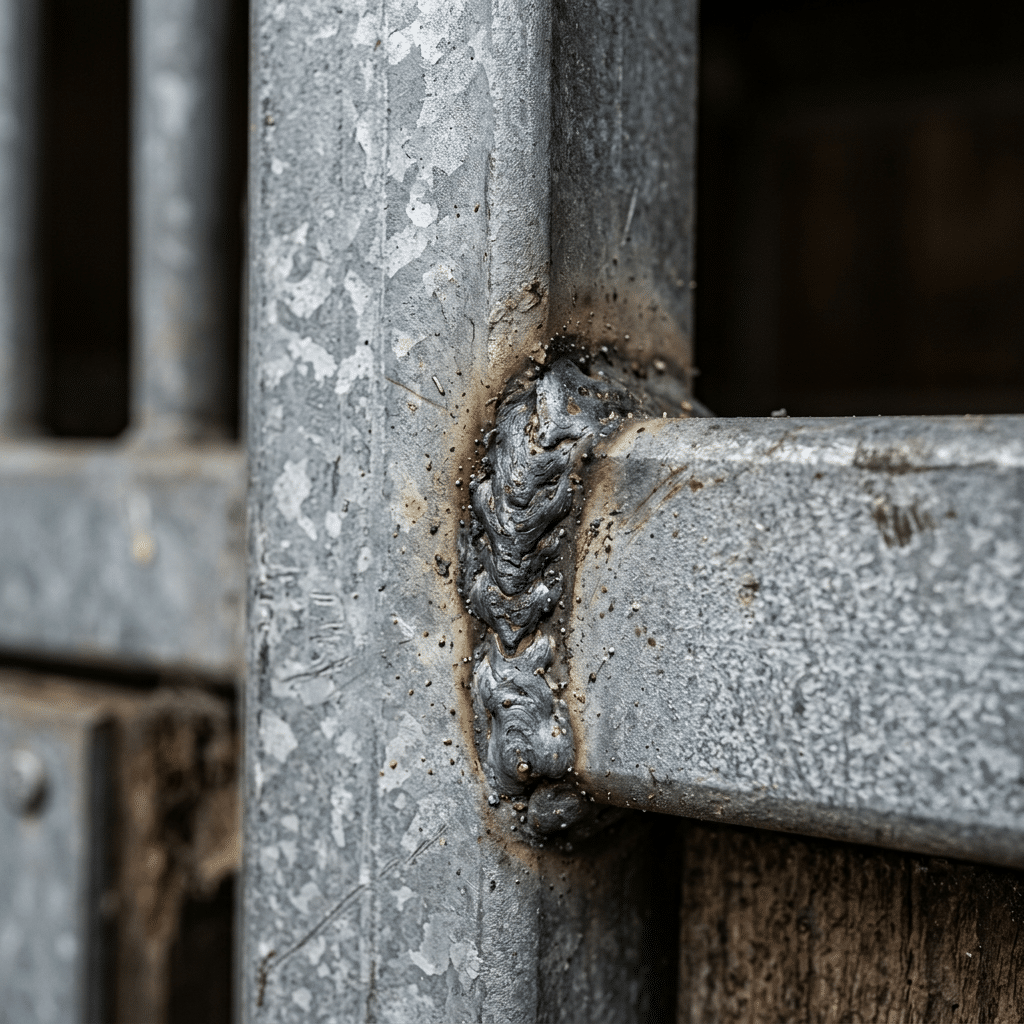
Watch for thin steel under 2.0mm, pre-galvanized tubing that rusts at welds, and vague specs. Demand specific standards like ISO 1461 to ensure safety and longevity.
When sourcing horse stables, the details in the steel and finishing process separate a safe, long-term asset from a dangerous liability. Many factories cut corners on material thickness and rust protection to offer a lower price, but these shortcuts inevitably lead to structural failure and rust. Knowing what to look for is the best defense for any distributor or project manager.
Here are the five most common red flags we see in the market and the professional standards you should demand instead.
| Red Flag | The Common Shortcut (Low Quality) | The Professional Standard (What to Demand) |
|---|---|---|
| 1. “Pre-Galvanized” Tubing | Suppliers weld pre-coated tubes. The welding process burns off the zinc coating at the joints, leaving every seam exposed and guaranteed to rust. | Hot-Dip Galvanization After Fabrication. The entire panel is welded first and then submerged in molten zinc. This process, compliant with **ISO 1461**, ensures every weld is fully protected. |
| 2. Under-Gauge Steel | Using thin-walled steel (e.g., 1.6mm or 18-gauge) that can dent, bend, or break from a single horse kick, creating a serious safety hazard. | A minimum wall thickness of **14-gauge (2.0mm)** on all structural steel (Q235B or equivalent). This provides the necessary strength to withstand daily impacts. |
| 3. Vague Material Specs | Claims like “high-quality steel” or “durable wood” without providing specific grades, densities, or treatment standards. | Specific material grades. For steel, demand Q235B or Q345B for cold climates. For infill, ask for Janka hardness ratings on bamboo (>3000 lbf) or UV stabilization specs for HDPE. |
| 4. Missing Galvanizing Standards | General claims of being “galvanized” without reference to a specific international standard. This often means a thin, inconsistent coating that offers little real protection. | Compliance with a recognized standard like **BS EN ISO 1461**. Ask for specific zinc coating thickness data (e.g., >70 microns) and salt spray test results. |
| 5. Fully Welded Designs | Fully-welded panels are incredibly bulky. Shipping 12-15 sets can fill an entire 40HQ container, making freight costs per unit unworkable for distributors. | Flat-pack systems. A modular design allows for 30-45 sets in a single 40HQ container. This protects distributor margins by drastically reducing freight costs per stable. |
Questions fréquemment posées
What is ‘Hot-Dip Galvanizing After Fabrication’ and why does it matter?
It is a crucial anti-rust process. We first fully weld the black steel frame, then submerge the entire completed panel in molten zinc. This ensures a thick, protective coating (over 70 microns) covers every surface, including the welds and cut edges which are the areas most v
ulnerable to rust. This is far superior to using pre-galvanized steel, where tubes are coated before welding, leaving the welded joints exposed and prone to corrosion.
Are your stables suitable for cold climates with freezing temperatures?
Yes. While our standard Q235B steel is robust, we offer an upgrade to Q345B Low Alloy High Strength Steel for cold regions. This material has superior low-temperature impact toughness, which prevents it from becoming brittle in the cold. It ensures the stables can withstand powerful kick
s even in harsh winter conditions without the risk of fracture.
En quoi votre système de colis à monter permet-il de réduire les frais d'expédition pour les distributeurs ?
Traditional fully-welded stables are bulky and ship inefficiently, fitting only 12-15 sets in a 40HQ container. Our steel pallet flat-pack system allows us to stack components compactly, loading 30-45 sets into the same container. This more than doubles the shipping efficiency, significantly lowering the per-unit freight cost and protecting our distributors’ profit margins.
What is the minimum order quantity (MOQ)?
We support businesses at different stages. For a trial order, the MOQ is 3-5 stable sets. For a typical project, we recommend a 20GP container, which holds approximately 10-15 sets. For distributors seeking the best value and freight efficiency, the standard order is a 40HQ container, holding approximately 30-40 sets.
Durable, Compliant Stables for Any Climate.
Réflexions finales
While fully welded stables seem cheaper per unit, our flat-pack system is engineered to protect your margins. Paying to ship empty air with bulky panels makes distribution unprofitable. This logistics-first design is what separates a viable product line from a liability.
Verify our engineering and finish for yourself. We recommend a trial order of 3-5 sets to confirm the assembly process and material quality. Contact our team to get a detailed quote and discuss your specific distributor or project requirements.

 French
  English
  Spanish
  Arabic
  German
0 commentaires